
Article Writing Services for Equipment Suppliers
Article writing services are more than just content creation; they're strategic partnerships. You're essentially bringing on an expert team to build out a library of high-value, educational content that attracts the right customers and helps them decide to buy from you. Think of it as hiring a consultant who works 24/7, answering your audience's most pressing questions, building trust, and gently guiding them toward a sale. This is an absolute must for businesses selling complex or high-ticket items.
Why Content Is Your Hardest Working Salesperson

Picture a salesperson who never sleeps. This person is an expert, always on call, ready to patiently explain the nuanced differences between a convection oven and a combi oven, or to walk a customer through the proper maintenance schedule for a commercial ice machine. That's the power of great content.
In the cutthroat restaurant equipment market, the old sales playbook just doesn't work anymore. Today's B2B buyers—the chefs, purchasing managers, and restaurant owners—are researchers first. They’re digging for knowledge and solutions, not listening to a hard pitch. They want to feel like they understand their options inside and out long before they ever pick up the phone to talk to a sales rep.
Shifting From Selling To Educating
This move from a "sell at all costs" mindset to one focused on education is everything. Well-written articles become your digital consultants, meeting buyers exactly where they are in their journey. This content does more than just list features; it builds your authority and cements your brand as a go-to advisor in the foodservice world.
The payoff for this value-first approach is huge:
- It Builds Trust: When you answer questions honestly and offer genuine help, you build a foundation of trust that's absolutely crucial for closing big-ticket sales.
- It Qualifies Your Leads: In-depth articles naturally attract serious buyers who are already in research mode. This means the leads that come your way are better informed and much closer to making a decision.
- It Empowers Your Sales Team: Your human sales reps can use these articles as tools. They can send them to prospects to answer common questions, handle objections, and keep the conversation moving forward.
Content is the engine of modern B2B sales. It works silently in the background, nurturing potential customers, overcoming objections, and establishing your expertise long before a formal sales call is ever made.
The Growing Demand For Quality Content
You don't have to take my word for it—the market trends tell the same story. The global content writing services market has exploded, now valued at around $22.6 billion. This massive growth is driven by businesses finally realizing that top-notch, targeted content is non-negotiable for getting seen online and connecting with customers.
To truly make your content work as your best salesperson, you need a plan. It all starts with developing a robust content strategy that lines up with your actual business goals. This guide will give you the practical steps to put article writing services to work, turning your company blog into a machine for generating leads and sales. For a deeper look at planning, check out our guide on creating an effective SEO content strategy.
Creating Content That Closes Deals
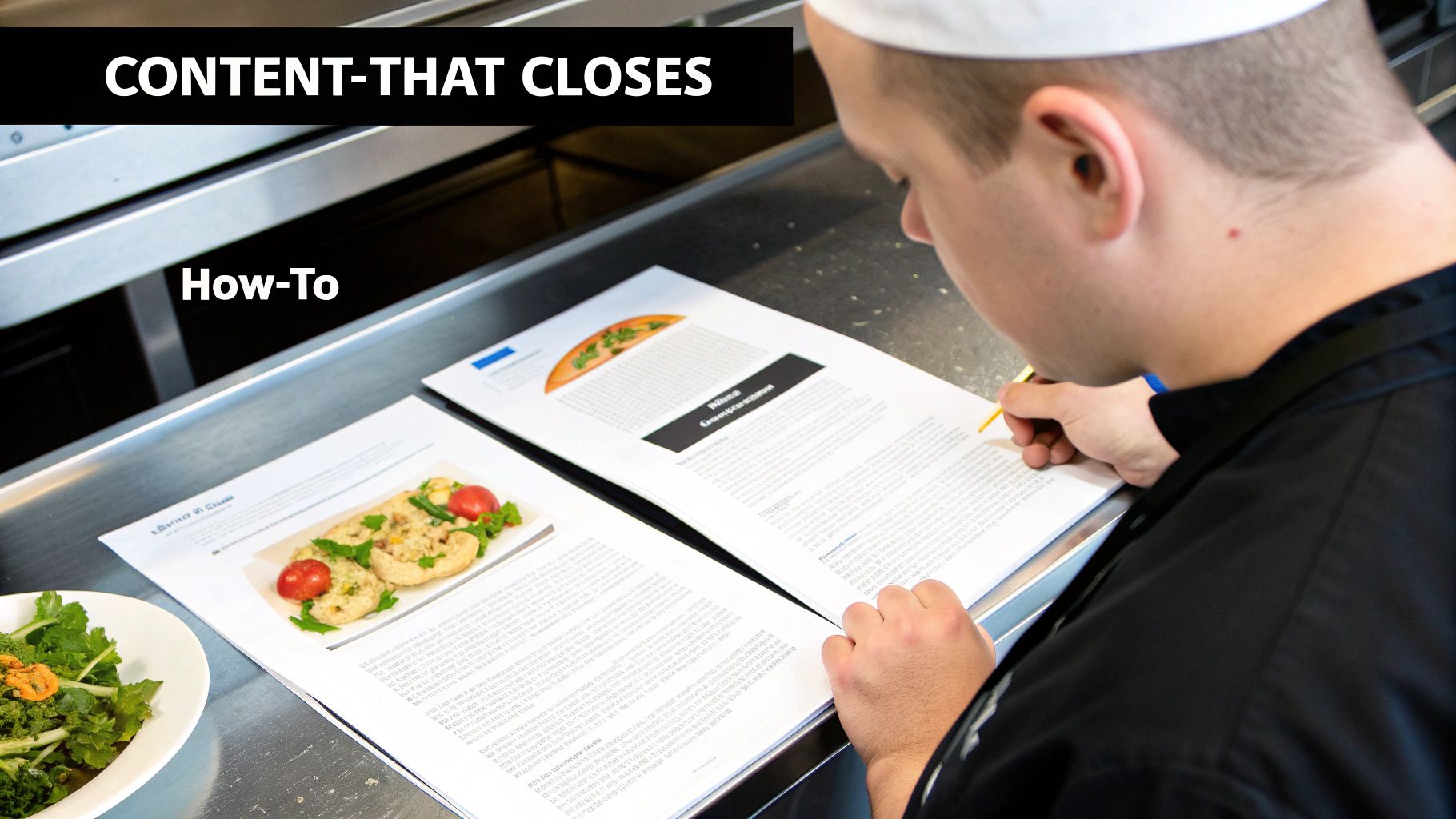
Let's be honest: not all content is created equal. A quick blog post might catch a few eyes, but restaurant equipment suppliers need articles that do the heavy lifting. We're talking about content that educates serious buyers and actively guides them toward a purchase decision.
Think of your articles as specialized tools in your sales kit. You wouldn't use a wrench to do a screwdriver's job, right? The same logic applies here. Each article format has a unique purpose and a specific role to play in moving a potential customer from mild curiosity to a confident purchase.
This is how you transform your company blog from a simple collection of posts into a strategic resource—one that consistently generates and nurtures high-quality leads. Let's break down the types of articles that actually work for busy industry pros and directly impact their buying decisions.
Build Trust With How-To Guides
In-depth "how-to" guides are the bedrock of trust. When you teach a potential customer how to properly maintain, clean, or get the most out of a piece of equipment, you’re doing more than just providing value. You’re positioning your brand as an expert and a reliable partner they can count on.
These guides are magnets for readers who either already own equipment or are in the final stages of their research, thinking about long-term value and operational headaches. It proves your company cares about their success long after the invoice is paid.
- Strategic Purpose: Establish authority and build lasting customer relationships.
- Target Persona: Restaurant managers, head chefs, and maintenance staff focused on getting things right.
- Example Topic: A Step-by-Step Guide to Maintaining Your Commercial Ice Machine for Peak Performance.
Simplify Choices With Product Comparisons
The restaurant equipment market is crowded, and buyers are often overwhelmed with choices. Detailed product comparison articles cut straight through that noise by answering the "this vs. that" questions customers are already typing into Google.
When you objectively lay out the pros, cons, and best-fit scenarios for different models or types of equipment (like gas vs. electric fryers), you make their research process a whole lot easier. This simple act positions your brand as a helpful, unbiased advisor, not just a seller.
By directly comparing complex products, you meet buyers at a critical decision point. This content format is powerful because it addresses high-intent search queries and accelerates the purchasing timeline by providing clear, actionable insights.
This kind of content is especially valuable for procurement managers and owners who are deep in the weeds, comparing spec sheets and trying to find the perfect fit for their kitchen's specific needs and budget.
Solve Problems With Compliance and Best Practice Articles
Restaurant owners and managers are under constant pressure to meet health codes, safety regulations, and efficiency standards. Articles that help them untangle these complex requirements are absolute gold because they solve an immediate, pressing problem.
These pieces attract decision-makers who are actively looking for solutions to operational challenges, like navigating new NSF standards or figuring out how to lower their energy bills. By providing clear guidance, you become an indispensable resource.
This is precisely why professional article writing services have become so important in B2B marketing. In fact, article writing now makes up over 34% of the entire content services market. And it’s the deeper, more substantial articles that truly move the needle. Research consistently shows that long-form content of 3,000+ words can generate 3.3 times more shares and links than shorter posts. You can dive into the full research about content market trends to see the data for yourself. It all points to one thing: creating genuinely helpful, in-depth resources is how you win.
Now, let's map these concepts to a clear strategy. To help you visualize how different article types can support your business objectives, here’s a quick-glance table.
Strategic Content Types for Equipment Suppliers
| Article Type | Primary Business Goal | Example Topic for Restaurant Equipment |
|---|---|---|
| How-To Guides | Build Trust & Authority | "How to Properly Calibrate Your Commercial Convection Oven" |
| Product Comparisons | Accelerate Purchase Decisions | "Gas vs. Electric Deep Fryers: Which Is Right for Your Kitchen?" |
| Compliance Articles | Solve Urgent Problems | "Navigating the Latest NSF Standards for Food Prep Surfaces" |
| Listicles/Checklists | Attract Top-of-Funnel Traffic | "10 Essential Pieces of Equipment for a New Pizzeria" |
| Case Studies | Provide Social Proof | "How [Client's Restaurant] Cut Energy Costs by 25% with Our New Refrigeration Line" |
As you can see, each format serves a distinct purpose. A well-rounded content strategy uses a mix of these types to engage buyers at every stage of their journey, from initial awareness to the final handshake.
Getting Found by Your Ideal Customers

Think of your website as a giant warehouse packed with the best restaurant equipment money can buy. Now, imagine a restaurant owner walks in. If everything is just piled up randomly, they'll get frustrated and walk right back out. This is where Search Engine Optimization (SEO) comes in.
SEO is the logic behind your digital warehouse. It’s the signage, the organization, and the smart layout that helps customers find exactly what they’re looking for, right when they need it. It’s not about gaming the system; it’s about being genuinely helpful to the people you want to serve.
When you hire a professional article writing service, you’re bringing in content architects. They know how to build this system from the ground up, turning your site into a customer-friendly powerhouse that naturally attracts qualified buyers.
Creating Clear Aisles with Keyword Strategy
Every well-run warehouse groups similar products into clearly marked aisles. In the world of SEO, your keywords are those "aisles." A smart keyword strategy is all about figuring out the exact phrases your ideal customers are typing into Google.
The goal isn't just to rank for broad terms like "commercial freezer." That’s a crowded aisle with a lot of window shoppers. You want to get more specific with what we call long-tail keywords.
- Broad Keyword: "Commercial ovens" (High competition, low buying intent)
- Long-Tail Keyword: "Energy-efficient convection oven for a small bakery" (Less competition, sky-high buying intent)
Crafting articles around these very specific phrases creates dedicated aisles for customers who are deep into the buying process. They know what they want, and you’re there to provide it. To really dig into what your local customers are looking for, you need a solid process. You can learn more by exploring our detailed guide to local keyword research.
Labeling Every Product with On-Page SEO
Once your aisles are set, every product on the shelf needs a clear, easy-to-read label. That’s exactly what on-page SEO does for your articles. It’s the practice of fine-tuning individual pages so search engines and, more importantly, human readers can understand what the content is about in a split second.
A top-tier article writing service handles all these technical details for you, making sure every piece of content is perfectly labeled for maximum visibility.
Key On-Page SEO Elements:
- Title Tags: The headline that grabs attention in Google search results.
- Meta Descriptions: The short summary beneath the title that convinces someone to click.
- Header Tags (H1, H2, H3): These act like signposts, breaking up the text and making it scannable.
- Internal Linking: This connects your related articles, guiding users deeper into your site and spreading authority.
Think of on-page SEO as creating the perfect in-store experience. It's the clean signage, helpful product descriptions, and logical flow that makes a customer feel confident and informed. It encourages them to stick around and see what else you have to offer.
Earning Your Reputation as a Trusted Supplier
A great warehouse isn't just organized; it builds a reputation for quality and reliability. In the digital world, we call this authority. Google’s main job is to recommend websites that are trustworthy experts, and that’s what you want to become.
This is where consistently publishing genuinely helpful articles really shines. When other credible websites link back to your content because they see it as a valuable resource, it’s like a public endorsement. This process, called link building, sends powerful signals to search engines that you're a leader in the restaurant equipment space.
An expert article writing service doesn't just produce content; it creates assets that are worthy of earning those valuable links. This cements your reputation, boosts your rankings, and ensures that when a restaurant owner needs new equipment, your "warehouse" is the first one they think to visit.
How to Choose the Right Writing Partner
Picking an article writing service isn't just about outsourcing a task; it's about finding a strategic partner. This is especially true in a technical field like restaurant equipment, where you need a team that can get up to speed on complex subjects and turn them into clear, compelling content.
You don't need someone who already knows the exact difference between a blast chiller and a shock freezer. What you really need is a partner who knows how to become an expert—fast. The best content partners have a repeatable process for diving headfirst into complex industries. They're expert learners and communicators first, which is exactly what separates a professional content team from a generalist writer who might get tripped up by the technical details of your products.
Look for Niche Experience, Not Just Industry Experience
When you start vetting potential providers, it helps to shift your perspective. Instead of hunting for a writer who has a portfolio filled with articles on commercial kitchen ventilation, look for writers who have experience in other complex B2B niches.
Have they written for manufacturing clients, industrial suppliers, or even SaaS companies? That kind of background is incredibly valuable. It proves they have a solid system for digging deep into research, interviewing your in-house experts, and translating technical jargon into content that a busy restaurant owner can actually use. A provider with a strong B2B track record just gets it—they understand the longer sales cycle and know that building trust starts with genuinely helpful, educational content.
Differentiate Agencies from Content Mills
The market for article writing services is crowded, ranging from huge "content mills" to smaller, specialized agencies. Knowing the difference will save you a lot of headaches.
- Content Mills: These platforms are known for their low per-word rates. While they might seem like a bargain, they typically rely on a massive pool of writers who aren't specialists. The result is often generic content that lacks the authority and depth needed to connect with your audience of industry professionals.
- Specialized Agencies: These folks operate more like consultants. They don't just write; they provide strategy on SEO, topic ideas, and even content promotion. They take the time to learn your brand voice, understand your customers, and align with your business goals. They become a genuine extension of your marketing team.
Choosing a writing partner is an investment in your brand's authority. A specialized agency helps build that authority with every article, while a content mill often just fills a space on your blog. The right choice depends on whether you need words on a page or a genuine business asset.
Ask the Right Questions During Vetting
Once you've got a shortlist, the questions you ask will tell you everything you need to know about a potential partner's real capabilities. Go beyond the basics of pricing and turnaround times. You want to understand their process and their strategic thinking.
Here are a few questions that will cut to the chase:
-
"Describe your process for researching a topic you're not an expert in."
Listen for answers that include digging into technical documents, analyzing what competitors are doing, and, most importantly, interviewing your internal team. -
"How will you capture our company’s unique voice and expertise?"
A great partner will immediately start talking about brand guidelines, tone analysis, and a collaborative onboarding process to make sure they sound like you. -
"Can you share a case study or example from a similarly complex B2B industry?"
This is your chance to see their work in action. Pay attention to the quality and depth they were able to achieve for another technical client.
These conversations will point you toward a service that truly aligns with what you're trying to accomplish. As you weigh your options, some are also looking at AI-driven solutions as an alternative, a trend explored in articles like how to replace your $3000 ghostwriter with an AI content marketing suite. Ultimately, whether you choose a human team or an AI-assisted one, the goal is the same: find a partner who can handle the technical demands of the food service equipment world.
Writing a Brief That Guarantees Great Content

So, you’ve decided to hire a professional article writing service. That's the first step. The next one is arguably even more important: giving them the right instructions. A truly great article is never an accident; it's the direct result of a clear, thoughtful brief.
Think of it like this: you wouldn't ask a contractor to just "build me a kitchen" and hope they get it right. You’d hand them a detailed blueprint showing the exact layout, the specific model of combi oven you need, where the walk-in cooler goes, and how the workflow is designed. The more detail in the blueprint, the better the final kitchen.
The same rule applies to your content. A solid brief gets rid of the guesswork, minimizes back-and-forth edits, and makes sure the final article hits the mark from the get-go. It's the most critical document in the entire process.
Nail Down Your Target Reader
Before anyone starts typing, you have to know exactly who you're talking to. "Restaurant owners" is way too broad. Think about it—the owner of a multi-state fast-casual chain has completely different challenges than the chef opening their very first farm-to-table bistro.
You need to get specific. Are you trying to reach a procurement manager who lives and breathes ROI calculations and long-term operating costs? Or is your audience the head chef who cares more about how quickly an oven preheats and how easy it is to clean?
Defining this upfront helps your writer adopt the right tone, focus on the right problems, and use language that actually connects with your reader.
- Vague brief: "Write for business owners."
- A much better brief: "Targeting experienced multi-unit restaurant operators who are looking to upgrade their warewashing systems to cut down on utility costs and improve staff efficiency."
That level of detail gives your writer a clear picture of the person they’re writing for, which is the secret to creating content that truly resonates.
Define the Core Message and Keywords
Every single article should have one primary goal. What's the main takeaway you want your reader to remember long after they've closed the tab? This core message is your North Star, keeping the entire piece focused and ensuring it makes a strong, memorable point.
Once you have that, you need to provide the keywords—the search terms your ideal customer is plugging into Google. Giving your writer a primary keyword and a few secondary ones ensures the article is built for search engines from the ground up. If you need a deeper dive on this, check out our guide on how to write SEO-friendly blog posts.
Think of your brief as more than just a list of instructions. It's the strategic bridge connecting your deep industry expertise with the writer's skill to build a compelling story that search engines and customers will love.
Don't forget to include links to any specific product or service pages you want the article to feature. This not only gives the writer essential context but also helps them build valuable internal links, guiding your reader from the helpful blog post straight to a relevant product page.
By putting in the effort to create a thorough brief, you're not just giving instructions—you're setting your article writing services partner up for a huge win. And that's how you get the high-impact content your business needs.
To make this easier, here's a simple template you can adapt.
Sample Article Brief Template
This table breaks down the key components of an effective brief. Using a structure like this ensures you cover all the critical details your writing partner needs to create outstanding content.
| Brief Component | Description | Example for an Article on 'Walk-In Coolers' |
|---|---|---|
| Topic/Title Idea | The proposed headline or subject of the article. | "5 Signs It’s Time to Upgrade Your Restaurant’s Walk-In Cooler" |
| Target Audience | A detailed description of the ideal reader. | "Independent restaurant owners and kitchen managers of established single-location eateries who are concerned about energy costs and food safety." |
| Core Message | The single most important takeaway for the reader. | "An old, inefficient walk-in cooler is costing you more than you think in energy bills and food waste; upgrading is a smart investment." |
| Primary Keyword | The main search term you want the article to rank for. | "walk-in cooler upgrade" |
| Secondary Keywords | 2-3 related search terms to include naturally. | "commercial refrigeration," "restaurant cooler efficiency," "walk-in cooler maintenance" |
| Tone of Voice | The desired style and personality of the writing. | "Helpful, expert, and direct. Avoid overly technical jargon. Focus on practical business benefits." |
| Key Points to Cover | A bulleted list of the main topics or sections to include. | - Rising energy bills as a warning sign - Temperature fluctuation risks - Signs of physical wear and tear - New energy-efficient features |
| Call to Action (CTA) | What you want the reader to do after reading the article. | "Encourage readers to check out our selection of energy-efficient walk-in coolers and request a free consultation." |
| Internal Links | Specific URLs on your site to link to within the article. | Link to the main "Walk-In Coolers" category page and a blog post on "Commercial Kitchen Energy Saving Tips." |
| Competitor Articles | Links to 1-2 top-ranking articles on the same topic for reference. | [Provide links to high-ranking competitor posts here] |
A brief this detailed leaves nothing to chance. It empowers your writer to work efficiently and deliver a piece of content that aligns perfectly with your strategic goals.
Got Questions? Here Are Some Straight Answers
When you're thinking about bringing in pros to handle your content, a few key questions always pop up. It makes sense. For a restaurant equipment supplier, every dollar you spend needs to work hard for you. Let's tackle the big ones I hear all the time so you can get a clear picture of how article writing services really work.
So, What's the Investment?
This is usually question number one, and the honest answer is: it depends on what you need. It’s a lot like buying a new piece of kitchen equipment. You can get a basic countertop fryer for a low price, but a high-capacity, energy-efficient floor model is a bigger investment because it’s built for performance and longevity. Content is the same deal.
For a specialized industry like restaurant equipment, you’re not just paying for words on a page. You're investing in a writer who understands the difference between a convection and a combi oven, and who knows how to write for a chef, not a home cook.
Generally, you'll see a few common pricing structures:
- Per-Word: This is straightforward and easy to understand. For quality B2B writers who know their stuff, you can expect rates from $0.10 to over $1.00 per word. The higher end typically gets you someone with deep industry knowledge and serious SEO chops.
- Per-Project: This gives you a predictable, fixed cost for a specific article. The price usually bundles in all the necessary research, writing, editing, and on-page SEO. It’s a great way to try out a service without a long-term commitment.
- Monthly Retainer: If you're serious about building a content engine, a retainer is the way to go. This model lets the writers really get to know your products, your brand, and your customers. It's the best bang for your buck in the long run, essentially making them a seamless part of your marketing team.
Remember, you're not just buying a 1,000-word article. You're paying for the research, the SEO strategy, the industry expertise, and the skill it takes to turn technical specs into a story that convinces a customer to buy.
How Will I Know If This Is Actually Working?
Great question. Measuring the return on your investment (ROI) isn't just a "nice-to-have"—it's a must. You need to connect the dots between the content you publish and the results you see in your business.
First things first, keep an eye on your organic traffic in a tool like Google Analytics. Are more people finding your site through Google searches? That's your first sign that things are moving in the right direction.
Next, watch your keyword rankings. Are you starting to show up on page one for valuable searches like "best commercial ice machine for a bar" or "how to clean stainless steel prep tables"? When you rank for terms your customers are actually using, you get in front of the right people.
Then, look at engagement metrics. Are people sticking around to read the whole article (high "time on page")? Or are they bouncing away immediately? High engagement is a huge signal to Google that your content is valuable, which helps you rank even higher.
The real magic happens when you start tracking conversions. This is how your content goes from being a marketing expense to a money-making machine. By setting up goals, you can draw a straight line from an article to a new lead or sale.
Here’s what that looks like in practice:
- Tracking how many readers click from a "Best Commercial Ranges" article to your product pages.
- Counting how many people download a spec sheet after reading a detailed product review.
- Seeing how many quote requests come in from a form located at the end of a helpful blog post.
Can't I Just Use AI to Write Everything?
It's the talk of the town right now, isn't it? AI writing tools are fantastic for kickstarting ideas, whipping up a quick outline, or even getting a rough first draft down. But can they replace a professional, especially in our industry? Not a chance.
Think about it: trust and technical accuracy are everything for restaurant equipment suppliers. A small mistake in a spec or a bad recommendation can cost a customer thousands. AI-generated content, left to its own devices, can be generic, full of factual errors, or just plain weird. It doesn't understand the nuance of a chef's daily struggles or how to translate a boring feature into a game-changing benefit.
The smart play is to use AI as a co-pilot, not the pilot. A skilled human writer uses these tools to work faster and smarter, but they are still the one steering the ship, fact-checking every detail, and injecting your brand's unique personality and expertise into the final piece.
Do I Have to Be a Writing Expert to Make This Work?
Not at all. In fact, that's the whole point. You hire an article writing services provider so you can offload the content work and focus on what you're best at—selling equipment and running your business.
Your job isn't to be the writer; it's to be the subject matter expert. You have the real-world knowledge. You know your products inside and out, you understand your customers' biggest headaches, and you have the stories from the field.
The writer’s job is to pull all that brilliant knowledge out of your head and shape it into articles that are clear, compelling, and optimized for search engines. It’s a partnership. You bring the "what" (the industry expertise), and they bring the "how" (the writing and SEO skills). A good service will have a system for interviewing you, asking the right questions, and turning your insights into content that your audience will love.
Ready to turn your industry expertise into content that drives real sales? Restaurant Equipment SEO specializes in creating high-authority articles tailored for the food service industry. Learn how our article writing services can build your online presence and attract more qualified buyers today.