
Guest Blogging for Backlinks in Foodservice
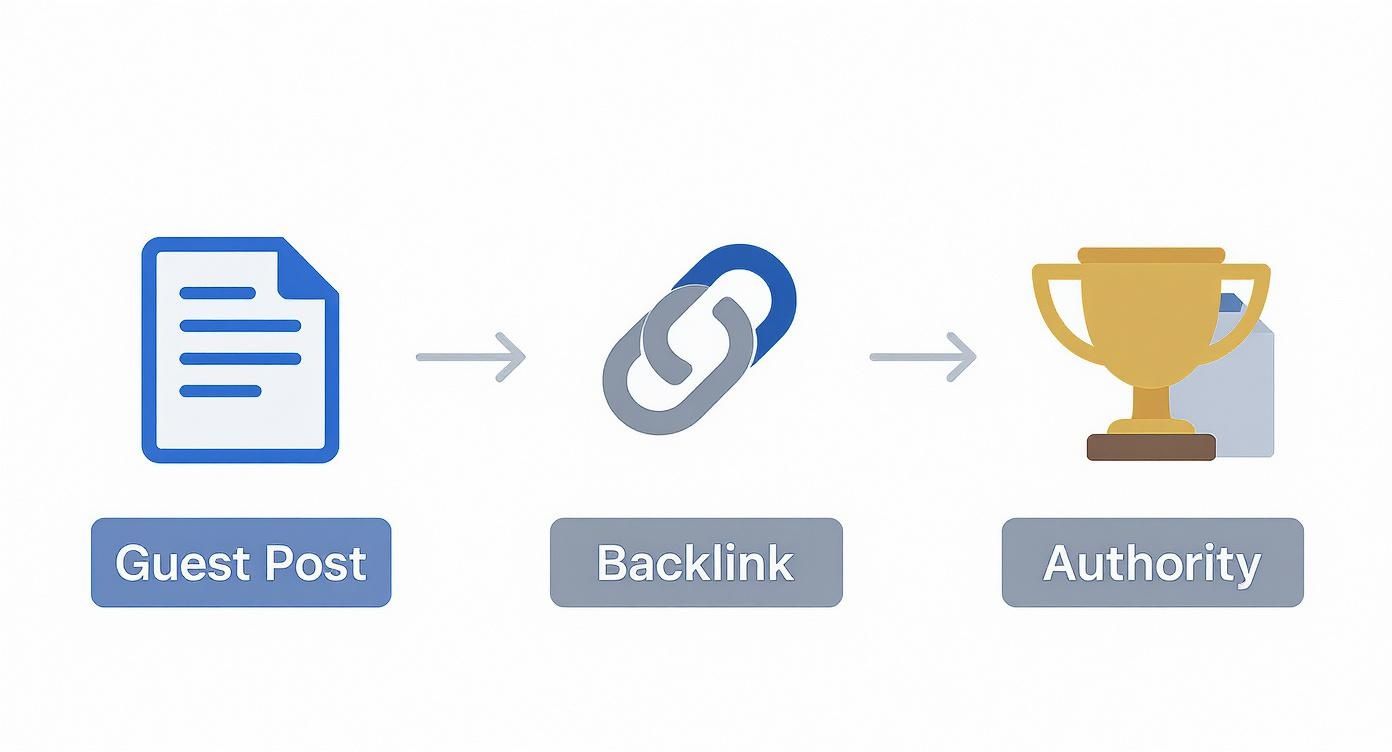
Guest blogging is a pretty straightforward concept: you write an article for another website in your niche, and in return, you get a link back to your own site. But don't let the simplicity fool you. This isn't just about swapping content; it’s one of the most powerful, long-term SEO strategies you can use to build your site's authority and pull in genuinely interested traffic. It's about giving away your expertise to earn trust and, ultimately, visibility.
Why Guest Blogging Is Your Strongest SEO Tool
Let's be clear: guest blogging is way more than a simple content exchange. It's a calculated move to cement your brand's authority in the cutthroat foodservice industry. When you land a high-quality article on a respected culinary or restaurant management blog, you're not just getting your name out there—you're getting a powerful vote of confidence that search engines pay close attention to.
Every backlink from a relevant, authoritative site is a major trust signal. For a restaurant equipment supplier, this is how you go from being just another online store to a go-to industry resource.
Think of it this way: a link from a well-known chef’s blog is like that chef personally telling their entire audience to check out your equipment. That's the kind of endorsement Google loves to see.
The Direct Impact on Your Rankings
These endorsements have a real, measurable impact on your search engine rankings for the keywords that actually make you money. When Google’s crawlers see that credible food industry blogs are linking to your pages for terms like 'commercial kitchen equipment' or 'restaurant management software,' it starts seeing your site as a much more reliable source on those subjects.
And that's when the magic happens. Higher rankings bring in more organic traffic, which then signals to Google that your site is valuable, which helps lock in your higher ranking. It’s a powerful upward spiral.
A single, well-placed backlink from an industry-leading publication can have a more significant SEO impact than dozens of low-quality links. Prioritize relevance and authority over sheer volume every time.
More Than Just SEO Juice
Beyond the raw SEO power, guest blogging for backlinks helps you hit other crucial business goals. It's your chance to step up and show you're a genuine expert. For example, imagine writing an in-depth guide on 'Optimizing Ghost Kitchen Workflows' for a popular hospitality site. That one piece of content does a lot of heavy lifting:
- Builds Brand Credibility: It proves you genuinely understand the day-to-day struggles of your potential customers.
- Drives Qualified Leads: The people reading that article are exactly who you want to sell to. A natural link back to a relevant product page will bring you traffic that's already warmed up and ready to buy.
- Creates Networking Opportunities: It opens doors. Suddenly, you're on the radar of other industry influencers and publications, which can lead to even more collaborations.
At the end of the day, this strategy isn't just about link-building. It’s about embedding your brand into the foodservice community, building real relationships, and establishing a foundation of trust that will drive real, sustainable growth.
Finding High-Value Guest Post Opportunities
Your guest blogging success lives and dies by the quality of the blogs you target. It's simple, really. A fantastic article on a website your customers have never heard of is a complete waste of time and money. The real goal is to get your content in front of the people who actually buy commercial kitchen gear—the restaurant owners, head chefs, and foodservice managers.
This isn't just about a quick Google search. It’s about being methodical and building a curated list of high-impact blogs that your competitors are probably overlooking. Let's break down how to find them.
Mastering Advanced Search Operators
The most straightforward way to start is by putting Google to work for you. Advanced search operators are just simple commands you can type into the search bar to get incredibly specific results. They help you cut through the noise and find blogs that are actively looking for writers like you.
Here are a few search strings I use all the time for clients in the foodservice space:
"restaurant management" + "write for us""commercial kitchen" + "guest post""food tech" + "contributor guidelines""hospitality industry" + "submit an article"
Mixing industry keywords with these phrases will pull up pages built specifically for guest contributors. This is the absolute lowest-hanging fruit in your prospecting journey and a fantastic way to get an initial target list together.
My Two Cents: Don't just stick to the obvious keywords. Think about what else your audience cares about. Topics like food safety regulations, sustainable restaurant practices, or even staff retention strategies can open up a whole new world of less competitive blogs.
Reverse Engineering Your Competitors' Backlinks
Want to know one of the fastest ways to build a high-quality prospect list? See where your competitors are already getting their links. If a major foodservice blog published an article from a rival equipment supplier, there’s an excellent chance they'll be open to hearing from you, too.
This is where you need a good SEO tool. Something like Ahrefs or Semrush lets you pop in a competitor's domain and get a full report of every single website that links to them.
Digging into their backlink profile gives you a "warm" list of blogs that are already proven to accept guest content from your industry. To get a handle on this technique, you can check out our detailed guide on how to find every site linking to your competitors. It’s like getting a pre-vetted list of opportunities delivered on a silver platter.
Guest Post Prospecting Channel Comparison
Finding the right blogs is a mix of art and science. Different methods work better for different goals. Here’s a quick breakdown of the main ways to prospect and where each one shines.
| Prospecting Method | Effectiveness | Time Commitment | Best For Finding... |
|---|---|---|---|
| Google Search Operators | Moderate | Low | "Low-hanging fruit" sites with clear "write for us" pages. |
| Competitor Backlinks | High | Medium | High-authority, industry-relevant blogs already open to guest posts. |
| Social Media Search | Moderate | Medium | Niche communities and influencers who might not have formal programs. |
| Industry Forums/Groups | Low to Moderate | High | Hyper-specific blogs and uncovering what your audience actually reads. |
Ultimately, a blended approach works best. Start with competitor analysis to find the heavy hitters, then use search operators to fill in the gaps.
Vetting Your Prospects for Quality and Relevance
Okay, so you’ve got a list of potential blogs. Now comes the critical part: separating the gold from the garbage. A backlink from a low-quality, spammy site can actually hurt your SEO, so this step is non-negotiable.
Run every potential site through this quick checklist:
- Audience Fit: Does this blog speak directly to your people? A quick scan of their latest articles and the comments section will tell you if restaurant owners and chefs are hanging out there. If it's all home cooks, move on.
- Website Authority: Use a tool to check the site’s Domain Rating (DR) or Domain Authority (DA). You generally want sites with a score similar to or higher than your own, but never choose a high-metric site if it isn't relevant. Relevance always trumps authority.
- Content Quality: Is the stuff they're already publishing actually good? Look for well-researched, insightful articles. If it looks like a content farm churning out generic fluff, it's a hard pass. High editorial standards mean their links carry more weight with Google.
- Real Engagement: Do people actually read and interact with the content? Look for social media shares and thoughtful comments. An engaged audience means real eyeballs on your post, which can drive valuable referral traffic back to your site.
Consistency is key here. The average guest blogger sends out about 25.8 pitches a month, but a surprising 50% send ten or fewer. The real movers and shakers—about 7% of bloggers—are sending over 100 pitches every single month.
While you don't need to hit that volume right away, it shows that building a systematic process for finding and vetting opportunities is what separates the pros from the amateurs. This is how you create a sustainable engine for acquiring powerful backlinks that drive real, measurable SEO results.
Crafting a Pitch That Editors Actually Read
Alright, you've done the legwork and have a solid list of blogs you'd love to get featured on. This is where the rubber meets the road: the outreach.
Let’s be honest. A generic, copy-and-paste email is a one-way ticket to the trash folder. Editors at popular food industry blogs are swamped, and they can spot a low-effort, templated pitch from a mile away. To stand a chance, your email has to prove you’re different from the moment they read the first line.

The secret sauce? Personalization. It’s the single biggest factor that separates a pitch that gets a reply from one that gets archived. Mastering how to write cold emails that get replies is a game-changer, turning your outreach from a shot in the dark into a targeted, effective strategy.
The Anatomy of a Winning Pitch
A great pitch isn't just a block of text; it's a strategic message where every piece has a job. Think of it as guiding the editor from "Who is this?" to a confident "Yes, let's do this."
Here’s what every solid pitch needs:
- A Subject Line That Doesn't Suck: Ditch the generic "Guest Post Submission." You need to spark curiosity. Get specific and hint at the value inside.
- An Opening That Shows You've Done Your Homework: Start by proving you're a real fan, not a robot. Reference a recent article they published. Mention a specific point you liked. Connect your idea to a recurring theme on their blog.
- A Clear "What's In It For Them": Get straight to the point. Why are you emailing them? What unique expertise are you bringing, and how will it benefit their readers?
- A Few Killer Topic Ideas: Don't make the editor brainstorm for you. That's your job. Offer 2-3 highly relevant, well-thought-out article ideas that you know would be a home run for their audience.
- Proof You Can Actually Write: This is crucial. Show, don't just tell. Link to 1-2 of your best-published articles on other respected sites. This instantly lowers their risk and proves your credibility.
This structure immediately signals that you're a professional who respects their time, not just another link-builder blasting out emails.
A Real-World Pitch Example
Let's put this into practice. Here’s how you’d approach a high-value blog where you have no prior connection. The goal is to be concise, respectful, and immediately valuable.
Subject: Guest Post Idea: Restaurant Inventory Tech
Hi [Editor's Name],
I just finished reading your article on ghost kitchen profitability—that point about strategic menu engineering was brilliant.
I've seen a lot of chatter in your comments section about inventory management, and as a specialist in restaurant equipment SEO, it's a topic I know inside and out. I'd love to write a piece for your readers that cuts through the noise.
A few potential angles:
- The Real ROI of RFID: How Modern Tech Slashes Food Waste
- Beyond Spreadsheets: 5 Inventory Tools for Today's Kitchen
- Connecting Your POS and Inventory for Real-Time Food Costing
To give you a feel for my writing style, here are a couple of recent posts I’m proud of for [Site A] and [Site B].
Would any of these be a good fit for your content calendar?
Best,
[Your Name]
The Gentle Art of the Follow-Up
So you sent the perfect pitch... and heard nothing but crickets. Don't panic. Silence isn't always a "no." Editors are juggling a dozen things at once, and your email might have just gotten buried.
A polite, gentle follow-up can work wonders.
Wait about 5-7 business days, then simply reply to your original email. Keep it incredibly short. Something like, "Just wanted to gently bump this to the top of your inbox in case you missed it," is all you need.
Being persistent shows you're serious, but there's a fine line between persistent and pushy. One or two follow-ups is the sweet spot. If you still don’t get a response, it’s time to respectfully move on to the next opportunity.
Pro Tip: For a deeper dive into follow-up strategies and more templates, check out our complete guide on perfecting your guest posting outreach.
Writing Content That Actually Earns the Backlink
Getting a "yes" from an editor is a great first step, but the real work starts now. You have to deliver an article so genuinely useful that they’re not just happy to publish it, but they see your backlink as a valuable addition for their readers. This is where you stop thinking like a link builder and start acting like the industry expert you are.
The article itself is the currency you're trading for that high-authority backlink. If you turn in something thin, overly salesy, or just a rehash of the first page of Google, you're asking for trouble. Best case, they strip your link out. Worst case, they reject the piece entirely. Your mission is to give their audience something that truly helps them.
Brainstorming Topics That Hit the Mark
The sweet spot for a guest post topic lies at the intersection of three things: what you know (your expertise), what their audience needs (their pain points), and what the host blog is missing (a content gap). You're not just writing about a commercial oven; you're solving a real-world problem for a stressed-out kitchen manager.
Think past your product pages. What keeps restaurant owners up at night? Labor costs, food waste, razor-thin margins, and kitchen efficiency. Your content needs to tackle these head-on.
- For a restaurant tech blog: "How to Design a Ghost Kitchen Workflow for Maximum Throughput" — This lets you talk about equipment layouts and automation without being promotional.
- For a restaurant finance blog: "Calculating the True ROI of an Energy-Efficient Walk-In Freezer" — This directly addresses cost savings and long-term value, a language that owners understand.
- For a culinary blog: "A Head Chef's Preventative Maintenance Checklist for a High-Volume Kitchen" — This positions you as an authority on equipment longevity and performance, helping the very people who use your products.
These topics frame you as a problem-solver, not a salesperson. They also create natural, logical places to link back to your own detailed resources in a way that feels helpful, not forced.
Your guest post isn’t an ad. It’s a free consultation. Offer the kind of sharp, actionable advice you'd give a high-value client, and the backlink will feel less like a payment and more like a proper credit for your expertise.
Use a Simple Content Brief to Avoid Headaches
Before you dive into writing, get on the same page with the editor by using a simple content brief. This isn’t some formal, 10-page document. It's often just a quick email or a shared Google Doc that prevents massive revisions and misunderstandings down the line.
A brief shows the editor you’re a pro who respects their time. It also gives you a clear roadmap for your article.
Here’s all you need to include:
- Working Title: A catchy, proposed headline.
- Core Idea: In one sentence, what’s the single most important thing the reader will learn?
- Key Talking Points: 3-5 bullet points that will become the main sections of your post.
- Target Reader: Who is this for? (e.g., "Independent pizzeria owners," "fast-casual franchise managers").
- Proposed Backlink: Briefly explain where your link fits and why it adds value. (e.g., "In the section on energy efficiency, I’ll link to our detailed guide on selecting walk-in coolers").
Firing this off for a quick "looks great!" from the editor means you can write with confidence, knowing you’re creating exactly what they want. It’s a small step that saves a ton of time. While 87% of bloggers generate their own guest post ideas, a surprisingly low 52% actually follow through and write them. A solid brief helps you bridge that gap from idea to published article.
If you’re curious about timing, guest blogging activity tends to spike in the summer. You can see more data like this in this deep dive into blogging statistics.
Weaving Your Backlink in Naturally
This is the make-or-break moment. A clunky, self-serving link is the fastest way to get your article flagged. Your link must feel like an organic, helpful part of the conversation.
Here's the golden rule: the link has to make the article better for the reader. It should point to something that offers more depth, a useful tool, or data that backs up your claims.
Here are a few proven ways to do this right:
-
Link to a Deeper Resource: If your post touches on the importance of HACCP compliance, it's the perfect opportunity to link to your definitive guide on the subject. The anchor text could be something like, "For a full breakdown, see this comprehensive guide to HACCP compliance."
-
Cite Your Own Data: Have you run a survey or collected unique industry data? Use it! For instance, if you write, "our analysis shows a 15% drop in energy costs for kitchens that switch to LED lighting," you can link that phrase directly back to the original study on your site.
-
Provide a Practical Solution: When discussing a common problem like an inefficient kitchen layout, you can link to a resource that helps solve it. For example, "This approach can dramatically cut down on ticket times, as seen in this ghost kitchen redesign case study."
Always avoid generic anchor text like "click here" or "read more." Use descriptive phrases that tell both the reader and Google what they’ll get when they click.
By focusing on delivering exceptional, non-promotional content that solves real problems, you’re doing more than just earning a backlink. You’re building a reputation as a go-to authority in the foodservice industry.
Getting the Backlink That Actually Counts
You've done the hard work. You've prospected, pitched, and poured your expertise into crafting a great piece of content. But the real payoff comes down to the technical details of the backlink itself. Getting this part right is what separates a link that genuinely boosts your SEO from one that’s just a line of text on a page.

It’s easy to get excited about landing a guest post on a big-name blog, but the specific attributes of that link are what matter most. We need to look under the hood to see if it’s a "dofollow" link, where it’s placed, and what anchor text is used. For any serious guest blogging campaign, these aren't just minor details; they're everything.
Dofollow vs. Nofollow: The Deal-Breaker
Your number one goal in guest blogging for SEO is to secure dofollow links. Plain and simple. Think of a dofollow link as a direct endorsement. It’s the host site telling search engines, "We trust this resource. Pass some of our authority over to them." This is the "link juice" that directly helps improve your own site's authority and search rankings.
On the flip side, a nofollow link has a small bit of code (rel="nofollow") that tells search engines not to pass that authority along. While these links can still bring some great, relevant visitors to your site (referral traffic), they don't give you that core SEO power-up.
Before you even start writing, you should have this conversation with the editor. A quick "Just to confirm, are external links in guest posts dofollow?" can save you a ton of wasted effort. To dig deeper into this, check out our guide on why dofollow backlinks matter for SEO.
A quick word on nofollow links: Don't dismiss them entirely. If the site has a massive, relevant audience, the referral traffic alone can be worth it. But it should be seen as a secondary benefit, not the main prize of your guest blogging efforts.
Where Your Link Lives and What It Says
The placement of your backlink and the words used to create it—the anchor text—are hugely important. A link crammed into a tiny author bio at the very bottom of the article is worth a fraction of one placed naturally within the main body of the content.
The gold standard here is the contextual link. This is a link embedded right into a relevant sentence in the article, where it adds value for the reader.
For example, a link within a sentence like, "Implementing a preventative maintenance schedule for commercial fryers can significantly extend their lifespan," is incredibly powerful. The surrounding text provides Google with strong clues about what your linked page is about, making the link that much more potent.
When it comes to the anchor text itself, keep it natural and descriptive. Stuffing it with exact-match keywords is an old-school tactic that can look spammy to search engines today.
- Good Anchor Text: "our complete guide to commercial refrigeration"
- Poor Anchor Text: "buy commercial refrigerator"
- Terrible Anchor Text: "click here"
Your link should feel like a helpful, organic part of the conversation, not a billboard.
Don't Forget On-Page SEO for Your Post
Your guest post is a piece of content that can (and should) rank in search engines on its own. An article that performs well on the host's site is a gift that keeps on giving, sending you more authority and referral traffic for years to come. So, treat it with the same on-page SEO care you'd give an article on your own blog.
Here's a quick checklist to run through:
- Keyword in the Title: Make sure the headline includes the main keyword you're targeting.
- Clean Heading Structure: Use H2s and H3s to break up the content. This makes it scannable for readers and easy for search engines to understand.
- Link to Their Content: Find a couple of opportunities to link to other relevant articles on the host's blog. This is a pro move that shows the editor you’ve done your homework and helps their internal linking.
-
Optimize Your Images: If you're providing images, give them descriptive file names (e.g.,
commercial-kitchen-ventilation-hood.jpg) and suggest relevant alt text.
Optimizing your guest post creates a win-win. The blog you're writing for gets a fantastic, high-performing article, and your backlink becomes a long-term asset that continuously works for you.
Measuring and Scaling Your Guest Blogging Efforts
Guest blogging isn't a one-off project you can check off a list. To get real, lasting results, you have to treat it like an ongoing campaign—one that needs careful tracking to prove its worth. If you're not measuring, you're just guessing. The whole point is to build a reliable system for earning backlinks that actually improve your search rankings and drive business.
To make that happen, you need to zero in on a few key performance indicators (KPIs) that show tangible impact. Forget the vanity metrics that look nice but don't mean anything for your bottom line. The data that truly matters will tell a clear story about how your website's authority and visibility are growing within the foodservice world.
Key Metrics to Keep Your Eye On
The best way to start is by setting up a simple tracking dashboard. You don't need anything fancy; free tools like Google Analytics combined with a solid SEO platform like Ahrefs will give you a surprisingly clear picture of your campaign's performance.
Here’s what you should be monitoring:
- New Referring Domains: This is your North Star metric. Are you consistently earning links from new, relevant sites in the restaurant and hospitality space? A steady increase here is the most direct sign that your guest blogging is working.
- Organic Keyword Rankings: Keep a close watch on the search rankings for the specific pages you're pointing links to. Seeing a gradual climb for your most important commercial keywords—like "commercial convection ovens" or "restaurant POS systems"—is proof that your efforts are paying off.
- Referral Traffic: Pop into Google Analytics and see how many people are actually clicking the links in your guest posts to visit your site. This isn't just any traffic; it's highly qualified traffic coming from an audience that's already interested in what you have to say.
Tracking these core metrics is what separates professional link building from amateur hour. It turns guest blogging from a hopeful guess into a predictable science, letting you pour more resources into what works and cut out what doesn't.
As you get into a rhythm, think about how these guest posts fit into a holistic restaurant marketing plan. This ensures your link-building efforts are supporting broader business goals, not just happening in a silo.
Finally, a pro tip: don't let your hard work die after one publication. Squeeze every last drop of value out of each article by repurposing it. That in-depth guide to commercial kitchen ventilation? It can easily become a slick infographic, a series of a dozen social media posts, or even a short explainer video. This strategy breathes new life into your content, turning a single guest post into multiple brand-building assets that work for you around the clock.
A Few Common Questions About Guest Blogging
If you're just getting your feet wet with guest blogging, you've probably got some questions. That's a good thing. Asking the right questions upfront is what separates a successful link-building campaign from one that just spins its wheels.
Let's clear up a few of the most common things that come up when we talk to foodservice suppliers about this strategy.
So, How Many Guest Posts Does It Actually Take to See Results?
Everyone wants a magic number, but the honest answer is: quality will always, always beat quantity.
Think about it this way. One single backlink from an industry authority like Restaurant Business or FSR Magazine is worth more than ten links from random, low-traffic blogs nobody in your industry has ever heard of. It’s about impact, not volume.
Instead of chasing a specific number of posts, aim for a consistent pace. Securing 2-4 high-quality, relevant links per month is a fantastic, sustainable goal. This steady rhythm sends all the right signals to Google, showing them you're a credible, growing authority in the foodservice space.
What’s the Deal with Paying for Guest Posts?
This is a tricky one, and it's easy to get bad advice here. First, let's be clear: you should run, not walk, from any site that openly "sells links" on a menu. Those are almost always part of a link scheme, and that’s a quick way to get penalized by Google.
However, the reality on the ground is that many legitimate, high-quality publications now have editorial or administrative fees. They're not selling a link; they're covering the costs of their editorial team to review, edit, and publish your content.
Don't focus on the fee; focus on the opportunity. If the site has a real, engaged audience of chefs and restaurant owners, strong SEO metrics, and high editorial standards, then a reasonable fee is simply a marketing expense, not a shady transaction.
What Domain Authority Score Should I Be Aiming For?
It’s tempting to get obsessed with Domain Authority (DA), but don't let it be your only guide. Relevance is the most important factor, period.
A backlink from a niche blog with a DA of 35 that's laser-focused on commercial kitchen design is infinitely more valuable than a link from a generic business site with a DA of 70. Why? Because the audience is a perfect match.
As a general rule of thumb, it's good to target sites with a DA equal to or higher than your own. But never, ever sacrifice relevance just to get a slightly higher DA score. The best backlinks don't just boost your authority; they send you qualified referral traffic that can actually turn into customers.
At Restaurant Equipment SEO, we build targeted link acquisition strategies that connect you with the foodservice audience you need to reach. Let us handle the complexities of guest blogging so you can focus on your business. Find out more at https://restaurantequipmentseo.com.