
How to Create a Content Calendar That Drives Restaurant Supplier Sales
Are you tired of feeling like your marketing is just a series of random posts about commercial ovens and last-minute supplier news? I’ve seen it a hundred times. Without a solid plan, content feels disconnected and, frankly, it just doesn't work.
This is exactly why learning how to create a content calendar is a total game-changer for any food service supplier.
Why a Content Calendar Is Your Secret Weapon
Think of a content calendar as your strategic playbook. It’s so much more than a simple schedule; it's a detailed roadmap for planning, creating, and publishing every blog, video, and social media post with a clear, specific purpose. Before getting into the nuts and bolts, it's worth understanding what a content calendar is at its core. It’s the tool that turns your marketing from a guessing game into a predictable system for getting real results.
This simple tool also builds incredible consistency for your brand. When restaurant owners see your company regularly publishing genuinely helpful guides—like how to maintain walk-in freezers or compare different commercial mixer models—you build trust. You become the authority.
This organized approach guarantees that every piece of content you create is directly tied to a business goal, whether that's selling more commercial refrigeration units or becoming the go-to expert for kitchen efficiency tips.
The Power of Planning Ahead
A well-built calendar shifts your entire mindset from reactive to proactive. You’re no longer scrambling for ideas. Instead, you can map out content around industry events, seasonal demands, and product launches months in advance.
Imagine scheduling a series of articles about high-capacity ice machines in early spring, right before restaurants start gearing up for their summer rush. That's strategic thinking.
This kind of foresight isn't a luxury anymore; it's essential. Projections show that by 2026, 92% of marketers will rely on content calendars, a big leap from 85% in 2025. It’s clear that structured planning is the only way to cut through the noise of 4.8 billion pieces of content published online every single day.
For your food service audience, this means planning content around their peak buying seasons, like the Q4 holiday rush when restaurant owners are upgrading and stocking up. This is the kind of strategy that can explode organic traffic—one Restaurant Equipment SEO company saw a 390% surge in just 11 months by doing exactly this. You can find more of these key insights and learn how planning impacts traffic.
A content calendar isn't about restricting creativity; it's about channeling it. By handling the 'what' and 'when,' you free up mental energy to focus on creating truly valuable content that solves your customers' problems.
Core Components of an Effective Content Calendar
To truly be effective, your calendar needs to track more than just a publish date. A solid plan for a restaurant equipment business should include several key pieces of information that give your whole team clarity and direction.
Here's a quick look at the core components every effective content calendar should have.
Core Components of an Effective Content Calendar
| Component | Purpose | Example for Food Service |
|---|---|---|
| Topic & Title | Clearly defines the content piece. | "5 Signs Your Commercial Oven Needs an Upgrade" |
| Content Pillar | Aligns the topic with a core business theme. | Kitchen Efficiency |
| Target Keyword | Guides SEO efforts for organic visibility. | "commercial oven repair" |
| Format | Specifies the type of content being created. | Blog Post, Video, Infographic |
| Publish Date | Sets the timeline for publication. | October 15, 2024 |
| Status | Tracks progress from idea to completion. | In Progress |
| Owner | Assigns responsibility for creation. | Marketing Team Member |
By including these basic components, you create a central source of truth that keeps your marketing efforts organized, focused, and perfectly aligned with your business goals.
Laying the Groundwork for Your Content Plan
Before you even think about opening a spreadsheet, we need to talk strategy. A content calendar without a solid plan behind it is just a list of random ideas—it's busy work, not smart work. The real magic happens when every single piece of content you create has a clear, measurable business purpose from the get-go.
This means moving beyond fuzzy goals like "get more traffic." While traffic is nice, it doesn't pay the bills. You need to get specific.
Think about it this way. A much better goal is: "Increase qualified leads for commercial refrigeration units by 25% this quarter through targeted blog content." See the difference? Now your content has a mission.
First Things First: Define Your Business Goals
Every piece of content, from a deep-dive blog post to a quick social media update, needs a job. What do you want someone to do after they read it? What larger business objective does it support?
Start by outlining what you need to achieve in the next six to twelve months. These goals will be the north star for your entire content plan.
- Generate Leads: Are you looking for more restaurant owners to request a quote on a new line of combi ovens?
- Build Brand Authority: Do you want to be seen as the ultimate expert in kitchen efficiency and food safety?
- Support the Sales Team: Can you create content, like detailed product comparison guides, that helps your sales reps close more deals?
- Boost Customer Retention: How about developing maintenance guides that help your current customers get more out of the equipment they already bought from you?
When you answer these questions first, you ensure your content calendar is built to grow your business, not just to fill a void.
Get to Know Your Audience—Really Well
Once your goals are locked in, you have to know exactly who you're talking to. A one-size-fits-all approach is a recipe for disaster in the specialized world of food service. You need to develop detailed personas for your ideal customers.
Are you talking to the frazzled independent restaurant owner who’s constantly worried about rising energy bills and equipment longevity? Or is it the kitchen manager for a big hotel chain, whose top priorities are workflow efficiency and getting new staff up to speed?
These two people have completely different problems, questions, and reasons for buying. Understanding this is everything. When you know their specific pain points, you can create content that hands them a solution on a silver platter, making your brand instantly more relevant and trustworthy.
Here’s a pro tip: Stop writing for a faceless "business." Instead, picture one person. Write for the stressed-out pizzeria owner who just Googled "how to clean a commercial dough mixer" at 11 PM on a Friday. That’s how you make a real connection.
Establish Your Core Content Pillars
With your goals and audience clear, it’s time to define your content pillars. Think of these as the 3-5 big, foundational topics your brand is going to own. They should live right at the intersection of what you're an expert in and what your audience desperately needs to know.
For a restaurant equipment supplier, your pillars might look something like this:
- Kitchen Efficiency & Workflow
- Equipment Maintenance & Longevity
- Food Safety & Compliance
- Cost Savings & ROI
These pillars become the main buckets for all your content. Every single blog post, video, or guide you create should fit neatly under one of them. This simple structure builds consistency and hammers home your expertise in the areas that matter most to your customers. A well-organized approach is a critical piece of any SEO content strategy for restaurant equipment suppliers.
From here, brainstorming topics becomes so much easier. That "Equipment Maintenance" pillar could naturally lead to articles like "Your Weekly Checklist for Commercial Fryer Upkeep" or "5 Signs It's Time to Service Your Walk-In Cooler."
A great way to get started is by looking at what’s already worked. Dive into your analytics for the past 6-12 months and find the winners. Did that one blog post on energy-efficient fryers get 50% more engagement than anything else? That’s your audience telling you exactly what they want. Next, pull out a calendar and mark down the big moments—major trade shows, seasonal promotions, new product launches—and start building your topics around those key dates.
Choosing the Right Tools to Build Your Calendar
A brilliant content strategy can fall flat without the right system to manage it. Now that we've mapped out the what and the why, it's time to get practical and choose the tools that will bring your calendar to life.
The goal isn't to find the flashiest or most expensive software. It’s about finding a platform that fits how your team actually works and helps you turn ideas into published content without unnecessary friction.
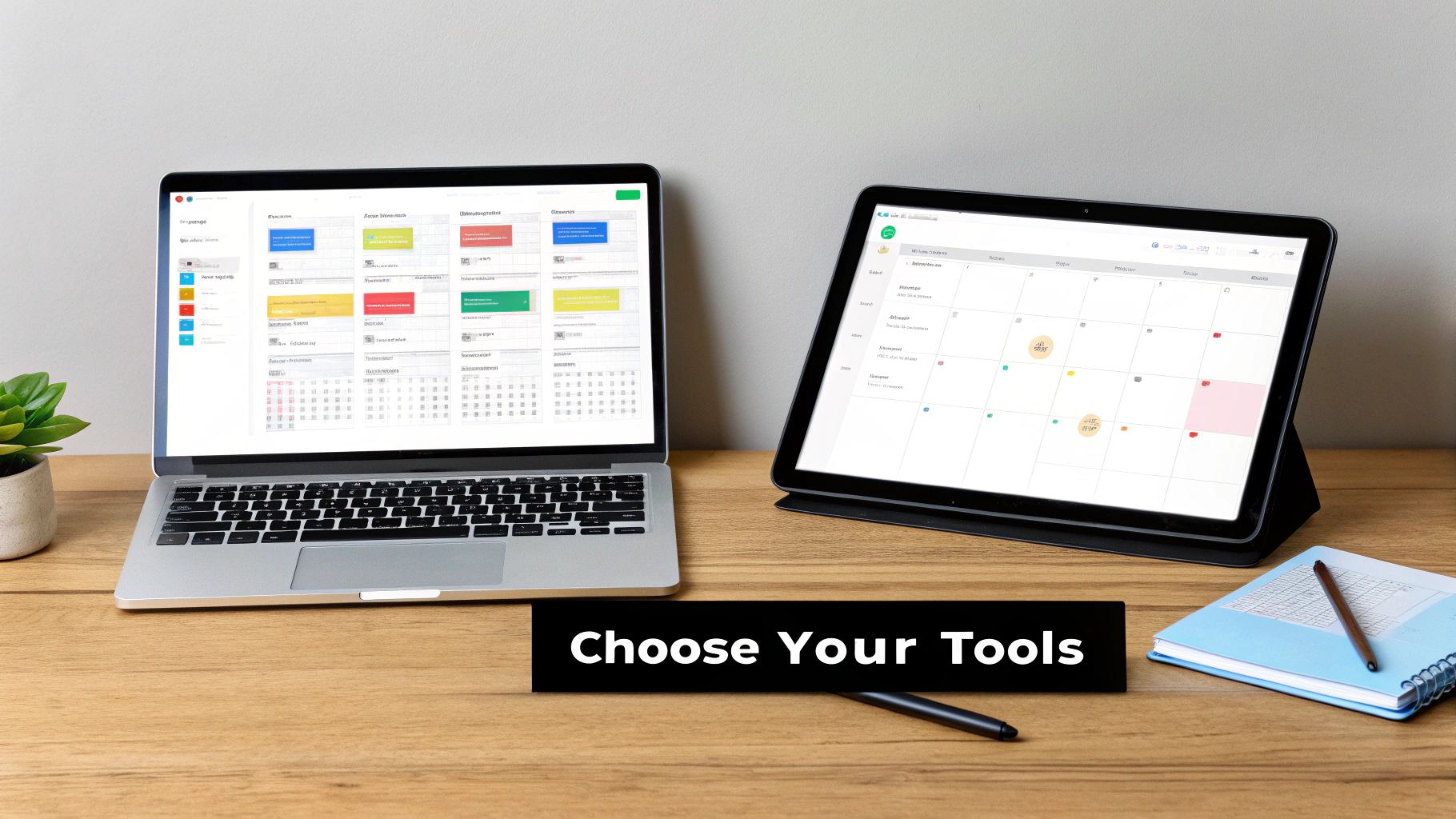
Let's walk through three solid options I've seen work for businesses of all sizes, from a simple spreadsheet to a full-blown marketing suite.
Google Sheets: The Simple and Powerful Starter
Never underestimate a well-organized spreadsheet. Seriously. For many businesses, especially those just getting their content engine running, a Google Sheets calendar is the perfect choice. It’s free, built for collaboration, and you can customize it endlessly.
The beauty of a spreadsheet is its straightforward nature. You can spin up a robust calendar in under an hour that tracks every critical detail. The trick is to build it with the right columns from day one so nothing ever slips through the cracks. This approach gets everyone on the same page without the learning curve of a brand-new software platform.
Here are the columns I consider non-negotiable for a spreadsheet-based calendar:
- Publish Date: The day the content goes live.
- Topic/Headline: The working title (e.g., "How to Choose a Commercial Convection Oven").
- Primary Keyword: The main SEO term you're targeting (e.g., "commercial convection oven").
- Content Pillar: Which of your big strategic themes does this support? (e.g., Kitchen Efficiency).
- Format: Is it a blog post, video, or case study?
- Status: Where is it in the pipeline? (e.g., Idea, Writing, Published).
- Owner: Who's the point person responsible for getting this done?
- Key Metric: What’s the main goal? (e.g., Organic Traffic, Leads Generated).
This simple setup gives you a powerful, at-a-glance overview of your entire content operation. It’s the foundational first step in learning how to create a content calendar that actually gets used.
Trello: The Visual Workflow Manager
If your team thinks in terms of processes and visual workflows, Trello is a fantastic step up. It ditches the grid format for a Kanban-style board with cards and lists, letting you physically see a piece of content move through your production stages.
Think of each content idea as a "card." You can literally drag that card from a list called "Ideas" to "Writing," then "Editing," and finally to "Published." It’s an incredibly intuitive way to manage multiple projects at once and see potential bottlenecks before they become real problems.
Trello really shines when you use it as more than just a calendar. It becomes a dynamic project hub. Inside each card, you can add checklists for writers, assign due dates, attach drafts, and have conversations—all in one place. No more digging through scattered emails.
You can also use Trello's custom fields to track the same strategic info from our spreadsheet: the keyword, content pillar, and success metric. This gives you the visual flow of a Kanban board without sacrificing the data you need to make smart decisions.
CoSchedule: The All-in-One Command Center
For teams that are juggling a high volume of content across many channels, a dedicated marketing suite like CoSchedule can be a game-changer. It’s designed to be a true command center, pulling your content calendar, social media scheduling, project management, and analytics into one unified platform.
The whole point of a tool like this is to stop the constant tab-switching. You can plan a blog post, schedule its promotion across Facebook, LinkedIn, and Twitter, and track its performance, all without leaving the app. This integrated view saves a ton of time and, more importantly, gives you a much clearer picture of what's actually working.
For example, CoSchedule’s Marketing Calendar gives you a single, color-coded timeline showing every blog post, email newsletter, and social campaign. It’s a bird’s-eye view of your entire marketing universe.
While an all-in-one tool comes with a subscription fee, the investment often pays for itself in efficiency gains and better-integrated analytics, especially for larger teams.
Content Calendar Tool Comparison
Choosing the right platform really comes down to your team’s size, budget, and workflow. Here’s a quick breakdown to help you decide.
| Feature | Google Sheets | Trello | CoSchedule |
|---|---|---|---|
| Best For | Small teams, startups, or those on a tight budget. | Visual thinkers and teams managing a clear workflow process. | Larger marketing teams needing an all-in-one solution. |
| Cost | Free | Freemium (paid plans offer more features) | Paid subscription |
| Learning Curve | Very low | Low | Medium |
| Key Strength | Ultimate flexibility and zero cost. | Visual project tracking and collaboration. | Integration of content, social media, and analytics. |
| Main Limitation | Lacks automation and built-in project management features. | Can become cluttered without a disciplined process. | Can be overkill (and too costly) for smaller operations. |
Ultimately, the best tool is the one your team will actually use every single day. My advice? Start simple, see what sticks, and don’t be afraid to upgrade as your content machine grows and your needs evolve.
How to Find and Schedule High-Impact Content Ideas
You’ve got the framework of your calendar built and your goals defined. Now for the fun part: filling it with content ideas that will actually move the needle. This is where we shift from planning the "when" and "where" to figuring out the "what"—the specific topics that will attract, engage, and ultimately convert your ideal customers.
It’s easy to fall into the trap of brainstorming ideas in a vacuum. A much smarter approach is to start with targeted keyword research. You need to uncover what restaurant owners, kitchen managers, and procurement officers are actually typing into Google. We're not just looking for broad, obvious terms here; the goal is to dig deep for the specific, long-tail questions that signal a real need and purchasing intent.
Get out of the marketer mindset for a minute and think like your customer. What problem is keeping them up at 10 PM on a Tuesday? It’s probably not a generic search for “commercial kitchen equipment.” It’s far more likely to be something like “best commercial dishwasher for small kitchen” or “how to reduce energy costs from walk-in cooler.” These are the golden nuggets you’ll build your content around.
Mapping Content to the Buyer’s Journey
Finding great keywords is only the first step. To make your content truly effective, every single idea needs to be mapped to a specific stage of the buyer's journey. This simple act ensures you’re creating a balanced mix of content that guides prospects from their first inkling of a problem all the way to signing a purchase order.
Your calendar should intentionally feature content across these three crucial stages:
-
Awareness Stage: Your prospects know they have a problem, but they don't know the solution yet. Your content here is all about education, addressing their pain points without a heavy sales pitch. Think of it as being a helpful expert.
- Example Topic: "5 Signs It’s Time to Replace Your Commercial Walk-In Cooler"
- Goal: Attract a new audience and start building trust from day one.
-
Consideration Stage: They’re now actively researching solutions. This is your chance to help them compare options and understand what to look for in new equipment. Your content should guide their research and subtly position your brand as the authority.
- Example Topic: "Convection vs. Combi Ovens: A Complete Buyer’s Guide"
- Goal: Become their go-to resource and shape their purchasing criteria.
-
Decision Stage: They’re on the verge of making a purchase. The content you serve them now should provide the final proof they need to choose you over a competitor.
- Example Topic: "Case Study: How Pizzeria Roma Cut Energy Costs by 30% with Our New Ovens"
- Goal: Build confidence and drive conversions with tangible social proof.
When you deliberately plan content for each stage, your calendar transforms from a simple schedule into a powerful sales funnel. You can see how this journey-based approach works in practice by checking out these real-world content marketing examples.
Adopting the 80/20 Rule for Content Creation
As you start plugging these ideas into your schedule, it's critical to maintain a healthy balance. Pushing for a sale in every single blog post or social update is a fast track to alienating your audience. This is where the classic 80/20 rule is your best friend.
80% of your content should be genuinely helpful, valuable, and educational. This is the stuff that solves problems, answers questions, and builds your reputation as a trusted advisor, not just a seller.
20% of your content can be more directly promotional. This is where you talk about product launches, special offers, and direct calls-to-action to request a quote or schedule a demo.
This approach builds a bank of goodwill. When you’ve consistently provided value, your audience is far more receptive to the occasional promotional post—it feels earned and natural, not intrusive.
Top social media marketers live by this model. The bulk of their calendars are filled with educational pieces, like articles on equipment ROI or videos explaining new safety compliance standards. This leaves a few strategic slots for targeted promotions. Thinking this way also makes your life easier. You can batch-create your educational content a month at a time, freeing you up to focus on client work and other high-value tasks. By applying this simple ratio, you create a sustainable content engine that attracts customers instead of just advertising at them.
Nail Down a Realistic Workflow and Publishing Cadence
All the planning in the world won't matter if you don't have a system to actually create and publish the content. A beautiful content calendar is just a pretty document until you build the engine that brings it to life.
This is where we move from the what to the how. The goal here isn't just to get things done; it's to create a smooth, repeatable process that makes content production a routine part of your business, not a constant fire drill.
Set a Publishing Cadence You Can Actually Stick To
First things first: decide how often you're going to publish. It's so much better to consistently release one high-quality, deeply researched blog post every week than it is to dump five mediocre articles in one go and then disappear for a month.
Consistency is how you build trust. It’s how you train your audience—from busy restaurant owners to procurement managers—to look for and expect your content.
Take an honest look at your resources. What can you genuinely commit to without burning out your team?
- If you're a small team: Maybe that looks like one solid, well-researched blog post every two weeks, paired with a few social media updates each week.
- For a larger operation: You might be able to scale up to two blog posts a week, a monthly video demo of a new combi oven, and daily social media engagement.
The key is to start small and earn the right to get more ambitious. Hitting your deadlines builds momentum. Missing them kills it.
Your cadence is your promise to your audience. Whether it's a weekly newsletter or a monthly case study, showing up consistently is one of the most powerful ways to build brand authority in the competitive food service space.
Map Out Your Content Production Workflow
With your cadence set, it's time to map out the journey each piece of content will take, from a spark of an idea to a fully promoted, published article. A clear workflow stops things from getting stuck and makes sure everyone knows what they’re responsible for. Even if you're a one-person show, defining these steps will keep you organized.
A typical production line for a piece of content usually includes these stages:
- Idea & Keyword Research: The initial concept and its SEO validation.
- Brief Creation: Outlining the topic, target persona, primary keyword, and call-to-action.
- Drafting: Getting the words on the page.
- Editing & Review: Polishing the copy for clarity, tone, and grammar.
- Design: Creating visuals like custom graphics, charts, or product photos.
- Scheduling & Publishing: Loading the final piece into your website's CMS.
- Promotion: Pushing the content out through email, social media, and paid channels.
This visual helps break down how the whole process flows together, from initial research to getting content on the calendar.
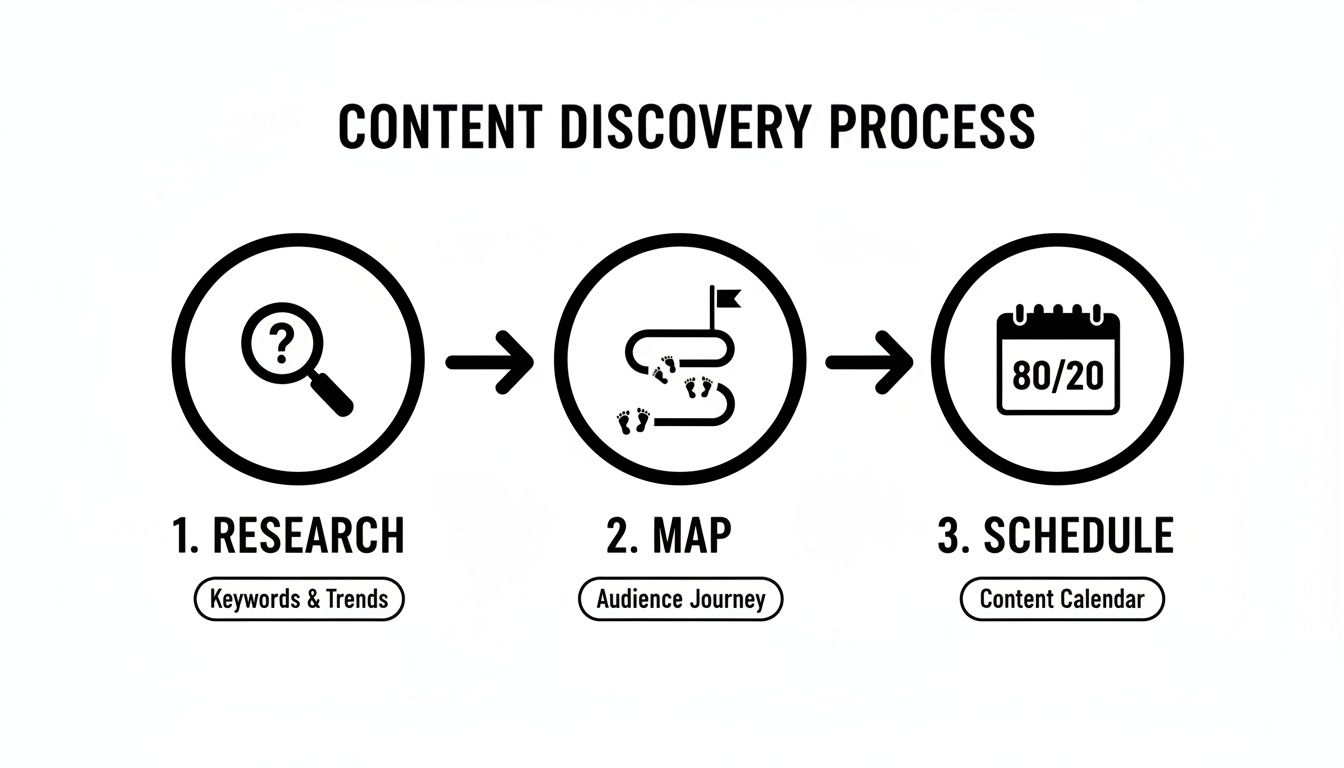
As you can see, the foundational research and audience understanding directly feed into what gets scheduled. This ensures every single piece of content serves a real, strategic purpose.
The Productivity Secret: Content Batching
One of the most effective tricks I've learned for staying ahead is content batching. Instead of jumping between writing, editing, and planning every single day, you dedicate specific blocks of time to a single type of task.
For instance, you could spend a Monday morning brainstorming a month's worth of blog topics. The next day, you could outline all of them. Then, you might block off a few days later in the week just for writing drafts.
This approach is a game-changer because it cuts down on context switching—a massive productivity killer. By focusing on one thing, you get into a flow state and produce better work, faster. It's not uncommon to see businesses using AI tools to make this even more efficient; in fact, 78% of businesses now use them for tasks like predictive scheduling. The trick is to always humanize the output to maintain that expert tone. You can discover more insights about AI in content planning on bloghunter.se.
By batching your tasks and using smart tools, creating a full month's worth of content in just a few focused days is totally achievable.
Measure Your Performance and Refine Your Strategy
A content calendar isn't something you just set and forget. Think of it as a living document. Its real value comes from treating it as a dynamic tool that gets smarter with every piece of content you publish. This is where data comes in, turning your schedule into a feedback loop that continually sharpens your marketing.
The first step is to stop obsessing over vanity metrics like raw page views. If you're selling restaurant equipment, you need to track the numbers that actually move the needle on your bottom line. These are your key performance indicators (KPIs), and they tell you the real story behind your content's performance.
Identifying the KPIs That Matter
Instead of chasing big, flashy numbers, let's get specific. Your goal is to tie every piece of content back to a business objective. Your KPI report should look less like a generic traffic summary and more like a sales pipeline analysis.
For a business in the food service industry, here are a few KPIs that actually mean something:
- Organic Rankings for High-Intent Keywords: Are you showing up on page one for terms like "commercial combi oven reviews" or "walk-in freezer installation costs"? This is a direct signal that your SEO is working.
- Lead Form Submissions from Blog Posts: How many potential customers filled out a quote request after reading your buyer's guide on commercial ice machines? This is content directly generating leads.
- Engagement on Equipment Demo Videos: Are chefs and kitchen managers watching your product demos all the way through? High watch time is a massive buying signal.
- Download Rate for Spec Sheets: When someone downloads a technical spec sheet, they're not just browsing. They're seriously considering a purchase.
Focusing on these data points gives you a much clearer picture of what's resonating with your audience. We dive even deeper into this in our dedicated guide on how to measure SEO performance.
Conducting a Quarterly Content Audit
Once you know what to measure, set aside time every quarter for a content audit. This doesn't have to be a massive, overwhelming project. The point is to quickly identify your winners and losers so you can double down on what works.
As you review your performance, ask yourself a few critical questions:
- Which articles or videos drove the most qualified leads?
- What topics got the most shares and comments on social media?
- Which posts are ranking for our most valuable keywords?
- What formats are hitting home? Are blog posts outperforming videos, or are case studies the real winners?
The goal here is simple: find your best-performing content and figure out why it worked. Maybe you discover that detailed case studies convert 2x better than your standard blog posts. That’s a powerful insight you can immediately use to shape your next quarter's calendar.
Ultimately, learning how to measure content marketing ROI is what separates a content plan from a genuine business driver. The impact can be huge. We've seen businesses that meticulously track these metrics boost engagement by 50% and see sales climb by 35%. Your calendar stops being a simple schedule and becomes a machine that can triple your social media engagement.
This data-driven feedback loop is what separates the good content strategies from the great ones, making sure every dollar and hour you invest is working as hard as it possibly can.
A Few Lingering Questions
Even the best-laid plans can leave you with a few questions. As you start putting your content calendar into action, some common queries tend to bubble up. Let's tackle a few of the ones we hear most often from restaurant equipment suppliers.
How Far Out Should I Really Be Planning?
My rule of thumb? Plan your content at least one full month in advance. This buffer is your best friend—it gives your team the space they need to research, write, and polish everything without that last-minute scramble.
But for the big stuff, you need a longer runway. Think about major seasonal pushes (like gearing up for the summer patio season or the holiday rush) or key industry events and trade shows. For those, you'll want to be mapping things out 3 to 6 months ahead. That's how you make sure all the moving parts of a big campaign come together smoothly.
What's a Realistic Publishing Schedule?
Here’s the honest truth: consistency trumps frequency every single time. It’s far more effective to publish one truly excellent, in-depth blog post each week than it is to churn out three so-so articles that don't really help anyone.
Start with a pace you can genuinely stick with. For most equipment suppliers just getting started, this is a solid goal:
- 1-2 SEO-driven blog posts each week.
- 3-5 social media posts per week on the platforms where your customers actually hang out.
Once you’ve got that rhythm down and it feels easy, then you can think about ramping things up.
I'm Worried I'll Run Out of Ideas. What Then?
Don't be. You're sitting on a goldmine of content ideas and you might not even realize it.
The most effective content calendars aren't just about brand-new ideas; they're also about smartly repurposing what you already have. But your single greatest source of inspiration will always be your customers. Listen to the questions your sales team fields every day. Pay attention to the discussions happening in industry forums. Dig into your keyword research. Your audience is literally telling you what they want to know.
Ready to build a content strategy that drives real results? Restaurant Equipment SEO can help you create a high-performance content calendar that attracts qualified leads and establishes you as an industry authority. Learn more about how we help suppliers grow.