
How to Determine Search Volume for Keywords: A Quick Guide
Keyword search volume is pretty simple on the surface: it’s the average number of times people type a specific keyword into a search engine each month. You can find this data using tools like Google Keyword Planner or Ahrefs.
But thinking of it as just a number is a mistake. This metric is a direct signal of customer demand. It shows you exactly what your audience is looking for, making it one of the most important data points in your entire marketing strategy.
Why Search Volume Is the Compass of Your SEO Strategy

Before you even think about writing a blog post or building a product page, you have to know if anyone is actually looking for it. That's what search volume tells you. A high number means a lot of people are interested. A low (or zero) number means you might be creating content for an empty room.
It’s your strategic compass. It points you toward the topics and products worth your time and away from the ones that aren't. Honestly, one of the biggest mistakes I see people make is ignoring this data. They'll spend weeks creating content for a keyword that sounds perfect but has no actual audience.
The Real-World Impact on a Business
Let’s get practical. Say you're a restaurant equipment supplier. You might think "industrial kitchen appliances" is a solid keyword. It sounds official and covers a lot of ground. But when you check, you find it only gets about 500 searches a month.
On the other hand, a more specific term like "commercial refrigerators" pulls in 5,000 searches per month. Boom. That one number tells you where the real audience is. By targeting the second term, you're tapping into a market that's ten times bigger. This is exactly how you use search volume to make smart decisions that drive real clicks. Understanding this is central to good e-commerce SEO best practices.
By prioritizing keywords based on proven search volume, you're not just guessing what your customers want; you're using data to confirm it. This shift from assumption to evidence-based strategy is what separates stagnant websites from those that experience consistent growth.
How Search Volume Shapes Your SEO Efforts
This simple metric guides everything from content planning to competitive analysis, ultimately impacting your ability to generate leads. It helps you decide what blog post to write this week versus what can sit on the back burner. To learn more about how these clicks become actual visitors, check out our guide on what is organic traffic: https://restaurantequipmentseo.com/blogs/restaurant-equipment-seo-blog/what-is-organic-traffic.
The table below gives you a quick look at how keyword search volume directly influences key SEO and marketing outcomes.
How Search Volume Shapes Your SEO Efforts
| SEO Metric | Impact of High Search Volume | Impact of Low Search Volume |
|---|---|---|
| Traffic Potential | Significantly larger pool of potential visitors. | Limited audience, resulting in a lower traffic ceiling. |
| Content Prioritization | These topics should be high-priority to capture a proven audience. | Lower priority; often best for highly-specialized niche content. |
| Competitive Landscape | Usually attracts more competition, requiring a stronger strategy to rank. | Often less competitive, offering easier ranking opportunities. |
Ultimately, whether you're chasing high-volume "trophy" keywords or finding gold in low-volume niches, the data has to lead the way. It's the only way to ensure your efforts pay off.
Getting Started with Google's Free Tools
You don't have to break the bank on fancy software to figure out what your customers are searching for. Google gives you two powerful tools for free, and they pull data straight from the source. Mastering these is the best place to start if you're building an SEO strategy from scratch for your restaurant equipment business.
We'll walk through the two essentials: Google Keyword Planner for finding new keyword ideas and Google Search Console for understanding the keywords you're already ranking for.
Kicking Things Off with Google Keyword Planner
Think of Keyword Planner as your starting point for exploration. It was built for advertisers, but anyone with a Google account can use it, even without spending a dime on ads. This is where you get your first real data on search demand.
Let’s say you sell commercial kitchen appliances. Start with a broad "seed keyword" like "commercial ovens." Pop that into the planner, and it spits back a list of related keywords, each with that all-important metric: "Average monthly searches."
This is where the magic starts. You might see that "commercial convection oven" gets around 2,400 searches per month, while "deck pizza oven" pulls in a whopping 4,400. Right away, you know where the bigger audience is.
So, what does that number actually mean? According to the Google Ads Help documentation, it’s an average of searches for that term and its close variations over the past 12 months, specific to your location. This means it bundles in common misspellings and plurals, giving you a more complete picture of demand.
How to Read the Tea Leaves in Keyword Planner
It's crucial to remember that these numbers are annualized averages, not a snapshot of last month. This smooths out seasonal trends. For example, a term like "outdoor patio heaters" will naturally see a huge spike in the fall and die down in the spring. The "Average monthly searches" figure gives you the middle ground.
My Two Cents: If you don't have an active ad campaign, Keyword Planner often shows you broad search volume ranges like "1K–10K." It’s still useful for comparing terms, but it's not precise. I've found that setting up even a tiny, paused campaign can sometimes unlock more specific data.
Your mission here is to build a master list. Gather all the relevant terms, sort them by volume, and get a clear picture of what topics your audience cares about most. This list will be the bedrock for your product page optimizations and future blog posts.
Uncovering Hidden Gems in Google Search Console
If Keyword Planner is for looking outward, Google Search Console (GSC) is for looking inward. It's your secret weapon for finding out what keywords are already bringing people to your doorstep, even if it's just a trickle.
Once you're in GSC, head straight to the "Performance" report. This is a goldmine of real-world data showing the exact search queries people used to find your site.
You're looking for two specific opportunities here:
- High Impressions, Low Clicks: This is the lowest-hanging fruit you'll ever find. Lots of impressions mean Google is already showing your page to people. But a low click-through rate (CTR) means your page title or description isn't grabbing their attention. A quick rewrite could change everything.
- Keywords on Page Two: Filter your report to show keywords where your average position is between 11 and 20. You are so close to hitting page one for these terms. Often, all it takes is a little on-page tuning or adding a few internal links to give them the final push into the top 10, where the real traffic is.
Imagine you find your site got 10,000 impressions for "restaurant deep fryer maintenance" but only 50 clicks. That’s a clear signal! The demand is there, and you're already on the radar. Now you can dive into that specific page, improve it to better match what searchers want, and start capturing a much bigger slice of that traffic.
Getting a Real Competitive Edge with Advanced SEO Tools
https://www.youtube.com/embed/H9LbJOyT6G8
While Google's own tools are a great starting point, they tend to give you broad ranges instead of concrete numbers. If you really want to get ahead of the competition, it's time to bring in the heavy hitters: advanced SEO platforms like Ahrefs and Semrush. These tools give you far more precise data, deeper insights, and a much clearer picture of what you're up against.
What’s their secret? They go beyond Google’s basic data by using something called clickstream data. They analyze anonymized browsing behavior from millions of users to see what people actually click on after they search. This allows them to turn a vague Google estimate like "1K-10K" searches per month into a much sharper number like "4,400," giving you a truer sense of a keyword's actual traffic potential.
Going Deeper with Semrush and Ahrefs
This is where the real work begins. Tools like Semrush’s Keyword Magic Tool or Ahrefs’ Keywords Explorer are the bread and butter of a professional SEO workflow. They don't just spit out search volume; they enrich it with other critical metrics that help you make much smarter strategic decisions.
Let's say you're looking into the keyword "commercial ice machine." Instead of just a volume number, these platforms will show you a full suite of data points that Google Keyword Planner simply doesn't provide:
- Keyword Difficulty (KD): This is a score, usually from 0 to 100, that tells you how tough it will be to crack the first page of Google. It’s crucial for balancing high-volume ambitions with what's actually achievable.
- Cost Per Click (CPC): This shows the average price advertisers are willing to pay for a single click on that keyword. A high CPC is often a dead giveaway for strong commercial or buyer intent.
- Parent Topic: This handy feature shows you if a long-tail keyword is really just part of a bigger topic. For example, it will tell you that "how to clean a commercial ice machine" falls neatly under the main topic "commercial ice machine," helping you structure your content more effectively.
- SERP Features: You can see at a glance if the search results include things like video carousels, featured snippets, or "People Also Ask" boxes. This helps you figure out what kind of content you need to create to compete.
This extra layer of context is what separates the pros from the amateurs. It allows you to move from just knowing how many people are searching to truly understanding how to win their attention. By combining these metrics, you can pinpoint keywords in that sweet spot of high volume, manageable difficulty, and clear buyer intent. To see how this fits into the bigger picture, it's worth understanding the full scope of how to do SEO competitor analysis: https://restaurantequipmentseo.com/blogs/restaurant-equipment-seo-blog/how-to-do-seo-competitor-analysis.
Spotting Trends and Seasonal Shifts
One of the most powerful things you can do with an advanced tool is look back in time. Seeing a keyword's historical search volume is a game-changer, and it's something Google's tools don't make easy. This historical data helps you spot rising stars and prepare for predictable seasonal demand.
For instance, a restaurant equipment seller could use Semrush to discover that searches for "contactless payment systems" shot up and have stayed high over the past couple of years. That’s not just a fad; it’s a sustained market shift and a clear signal to create content around that topic.
The Semrush dashboard below shows exactly what I mean—you get volume, trends, intent, and difficulty all in one view.
This immediately helps you filter and prioritize keywords based on a complete profile, not just a single, often misleading, volume metric. It's a much more strategic way to work.
This kind of analysis is possible because these platforms combine Google's data with their own clickstream tracking. For example, a tool might show that a term like 'remote work tools' held steady at 22,000 searches in early 2020 before rocketing to 45,000 just a few months later as the world changed. You can even export this trend data to build your own forecasts, as detailed in this great guide on historical keyword search volume trends: https://momenticmarketing.com/blog/historical-keyword-search-volume-trends.
By looking at historical data, you're not just reacting to current search volumes; you're proactively identifying market shifts. This foresight allows you to create content that meets emerging demand before your competitors even know it exists.
Understanding Keyword Trends and Seasonality
That average monthly search volume you see in tools like Ahrefs or Google Keyword Planner? It’s a useful starting point, but it's just that—an average. It smooths out the peaks and valleys that can make or break a campaign, telling you an incomplete story.
The truth is, search demand is rarely flat. It breathes with the seasons, holidays, and whatever is happening in the world. For someone selling restaurant equipment, knowing that rhythm is everything. After all, the demand for 'commercial ice cream machines' looks a whole lot different in June than it does in January. This is where you need to dig a little deeper.
Peeking Behind the Curtain with Google Trends
This is exactly why Google Trends is one of my go-to tools. It doesn't bother with absolute search volume numbers. Instead, it shows you a keyword's relative popularity over time on a simple 0-100 scale, where 100 is the moment it was most popular.
This relative data is fantastic for comparing keywords head-to-head. Imagine you're a restaurant supplier trying to decide on your next blog post. You're torn between two topics:
- 'Outdoor patio heaters': No surprise, this one will spike like crazy every single fall as restaurants start prepping their outdoor spaces for the cold.
- 'Commercial slushie machines': And on the flip side, this term will hit its peak in late spring as businesses get ready for summer crowds.
Here’s a perfect example from Google Trends, showing that exact seasonal tug-of-war. You can literally see the interest rise and fall with the seasons.
When you understand these cycles, you can time your content, your sales, and your ad campaigns to perfection. You launch them right as the wave of interest starts to build, not after it has already crested.
Connecting Trends to Real Numbers
Now, here’s where the real strategy comes in. A trend line going up is exciting, but you need to know what it actually represents. Is interest climbing from 10 searches to 100, or from 10,000 to 100,000? That context changes everything.
A keyword's trend tells you when to make your move, but its search volume tells you how big the prize is. Fusing these two datasets together is the secret to smart forecasting.
This is how you go from just noticing a trend to actually predicting search volume for your peak season. You can get your inventory ready, have your marketing assets prepped, and be ready to go well before your competitors even know what's happening.
How to Make Trends Actionable
So, how do you translate a relative trend score into a hard number? While Google Trends doesn't do it for you, there are some clever ways to connect the dots. By pairing the trend data with metrics from Google Keyword Planner or other tools, you can get a much sharper picture.
For instance, you might see a term like 'plant-based menu ideas' showing a high, steady score on Trends. A quick cross-reference in another tool could confirm this represents a solid monthly search volume of around 25,000. Some third-party tools can even help you do this automatically, and you can learn more about how they combine Google Trends with volume data to estimate searches.
This step turns an abstract trend line into a concrete, strategic advantage, ensuring you’re always ready to catch the next seasonal wave.
Turning Search Volume Data into a Winning Strategy
Having a spreadsheet full of keywords and their monthly search volumes feels like progress, but it's really just the raw material. The real work starts now: turning that data into an intelligent SEO plan that actually drives sales for your restaurant equipment business. This is where you connect the dots between what people search for and a strategy that gets you in front of them.
A winning plan isn't about blindly chasing the highest search volume. It's a careful balancing act—weighing search volume against keyword difficulty and, most importantly, the searcher's intent. This is how you build a roadmap that generates not just any traffic, but the right traffic.
How to Prioritize Your Keywords
First things first, you need to move beyond a one-dimensional view of your keyword list. A term like "commercial refrigerator" with 10,000 monthly searches might look like a golden ticket, but if its keyword difficulty score is 85, it could take years of hard work to even crack the first page.
On the flip side, a keyword with only 200 searches but a difficulty score of 5 could be a quick win that starts bringing in targeted traffic next month.
Your goal is to find that sweet spot. You're looking for keywords that offer a healthy balance: enough search volume to make an impact, but with a difficulty score that's actually realistic for your website's current authority.
A common mistake I see is companies only targeting high-volume "trophy" keywords. A much smarter approach is to build a diversified portfolio. Think of it like investing: you want some long-term, high-growth stocks (the high-competition terms) mixed with plenty of reliable, quick-win assets (the low-competition terms) to generate momentum.
This means looking at your list and bucketing keywords into priority tiers. For example, high-priority terms might be those with a volume over 1,000 and a difficulty under 40. Lower-priority, long-term targets could have much higher volume and difficulty, and that's okay—you just need to know what you're up against.
Map Keywords to the Buyer's Journey
Not all searches are created equal. Someone typing "how to start a cafe" is in a completely different mindset than someone searching "buy Rancilio espresso machine." Understanding this distinction is the key to mapping your keywords to the right stage of the buyer's journey.
- Top of Funnel (Awareness): These are broad, informational queries. Think high-volume terms like "best commercial kitchen layout" (1,200/mo). This is perfect for attracting a wide audience with blog posts and in-depth guides.
- Middle of Funnel (Consideration): Here, searchers are comparing their options. Keywords like "commercial convection oven reviews" (500/mo) fit perfectly. This is where your content should help them evaluate their choices and build trust in your expertise.
- Bottom of Funnel (Decision): These are the money keywords—high-intent and transactional. They often have lower volume but are incredibly valuable, like "Vollrath countertop induction range price" (70/mo). These terms belong squarely on your product and category pages.
By mapping keywords this way, you ensure you’re creating the right content to meet your customer's needs at every step, gently guiding them from their initial research right through to a final purchase.
Estimate Your Realistic Traffic Potential
A keyword's search volume isn't a measure of the traffic you'll get; it's the size of the total potential audience. To get a realistic traffic estimate, you have to factor in click-through rates (CTR). The simple truth is that the #1 spot on Google gets the lion's share of the clicks—often around 27-30%.
This means for a keyword with 1,000 monthly searches, ranking first might realistically net you around 270 visitors. If you're ranking fifth, that number could be closer to 50. Using these CTR benchmarks helps set realistic traffic goals for each keyword you target. Of course, as you build out your strategy, you'll need to keep an eye on your progress. You can find a detailed walkthrough on how to track keyword rankings to measure the real-world impact of your efforts.
The process of analyzing volume, checking trend data, and then forecasting potential is a workflow we use all the time.
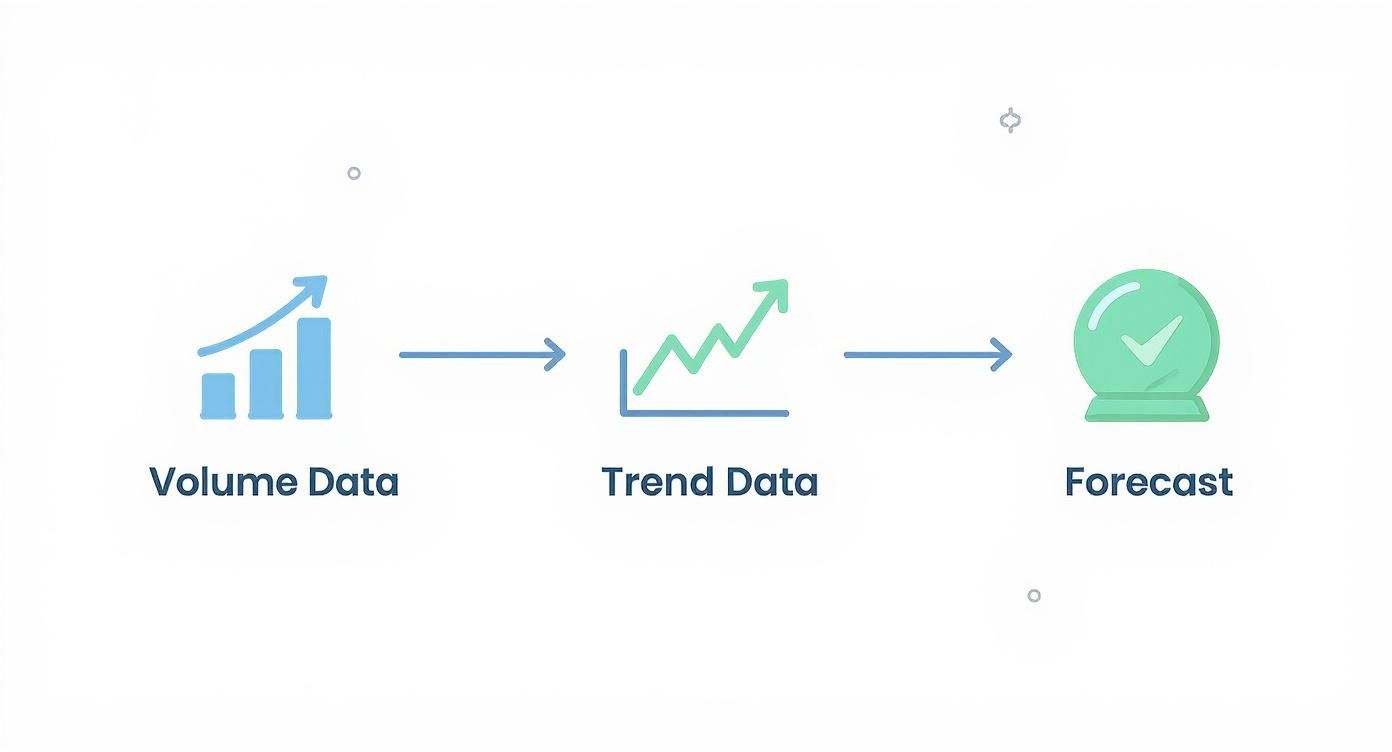
This flow from raw data to trend analysis and finally to forecasting is essential for timing your content and SEO campaigns for maximum impact.
Win in Your Local Market
For businesses like restaurant equipment suppliers, local search is a goldmine. Analyzing search volume for specific geographic areas lets you focus your efforts where they'll have the biggest payoff. Instead of just targeting a broad term like "restaurant supplies," you can zero in on "restaurant supplies in Austin" (300/mo).
Using a tool like SEMrush or Ahrefs, you can filter search volume data right down to the city or state level. This almost always reveals hyper-relevant, high-intent keywords that your local competitors are probably overlooking. A great way to get fast insights into which local terms convert best is by mastering pay per click keyword research, as the data is immediate.
From there, creating location-specific landing pages that target these terms is a powerful way to attract qualified local buyers who are ready to pick up the phone or walk in the door.
Common Questions About Keyword Search Volume
Once you start digging into keyword research, you'll find that the data brings up a lot of questions. Getting a handle on the quirks and nuances of search volume is what separates a decent SEO plan from a great one. Let's tackle some of the most common things people ask when they're figuring this stuff out.
Getting these concepts straight is the key to making decisions with confidence.
How Accurate Is Keyword Search Volume Data, Really?
This is the big one, and I get it. The short answer? It's an estimate. A very, very good estimate, but an estimate nonetheless. No tool on the planet, not even Google's own, can give you a perfect, up-to-the-second count of every search. It’s more like a poll than a census.
You'll notice that paid tools like Ahrefs or SEMrush often give you sharper numbers than the big, vague ranges you see in Google Keyword Planner (especially if you aren't running an ad campaign). That’s because they supplement Google's data with clickstream information, which analyzes the browsing behavior of millions of internet users. It's how they can turn a foggy "1k-10k" range into a much more useful number like "4,400."
My Takeaway: Don't get obsessed with the exact number. Honestly, whether a keyword gets 4,000 searches or 4,200 doesn't change a thing about your strategy. The real power is in using the data for comparison—to see that keyword A is in a totally different league of demand than keyword B.
What's Actually a "Good" Search Volume?
This is the classic "it depends" question, but I can give you some solid benchmarks to work from. What's "good" is completely tied to your industry and your goals.
For someone selling restaurant equipment, the numbers are going to look way different than they do for a national fashion brand. Here’s a framework I use:
- High Volume (10,000+ searches/month): These are your massive, super-broad terms like "commercial kitchen." The traffic potential is huge, but trying to rank for them is a brawl.
- Medium Volume (1,000-10,000 searches/month): This is the sweet spot for a lot of core content. Think major blog posts and category pages for terms like "commercial refrigerators" or "how to clean a deep fryer."
- Low Volume (100-1,000 searches/month): This is perfect territory for specific blog posts and niche product pages. A query like "Hoshizaki ice machine troubleshooting" fits right in here and pulls in people who know exactly what they need.
- Very Low Volume (0-100 searches/month): Do not sleep on these! Ultra-specific, long-tail keywords like "buy True T-49F-HC replacement parts" have incredible buyer intent. They're often easy to rank for and can be surprisingly profitable quick wins.
A smart SEO strategy doesn't just chase the big numbers; it has a healthy mix of all of these.
How Often Should I Check Search Volume?
Search volume ebbs and flows, so this is a great question. For your main, evergreen keywords—the core of your business—checking in every 3-6 months is perfectly fine. You’re just looking for major shifts in the market, not tiny monthly wiggles.
But for some keywords, you need to be a little more active:
- Seasonal Keywords: For something like "outdoor patio heaters," you should be looking at the data a couple of months before the busy season hits. This lets you get your content and promotions lined up and ready to go when demand spikes.
- Trending Keywords: If you're writing about a new piece of equipment or a trend sweeping the restaurant industry, you might want to watch that search volume weekly, or even daily. It’s all about catching the wave before it crests.
The goal is to stay on top of things without drowning in data. I usually just set a recurring calendar reminder to review my main keyword list once a quarter.
Should I Ignore a Keyword If It Shows Zero Search Volume?
Absolutely not! Seeing a "zero" in a tool doesn't mean no one on Earth has ever searched for it. It just means the volume is too low for the tool's model to pick it up reliably. These are often where you find gold.
Think about it: a phrase like "restaurant equipment financing Austin TX" might show zero volume, but the handful of people searching for that each month are exactly who you want to talk to. They're not browsing; they're ready to make a decision.
Because almost everyone else ignores these terms, ranking for them is usually a walk in the park. A single, well-targeted page can often grab 100% of that small, but incredibly valuable, search traffic. It’s a classic case of quality over quantity.
Ready to turn these insights into a powerful SEO strategy that drives real growth for your business? Restaurant Equipment SEO specializes in helping sellers in the food service industry dominate their market. We use data-driven techniques to increase organic traffic, generate qualified leads, and boost your bottom line.
Find out how we can build a winning strategy for you at https://restaurantequipmentseo.com.