
Winning Your Neighborhood A Guide To Local Business SEO
When a local chef urgently needs a new convection oven or their walk-in freezer suddenly dies, what's the first thing they do? They pull out their phone and search.
They’re not just browsing; they're looking for a solution right now. If your restaurant equipment store doesn't show up for searches like 'commercial oven repair near me' or 'restaurant supply in [Your City],' you're invisible to your most motivated customers. Local SEO is the strategy that puts your business front and center in those critical moments.
Why Local SEO Is Your Secret Weapon
Let's be blunt: if local restaurants, cafes, and commercial kitchens can't find you online, you are leaving a ton of money on the table. It’s really that simple. A solid local SEO strategy isn't just a "nice-to-have" anymore; it's the main way your best customers will discover you.
Think about the sheer panic behind a search like "commercial refrigeration services downtown." That’s not a casual query. That's a kitchen manager with a failing cooler and thousands of dollars of inventory at risk. They need a local expert, and they need one immediately. Your goal is to be the first, most credible result they see.
Tapping Into High-Intent Local Searches
The magic of local SEO is its ability to connect with buyers at the peak of their purchasing intent. These aren't broad, informational searches. Local queries are dripping with commercial intent. In fact, research shows that a staggering 78% of local mobile searches result in an offline purchase. The work you put into your online visibility directly translates to real-world sales.
When a local chef searches online, they aren't just looking for information. They are looking for a solution. Being the top result means you become the default answer to their urgent problem, positioning your business as the go-to local authority.
From Clicks to Customers
The customer journey often begins with a general search, something like "finding quality printing near me," before narrowing down to a specific need. For your business, that funnel looks something like this:
- Emergency Repairs: "24-hour commercial dishwasher repair [Your City]"
- New Equipment: "Buy True refrigerators near me"
- Specialty Supplies: "Best pizza ovens for sale in [Your County]"
Every one of these searches is a hot lead. By optimizing for these highly specific terms, you’re not just chasing web traffic; you're strategically inserting your business into the exact conversation your customers are having in their heads. This turns your website from a passive online brochure into a powerful lead-generation engine that drives phone calls, quote requests, and showroom visits that actually grow your bottom line.
Mastering Your Google Business Profile
If your website is your digital showroom, think of your Google Business Profile (GBP) as your digital storefront. For many local restaurant owners, it’s the very first—and sometimes only—interaction they'll have with your business before deciding whether to call you or stop by.
Getting this right isn't just a box to check; it’s the foundation of your entire local SEO effort.
Imagine a local chef's combi oven goes down during the dinner rush. Their first move? A frantic Google search for "commercial oven repair near me." The results they see in the Google Map Pack will determine who gets their business. Your GBP listing, packed with photos, current hours, and glowing reviews, is what makes them choose you over the competition down the street.
It's a simple journey from the customer's perspective. They search, they find, they buy.
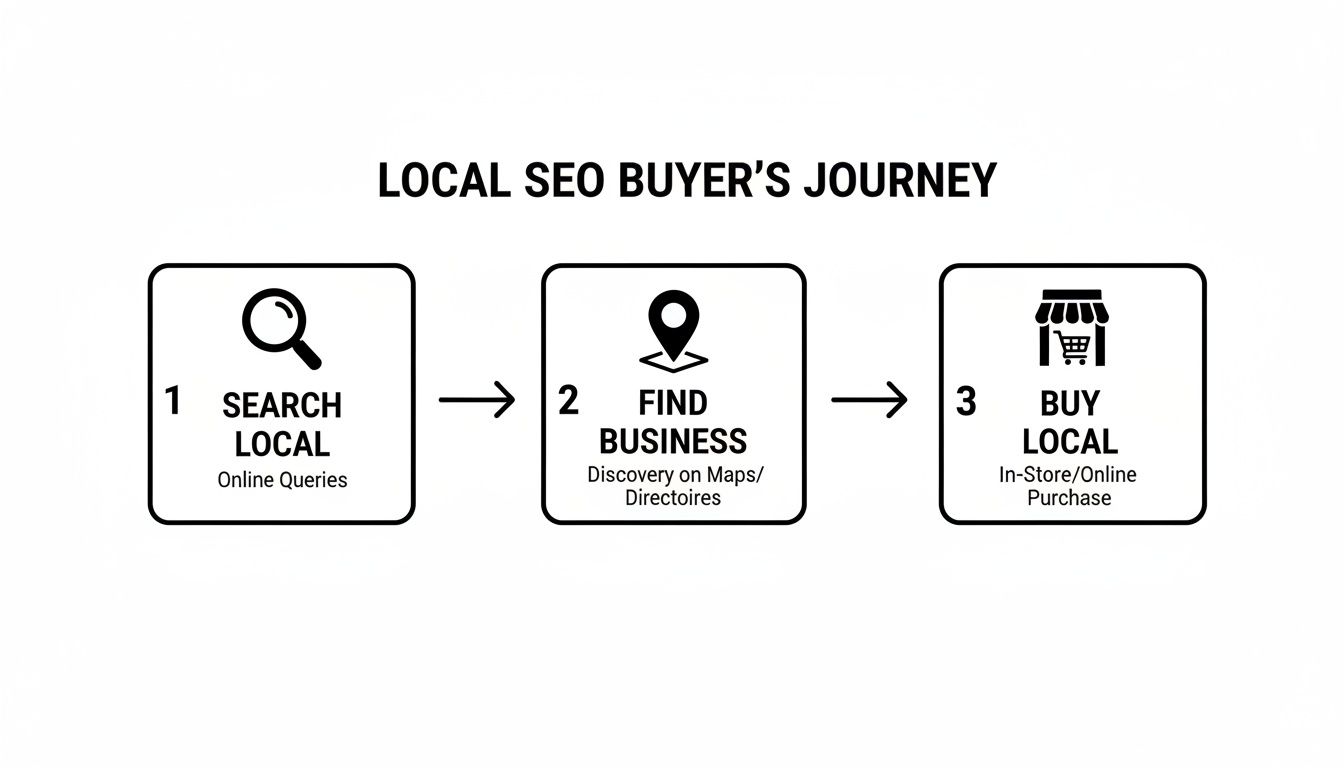
That middle step, "Find Business," is the moment of truth. An incomplete or unappealing profile can bring a potential sale to a screeching halt.
Choosing The Right Business Categories
Your primary category is the single most important field on your profile. It tells Google precisely what you are and which searches you should show up for. For nearly all restaurant equipment suppliers, this will be ‘Restaurant Supply Store.’
But don't stop there. Google lets you add secondary categories, and this is where you can really start to capture those specific, high-intent searches.
- Appliance Repair Service: An absolute must if you service the equipment you sell.
- Commercial Refrigeration Supplier: This helps you get found by someone looking specifically for a walk-in cooler or freezer.
- Used Restaurant Equipment: If you carry pre-owned inventory, this is a crucial category to add.
These extra categories broaden your reach, connecting you directly with chefs and managers searching for exactly what you offer. For a more detailed walkthrough, you can follow our guide on how to get a Google business listing.
Crafting a Compelling Business Description
You get 750 characters for your business description—make them count. This is your elevator pitch, not a place to stuff a bunch of keywords. Write it for your ideal customer, whether that's a local restaurant owner, a hotel manager, or a head chef.
Talk about what makes you different. Do you offer 24/7 emergency service? Specialize in energy-efficient kitchen designs? Are you a family-owned business that’s been part of the community for 30 years? This is where you build trust.
Pro Tip: Always end your description with a clear call to action. Something simple like, "Visit our showroom on Main Street to see our full inventory," or "Call our kitchen design experts today for a free consultation."
The data doesn't lie. A staggering 46% of all Google searches have local intent. With billions of searches happening every day, that's a massive audience looking for businesses nearby. On top of that, businesses with complete profiles are viewed as 2.7 times more trustworthy, which translates directly into more calls, more visits, and more sales.
Showcasing Your Inventory With Products and Photos
The "Products" feature in GBP is a goldmine for equipment suppliers, yet so many neglect it. It lets you build a virtual catalog right there in your search listing.
Don’t just create a generic entry for "Refrigerators." Get specific. Add an entry for the "True T-49 Two-Door Reach-In Refrigerator," complete with a high-quality photo, a price range, and a direct link to that product's page on your website. This gives a motivated buyer a straight line to making a purchase.
Photos are just as critical. You need to go way beyond a simple picture of your storefront.
- Showroom Photos: Give people a feel for your space with wide shots showing off your inventory.
- Product-in-Action Shots: Post images of equipment you've installed in a local client's kitchen (get their permission first!).
- Team Photos: Feature your sales and service staff. It humanizes your brand and shows off the experts behind the business.
Great visuals prove your credibility and give potential customers a reason to trust you before they even walk through the door. A well-managed GBP isn't just a listing; it’s a powerful sales machine working for you around the clock.
Finding The Keywords Local Chefs Actually Use
Solid local SEO starts with speaking your customer’s language. You need to get inside the head of a busy restaurant owner or chef who just had a critical piece of equipment go down. They aren't just browsing; they're in problem-solving mode.
They aren't typing "commercial oven" into Google. They're frantically searching for a "Blodgett convection oven repair in Brooklyn" or "used Hobart mixers for sale near me." The more specific their search, the more desperate they are for a solution—and the more likely they are to buy right now. Understanding that urgency is your secret weapon.
Uncovering High-Intent Local Keywords
The first move is to put yourself in your customers' shoes. What are the core services and products they absolutely cannot function without? Brainstorm a list, then start combining those with your location.
A simple formula is all you need to get started:
[Service/Product] + [Location]
From this basic structure, you can build out a powerful list of keywords that pull in real, local customers.
- Service-based keywords: These are your emergency, high-priority searches. Think "commercial refrigeration service Austin" or "24-hour kitchen equipment repair Dallas." People searching for these need you yesterday.
- Product-based keywords: This is for customers actively looking to buy. Keywords like "Hoshizaki ice machines for sale Miami" or "restaurant supply store Queens" capture people with a budget ready to spend.
- Qualifier-based keywords: Don't forget the little words that signal exactly what a customer wants. Adding terms like "used," "new," "for sale," or "rental" helps you find highly qualified buyers. A search for "used commercial deep fryer Chicago" is about as direct as it gets.
Some of your best keyword ideas will come straight from your customers. Listen to how they talk on the phone or what they type in emails. If three different chefs ask about "walk-in cooler gaskets" this week, that's a huge clue that you need a page optimized for that exact phrase.
Think Hyper-Local for Maximum Impact
In a sprawling metro area, simply targeting the main city isn't enough. A restaurant owner in the East Village isn't going to drive to Staten Island for a part if they can help it. Getting hyper-local gives you a massive advantage over competitors with a broader, less focused strategy.
Drill down by adding local modifiers like:
- Neighborhoods: "East Village restaurant equipment"
- Boroughs: "Commercial ovens Brooklyn"
- Counties: "Maricopa County food service supplies"
- "Near Me" Searches: You don't target "near me" directly in your content. Instead, you optimize your Google Business Profile and location pages so Google knows you are the most relevant result for these crucial, on-the-go searches.
This is how you connect with prospects who are not just ready to buy but are also right around the corner. We dive much deeper into this process in our comprehensive guide to local keyword research for equipment suppliers.
This table breaks down how different keyword types match up with what a customer is actually trying to do.
Local Keyword Intent Matrix For Equipment Suppliers
| Keyword Intent | Example Keyword | Target Customer | Best Content Type |
|---|---|---|---|
| Informational | "how to clean commercial grease trap" | Restaurant owner looking for DIY tips | Blog post, how-to video |
| Commercial | "best commercial ice machine brands" | Manager researching a future purchase | Product comparison guide, brand review |
| Transactional | "buy True T-49 refrigerator Atlanta" | Chef or owner ready to purchase now | Optimized product page, category page |
| Navigational | "[Your Company Name] hours" | Existing customer trying to find you | Google Business Profile, Contact page |
Once you have this list of keywords, the final piece of the puzzle is mapping them to the right pages on your site. Broader terms like "restaurant equipment [City]" are perfect for your homepage. Hyper-specific phrases like "True T-49 Refrigerator repair [City]" belong on a dedicated service page.
This methodical approach ensures every page is a magnet for qualified, local traffic.
Making Your Website a Local Magnet
Alright, you've got your list of local keywords. Now it's time to put them to work by weaving them directly into the DNA of your website. This is what we call on-page SEO, and it’s how you tell Google exactly who you are, where you’re located, and what problems you solve for local restaurants.
Think of it as making your website the most obvious, helpful answer for a chef in your city searching for a new walk-in cooler or emergency repairs. When you get this right, every part of your site works together to scream "local expert."
Weaving Keywords Into Your Core Pages
Let's start with the basics—the foundational elements on your most important pages. Google’s bots look at these first to get a quick snapshot of what your content is about.
- Title Tags: This is the big blue link people see in the search results. It needs to be punchy and lead with your main keyword. A homepage title might be Restaurant Equipment Supply in Chicago | Your Brand Name. A page for a specific service could be Commercial Refrigeration Repair in Austin | 24/7 Service.
- Meta Descriptions: This isn't a direct ranking factor, but it's your 155-character sales pitch in the search results. A great one earns the click. Mention your core service, your city, and something that makes you stand out, like "Free local delivery" or "Expert kitchen design consultations."
- H1 Tags (Page Headlines): Every page needs one (and only one) H1 tag. It should clearly state the page's purpose and feature the page's primary keyword. For instance, a page dedicated to ovens needs an H1 like: New & Used Commercial Ovens For Sale in Miami.
These three elements are a powerful trio. They create a clear, consistent message for search engines, establishing your relevance for those critical local searches.
Building Powerful, Location-Specific Pages
If you have showrooms in multiple cities or serve distinct neighborhoods, creating dedicated pages for each area is an absolute game-changer for your local business seo. And I don't mean just copying your homepage and swapping out the city name. That's a huge mistake.
These need to be unique, valuable pages designed to be the ultimate resource for a customer in that specific area. A chef in Brooklyn has different delivery logistics and local codes to worry about than one in Queens. Your Brooklyn location page should speak directly to that.
A truly effective location page feels personal and genuinely helpful. It must include the local address, a dedicated phone number, and an embedded Google Map. But go deeper. Mention specific delivery zones, showcase projects you’ve completed in that neighborhood, or feature testimonials from local restaurant clients.
These details prove to both users and Google that you aren’t just targeting an area—you’re a part of that community. It builds trust and makes you a far more relevant result.
Optimizing Product Pages For Local Buyers
Your product pages shouldn't read like a generic, nationwide catalog. You have to infuse them with local details that answer the immediate questions of a buyer right down the street. It’s a small tweak that can have a massive impact on conversions.
Take a product page for a "Blodgett ZEPH-100-E Convection Oven." A national site just lists specs. You can do better by adding a localized content block right on the page.
Example Localized Product Block:
- Availability: In-stock at our San Diego showroom.
- Delivery: Same-day local delivery available for orders placed before 2 PM.
- Service: Our certified technicians in San Diego County can handle installation and ongoing maintenance.
That information is pure gold for a local buyer. It instantly tells them you can solve their problem today, removing all the uncertainty of ordering from some faceless online retailer.
The Secret Weapon: LocalBusiness Schema
Finally, let's talk about a powerful piece of code that works behind the scenes: LocalBusiness schema markup. Think of this as a direct cheat sheet you hand to Google, spelling out your business details in a perfectly structured format that search engines love.
This structured data explicitly tells Google your:
- Business Name
- Address
- Phone Number
- Opening Hours
- Business Type (e.g., 'RestaurantSupplyStore')
While customers don't see this code on the page, implementing it helps Google show rich information—like your hours or review rating—right in the search results. This makes your listing stand out, improves click-through rates, and is a non-negotiable step for proving your local legitimacy.
Building Trust With Citations And Reviews
Once your website is in good shape, it's time to work on how your business shows up across the rest of the web. Think of local SEO as being built on a foundation of trust and consistency. To really prove your legitimacy to Google, you need to focus on two incredibly powerful signals: business citations and customer reviews.
Here's a simple way to look at it: every time another reputable website mentions your business, it’s like a vote of confidence. When those mentions are all consistent, Google starts to see you as a credible, established local player.
The Power Of Consistent Citations
A citation is just any online mention of your business's Name, Address, and Phone number—what we in the industry call NAP. You'll find them on industry directories, local business bureaus, data aggregators, and social media profiles.
Consistency is everything here. If your address is listed as "123 Main St." on one site and "123 Main Street" on another, that tiny difference can create confusion for search engines. These inconsistencies slowly chip away at the trust Google has in your business information, which can absolutely hurt your local rankings.
Your first job is to do a citation audit. You need to hunt down all the existing mentions of your business online and make sure the NAP is 100% identical to what you have on your Google Business Profile.
Key Takeaway: Think of your NAP as your business's digital fingerprint. It has to be perfectly consistent everywhere. Even tiny variations like "St." vs. "Street" or "Suite" vs. "#" can dilute your local authority.
After you've cleaned up your existing listings, you can start building new ones. The key is to focus on high-quality, relevant directories for the food service industry.
- Industry-Specific Sites: Get listed on equipment manufacturer directories or in food service association member lists.
- Hyper-Local Directories: Your local Chamber of Commerce or a neighborhood business association are goldmines for building local authority.
- Major Data Aggregators: These services feed your business data to hundreds of other sites, amplifying your efforts fast.
Getting this right is a meticulous process. To help you nail it, we’ve put together a complete guide to master local citation building here: https://restaurantequipmentseo.com/blogs/restaurant-equipment-seo-blog/build-local-citations
Driving Sales With Customer Reviews
Reviews are the other side of the trust coin. They’re the social proof that convinces a potential customer to call you instead of your competitor down the street. In fact, a steady stream of positive reviews on your Google Business Profile is one of the most powerful local ranking factors there is.
But let's be honest, getting reviews can be a pain. You can't just sit back and hope customers will leave them. You need a simple, proactive system to encourage that feedback.
The absolute best time to ask is right after a positive interaction—a successful equipment installation, a quick repair service call, or when a customer thanks you for your help in the showroom. That's the moment they're happiest and most willing to share their experience.
The data backs this up, too. Local searches are known to convert at rates 300% higher than social media because they catch high-intent users who are ready to buy. For the food service industry, where 80% of local searches result in conversions, this is a massive opportunity. What's more, 76% of people who search for something local on their smartphone visit a store within a day, showing just how immediate the impact of a strong local presence can be.
Managing Your Online Reputation
Actively managing your reviews means more than just collecting them. You have to respond to every single review, both the good and the bad. A thoughtful response to a negative review can often win over more future customers than a dozen five-star ratings.
Here's a simple framework I use for responding:
- Thank the reviewer: Always start by acknowledging their time and feedback.
- Reinforce the positive: If it's a good review, echo a specific point they enjoyed.
- Address the negative: For a bad review, apologize for their experience and offer to take the conversation offline to resolve it. Never get defensive.
- Invite them back: End on a positive note, encouraging them to give you another try.
To make this process easier, you might want to look into the best reputation management software. These tools can help you track mentions and manage reviews all in one place, ensuring your online reputation stays stellar.
Taking It to the Next Level with Local Links and Content
Once your on-page SEO and business listings are dialed in, you've already pulled ahead of most of the competition. But if you want to truly own your local market, it's time to build real authority. This is where a smart local link and content strategy separates the amateurs from the pros, shifting from simple optimization to genuine community involvement.
Think of local links as digital handshakes. When another well-regarded local business, a culinary school, or a popular food blogger links to your website, they're giving you a vote of confidence. These endorsements are incredibly powerful signals to Google.
Earning High-Impact Local Links
Forget about chasing hundreds of links from spammy, irrelevant websites. That's a waste of time. For a restaurant equipment supplier, just a few high-quality, locally relevant links are worth their weight in gold. The real goal is to get your business mentioned in the digital spaces where your customers are already hanging out.
Here are a few practical, high-impact ideas you can actually use:
- Sponsor a Culinary School Event: Does the local community college have a culinary program? Offer to sponsor their annual student cook-off or provide a new mixer for their training kitchen. This often gets you a powerful link from an .edu domain, which Google loves.
- Team Up with Local Food Bloggers: Find the top food bloggers in your city. Don't just email them a press release; invite them for a behind-the-scenes tour of your showroom. Let them test-drive a new pizza oven. Their write-up and link can send a flood of interested local buyers your way.
- Join the Chamber of Commerce: This is one of the easiest and most authoritative local links you can secure. Your membership almost always comes with a spot in their online business directory—an immediate signal to Google that you're a legitimate, trusted local player.
Local link building is really just relationship building. It's not some technical hack. It’s about weaving your business into the fabric of your local food scene. One great link from a well-known local institution is more valuable than a hundred generic directory listings.
Creating Content That Solves Local Problems
Your content needs to go beyond generic blog posts. An article titled "How to Choose a Commercial Oven" is okay, but it doesn't do anything to establish you as a local expert. You need to create resources that speak directly to the unique challenges restaurant owners face right here in your city.
This hyper-local approach positions you as the go-to resource, not just another supplier on the internet. It builds trust and naturally earns links from other local businesses who find your content genuinely helpful.
Think about creating content like this:
- "A Guide to Passing [Your State]'s Health Inspection for Commercial Dishwashers": This is an incredibly valuable resource. It solves a specific, high-stakes problem that keeps your local customers up at night.
- "Case Study: How We Upgraded the Kitchen at [Popular Local Restaurant]": Showcase a recent project. Walk through the challenges, the specific equipment you installed, and the fantastic results. Don't forget to include a glowing quote from the happy client.
- "Comparing Water Filtration Systems for [Your City]'s Hard Water": Does your city have notoriously hard water? Write a guide on how it affects ice machines and dishwashers and which systems hold up best. This shows you get it.
This isn't just content for the sake of SEO. It's a powerful sales tool that proves your expertise and shows you have a deep understanding of what it takes to succeed in your local market.
Your Local SEO Questions Answered
Even with a solid game plan, you're bound to run into questions once you start digging into local SEO. Let's tackle some of the most common ones I hear from clients so you can keep making progress without getting stuck. These aren't just textbook answers; they come from years of working in the trenches.
One of the first things everyone wants to know is, "How long until I see results?" Local SEO isn't like flipping a switch on a paid ad campaign. It's a long game. You might see a little bump in traffic from fine-tuning your Google Business Profile within a few weeks, but ranking for the really competitive stuff? That usually takes three to six months of consistent work.
Think of it like building your reputation in a new town. It takes time. All the little things—cleaning up your business listings, getting new reviews, and publishing helpful local content—add up and start to build real momentum.
Does My Website Design Affect Local SEO?
You bet it does. While the technical backend stuff like schema markup is important, don't ever underestimate the power of a good user experience. When a potential customer clicks over from a local search, they need to find what they're looking for, and they need to find it now. If your site is sluggish, a nightmare to use on a phone, or buries your contact info, they're gone.
That quick exit, what we call a "bounce," tells Google your page wasn't a very good answer for their search. Too many of those, and your rankings can start to slip.
A mobile-friendly website is no longer optional. About 60% of Google searches happen on mobile, and for urgent, local queries like "emergency kitchen repair near me," that figure is even higher. If a frantic restaurant manager can't easily tap your phone number on their screen, you've just lost a customer.
Can I Rank In A City Where I Don't Have A Physical Address?
This is a tough one, especially for suppliers who cover a wide service area. Ranking in the Google Map Pack for a city where you don't have a physical storefront is incredibly difficult, bordering on impossible. But that doesn't mean you can't rank in the standard organic search results below the map.
This is exactly where dedicated location pages come into play. A well-built page targeting a neighboring city you service can be a goldmine. Load it up with testimonials from customers in that area, mention specific projects you've done there, and detail your delivery routes. It’s all about proving your relevance to Google, even without a physical address.
Ready to stop guessing and start dominating your local market? The experts at Restaurant Equipment SEO build strategies that turn local searches into paying customers. Visit us at https://restaurantequipmentseo.com to see how we can help.