
A Guide to Local Listing Management for Equipment Suppliers
Local listing management isn't just about keeping your digital house in order. It’s the continuous work of making sure your business details—name, address, phone number—are correct and consistent everywhere they show up online. For a restaurant equipment supplier, this is the make-or-break difference between a local chef finding your showroom or your competitor's when their commercial mixer suddenly dies.
It’s all about ensuring accuracy and consistency, so when someone needs you, they can find you. No questions asked.
Why Local Visibility Is Everything for Equipment Suppliers
Picture this: a new restaurant is just days from its grand opening, but their walk-in freezer fails the final health inspection. The frantic owner grabs their phone and searches for "commercial refrigeration supplier near me." In that exact moment, being visible is everything.
If your online business information is wrong, outdated, or all over the place, you don't just lose a sale. You lose a high-value customer for life. This isn't just a story; it's a daily reality in our industry. For equipment suppliers, managing your local listings isn't some passive marketing task—it's a core business function that drives revenue. Your customers run on tight deadlines where a broken piece of equipment can shut down their entire operation. They simply don’t have time to figure out which of the three phone numbers listed for your store is the right one.
The Real Cost of Bad Information
Inconsistency breeds doubt. When a potential buyer sees conflicting details about your business across different websites, it immediately kills their trust. And it's not just customers who notice.
Search engines like Google see this confusion, too. An inconsistent Name, Address, and Phone number (NAP) profile sends red flags, tanking your ability to show up in local search results and that all-important Google Maps pack. This digital mess has serious consequences.
In fact, the stakes are incredibly high. A staggering 40% of customers say they would give up on finding a local business if they couldn't find its location online. In an industry where one sale can be worth thousands, losing nearly half of your potential foot traffic is a financial disaster.
Building Trust, One Listing at a Time
Getting your local listings right does more than just help customers find your showroom. It builds a solid foundation of trust with search engines. Every single time Google's bots find your correct NAP data on a reputable directory, it's like a vote of confidence. It verifies that your business is real, open, and located exactly where you say it is.
Think of each accurate listing as a digital breadcrumb leading straight to your front door. The more consistent crumbs you leave across the web, the clearer the path becomes for both customers and search algorithms, cementing your reputation as the go-to local expert.
This digital trust translates directly into better rankings, more visibility, and most importantly, more chefs and restaurateurs walking through your doors. The benefits of local SEO are massive and they build on each other over time, making it one of the smartest investments you can make. To take your local presence even further, you can pair it with other powerful strategies, like Social Media Marketing for Local Business, to connect with your community on multiple fronts.
When you manage your online presence effectively, you ensure that when a local food professional has an urgent problem, your business is the first—and most trusted—solution they find.
To wrap your head around the key moving parts, it helps to break down the strategy into its core components. Each piece plays a distinct role in making sure you get found by the right people at the right time.
The Core Components of a Winning Local Listing Strategy
| Component | What It Is | Why It Matters for Your Store |
|---|---|---|
| GBP Optimization | Fully completing and actively managing your Google Business Profile with posts, photos, and Q&As. | This is your digital storefront. It's often the first interaction a local chef has with your brand. |
| Citation Building | Creating consistent listings for your business on relevant online directories and industry-specific sites. | Each consistent citation is a vote of confidence for search engines, boosting your local authority. |
| Review Management | Actively monitoring, responding to, and encouraging customer reviews on platforms like Google and Yelp. | Positive reviews build social proof and directly influence a potential customer's decision to visit. |
| Duplicate Suppression | Finding and removing incorrect or duplicate business listings that confuse search engines and customers. | Inaccurate listings dilute your authority and can send potential buyers to the wrong address or phone number. |
| Performance Tracking | Monitoring key metrics like website clicks, calls, and direction requests from your listings. | This shows you what's working, so you can double down on the strategies that actually drive sales. |
Mastering these five areas is the foundation for dominating your local market. It ensures that every time a restaurant owner needs equipment, your store is the obvious choice.
Conducting Your Initial Local Listing Audit
Before you can start fixing your online presence, you need a crystal-clear picture of where your restaurant equipment store stands right now. I’ve seen countless business owners get blindsided when they discover dozens of listings they never even created, many riddled with outdated or flat-out wrong information. This initial audit is your first real step toward taking back control. It sets the baseline for everything that comes next.
Think of it like taking inventory in your warehouse. You wouldn't order new slicers and ovens without knowing what you already have on the shelves, right? The same logic applies here. You can't just start building new online listings without first understanding your existing digital footprint—the good, the bad, and the ugly.
The whole point of this audit is to systematically hunt down every single mention of your business online and pinpoint the inconsistencies. These errors, no matter how small they seem, confuse both potential customers and search engines, which can directly tank your local search rankings.
It's a surprisingly common problem. A potential customer searches for you, finds the wrong address, and you lose their business forever.
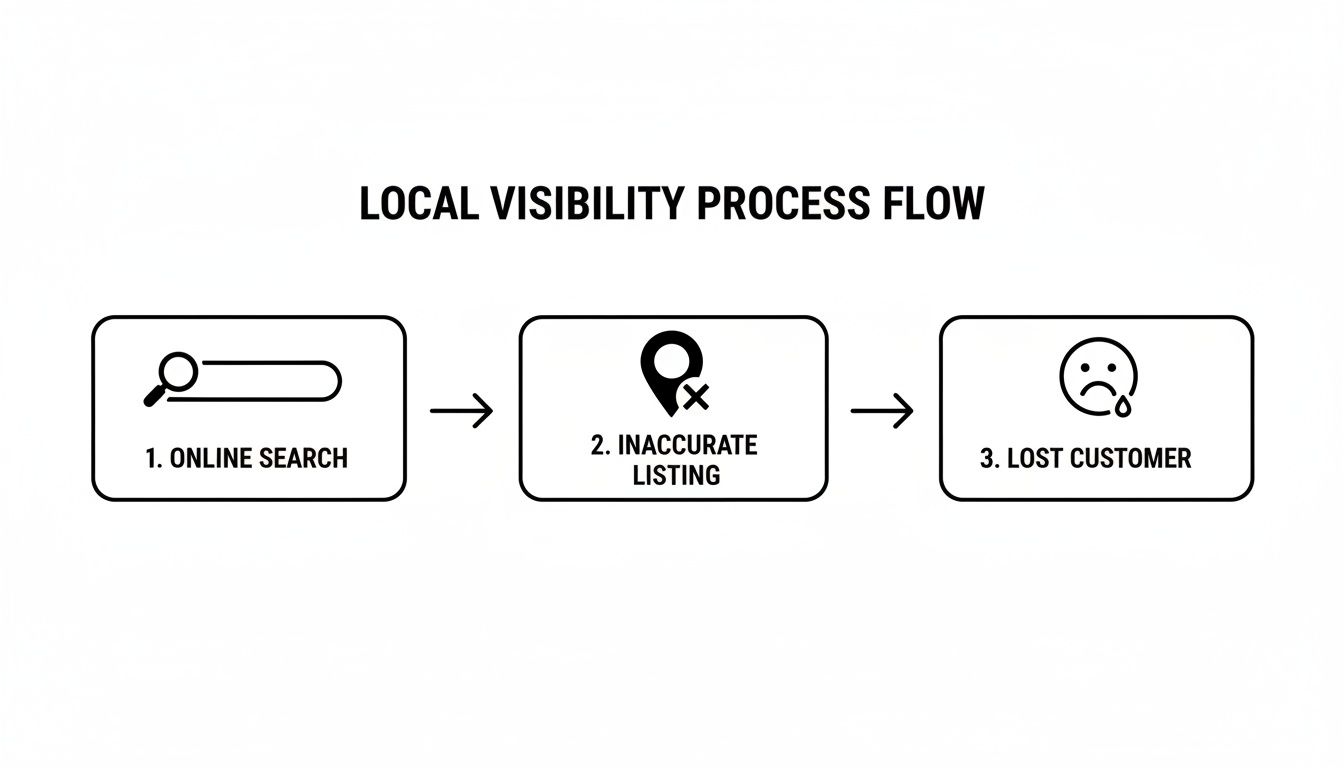
This flowchart really drives the point home. It shows that critical break in the customer's journey where bad data stops a sale before it can even happen.
Uncovering Your Digital Footprint
So, where do you begin? The first job is simply to find all your existing listings. You could start by manually searching your business name on the big players like Google, Yelp, and Apple Maps, but that's just scratching the surface. This approach will almost certainly miss the dozens of smaller, niche directories where your data might be lurking and causing problems.
A much more efficient way to tackle this is with a dedicated tool. Many local SEO software platforms offer free or low-cost audit scanners that crawl the web for your business info. These tools are built to quickly find where you’re listed and immediately flag inconsistencies in your Name, Address, and Phone number (NAP).
For instance, a tool like BrightLocal can spit out a comprehensive report in minutes. It’ll show your listings across major directories and data aggregators, pinpointing critical errors such as:
- NAP Inconsistencies: An old address from a previous location, a disconnected phone number, or even slight variations in your business name (e.g., "Main St Restaurant Supply" vs. "Main Street Restaurant Supply Inc.").
- Duplicate Listings: This is a big one. Finding multiple profiles for the same store on a single platform splits your SEO value and just confuses everyone.
- Missing Information: Incomplete profiles are a red flag. They might be missing crucial details like your hours, website URL, or service categories.
- Incorrect Categories: I’ve seen commercial kitchen suppliers listed under "Home Goods Store." This kind of misclassification makes you invisible to your actual customers.
An audit isn't just about finding typos; it's about reclaiming your business's identity online. Every incorrect listing is a potential lost sale and a signal to Google that your business information isn't trustworthy.
Systematically Tracking and Prioritizing Issues
Once you have a full list of your online citations and all their errors, don't get overwhelmed. The next step is to get organized. The key is not to try fixing everything at once. Instead, create a simple spreadsheet or use a checklist to document each issue and prioritize what to tackle first.
Your audit spreadsheet should track a few key details for every single listing you find:
- Directory Name: The website where the listing was found (e.g., Yelp, Yellow Pages).
- Listing URL: A direct link to your business profile page.
- NAP Accuracy: A simple "Correct" or "Incorrect" for your Name, Address, and Phone.
- Ownership Status: Is the listing claimed by you, or is it unclaimed?
- Notes on Errors: Get specific. Jot down things like "wrong hours listed" or "old address from 2018."
- Priority Level: Assign a high, medium, or low priority to each one.
Start with the fires. An incorrect address on your Google Business Profile is a high-priority emergency that needs to be fixed yesterday. On the other hand, a missing business description on a tiny, obscure directory is a low-priority task you can get to later. For a more structured approach, our comprehensive site audit checklist can give you a solid framework for organizing all your findings.
This methodical audit turns a chaotic mess of bad data into a clear, actionable roadmap. It’s the foundation for all your local listing management work, ensuring you're building your online presence on solid, accurate ground.
Optimizing Your Foundational Business Listings
Once you've mapped out your digital footprint, it's time to get to work building powerful, optimized profiles on the platforms that really matter. These aren't just digital placeholders; they are your most important storefronts. Creating bulletproof "source of truth" profiles on foundational sites like Google, Yelp, and Apple Maps is the key to anchoring your brand's consistency across the entire web.
Think of these main listings as the concrete slab for your digital house. If that foundation is cracked—with the wrong hours, a fuzzy logo, or a bland description—everything you build on top of it will be wobbly. Getting these core profiles right isn't just a good idea; it's non-negotiable.
Mastering Your Google Business Profile
For any local business, but especially for a high-value supplier, your Google Business Profile (GBP) is the undisputed king. It’s often the very first impression a potential customer gets, showing up front and center in Google Search and Maps. A weak GBP is like having a poorly lit, messy showroom; it just turns people away before they even think about stepping inside.
A top-tier profile for an equipment supplier needs to go way beyond just a name and address. It demands a detailed, strategic approach.
- Choose Hyper-Specific Categories: Don't just list "Store." Get granular. Your primary category should be something like "Commercial Kitchen Supplier" or "Restaurant Supply Store." Then, layer in secondary categories like "Refrigeration Equipment Supplier" or "Bakery Equipment" to show up for those more specific, high-intent searches.
- Upload High-Quality Photos and Videos: Show off what you sell. Post clear, well-lit photos of your most popular items—think walk-in freezers, convection ovens, and commercial mixers. A short video tour of your showroom can work wonders.
- Use Google Posts Actively: This is your free ad space! Announce the arrival of a popular blender brand, share a limited-time promo on ice machines, or highlight a quick case study from a recent kitchen installation. Posting consistently keeps your profile looking fresh and active.

From your dashboard, you can jump in and respond to reviews, update your hours, or add new photos. It's the command center for your most important local listing.
Expanding to Yelp and Apple Maps
While Google is the giant in the room, other platforms carry serious weight, each with its own audience and quirks. Ignoring them is like leaving money on the table. Both Yelp and Apple Maps are critical touchpoints in a customer's journey to find you.
Yelp, for instance, is heavily driven by reviews. I've seen countless restaurant owners comb through Yelp not just for customer feedback on a supplier, but for detailed business info. A fully fleshed-out Yelp profile with professional photos and quick responses to reviews screams trustworthiness.
Then you have Apple Maps, the default navigation app for millions of iPhone users. An incorrect pin or an old phone number here can literally send a customer driving in circles. Making sure your information is perfect on Apple Business Connect is essential for grabbing that mobile-first crowd.
The goal here is simple: create a seamless and identical experience no matter where a customer finds you. The hours on your GBP should perfectly match the hours on Yelp, which should perfectly match the hours on Apple Maps. This consistency is the absolute bedrock of local SEO.
The payoff for this effort is huge. Data shows that 56% of actions on Google Business Profile listings lead directly to website visits, and we know that review signals heavily influence who shows up in Maps rankings. For suppliers, this means a well-managed profile doesn't just look good—it actively drives real, measurable business.
Key Optimization Checklist for Foundational Listings
As you start refining your core profiles, keep these action items front and center. This isn't a one-and-done setup; it's an ongoing process.
- Complete Every Single Field: Seriously. Don't skip the "from the business" description or attributes like "wheelchair accessible." A 100% complete profile just performs better.
- Use High-Resolution Imagery: Your logo, cover photo, and gallery images need to be crisp and professional. Pixelated, blurry photos suggest a low-quality operation.
- Enable Messaging Features: Platforms like Google and Yelp let customers message you directly. Turn this feature on and be ready to respond quickly—it opens up a fantastic channel for hot sales leads.
- Build Out Your Q&A Section: Get ahead of the curve by adding common questions and your own answers. Things like, "Do you offer financing?" or "Do you deliver?" are perfect starting points.
By meticulously optimizing these foundational listings, you're sending a powerful, consistent signal to both customers and search engines that you are a legitimate, trustworthy, and authoritative local supplier. To get a handle on the initial setup, check out our guide on how to get a Google Business listing for a step-by-step walkthrough.
Finding High-Value Industry and Niche Citations
Alright, you've got your core listings like Google and Yelp dialed in. That’s the foundation. Now, it's time to build the rest of the house and really establish your authority.
Think about it: where are your actual customers—the chefs, restaurant owners, and GMs—spending their time online when they're looking for suppliers? They’re not just scrolling through generic local directories. You need to show up where they are, and that means hunting down high-value, industry-specific listings.
These niche citations are gold. Getting listed on a respected food service portal, a B2B supplier directory, or even a local hospitality association's website sends a powerful message. It tells search engines you're not just another local business; you're a specialist, a real player in the restaurant equipment space.
It's All About Quality, Not Quantity
There was a time in local SEO when the goal was to get your business name plastered on as many websites as humanly possible. That game is long over.
Today, the relevance of the listing is what matters. One solid citation from a well-respected food service industry blog is worth more than a dozen random listings on ghost-town websites. This is a huge part of a modern local listing management strategy. Your goal is to build a profile that screams expertise. Anyone can get into the Yellow Pages, but only a legitimate commercial kitchen supplier gets featured on a site for professional chefs.
How to Uncover Niche Listing Opportunities
So, where are these hidden gems? You'll have to put on your detective hat, and the best place to start is by looking at what your competitors are doing. They’ve probably already done some of the heavy lifting for you.
A simple but incredibly effective trick is to use a few advanced search queries to see where they're listed. By searching for a competitor's exact name and phone number, you can uncover a treasure trove of directories they're on.
Pop these into Google, but use your competitor's info:
"Competitor Business Name" + "Competitor Phone Number""Competitor Business Name" + "Competitor Address"-
"Competitor Business Name" -inurl:competitorwebsite.com(This one is great for finding mentions of them on sites that aren't their own.)
This will give you a raw list of potential directories. Sift through it and prioritize the sites that are clearly focused on the food service, hospitality, or B2B supply industries.
Don't just copy your competitors; use their footprint as a map to find relevant industry hubs. Your objective isn't to mirror their strategy but to discover the authoritative platforms within your niche and then build an even stronger presence there.
High-Impact Citation Categories for Equipment Suppliers
As you build out your target list, it helps to organize your opportunities. This keeps your efforts focused on the platforms that are most likely to bring in qualified leads and boost your authority.
I usually group them like this:
- B2B Supplier Directories: Think websites like Thomasnet or Global Sources that are built for business-to-business searches.
- Food Service Industry Portals: These are online communities, blogs, and news sites where restaurant pros hang out. A listing here puts you right in front of your ideal customer.
- Local and Regional Hospitality Associations: Your city’s restaurant association or state hospitality group? Get in their member directory. It's an incredibly powerful local signal.
- Trade Show and Event Websites: If you’ve ever had a booth at a restaurant or food service trade show, make sure you're still listed on the event’s exhibitor directory. Those listings often stay live for years.
Getting your name on these niche platforms does more than just help your SEO. It strategically places your brand in the digital spaces where serious buyers are doing their research and making decisions. This targeted approach is what separates a business with a basic online presence from one that truly dominates the competitive restaurant equipment market.
Managing Your Reputation and Cleaning Up Listings
Think of your online presence as something that's never really "done." It’s constantly evolving. Once you've got your main listings built out and optimized, the real, ongoing work begins. This next phase is all about managing your reputation and keeping your data clean. It’s where you actively engage with customers and sweep away the digital junk that can seriously hurt your search rankings.
Dealing with reviews and hunting down duplicate listings aren't just one-off tasks. They're active strategies that safeguard your credibility and make sure you have one clear, official identity online. If you let this slide, you'll end up with a confusing and untrustworthy digital footprint that pushes customers away.

Turning Customer Feedback Into a Marketing Asset
Every single review—good or bad—is an opportunity. In the restaurant equipment business, a single sale can be a huge investment for a client. You can bet potential buyers are watching to see how you handle feedback from your current customers. A quick, thoughtful response can turn a happy customer into a vocal advocate or a frustrated one into a loyal client who feels heard.
When you get a positive review, a simple "thank you" is fine, but getting specific is much better. Acknowledge what they mentioned. For example, if a chef praises your knowledgeable staff for helping them pick the perfect convection oven, your reply should highlight that expertise.
For negative feedback, the game plan is to respond fast, stay professional in your public reply, and then immediately move the conversation offline. Don't get defensive. Ever. Acknowledge their frustration, apologize for their experience, and give them a direct contact to make things right. This shows everyone else looking that you take issues seriously and won't leave a customer hanging.
The Technical Challenge of Duplicate Listings
Duplicate listings are a silent killer for local SEO. They pop up for all sorts of reasons—you moved locations, a past marketing agency made a new profile without checking, or data aggregators just got their wires crossed. The result is a mess that confuses both search engines and your potential customers.
When Google finds multiple profiles for your store with the same address or phone number, it has no idea which one is the "real" you. This splits your SEO authority, waters down the impact of your reviews, and can actually cause your legitimate profile to rank lower.
Finding and eliminating these digital ghosts is non-negotiable. Each duplicate is a rogue signpost pointing customers in the wrong direction, eroding the trust and authority you've worked so hard to build.
A huge part of this is just keeping your information accurate over time. It's really about maintaining lead data freshness, because outdated or wrong details can undo all your hard work.
A Clear Process for Listing Cleanup
You can't just start deleting profiles randomly. You need a methodical approach to consolidate your online presence without accidentally trashing valuable assets like good reviews.
Here’s a structured way to handle it:
- Find All the Clones: Use your audit spreadsheet or a tool like BrightLocal to hunt down every single duplicate listing on platforms like Google, Yelp, and industry-specific directories.
- Pick Your "Primary" Profile: Look at the duplicates on one platform at a time. The one you want to keep is usually the oldest, the one with the most reviews, or the one you already control. This becomes your single source of truth.
- Move Over Good Stuff: Before you ask for a removal, manually save any unique, high-quality photos or important Q&A info from the duplicate and add it to your primary profile. Don't lose that content.
- Request a Merge or Removal: Each platform has its own process. On Google Business Profile, you can report the duplicate and request that it be merged with your primary one. Other sites will have a "report a duplicate" or "suggest an edit" feature.
Following this cleanup process ensures you have one strong, authoritative profile everywhere that matters. It’s a critical step that solidifies your online identity and gives search engines the clear signals they need to trust you and rank you higher.
Answering Your Top Questions About Local Listings
If you're trying to get a handle on your online listings and citations, you've probably got questions. It's easy for any business owner, especially in a busy industry like restaurant equipment, to get tangled up in the details. Let's clear up some of the most common questions we hear so you can build a strategy that actually works.
How Long Does This Stuff Actually Take to Work?
This is the big one, and the answer isn't a simple number. If you fix a critical error—like an old address on your Google Business Profile—you’ll see an immediate benefit for customers trying to find you. That’s an instant win.
But the real SEO impact, the kind that gets you ranking higher in local searches and on Google Maps, takes time to build. Search engines need to see a consistent, trustworthy pattern. Generally, you can expect to see real, measurable movement in your local search performance within three to six months. That's the typical timeframe for new, accurate citations and a steady stream of good reviews to start building the authority Google looks for. Think of it as a marathon, not a sprint.
Can't I Just Focus on My Google Business Profile?
Your Google Business Profile (GBP) is, without a doubt, the most critical piece of the puzzle. It's your digital storefront on the world's biggest search engine. But it can't stand alone.
Think of your GBP as the foundation of your online presence. All the other listings you have on sites like Yelp, Apple Maps, and industry-specific directories are the frame, walls, and roof. These other listings act as "citations," and each one confirms to Google that your business information is correct and legitimate. For a restaurant equipment supplier, getting listed in niche directories for the food service industry is pure gold—it reinforces your authority and brings in traffic from people who are already looking for exactly what you sell.
Relying solely on Google is like building a house with only a foundation. It’s a great start, but without walls and a roof—in this case, supporting citations—your structure is incomplete and vulnerable.
What's the Single Biggest Mistake I Can Make?
The most damaging thing you can do is treat your listings as a "set it and forget it" task. Your business is always evolving. You might change your Saturday hours, get a new phone line, or move to a bigger showroom.
When those changes happen, failing to update that information everywhere it exists online is a recipe for disaster. It creates confusion for your customers and sends conflicting signals to search engines, which can tank your rankings in a hurry. Consistent, ongoing management isn't just a good idea; it's the only way to succeed. This isn’t a one-off project; it’s a core part of running your business.
Should I Do This Myself or Hire Someone?
The DIY vs. professional service question really boils down to two things: your scale and your time. If you have a single location and just need to keep an eye on a few key listings, you can absolutely manage it yourself. You just have to commit to checking in on it regularly.
But the moment you're dealing with dozens of directories, trying to hunt down old, incorrect data, and keeping up with online reviews, the task can quickly become a massive time sink. This is where a professional service or specialized software really shines. They can push updates across hundreds of sites at once, monitor your reputation around the clock, and get rid of confusing duplicate listings—saving you a ton of time and preventing the kind of small human errors that can seriously hurt your visibility.
Ready to ensure every local chef can find your showroom? Restaurant Equipment SEO offers specialized local citation services designed specifically for the food service industry. We build and maintain a powerful, consistent online presence so you can focus on what you do best—selling equipment. Take control of your digital storefront by visiting us at https://restaurauntequipmentseo.com to learn more.