
A Guide to Local Listings Management for Equipment Sellers
For restaurant equipment sellers, local listings management is all about making sure your business information—name, address, phone number, and hours—is spot-on and identical everywhere online. It's the digital plumbing that connects you to local chefs and restaurateurs the moment they search for something like a "commercial oven supplier near me."
Think of it as your business's digital handshake. If it's weak or inconsistent, you're losing trust before you even get a chance to make a sale.
Why Local Listings Management Is A Must-Do, Not A Maybe
Let's be real: for an equipment supplier, local listings aren't just a nice-to-have. They are the backbone of being found in your own backyard. When a restaurant's walk-in freezer dies on a Friday night, the manager isn't flipping through a catalog. They're grabbing their phone and searching for an immediate solution.
If your details are wrong, outdated, or just plain missing, you don't exist in that critical moment. You're invisible when it matters most.
And this isn't just about your Google Business Profile. It's a whole digital ecosystem you need to manage, which includes:
- The Big Players: Google Maps, Apple Maps, Bing Places, and Yelp.
- Data Aggregators: These are the services that push your business data out to hundreds of smaller apps, directories, and GPS systems.
- Industry-Specific Sites: Think of niche platforms where foodservice pros go to find specialized suppliers.
The entire game is about getting your Name, Address, and Phone number (NAP) perfectly consistent across every single one of these touchpoints. No exceptions.
To really nail this down, it helps to see the core components laid out and understand why each piece is so important.
Core Components of a Winning Local Listings Strategy
| Component | Description | Impact on Your Business |
|---|---|---|
| NAP Consistency | Ensuring your Name, Address, and Phone number are 100% identical everywhere online. | Builds trust with search engines and customers. A single typo can create a duplicate listing and dilute your authority. |
| Claiming Listings | Taking ownership of your business profiles on key directories like Google, Yelp, and Bing. | Prevents others from providing incorrect information and allows you to control your brand's online narrative. |
| Category Optimization | Selecting the most accurate and specific business categories (e.g., "Restaurant Supply Store"). | Helps search engines understand exactly what you do, so you show up for relevant searches, not general ones. |
| Review Management | Actively monitoring and responding to customer reviews across all platforms. | Signals to Google that you're an active, engaged business. Good reviews directly influence purchasing decisions. |
| Citation Building | Getting your business mentioned on other reputable local or industry-specific websites. | Acts like a "vote of confidence" for your business, boosting your local search ranking and authority. |
Each of these elements works together. Neglecting one can undermine all your other efforts, which is why a comprehensive approach is the only way to win.
The Direct Link Between Consistency and Customer Trust
Here's a scenario I've seen play out too many times: a chef sees your address on Apple Maps, drives across town to check out a new combi oven, and finds an empty storefront because you moved six months ago. That’s not just a lost sale; it’s a customer you’ll likely never get back.
Inaccurate information doesn't just confuse Google; it erodes the trust of real people. On the flip side, consistent data sends a powerful signal of professionalism and reliability before a customer ever picks up the phone. It's a fundamental piece of the local search ranking factors that search engines use to verify you're a legitimate, active business worthy of a recommendation.
A strong, consistent digital presence is your most powerful tool for attracting nearby buyers. It turns a passive online entry into an active, lead-generating machine that works for you 24/7.
Local Search Is Only Getting Bigger
There’s a reason companies are pouring money into this space. The global market for business software and services, which includes local listings tools, is on track to hit USD 1,153.75 billion by 2030. This explosion in spending underscores a simple truth: for businesses like yours, being found locally is everything.
To dig deeper into how this impacts your bottom line, check out our full guide on the benefits of local SEO.
Optimizing Your Digital Showrooms
Think of your online business listings as your digital showrooms. For a restaurant equipment seller, your Google Business Profile (GBP), Bing Places for Business, and Apple Maps listings are often the first impression a potential buyer gets. Just claiming them isn't enough—you have to turn them into active lead-generation machines.
The first step is getting the fundamentals right. You need to know how to set up Google My Business correctly, and the same logic for verification and completion applies across all the major platforms.
Once you’ve claimed your turf, the real work begins. It’s all about transforming a static digital business card into a dynamic, interactive catalog that pulls in real, qualified inquiries from local chefs, GMs, and restaurant owners.
Go Way Beyond the Basics
Just filling in your name, address, and phone number is the bare minimum. The real competitive edge comes from digging into every single available field and packing it with keyword-rich, customer-focused details. This is where you can easily lap competitors who just set it and forget it.
Your business category, for instance, is a huge ranking signal for Google. Don't settle for a generic option like 'Appliance Store.' You need to be specific.
- Primary Category: Pick the most accurate option you can find. Think 'Commercial Kitchen Supplier' or 'Restaurant Supply Store'. This tells Google exactly what you're about.
- Secondary Categories: This is where you broaden your net. Add other relevant categories like 'Used Restaurant Equipment Supplier' or 'Commercial Refrigeration Supplier' to show up for more specific searches.
Getting this level of detail right immediately helps search engines connect you with the right buyers. From there, you need to dive into your service attributes.
Don't just list what you sell; describe how you sell it. Adding attributes like 'Showroom Open to Public,' 'Delivery Available,' or 'Installation Services' answers critical customer questions right in your profile, making it easier for them to choose you.
Filling out these fields isn't just for show. It builds trust with both search algorithms and potential clients. In fact, studies show that customers are 2.7 times more likely to trust a business when they find a complete local listing.
Turn Your Listing Into an Active Sales Tool
One of the most powerful—and most overlooked—features for equipment sellers is Google's 'Products' feature. This is your shot to showcase specific, high-margin items directly in the search results. Don't just list "ovens"; create individual product entries for the exact models you carry.
Picture a local bakery owner searching for a new convection oven. Instead of just seeing your business name, imagine they see a product card with:
- Great Photos: Multiple, high-quality shots of the Blodgett MARK V-100 Convection Oven.
- A Detailed Description: Include key specs, voltage requirements, and unique benefits.
- Pricing Info: Even putting "Call for Price" is far better than leaving it blank.
- A Direct Link: Send them straight to that specific product page on your website.
This single change transforms your profile from a passive directory listing into an active sales channel. You're not just telling customers you exist; you're showing them exactly what you have in stock the moment they start looking. You can get more insights on claiming and setting up your profile in our guide on how to get a Google Business Listing.
A fully optimized Google Business Profile isn't just a nice-to-have; it delivers real results. A typical verified profile gets around 200 clicks or interactions every month, and about 105 of those turn into website visits. In a high-value industry like ours, those numbers represent serious, measurable opportunities.
Building a Clean and Powerful Citation Profile
Once you’ve nailed your core profiles on Google and Bing, it’s time to look at the next crucial layer: your citation profile. A citation is simply any online mention of your business's Name, Address, and Phone number (NAP). Think of them as little votes of confidence from across the web. When search engines see your consistent NAP on dozens of trusted sites, it confirms you're a legitimate business, right where you say you are.
But here's the catch—inconsistent data does the exact opposite. An old address lingering on a niche directory or a typo in your phone number on a data aggregator creates confusion. It erodes the trust you're trying so hard to build with search engines. That's why kicking things off with a thorough citation audit is non-negotiable.
Performing a Comprehensive Citation Audit
The whole point of an audit is to hunt down every mention of your business online, spot the errors, and figure out what to fix first. It sounds like a massive job, but you can make it manageable by tackling it systematically. You’ll need a combination of automated tools and good old-fashioned manual searching to get the full picture.
I always start by manually Googling the business name and a few common variations. You'll be surprised what you find beyond your own website and the big-name profiles.
- Try Different Searches: Use queries like "Your Business Name," but also "Your Business Name + Old Address" and even just "Your Business Phone Number."
- Dig into Niche Directories: Search on sites specific to foodservice equipment, commercial kitchens, or even general contractors.
- Track Everything: Open up a simple spreadsheet. For every mention you find, log the URL, the NAP information listed, and a note on whether it's correct or needs fixing.
This manual deep-dive almost always uncovers rogue listings you had no idea existed. From there, you can bring in specialized tools like BrightLocal or Whitespark to scan hundreds of directories at once. These platforms are fantastic for flagging inconsistencies and duplicate listings that demand your attention.
Think of each incorrect citation as a crack in your digital foundation. Fixing them one by one reinforces your entire local SEO structure, making it stronger and more trustworthy in the eyes of search engines.
Prioritizing Your Cleanup Efforts
With your audit complete, you’ll likely have a list of fixes to make. The key is to prioritize based on impact. Not all directories are created equal, so focus your energy where it delivers the biggest returns first.
I recommend tackling them in this order:
- High-Authority Directories: Start with the heavy hitters like Yelp, Apple Maps, and Facebook. An error here carries far more weight than one on some obscure site.
- Industry-Specific Sites: Next, clean up listings on directories relevant to the restaurant and foodservice world. A correct listing on a site that chefs actually use is incredibly valuable.
- Data Aggregators: Finally, address any inconsistencies with major data providers. These aggregators feed information to hundreds of smaller sites and apps, so fixing the source can resolve issues downstream.
This process of claiming, optimizing, and then showcasing your business information is a fundamental workflow.
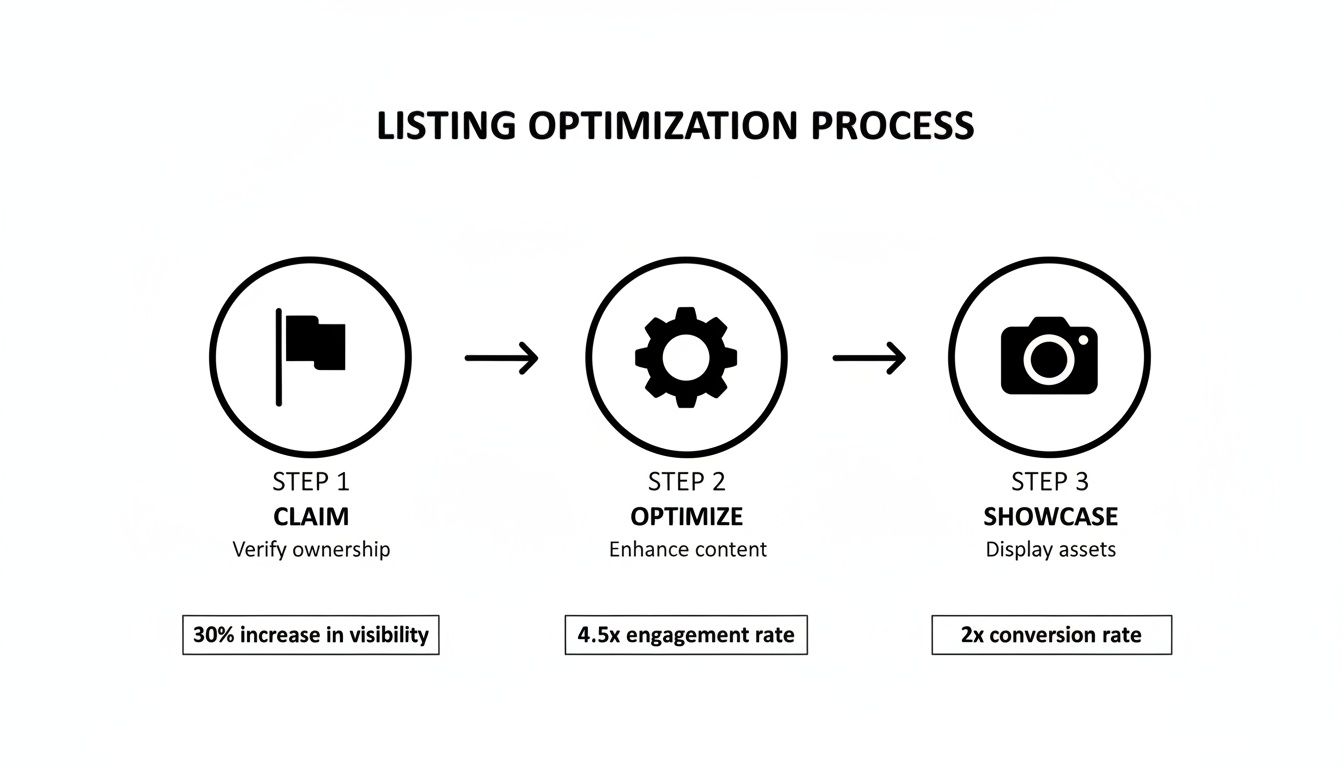
Each step builds on the last, turning what seems like a simple directory entry into a legitimate tool for bringing in new customers.
Proactive Citation Building for Authority
With the cleanup done, you can shift from defense to offense. Now it's about proactively building new, high-quality citations. This isn't a numbers game—you don't need to be listed everywhere. The goal is strategic placement on relevant and authoritative sites where your audience actually spends their time.
For a restaurant equipment seller, that means looking for opportunities on platforms for:
- Local Chambers of Commerce
- Foodservice industry associations
- Commercial construction or contractor directories
- Business-to-business supplier platforms
Every new, consistent citation you build adds another signal of trust and authority to your online presence. For a more detailed game plan, check out our guide on local citation building for your business. This ongoing process reinforces your NAP, helps boost your local search rankings, and ultimately drives more qualified buyers to your showroom.
Mastering Online Reviews and Reputation

In the restaurant equipment business, your reputation is everything. It’s built on trust, reliability, and word-of-mouth. A single glowing review from a respected local chef can drive more business than a week's worth of traditional advertising. This kind of social proof is a massive ranking signal for Google and a cornerstone of effective local listings management.
It’s not enough to just have listings out there; you need them to reflect a business that customers trust and recommend. That means building a proactive system for generating, monitoring, and responding to every single piece of customer feedback you receive.
Creating a Simple System to Generate More Reviews
Happy customers are usually willing to leave a review, but life gets in the way. They often forget or just don't know the easiest way to do it. Your job is to make the process as frictionless as possible. You don't need some complex, expensive setup; a simple, repeatable workflow is far more effective in the long run.
The absolute best time to ask is right after a successful transaction or installation when that positive experience is still fresh in their mind. Equip your sales and service teams with a simple process to capitalize on these moments.
Consider these straightforward tactics:
- Email Follow-Up: A day after a successful delivery, send a personalized email. Keep it short and to the point, thanking them for their business and dropping in a direct link to your Google Business Profile review page.
- SMS Request: For smaller transactions or quick service calls, a text message can have a surprisingly high response rate. Something as simple as, "Hi [Customer Name], thanks for choosing us today! We'd love to hear your feedback. You can leave a quick review here: [Link]" is all it takes.
- In-Person Request: For showroom sales, have a small sign or card with a QR code at the checkout counter. It can link directly to your review platforms and makes it incredibly easy for customers to act on the spot.
The key is consistency. Make the "ask" a standard part of your post-sale process. Over time, this simple habit will build a steady stream of fresh, positive reviews that bolster your online credibility and feed the search engines.
Responding to Every Single Review—Good and Bad
Responding to reviews is no longer just a nice-to-do; it's a must. It shows potential customers that you are engaged, professional, and genuinely care about your clients' experiences. It also gives you a golden opportunity to reinforce positive moments and skillfully mitigate the damage from negative ones.
The impact of this engagement is huge. Enterprises that respond to at least 32% of their reviews see an 80% higher conversion rate compared to competitors who only reply to 10% of theirs. As you can see from local SEO statistics found on seoprofy.com, active reputation management is a crucial part of your local strategy.
A timely and professional response is critical. Aim to reply to all new reviews within 24-48 hours.
Handling Negative Feedback Like a Pro
Look, no business is perfect, and a negative review is bound to happen. But how you handle it can turn a frustrated customer into a loyal advocate and, just as importantly, demonstrate your commitment to service for everyone else to see. The goal isn't to win an argument; it's to solve the problem and show you care.
Here’s a simple framework for your response:
- Acknowledge and Thank: Kick things off by thanking them for their feedback, even if it's harsh. "Thank you for bringing this to our attention."
- Apologize and Empathize: Offer a sincere apology for their poor experience. "We're very sorry to hear that the delivery of your commercial refrigerator did not meet your expectations."
- Take It Offline: Immediately provide a direct contact to resolve the issue privately. "We want to make this right. Please contact our manager, [Name], at [Phone Number] or [Email] so we can address this immediately."
- Keep It Brief: Avoid getting dragged into a public back-and-forth. State the facts from your side if necessary, offer a solution, and move the conversation offline.
This professional approach shows prospective buyers that even when things go wrong, you stand behind your products and services. That public display of accountability is often more powerful than a dozen five-star reviews.
Tracking Performance and Proving ROI
Let’s be honest: all this work managing your local listings doesn't mean much if you can't see the results. This isn't a "set it and forget it" activity. It’s a living, breathing part of your marketing that needs to be measured. If you're not tracking performance, you're essentially flying blind, with no idea what’s working, what's a waste of time, and how it’s all affecting your sales.
For a restaurant equipment dealer, proving the value comes down to connecting your online visibility to actual customer actions. We need to move past fuzzy metrics and zero in on the data that leads directly to phone calls, showroom visits, and sales inquiries. This is how you show a clear, undeniable return on your investment.
Identifying Your Most Important KPIs
Your first and best source of data is right inside your Google Business Profile (GBP) dashboard. The "Performance" (formerly Insights) section is where you’ll find out exactly how customers are finding you and what they do next. Don't get bogged down by broad traffic numbers; we're hunting for signs of real buying intent.
A great place to start is the search queries report. Are you seeing terms like “ice machine for sale near me” or “commercial freezer repair”? Those are gold. They tell you that your optimization is working, putting you in front of people who are ready to buy or book a service right now.
From there, you need to watch three key user actions like a hawk:
- Phone Calls: This is as direct as a lead gets. Tracking calls coming straight from your GBP listing is one of the clearest wins you can show.
- Direction Requests: When someone asks for directions, they're not just browsing—they're planning a trip to your showroom. This is a powerful measure of foot traffic driven by your online presence.
- Website Clicks: This shows your listing is doing its job and sending interested buyers to your site where they can dig into your inventory or fill out a contact form.
Tracking these core interactions is what transforms local listings management from a vague marketing task into a measurable lead-generation machine. Every call and every direction request is a tangible result of your efforts.
To really dig into what's working and what isn't, you need a clear view of your key performance indicators.
Here is a quick breakdown of the essential metrics you should be tracking to measure the success of your local SEO efforts.
Essential KPIs for Local Listings Management
| Metric (KPI) | What It Measures | Why It Matters for Your Business |
|---|---|---|
| Search Views | The number of times your business profile appeared in search results. | Shows your overall visibility. A rising number means you're appearing in more relevant searches. |
| Map Views | The number of times your profile was viewed on Google Maps. | Indicates local relevance and how often customers find you when searching geographically. |
| High-Intent Search Queries | Specific, long-tail keywords customers used to find you (e.g., "walk-in cooler installation"). | Tells you if you’re attracting customers with immediate needs for your equipment or services. |
| Website Clicks | Clicks on the website link in your profile. | Measures how effectively your listing drives traffic to your website for more detailed information. |
| Phone Calls | Clicks on the "call" button from a mobile device. | This is a direct lead. It’s one of the strongest indicators of immediate customer interest. |
| Direction Requests | Clicks on the "directions" button. | Directly measures how many potential customers are planning to visit your physical showroom. |
| Review Velocity & Rating | The rate at which you receive new reviews and your average star rating. | High velocity and ratings build trust and social proof, heavily influencing new customers. |
Monitoring these KPIs regularly will give you the data-backed insights needed to refine your strategy and demonstrate the direct impact on your business's bottom line.
Connecting Local Traffic to Your Sales Funnel
While GBP Performance data is incredibly valuable, it doesn't give you the full picture. To truly prove ROI, you need to follow the customer journey from your listing to your website and see what they do. This is where using UTM parameters becomes a total game-changer.
A UTM parameter is just a small bit of code you add to the end of your website URL in your Google Business Profile. It acts like a tracking tag, telling tools like Google Analytics exactly where that visitor came from. This simple step unlocks a whole new level of understanding.
Think about this scenario:
- A local chef clicks the website link in your GBP listing to look at new ovens.
- The UTM tag immediately identifies that visitor as someone who came from your local profile.
- Inside Google Analytics, you can see that this specific user browsed three pages for combi ovens, spent five minutes on your site, and then submitted your "Request a Quote" form.
Boom. You've just drawn a straight line from a local search to a qualified sales lead. This kind of detailed measurement allows you to confidently double down on what’s working and prove that local listings management isn’t just an expense—it’s a critical part of your revenue engine.
Creating Scalable Processes for Long-Term Success
In local SEO, consistency is what really separates the businesses that thrive from those that just get by. This is especially true if you're juggling multiple locations or have plans to expand. Managing one business profile is one thing, but keeping several in line is a whole different ballgame that requires a real system. This is how you stop treating your local listings as a chore and start turning them into a powerful, scalable asset for your company.
The first thing you need to do is write everything down. Create a straightforward standard operating procedure (SOP) that spells out exactly how to handle your most common tasks. This playbook makes sure that whether you’re opening a new showroom or just answering a customer question online, it's done the same way, every time. It’s all about brand consistency.
Building Your Repeatable Workflow
Look, your SOP doesn’t need to be some hundred-page beast of a manual. It can be a simple checklist in a shared Google Doc that covers the core workflows. Just think about the things you do most often and build a clear process for each.
- New Location Onboarding: Map out the entire process for a new branch. This should cover everything from claiming the Google Business Profile and choosing the right primary category to uploading that first batch of high-quality photos.
- Review Response Protocol: Come up with a few solid templates for responding to different types of reviews—say, for 1-star, 3-star, and 5-star ratings. This keeps your brand voice consistent and ensures every piece of feedback gets a professional, timely response.
- Information Update Cadence: Set a recurring calendar reminder for quarterly checks. You'll want to verify business hours, post any special holiday hours, and add fresh photos of new equipment to keep your listings from getting stale.
Having this all documented means nothing gets missed, even if your team changes or people shift roles. It’s the bedrock for managing your local presence effectively, no matter how big you get.
Think of a documented workflow as your single source of truth. It takes the guesswork out of the equation, cuts down on mistakes, and gives your team the confidence to manage your local presence like pros.
Leveraging Software and Assigning Roles
As you add more locations, trying to manage everything by hand just won't cut it. It’s not just inefficient; it's a recipe for errors. This is where dedicated software becomes a game-changer. Tools like BrightLocal or Uberall can handle the grunt work of pushing your business information out to hundreds of online directories, flagging inaccuracies, and pulling all your reviews into one place. This frees up your team to focus on what really matters—actually engaging with customers.
Once you have the right tools and processes, the final piece of the puzzle is to assign clear ownership. Who on your team is in charge of checking for new reviews each day? Who is responsible for making sure holiday hours are updated across every single location? Defining these roles creates accountability and makes sure things actually get done.
This systematic approach gives you a massive, sustainable leg up. It's actually shocking, but around 58% of businesses still haven't made local SEO a real part of their marketing. That leaves a huge opportunity on the table for you. By building scalable systems now, you're not just keeping up; you're creating a competitive advantage that your competitors will find incredibly difficult to match. You can find more stats on just how local SEO can benefit your business on sixthcitymarketing.com.
Frequently Asked Questions
We get a lot of the same questions when we're talking with restaurant equipment suppliers about local search. Let's dig into a few of the most common ones so you can get some clear, straightforward answers and get back to what you do best.
How Often Should I Update My Local Listings?
If your core business info changes—your Name, Address, or Phone number (NAP)—you need to update it everywhere, immediately. No exceptions. That's non-negotiable.
For everything else, getting into a quarterly rhythm is a great practice. Every three months, take a look at your listings. Are there any holidays coming up that will affect your hours? Did you just get a new line of convection ovens you should feature in your description? It's the perfect time to add fresh photos of your showroom or a recent client's kitchen installation.
Remember, platforms like Google Business Profile really like to see that you're active. If you can get into the habit of posting weekly updates about new inventory or jumping into the Q&A section to answer a potential customer's question, you'll see a real difference in your visibility over time.
What Is the Difference Between a Citation and a Backlink?
This one trips people up all the time, but it's pretty simple once you break it down.
A citation is just an online mention of your business's Name, Address, and Phone number (NAP). It doesn't even have to link back to your website. The whole point of a citation is to prove to search engines like Google that you are a real, legitimate business at a physical location.
A backlink, on the other hand, is an actual, clickable link from someone else's website to yours. Backlinks are all about signaling authority and trust for your overall SEO. While a citation can have a backlink inside it (which is great!), its primary job is purely for local verification.
Think of it this way: Citations prove where you are. Backlinks prove how important you are. You need both, but they play different roles in your marketing game plan.
Should I Manage Listings Myself or Use a Service?
Honestly, if you only have one location, you can probably handle this yourself. It takes a bit of dedicated time to claim your key profiles, hunt down and fix bad data on different directories, and keep an eye on your reviews. It's doable.
But once you start growing, or as your own time gets stretched thin, a management service or software platform becomes a game-changer. These tools can push your correct business information out to hundreds of directories at once, constantly scan for errors, and pull all your reviews into one place.
Trying to achieve that level of consistency on your own is a massive, time-sucking headache. And considering that 46% of all Google searches are for local information, you can't afford to have it wrong. You can dive deeper into why this matters with these local SEO statistics from sixthcitymarketing.com.
Tired of battling inconsistent listings and ready to have more local buyers find you? The team at Restaurant Equipment SEO lives and breathes this stuff. We build and run powerful local SEO campaigns specifically for the foodservice industry. Get in touch with us today and let's make your business the go-to supplier for every chef and restaurateur in town.