
A Guide to Local SEO Services for Business Growth
At its core, local SEO is all about making your business show up when a potential customer nearby is looking for what you offer. Think of someone searching for "restaurant equipment near me." The goal is to be the first name they see. It's like having a digital compass that points hungry, high-intent local buyers directly to your website or your front door.
Why Local SEO Services Are a Game Changer
Let's use an analogy. Imagine your restaurant equipment business is a physical store. Traditional, broad-based SEO is like putting up a massive billboard on an interstate highway hundreds of miles away. Sure, tons of people will see it, but how many are actually close enough to stop by?
Local SEO, on the other hand, is like placing a bright, flashing "Open" sign right on the corner of the busiest street in your town. It targets the people who are actually in your neighborhood and ready to make a purchase.

This difference is everything, because local searches are packed with an incredible amount of purchase intent. When a chef searches for "commercial oven repair in Austin," they aren't just doing research for a blog post. They have a real, urgent problem that needs solving right now. And the numbers back this up: a staggering 76% of people who search for something nearby on their smartphone end up visiting a related business within 24 hours.
The Power of Local Intent
This concept of local intent is what makes these services so powerful. It’s the critical difference between a general query like "how do commercial refrigerators work" and an urgent plea like "emergency commercial refrigerator repair near me." One is about curiosity; the other is about a transaction waiting to happen.
Local SEO is about positioning your business to capture that moment of urgency. It’s about making sure you’re the first, most visible, and most trustworthy solution when a local customer is ready to pull out their wallet.
A solid local strategy closes the gap between someone searching on their phone and them walking into your showroom. The point isn't just to climb the search rankings; it's to generate real, measurable results for your business.
What kind of results? We're talking about:
- More Phone Calls: Customers find your number instantly and call for quotes or emergency service.
- Increased Foot Traffic: Optimized map listings give people turn-by-turn directions right to your door.
- Higher Conversion Rates: You’re connecting with people who are actively looking to buy, not just browse.
- Stronger Community Trust: A consistent local presence paired with positive reviews builds your reputation as a reliable local expert.
From Digital Clicks to Real-World Customers
Picture a local restaurant owner. It's Friday night, the dinner rush is on, and their walk-in freezer just died. What’s the first thing they do? They grab their phone and search for emergency repair services in their city. The businesses that show up in Google’s "Local Pack"—that little map with three listings at the top of the page—are the ones getting that desperate call.
This is exactly where expert local SEO services make a tangible difference. The focus is on fine-tuning the specific signals Google looks for to confirm a business is both relevant and truly local. This includes things like a perfectly optimized Google Business Profile, consistent business information across the web, and a steady stream of positive reviews from local customers.
When you invest in a sharp local strategy, you're doing more than just boosting your online visibility. You're plugging your business directly into the economic pulse of your community, ensuring you're the go-to provider people find, trust, and choose when it matters most.
Mastering Your Google Business Profile
If local SEO is about getting your business on the map, then your Google Business Profile (GBP) is the big, flashing star that says, "You are here!" Think of it as your digital storefront. For most customers searching for restaurant equipment "near me," your GBP is the very first thing they'll see in Google Search and Maps.
A neglected profile is like a shop with a dusty window and a flickering sign—it doesn't inspire confidence. But a well-tended GBP? That builds instant trust and gives a potential buyer everything they need to call you, visit your website, or walk into your showroom. It’s the absolute cornerstone of any serious local SEO services strategy.
Building Your Digital Welcome Mat
Getting started with GBP isn't just about plugging in your business name and address. It’s about carefully crafting an information-rich snapshot of your business that answers a customer's questions before they even have to ask. This initial setup is the foundation for everything that comes next.
This is where you lay the groundwork for how Google sees your business and understands its relevance in your service area. For a step-by-step guide on getting your profile up and verified, you can check out our guide on adding your business to Google.
Why all the fuss? The data doesn't lie. One study found that customers are 2.7 times more likely to consider a business reputable if it has a complete GBP. On top of that, those complete profiles make a business 50% more likely to be considered for a purchase. This isn't just busywork; it's a direct line to getting more customers. You can find more stats on local SEO trends over at Backlinko.
Optimizing Every Detail for Maximum Impact
Once your profile is claimed and the verification postcard has arrived, the real work begins. Every single section of your GBP is another chance to send strong local signals to Google and, more importantly, provide real value to your customers.
Let's break down the key pieces to get right:
- Business Categories: Be specific! Instead of a generic "Equipment Supplier," choose precise primary and secondary categories. Think "Restaurant Supply Store," "Commercial Refrigeration Supplier," or "Kitchen Supply Store." This helps you show up for the exact terms people are searching for.
- Service Areas: Clearly define the cities, neighborhoods, and even zip codes you serve. This tells Google exactly where your customer base is.
- Photos and Videos: This is your chance to shine. Show off your products, your showroom, and your team. High-quality visuals of the commercial ovens, mixers, and refrigeration units you sell can make a huge difference in engagement.
- NAP Consistency: This is a big one. Your Name, Address, and Phone number need to be identical everywhere—on your GBP, your website, and any other online directory. Consistency builds trust with search engines.
This infographic gives you a great visual of how a well-optimized Google Business Profile acts as a powerful digital business card right in the search results.
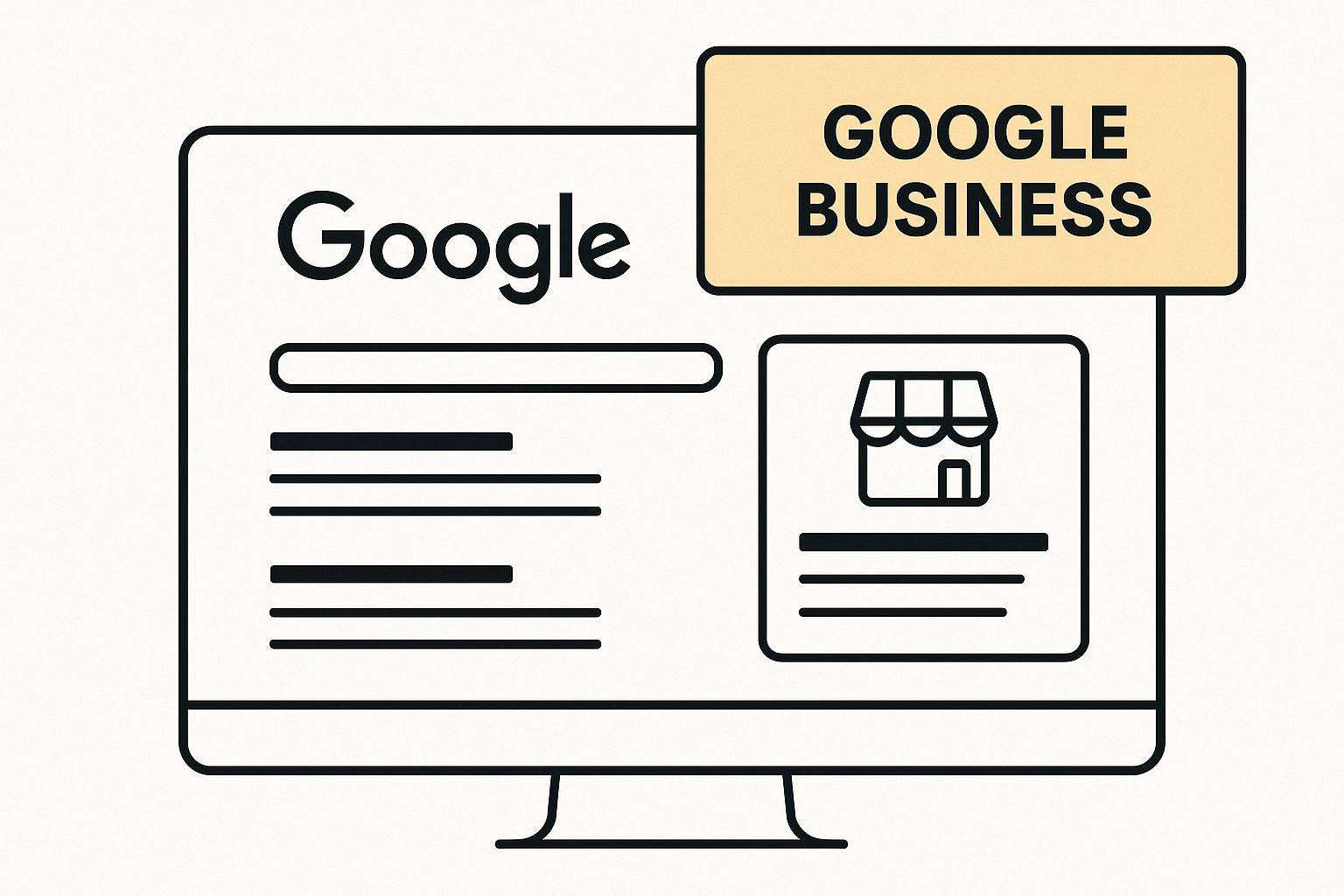
As you can see, essential info like reviews, photos, and contact details are front and center, making it incredibly easy for a potential customer to take the next step.
A fully optimized Google Business Profile doesn't just inform—it converts. It turns a simple search into a phone call, a website click, or a visit to your showroom.
Remember, your profile is a living, breathing tool, not a "set it and forget it" task. To truly get the most out of it, you need to actively use its more advanced features.
Advanced Features That Drive Engagement
Beyond the basics, GBP has some powerful tools that let you engage with your audience directly from the search results page. These features can turn your static listing into a dynamic, interactive hub for your business.
1. Google Posts
Think of these as free mini-ads or social media updates that show up right on your profile. You can use them to announce new product arrivals, promote a sale on commercial ranges, or highlight a special financing offer. Posts are a fantastic way to keep your profile looking fresh and signal to both customers and Google that your business is active.
2. Questions & Answers
This is a feature where anyone can ask a question about your business, and anyone can answer. It's crucial to stay on top of this. You can even get ahead by "seeding" it with your own FAQs, like "Do you offer delivery for large equipment?" or "What are your weekend hours?" Answering questions quickly shows you're paying attention and helps future customers find information easily.
3. Product Catalogs
For a restaurant equipment business, this is a game-changer. You can upload high-quality photos of key products—like ice machines or commercial dishwashers—complete with descriptions and prices. This effectively creates a virtual showroom right inside your GBP, letting customers browse your inventory before they even click through to your website.
By using these features consistently, you're not just feeding Google fresh content it loves; you're creating a much richer experience for potential buyers. This kind of proactive management is a core part of what high-quality local SEO services do, transforming your GBP from a simple listing into a genuine lead-generation machine.
Building Trust with Citations and NAP Consistency
Imagine your business has an official record at a massive digital city hall. Every time your business is mentioned online—on a directory, a blog, or a local news site—it's like another entry in that official record. This mention is called a local citation.
Search engines like Google are constantly scanning these records. They’re looking for proof that your restaurant equipment business is a real, legitimate operation at the address you say it is. Each accurate citation you have is like a small vote of confidence from across the web, telling Google, "Yep, they're the real deal."
The more consistent and widespread these votes are, the more Google trusts you. But if the information is all over the place? That's when problems start. It’s why managing your online citations is a cornerstone of any good local SEO strategy.
The Critical Importance of NAP Consistency
The bedrock of every single citation is your NAP: your business Name, Address, and Phone number. These three details have to be perfectly identical everywhere your business shows up online.
And when I say identical, I mean identical. The smallest details matter more than you think.
- Is it "Main Street" or "Main St."?
- Is your company "ABC Supply LLC" or just "ABC Supply"?
- Do you use "Suite 101" or "#101"?
These tiny differences might seem trivial to a human, but to a search engine algorithm, they create confusion. Google's job is to provide users with certainty, and conflicting NAP information erodes that certainty. This can cause your rankings to slip as Google loses confidence in which information is the correct one.
Think of NAP consistency as the glue holding your local online identity together. It gives search engines the solid proof they need to trust your business and show it to people searching for restaurant equipment nearby.
Understanding Different Types of Citations
Not all citations carry the same weight. They typically fall into two buckets, and a smart local SEO plan needs a healthy blend of both to really make an impact.
1. Structured Citations
These are the clean, organized listings you find on major business directories. They present your NAP information in a predictable format that search engine crawlers can easily understand.
Common examples include profiles on:
- Yelp
- Yellow Pages
- Better Business Bureau
- Industry-specific directories for food service suppliers
Getting your business listed accurately on these high-authority sites is the essential first step.
2. Unstructured Citations
These are more organic, contextual mentions of your business that pop up in different places online. It's less of a formal listing and more of a natural shout-out.
This could be:
- A local food blogger writing about the best places to buy commercial kitchen gear and mentioning your showroom.
- A press release announcing a new partnership or product line you're now offering.
- Your company name appearing on a local charity event's sponsor page.
Unstructured citations are pure gold. They signal to Google that your business is an active, relevant player in your local community, not just a name in a database.
Your Roadmap to a Clean Citation Profile
So, how do you get this right? It’s a methodical process.
You start with a citation audit to see where you stand. This means hunting down every single mention of your business online to find errors, duplicates, and outdated information. It's the discovery phase.
Next comes the cleanup. You have to go through, one by one, and contact every website with wrong information to get it corrected to match your official NAP. Once the existing mess is fixed, you can focus on building new, high-quality citations on relevant directories you might have missed.
If you want a step-by-step guide on how to tackle this, our detailed article on local citation building walks you through the entire process. This isn't a one-and-done task; it's about ongoing management to keep your business's foundation solid and trustworthy in the eyes of Google.
Making Your Website a Local Search Powerhouse
Think of your Google Business Profile as the bright, welcoming sign on your storefront and online directories as your glowing recommendations. But your website? That's your showroom. It’s the one piece of digital real estate you own completely, and it needs to be optimized to pull in local customers.
A good local SEO strategy doesn't stop with off-site listings. It digs deep into your website, transforming it from a simple online brochure into a precision tool for attracting restaurant owners in your specific service area. It's about sending unmistakable signals to both search engines and potential buyers that you are the go-to equipment supplier right in their backyard.
Creating Hyper-Focused Local Landing Pages
Let’s get practical. A generic "Services" page is fine, but it’s not going to win you the top spot in local search. The real magic happens when you build dedicated pages for each city, town, or even neighborhood you serve.
Imagine a potential customer searching for "commercial oven repair in Austin." A page on your site titled exactly that speaks directly to their immediate need. This approach lets you target those long-tail, high-intent keywords that serious buyers use. You’re no longer just competing for "restaurant equipment"; you're aiming to dominate searches like "ice machine supplier in Dallas" or "commercial kitchen design Houston."
But here’s the key: these pages can't be flimsy, copy-paste jobs where you just swap out the city name. They need real, local flavor.
- Show you’re a local. Mention nearby landmarks, well-known streets, or specific business districts.
- Build trust. Feature testimonials from clients in that exact area. Nothing sells better than social proof from a neighbor.
- Make it easy for them. Embed a Google Map of your showroom or highlight your specific service radius for that community.
- Get specific. Detail any unique services or special offers you provide to that particular location.
For an even more personalized touch, savvy businesses are learning how to insert a dynamic location on landing pages, which can make a visitor feel like your content was written just for them.
Speaking Google's Language with Local Schema Markup
Next up is something that works behind the scenes: Schema markup. It's a type of code you add to your website that acts like a translator, speaking directly to search engines. While a human visitor won't see it, it gives Google a perfectly clear, structured understanding of who you are, what you do, and where you're located.
Think of schema markup as putting clear, concise labels on all the important information on your website for Google. You’re not just hoping it figures things out; you’re telling it directly: "This is our business name. This is our physical address. And these are our hours of operation."
By adding LocalBusiness schema, you're essentially handing Google your business vitals on a silver platter. This helps it generate "rich snippets" in the search results—those enhanced listings that show your star rating, hours, and address right under your name. A listing with rich results stands out, looks more credible, and gets more clicks than a plain blue link. It's a simple addition that can have a huge impact.
Here's a quick look at the most critical on-page elements that broadcast your local relevance.
Key Local On-Page SEO Elements
| Element | Description | Example |
|---|---|---|
| Title Tags | The main headline of your page that appears in browser tabs and search results. | `Austin Commercial Kitchen Supply |
| Meta Descriptions | The short sales pitch that shows up under your title in Google search. | Your top source for commercial refrigerators, ovens, and kitchen supplies in Austin, TX. Visit our showroom or call for a quote! |
| Header Tags (H1, H2) | The on-page headings that organize your content for readers and search engines. | <h1>Restaurant Equipment Experts in Austin</h1> |
| NAP on Website | Your Name, Address, and Phone number displayed consistently, usually in the footer. | `Restaurant Equipment Pros |
When you meticulously fine-tune these elements, you’re weaving a powerful local story. From the title of your page to the hidden schema code, every piece works together to scream "local authority." You're leaving Google with zero doubt that when someone in your town needs new kitchen equipment, your website is the first one they should see.
Managing Your Online Reputation Through Reviews

When it comes to local search, your online reputation is everything. Customer reviews are the new word-of-mouth, and they're one of the most powerful signals you can send to both potential customers and search engines.
Put yourself in a restaurant owner's shoes. They're looking for a new commercial oven and find two local suppliers. One has a handful of reviews; the other has dozens of recent, glowing five-star testimonials. Which one do you think they'll call first? The reviews build immediate trust and signal quality long before they ever pick up the phone.
This is a core part of what local SEO services focus on. A consistent flow of positive feedback tells Google that you're a legitimate, active business that customers love. This can directly boost your visibility in local search and on the map.
How to Encourage Customer Feedback (Without Being Annoying)
Asking customers to leave a review can feel a bit awkward, but it doesn't have to be. The trick is to make it a simple, natural step in your customer service process. You’re not begging for a good review; you’re asking for their honest thoughts to help your business get better.
Here are a few proven strategies that work:
- Strike while the iron is hot. The best time to ask is right after a great experience, like a smooth equipment installation or a successful service call when the customer is happiest.
- Make it incredibly easy. Send a direct link to your Google review page in a follow-up email or put a QR code on the final invoice. The fewer clicks it takes, the more likely they are to do it.
- Keep the language simple and direct. Ditch the formal corporate speak. Something like, "We'd love to hear how the installation went. If you have a minute, your feedback helps us a ton," feels much more genuine.
You can also explore using testimonial generation tools to help automate the request process and display the great feedback you collect.
The Art of Responding to Every Single Review
Getting the review is only half the battle. Your job isn't finished until you've responded—to both the good and the bad. Responding shows everyone (including future customers) that you're engaged, you value feedback, and you stand behind your work.
A smart response strategy can build a ton of trust and even flip a negative experience into a major win for your brand.
Responding to reviews transforms your online profile from a static listing into a dynamic conversation. It shows potential customers that a real, caring team is behind the business name.
For Positive Reviews:
Always thank them personally. Try to mention a specific detail from their review, like, "We're so glad our team could get your new oven installed quickly!" It proves you actually read it and reinforces your company's strengths for others who are reading along.
For Negative Reviews:
This is where you can really shine and show off your customer service chops.
- Acknowledge and Apologize: Start by thanking them for bringing the issue to your attention and offer a sincere apology for their bad experience.
- Take It Offline: Provide a direct phone number or email and ask them to contact you so you can resolve the issue privately. This shows you're taking action without starting a public argument.
- Stay Professional: Never get defensive. A calm, helpful, and professional response often impresses potential customers more than a perfect five-star rating.
By actively managing your online reputation, you aren't just checking an SEO box. You're building a brand that local restaurant owners trust, respect, and want to work with.
Connecting Local SEO to Real Business Growth
All the tactics we've discussed—fine-tuning your Google Business Profile, managing reviews, building citations—aren't just isolated tasks on a checklist. They're individual gears in a much larger machine. When they all work in sync, they do a lot more than just bump you up in the search results. They connect directly to what really counts: your bottom line.
Think of it this way: each part of your local SEO strategy is like casting a line into the waters of your local market. Your GBP is one line. Your website's location pages are another. Your collection of five-star reviews is a third. A truly solid local SEO plan isn't just one of these lines; it's a wide net, designed to bring in real, measurable business.
And we're not talking about fuzzy metrics here. We're talking about tangible actions that lead directly to revenue. Things like phone calls for an emergency freezer repair, quote requests flying in from your website, or a restaurant owner walking through your showroom doors, ready to buy.
Translating Rankings into Revenue
It's easy to get caught up in the race to climb from the third spot to the top spot in Google's rankings. While that visibility is great, it’s not the end goal. The real prize is turning that high ranking into actual customer dollars.
Think about it. When a local chef or manager searches for "commercial oven repair near me" and sees your business first, they aren't just casually browsing. They are almost always at the very end of their buying journey, and they need a solution now. This is the most valuable kind of traffic you can possibly get. The immediacy is powerful; a staggering 76% of people who search for something nearby on their phone visit a related business within one day. You can find more stats like this on local search behavior at HookAgency.com.
Local SEO isn't just another marketing expense. It's a direct investment in your company's long-term health, building a digital asset that consistently brings in leads and sales from your own backyard.
This is exactly why a well-run strategy is so effective. It puts your business right in front of a customer at the precise moment they're ready to pull the trigger, which dramatically shortens the time it takes to make a sale.
Your Path to Sustainable Local Growth
When you invest in local SEO services, you stop shouting into a crowded room and start having real conversations with motivated buyers right in your neighborhood. You’re building a powerful digital storefront that works for you 24/7, capturing high-value leads while you're busy running the actual business.
The strategies we've laid out here give you a clear roadmap. From building trust through consistent business listings to weaving local keywords into your website, every step strengthens your bond with the community you serve. To see a more detailed breakdown of these growth drivers, check out our article on the benefits of local SEO.
The power to dominate your local market is in your hands. By putting these practices to work, you can stop hoping customers will stumble upon you by chance and start ensuring they find you by design. It’s time to capture those high-intent buyers in your area and turn their urgent needs into your next big sale.
Your Local SEO Questions, Answered
Even with a solid plan, it's natural to have questions as you start focusing on local search. Let's tackle a few of the most common ones we hear from business owners about timelines, resources, and how this whole thing actually differs from regular SEO.
How Long Does Local SEO Take to Show Results?
This is the big one, isn't it? While you might see some quick wins from simple tweaks—like sprucing up your Google Business Profile—a real, sustainable local SEO strategy needs some time to bake.
You should plan on it taking three to six months to see a significant, measurable lift in your local rankings and foot traffic. It's not a switch you flip. Factors like how fierce your local competition is, the current state of your website, and how consistently you work on it all impact the timeline. Think of it like building a great reputation in your town; it requires consistent, steady effort, not a one-time push.
Should I Hire an Agency or Do Local SEO Myself?
Honestly, you can absolutely handle some of the basics yourself. Things like updating your business hours, posting updates on your Google profile, or replying to new customer reviews are perfect in-house tasks.
But when you partner with a specialized agency for local SEO services, you're buying expertise and speed. They live and breathe the technical stuff—schema markup, deep-dive competitor research, and building a powerful network of local citations. For a busy owner, an agency often gets you better results, faster, freeing you up to do what you do best: run your business.
How Is Local SEO Different From General SEO?
This is a critical distinction, and it's where a lot of people get tripped up. Think of it this way: general SEO is like running a national TV commercial. You're trying to reach everyone, everywhere, with broad keywords. The goal is to cast the widest net possible.
Local SEO, on the other hand, is like putting up a billboard on the busiest road in your town. It’s hyper-focused. The entire goal is to attract customers who are physically nearby and actively searching for what you sell. We use specific tools like Google Business Profile optimization and local directory listings to make sure you show up in the Google "Local Pack" and on Maps when someone searches "restaurant supply near me." It’s all about connecting you with local buyers who are ready to walk through your door.
Ready to make your business the go-to spot for local customers? Restaurant Equipment SEO builds specialized strategies to put your business in front of the right people at the perfect moment. Visit us at https://restaurantequipmentseo.com to start winning in your local market.