
On Site Optimization for Restaurant Equipment Sellers
On-site optimization is all about fine-tuning your website's content and structure to rank higher in search results. For a restaurant equipment seller, it's the difference-maker. It’s how you ensure that when a busy chef searches for a "commercial convection oven," your product page is one of the first things they see.
It's about making your website an easy "yes" for both Google and your customers.
What Is On-Site Optimization and Why It Matters for Your Business
Think of your website as your flagship digital showroom. On-site optimization is how you merchandise that showroom to pull in the right kind of traffic. In a physical store, you’d strategically place your best-selling commercial refrigerators and griddles where customers are sure to see them. Online, you do the same thing by arranging your website’s pages and content to capture the attention of search engines and, most importantly, ready-to-buy customers.
This isn't just one single task. It's a continuous process that involves three core areas working together in harmony. This hierarchy shows how these pieces fit together to build a strong foundation for your online presence.
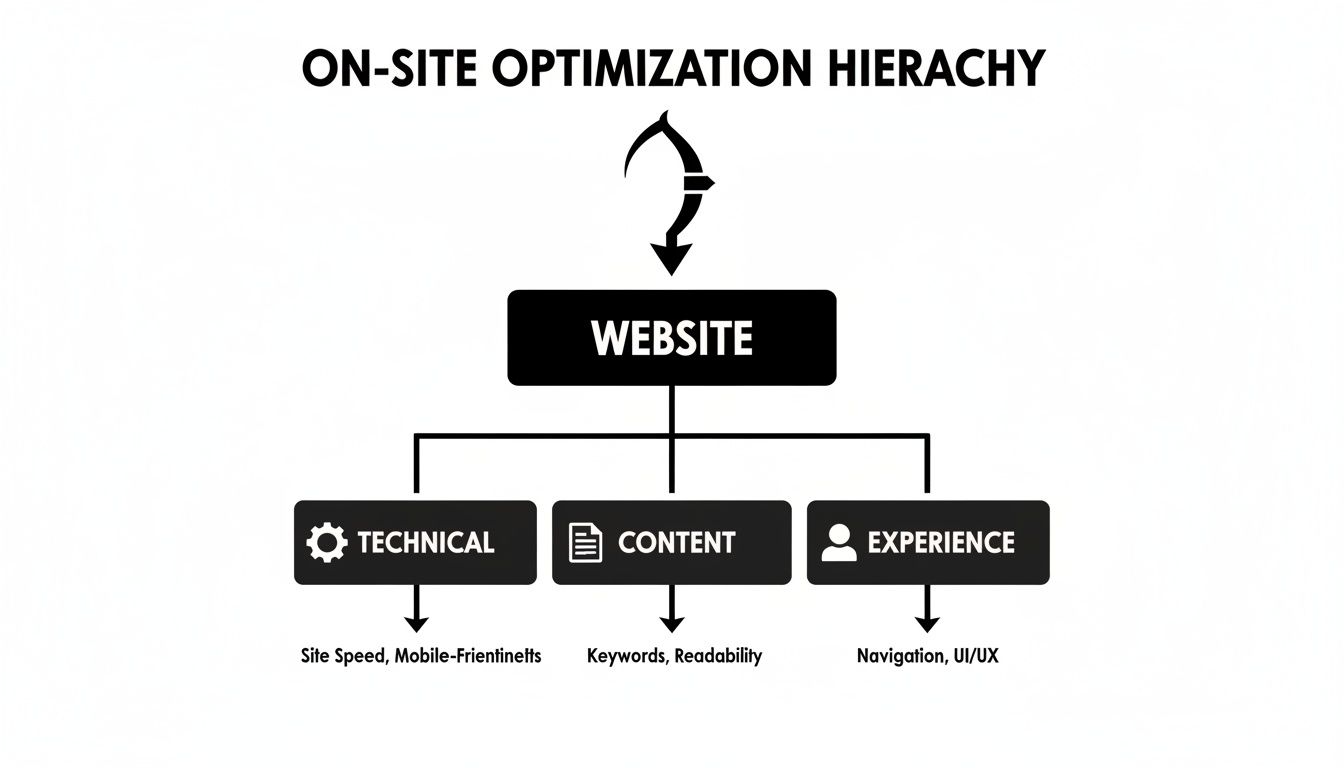
As you can see, a great user experience and powerful content can't stand on a shaky technical base. If you neglect any one of these pillars, the whole structure becomes unstable, which hurts your ability to rank, connect with customers, and ultimately, sell your equipment.
The Three Pillars of On-Site Optimization
A truly effective on-site strategy requires a careful balance of three distinct but interconnected areas. Each one sends critical signals about your website's quality and relevance to search engines, directly impacting how easily buyers can find you.
To make this clear, let's break down each component.
| Pillar | What It Is | Why It Matters for Equipment Sellers |
|---|---|---|
| Technical SEO | The "engine room" of your website—site speed, mobile-friendliness, clean code, and crawlability. | A slow site frustrates busy chefs. If Google can't easily understand your pages, it won't show them to potential buyers looking for specific equipment. |
| Content | Everything your customers read and see: product descriptions, category pages, spec sheets, and blog posts. | This is where you prove your expertise. Great content answers questions, builds trust, and uses the exact terms your customers are searching for. |
| User Experience (UX) | How a visitor feels navigating your site. Is it easy to find a specific walk-in freezer? Can they check out on a phone from a noisy kitchen? | Good UX makes buying easy and intuitive. Bad UX sends customers straight to your competitors, even if you have a better price. |
Each pillar supports the others. Great content on a technically broken site will never get seen, and a technically perfect site with a confusing layout will never convert.
On-site optimization is fundamentally about sending the right signals to Google and your users. It tells search engines what your pages are about and assures visitors they've found the perfect solution for their restaurant.
When you get this right, the results are powerful. This isn't just a box-ticking exercise; it's the engine that drives serious growth. For example, by focusing intensely on on-site elements like keyword-rich content and technical audits, our team was able to boost a client's organic traffic by an incredible 390% in just 11 months. That’s the kind of impact it can have.
At the end of the day, understanding how to improve Google search rankings is the core purpose of on-site optimization. It’s the combination of technical health, quality content, and a great user experience that turns your website into your best 24/7 salesperson.
Building Your Technical SEO Foundation
Think of your website like a brand-new restaurant. You can have the most amazing menu (your content) and the most welcoming atmosphere (your user experience), but if the kitchen's plumbing is busted and the wiring is a fire hazard, the whole operation is doomed from the start.
That's technical SEO in a nutshell. It’s the structural integrity of your website—the clean wiring, solid plumbing, and strong foundation that everything else depends on. This is the engine room of your on-site optimization efforts, where seemingly small tweaks can lead to huge improvements in how both search engines and customers see your business.
Imagine a disorganized, slow kitchen line. It leads to cold food and unhappy diners. A slow-loading, poorly structured website does the same thing, driving away potential buyers before they even get a chance to see that top-of-the-line commercial freezer you're selling.
For a restaurant equipment business, a solid technical base isn't just a "nice-to-have"—it's an absolute must for survival and growth.
Why Site Speed Is Non-Negotiable
In the fast-paced restaurant industry, nobody has time to wait. A page that takes more than a couple of seconds to load is the digital equivalent of putting a customer on hold for ten minutes. And we all know how that ends: they hang up and call your competitor.
Google has been very clear that site speed is a direct ranking factor for both desktop and mobile searches. So, a slow website doesn't just frustrate users; it actively hurts your chances of showing up on the first page of results.
It gets worse. Even a one-second delay in page load time can cause a 7% drop in conversions. When you're selling high-ticket items like commercial ovens, that one second could be costing you thousands in lost revenue every single month.
Key Technical Elements to Master
Beyond pure speed, a few other crucial behind-the-scenes factors are at play. Getting these right is about making it as easy as possible for search engines to find, understand, and rank your pages effectively.
- Mobile-Friendliness: Think about your customers. They're busy chefs grabbing their phones between services or general contractors on a job site. If your website is a nightmare to navigate on a small screen, you’re slamming the door on a huge portion of your audience.
- XML Sitemaps: This is basically a blueprint of your website that you hand-deliver to Google. It lists all your important pages, helping search engine crawlers discover and index your new product pages and categories much faster.
-
Clean URL Structure: Which URL is easier to understand?
yourstore.com/refrigeration/walk-in-coolersoryourstore.com/cat?id=45&prod=987? The first one, obviously. Clear URLs help both users and search engines know what a page is about with just a glance.
These aren't just minor details. In a food service industry projected to hit $1.5 trillion in sales by 2025, these technical fixes can mean the difference between being invisible and owning the top spots in search. Strong on-site optimization builds a foundation that keeps customers engaged, especially the 93% of people who check menus and related businesses online.
The Power of Schema Markup
Now for one of the most powerful tools in your technical SEO arsenal: schema markup.
Think of it as creating digital price tags and spec sheets for your content that search engines can instantly read. It turns your normal webpage text into structured data that Google understands perfectly.
For example, you can use product schema to tell Google:
- This specific product is a "Commercial Convection Oven."
- Its current price is "$4,500."
- It has an average customer rating of "4.8 stars."
- There are "12 units in stock."
Google can then pull this information directly into the search results page, creating what's called a "rich snippet." Suddenly, your listing stands out with pricing, ratings, and availability right there. This builds instant trust and gives searchers a compelling reason to click your link over a competitor's.
A strong technical base is always the first step. The best way to figure out where you need to improve is by learning how to do a site audit for your own website.
Crafting Content That Attracts and Converts Buyers
Once your website's technical foundation is solid, it's time to focus on what your customers actually see: the digital showroom floor. This is where your content—product descriptions, category pages, and blog posts—does the heavy lifting. Think of it less as just filling pages and more as turning your site from a static catalog into a trusted advisor that guides chefs and restaurant owners to the perfect piece of equipment.
Great content is your best salesperson, working 24/7 to answer questions and build confidence. It’s what turns a vague search for "commercial refrigeration" into a sale from a customer who trusts your expertise.
Writing Product Descriptions That Sell
So many equipment sellers make a classic mistake: they just copy and paste the generic description from the manufacturer. This is a huge SEO own-goal, creating duplicate content that Google dislikes. Even more importantly, it does absolutely nothing to connect with your customer.
Your product descriptions need to tell a story that resonates with a busy kitchen manager. You have to go beyond the spec sheet and translate those features into real-world benefits.
A great product description doesn't just list features; it sells outcomes. It translates technical specifications into tangible advantages for a commercial kitchen, building a bridge between what the equipment is and what it does for the buyer.
Let’s take a commercial convection oven as an example:
- Don't just say: "Features a 1/2 HP two-speed fan motor."
- Instead, say: "The powerful two-speed fan motor circulates heat evenly, eliminating hot spots and ensuring perfectly consistent results—from delicate pastries to hearty roasts—every single time."
See the difference? This approach helps both your customers and the search engines understand the real value you’re offering. If you sell on other platforms, the principles behind Amazon listing optimization offer a masterclass in writing compelling, conversion-focused product content.
Optimizing High-Value Category Pages
Your category pages for things like "Commercial Freezers" or "Ice Machines" are massive traffic hubs. They're often the first place a potential buyer lands when they know what they need generally but haven't picked a specific model. Your job is to make these pages incredibly helpful guides.
A simple but effective tactic is to add a short, keyword-rich intro paragraph at the top of the page. This text should orient the user, helping them understand the types of products they're looking at and what to consider. For a "Commercial Refrigeration" page, you might briefly explain the difference between a reach-in and a walk-in unit right from the start.
Then, use clear H2 and H3 subheadings to break the page into logical sections (e.g., "Reach-In Refrigerators," "Undercounter Coolers"). This makes the page easier to scan for a busy professional and also helps search engines grasp the page's structure and hierarchy—a big plus for modern SEO.
Building Authority with Helpful Blog Content
A blog is your secret weapon for building authority and catching buyers early in their research. The key is to stop writing about your products and start creating content that solves your customers' real-world problems.
Just listen to the questions your sales team gets every single day:
- "How do I choose the right commercial ice machine for my bar?"
- "What's the real difference between a convection oven and a combi oven?"
- "What are the maintenance tips for a commercial deep fryer?"
Every one of those questions is a fantastic blog post idea. When you answer them thoroughly, you're not just a seller anymore; you're an industry expert. That builds the trust that ultimately leads to a sale.
Better yet, this content creates natural opportunities to link back to your product and category pages. A post on choosing the right ice machine should, of course, link over to your "Ice Machines" category page. This strategy guides the user seamlessly from learning to shopping and spreads SEO value across your site. It all comes down to having a plan, which is why an effective SEO content strategy is so critical.
Optimizing for Local Searches to Dominate Your Service Area
For most restaurant equipment suppliers, the nearby chefs, contractors, and cafe owners are the lifeblood of the business. Sure, you might ship nationwide, but your local service area is often your most profitable and consistent source of revenue. This is where local on-site optimization becomes your playbook for turning "near me" searches into actual showroom visits and service calls.
The whole point is to make your website a magnet for local customers. When a restaurant owner in your city searches for "commercial mixer repair" or "restaurant supply store near me," you absolutely have to be the first business they see. This isn't about casting a wide net; it's about becoming the undeniable authority right in your own backyard.
Building Your Digital Storefront with Location Pages
If you have a physical showroom or serve multiple distinct areas, dedicated location pages are non-negotiable. Think of each page as a unique digital storefront for a specific town or city. Don't just swap out the city name and call it a day—that’s a classic mistake that gets you nowhere fast.
Each location page needs to be packed with unique, locally-focused content. This is your chance to really connect with the community you serve and send powerful local relevance signals to Google.
A great location page should always include:
- Unique Local Content: Talk about local landmarks, the neighborhoods you frequent, or successful projects you’ve completed in that specific area.
- Embedded Google Map: A map showing your exact location provides a clear visual for customers and reinforces your geographic relevance for search engines.
- Local Testimonials: Feature reviews from happy customers in that city. A glowing review from a well-known local restaurant builds incredible trust.
- Consistent NAP Information: Your business Name, Address, and Phone number must be clearly displayed and match your Google Business Profile perfectly.
These elements work together to prove to both users and search engines that you are a genuine, active part of that local business community.
The Critical Role of NAP Consistency
Imagine giving out three different addresses for your showroom. Customers would get confused and frustrated, and most would just give up. Search engines feel the same way about inconsistent NAP information across the web.
Your Name, Address, and Phone number (NAP) should be identical everywhere on your site—from the header and footer to your contact and location pages. Even tiny variations like "St." versus "Street" can create confusion for search engines and water down your local authority.
This consistency is a fundamental trust signal for local SEO. It reassures Google that it's showing the correct information to searchers, which directly impacts your ranking in the local map pack and organic results.
To help you get this right, here's a prioritized checklist of on-site actions that will make a real difference in your local search rankings.
On Site Local SEO Checklist
| Priority | Action Item | Impact on Local Rank |
|---|---|---|
| High | Create unique location pages for each physical branch or major service area. | Very High |
| High | Ensure 100% NAP consistency across your website and Google Business Profile. | Very High |
| Medium | Embed a Google Map and include local testimonials on each location page. | High |
| Medium | Add location-specific keywords to page titles, headings, and body content. | High |
| Low | Create blog posts or case studies featuring local clients or community events. | Medium |
Focus on the "High" priority items first, as they will deliver the most significant and immediate boost to your local visibility.
Proving Your Local Expertise
Beyond the basics, you can further cement your local presence by showcasing your community involvement. Feature blog posts about local food festivals you sponsored, share case studies of restaurant installations in the area, or post photos of your team servicing equipment for recognizable local clients. This adds a human touch and deepens your connection to the community you aim to dominate.
The impact of getting local optimization right is staggering. For instance, multi-location brands now claim 33.4% of the Google 3-pack presence for important keywords. For more data-driven insights, you can explore detailed statistics on local search trends.
Ultimately, a sharp local strategy ensures you’re not just another faceless online store. For a step-by-step guide to putting these ideas into action, check out our comprehensive local SEO checklist for restaurant equipment businesses. It breaks down exactly what you need to do to start winning more local customers today.
Common On-Site Optimization Mistakes to Avoid
Getting your on-site optimization right is a huge win, but knowing what not to do is just as critical. I’ve seen the same handful of mistakes trip up restaurant equipment suppliers time and time again, quietly killing their sales and search rankings. If you can learn to spot and sidestep these common blunders, you’ll be miles ahead of the competition.
Think of it like running a kitchen: you wouldn't let a disorganized storeroom bring service to a grinding halt. In the same way, you can't let these basic website errors get in the way of a customer making a purchase. Keeping your digital showroom clean and efficient is key.
The Duplicate Content Trap
One of the most common and damaging mistakes is simply copying and pasting the manufacturer's product description. It's the easy route, I get it. But when you do that, you create a massive duplicate content problem.
Imagine Google sees the exact same description for a Blodgett convection oven on your site and ten other dealers' sites. Who should rank first? It has no idea. Your page’s authority gets watered down, and your chances of ranking for that specific product plummet.
Key Takeaway: You absolutely have to write your own unique, compelling product descriptions. Turn the technical specs into real-world benefits. Don't just list the BTUs; explain how that power means faster pre-heating during a chaotic dinner rush. This approach not only dodges SEO penalties but also connects with your customers in a way generic jargon never will.
Neglecting the Mobile Experience
Picture this: a head chef is in the middle of a frantic service, and a critical piece of equipment goes down. They pull out their phone to order a replacement part right now. If your site is a nightmare to use on that small screen—requiring endless pinching and zooming—they're gone in seconds. That's not just an annoyance; it’s a lost sale and a terrible first impression.
A seamless mobile experience is no longer optional; it’s a core part of modern on-site optimization. A huge slice of your audience is on their phones, standing in a busy kitchen or on a job site. A clunky mobile site is the digital version of a locked front door. Plus, Google’s "mobile-first" indexing means a poor mobile experience directly torpedoes your search rankings.
Confusing Site Structure and Navigation
A messy website layout is another classic blunder that frustrates everyone—your customers and the search engines. If a potential buyer can't figure out how to get from "Commercial Ovens" to "Convection Ovens" in a click or two, they'll just give up and assume you don't carry what they need.
For search engine crawlers, a messy site is like a maze with no map. They can’t effectively find and index all your important pages.
To get this right, you need to think logically.
- Build a clear hierarchy: Your homepage should link to big categories like Refrigeration or Cooking Equipment. Those should then link to specific subcategories like Walk-In Coolers or Commercial Griddles.
- Use descriptive labels: Ditch vague terms like "Products." Be specific. Use "Commercial Freezers" or "Ice Machines" in your navigation.
- Add breadcrumbs: This simple navigation trail shows users exactly where they are on your site (e.g., Home > Cooking Equipment > Commercial Ranges). It makes it incredibly easy for them to jump back to a previous category without getting lost.
Steering clear of these critical mistakes builds a rock-solid foundation. It creates a user-friendly site that not only ranks well but also does its most important job: turning visitors into loyal customers.
How to Measure Your On-Site Optimization Success
Making changes to your website without measuring the results is like cooking without tasting. You’re putting in the effort, but you have no idea if you’ve created a masterpiece or a mess. Real on-site optimization is always driven by data, which is how you prove its value and make smarter decisions down the road.
Tracking performance connects your SEO efforts directly to business goals. It’s what turns abstract ideas like "better user experience" into tangible outcomes like "more quote requests." The trick is knowing which metrics actually matter and which tools to use—and thankfully, some of the best ones are completely free.
Key Performance Indicators That Matter
To see if your work is paying off, you need to focus on Key Performance Indicators (KPIs) that reflect actual business growth. It's easy to get distracted by vanity metrics like "impressions," but they don't pay the bills. Instead, concentrate on data that shows you're attracting the right people and turning them into customers.
Your two most important tools here will be Google Analytics and Google Search Console. These platforms give you a direct window into how people find your site and what they do once they get there.
Here are the essential KPIs every restaurant equipment seller should be watching:
- Organic Traffic Growth: This is the big one. An increase in visitors coming from search engines is a clear signal that your on-site work is resonating with Google.
- Keyword Rankings: Are you on page one for high-intent searches like "commercial ice machine financing" or "walk-in cooler installation"? Tracking your position for these money-making keywords is crucial.
- Conversion Rate: This is the percentage of visitors who take a specific action, like filling out a "Request a Quote" form or calling your sales line. This KPI is your direct link between SEO and revenue.
- Bounce Rate: How many people land on your site and leave after viewing just one page? A high bounce rate might mean your content isn't matching what the searcher wanted, or maybe the page is just too slow to load.
Creating a Simple SEO Dashboard
You don’t need fancy, expensive software to track your progress. A simple dashboard, even one built in a basic spreadsheet, can paint a clear picture of how your on-site improvements are moving the needle. It helps you see the direct cause-and-effect of your actions.
Tracking your SEO is about telling a story with data. It’s the narrative that shows how optimizing a product page title led to a measurable increase in organic traffic, which then resulted in more qualified leads for your sales team.
For example, let's say you focused on optimizing your "Commercial Ranges" category page. Your dashboard could look something like this:
| Metric (Before/After Optimization) | January (Before) | April (After) | Change |
|---|---|---|---|
| Monthly Organic Clicks | 150 | 450 | +200% |
| Average Keyword Position | 18 | 6 | +12 |
| Quote Requests from Page | 2 | 9 | +350% |
This kind of simple visualization makes it incredibly easy to demonstrate the return on investment. It proves that on-site optimization isn't just a box-ticking exercise—it's a powerful engine for growing your business.
Your Top On-Site Optimization Questions Answered
Even with a solid plan, it's natural to have questions when you start digging into on-site optimization. We hear the same ones all the time from restaurant equipment sellers, so let's clear them up right now. Think of this as your go-to guide for those nagging "what ifs" and "how-to's."
How Long Until I Actually See Results?
It's the million-dollar question, isn't it? The honest answer is: it depends. You might see a small bump in a few weeks from quick fixes, like tweaking a page title or adding some product schema. But the real, game-changing results don't happen overnight.
For significant, lasting growth in organic traffic and rankings for the keywords that matter, you should plan for a 3-6 month timeframe. On-site optimization is an investment in your digital storefront. It’s less like flipping a light switch and more like planting a garden—it takes consistent work upfront, but the payoff is a sustainable source of leads that keeps on growing.
SEO is a marathon, not a sprint. The initial work builds the foundation, and ongoing efforts compound over time to create a powerful, sustainable source of leads that grows stronger each month.
Do I Need to Be a Coding Whiz to Do This?
Not at all. While the "technical SEO" part sounds intimidating, many of the tasks that make the biggest difference are things you can absolutely handle. If you can write a clear and helpful email, you have the core skills to dramatically improve your website.
Here’s a quick way to think about it:
- Things You Can Do Now: Writing unique product descriptions, crafting compelling page titles, adding descriptive alt text to your images, and creating useful blog posts about equipment care.
- Things You Might Need Help With: Deep dives into site speed, implementing complicated schema markup, fixing crawl errors flagged by Google, or conducting a full technical audit.
Don't let the technical jargon scare you off. Start with the content and on-page elements you feel comfortable with. You'd be amazed how much progress you can make with just those fundamentals. You can always bring in a specialist later to handle the more complex, under-the-hood stuff.
What's More Important: On-Site or Off-Site SEO?
This is a classic debate, but it’s based on a flawed premise. It's not an either/or situation. You absolutely need both, but one has to come first: On-site SEO is the foundation.
Think of it like building a new restaurant. On-site SEO is everything that happens inside your four walls—the spotless kitchen, the well-designed dining room, the easy-to-read menu, and your friendly, efficient staff. Off-site SEO is all the external marketing you do to get people to visit, like glowing press reviews, local news features, and customer referrals.
You wouldn't spend a fortune on advertising a restaurant with a messy kitchen and a confusing menu, right? It's the exact same principle online. You must build a solid, user-friendly, and well-optimized website first. Get your house in order, and every dollar and hour you spend on off-site SEO will be ten times more effective.
Ready to build a powerful foundation that turns searchers into customers? The team at Restaurant Equipment SEO has the industry-specific expertise to help. Learn more about our proven strategies and get started today.