
What Are Serp Features - what are serp features and why they matter
Think of SERP features as anything on a Google search results page that isn't one of the classic "blue link" results. They're the interactive and visual upgrades—like answer boxes, maps, and image carousels—that Google adds to make search results more immediately useful.
Understanding The New Search Landscape
Imagine comparing an old-school, text-only restaurant menu to a modern digital one loaded with photos, daily specials, and customer reviews. The first just gives you the basic facts, but the second one helps you decide what to order much faster and with way more confidence.
That's the perfect way to think about SERP features. They’ve transformed Google's once-simple list of links into a dynamic, helpful, and interactive experience.
For a restaurant equipment seller, this shift is massive. A chef searching for a "commercial convection oven" doesn't just get a list of websites anymore. Instead, they might see:
- Image Packs: A whole gallery of different ovens right at the top of the page.
- Product Snippets: Listings that show prices, star ratings, and availability at a quick glance.
- Video Carousels: How-to guides or product demos of different oven models in action.
- The Local Pack: A map pointing to nearby suppliers with their contact info and store hours.
These features aren't just for show; they're the new front lines for getting noticed. They answer questions, showcase products, and build trust before a potential customer even thinks about clicking through to your site. Google’s whole game is to provide the most direct, helpful answer possible, and SERP features are its best tools for the job.
From Simple Links To Interactive Answers
The evolution here has been incredible. When Google first got started back in 1998, the results were just a straightforward list of ten text links. The real game-changer came around 2014 when Google rolled out Featured Snippets—those answer boxes that pop up right above the regular organic results. This fundamentally changed how we get information from search.
This shift means that simply ranking "number one" is no longer the only goal. The real opportunity lies in owning the most prominent and helpful real estate on the page, which is often a SERP feature.
Why SERP Features Matter To You
Getting your head around this is the first real step toward a smarter SEO strategy. Instead of just trying to get your link seen, you can aim to have your products, your expertise, and your business info featured directly in the search results.
This turns your search presence from a passive line of text into a compelling digital storefront that grabs the attention of restaurant owners and chefs. To really nail this down, it helps to understand the foundation of what a results page even is by exploring What Is A Google SERP.
To help organize these different elements, here’s a quick breakdown of the main categories of SERP features you'll encounter.
Key SERP Feature Categories at a Glance
| Category | Primary Function | Example for Restaurant Equipment |
|---|---|---|
| Rich Snippets | Enhance standard blue links with extra, eye-catching information. | A product page for a walk-in cooler showing its price, star rating, and availability. |
| Universal Results | Integrate results from different search verticals (Images, News, Videos). | A video carousel appearing for a search on "how to clean a commercial deep fryer." |
| Knowledge Graph | Provide direct, factual answers and summaries about entities (people, places, things). | A Knowledge Panel for "Hobart" showing the company's logo, history, and key products. |
| Local Results | Connect users with geographically relevant businesses and services. | A Local Pack map displaying nearby restaurant supply stores for "ice machine supplier near me." |
Each of these categories offers a unique opportunity to stand out. Knowing which ones apply to your business is the key to capturing valuable attention right on the results page.
The Most Valuable SERP Features for Your Business
While Google throws dozens of different SERP features at us, they're not all created equal—especially for a restaurant equipment seller. Some are nice to have, but others are the ones that actually make the phone ring and bring high-intent customers to your website or storefront. The key to an efficient and impactful SEO strategy is knowing which ones to chase.
Think of it like stocking a brand-new commercial kitchen. You could cram it with every niche gadget on the market, but the real workhorses—the six-burner range, the walk-in cooler, the industrial mixer—are what truly drive the business. In the same way, a few key SERP features act as the essential equipment for your online visibility, delivering real value time and time again.
Let's zero in on the features that put you in front of chefs and restaurant owners at the exact moment they need your help.
This diagram shows just how much SERP features have become their own powerful layer on the results page, sitting right alongside—and often above—the classic blue links.
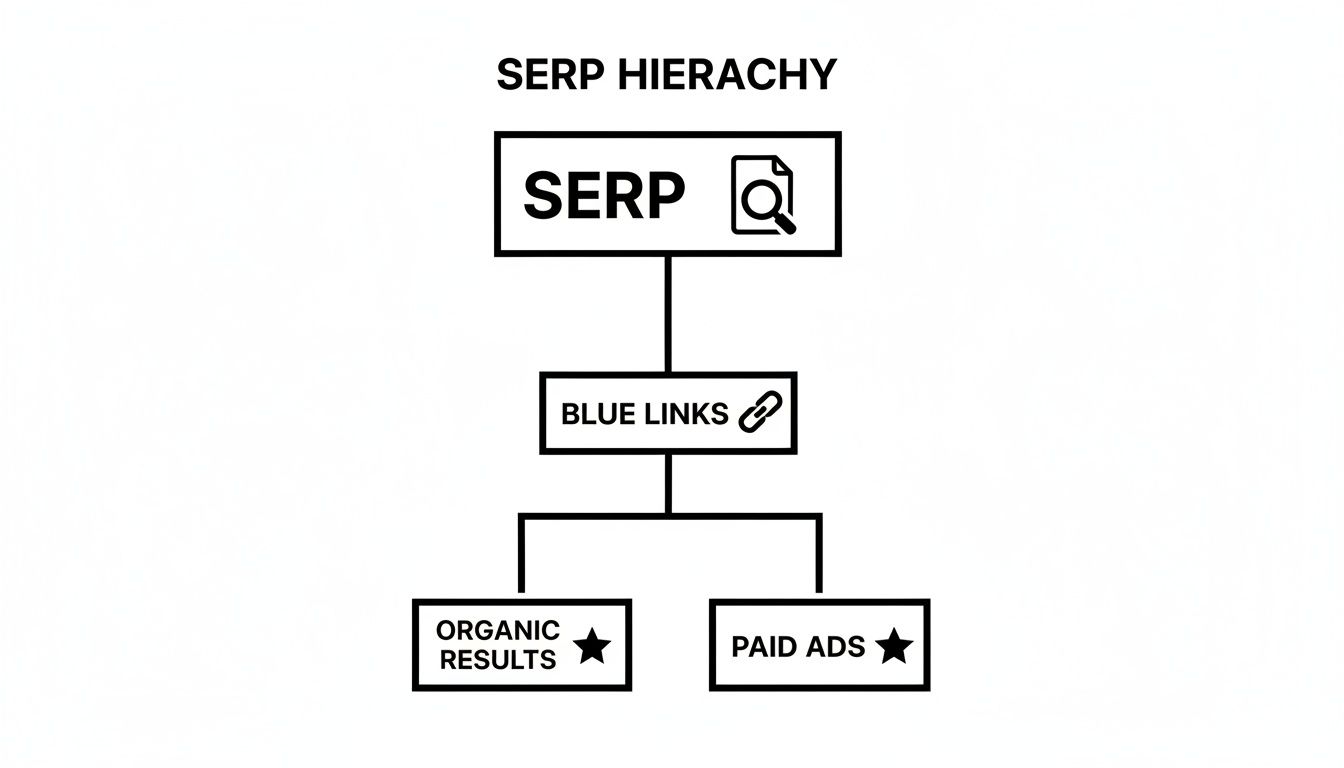
It really highlights a critical shift in SEO. Success isn't just about snagging a link anymore; it's about capturing these richer, more prominent visual spots.
The Local Pack: Your Digital Storefront
For any business with a physical address or a service area, the Local Pack is arguably the most valuable piece of real estate on Google. It’s that map with three business listings staring you in the face after searching for something like "commercial oven repair near me" or "restaurant supply store Chicago."
Landing here puts you directly in front of customers with an urgent, local need. These folks aren't just window shopping; they're often looking to buy or book a service right now. The Local Pack serves up your phone number, address, and hours on a silver platter, making it incredibly easy for them to connect.
Featured Snippets: The Authority Position
The Featured Snippet, which many of us in the industry call "position zero," is that answer box sitting at the very top of the results for question-based searches. It’s Google’s attempt to give a direct, concise answer, and in doing so, it positions the source website as an instant authority.
For a foodservice seller, this is a golden opportunity. Imagine a restaurant manager typing, "how to choose a commercial ice machine." If your content gets pulled for that Featured Snippet, you instantly become the definitive expert in their eyes.
Securing a Featured Snippet isn't just a ranking win; it's a brand-building power play. It tells potential customers that Google trusts your answer more than anyone else's, building immediate credibility before they even click.
This is an incredibly powerful way to capture people in the research phase, establishing your expertise and making your brand the go-to resource.
Image and Video Packs: Showcasing Your Equipment
Let's be honest, restaurant equipment is a visual business. Chefs and owners want to see the gear in action. This is where Image Packs and Video Packs become so important.
These are the rows or blocks of visual content that pop up right in the search results. A search for "Vollrath countertop induction range" might show an Image Pack with the unit from every angle. A query like "how to clean a commercial griddle" is the perfect setup for a Video Pack featuring a quick tutorial.
- Image Packs let you show off product quality, features, and scale.
- Video Packs are perfect for demonstrating how to use something, sharing maintenance tips, or even featuring customer testimonials.
These visual features grab attention in a way text just can't. They help potential buyers picture your products in their own kitchens, which builds the confidence they need to make a purchase.
Understanding Google's Evolving Intelligence
The reason all these features exist is that Google is getting much smarter about understanding language and what searchers actually want. A huge leap forward was the BERT update back in late 2019. BERT (Bidirectional Encoder Representations from Transformers) was a massive step in natural language processing that helped Google grasp the nuance and context of our messy, human search queries.
That update was a game-changer, one of the biggest in search history, and it laid the groundwork for the highly relevant, direct-answer SERP features we see today. You can always explore more about the history of Google's algorithm changes to see how we got here.
This constant evolution is exactly why creating genuinely helpful, high-quality content is non-negotiable. Google gets better every day at finding the best answer, sometimes regardless of old-school ranking signals. By focusing on the Local Pack, Featured Snippets, and visual packs, you're not just playing an SEO game—you're directly solving the problems of your foodservice customers.
Unlocking Interactive and E-Commerce Features
Some SERP features are more than just a link—they’re basically digital storefronts. These features are all about engaging potential buyers and nudging them closer to a decision, right there on the results page.
Think of it this way: they shorten the sales cycle by putting critical information like pricing, ratings, and answers to common questions front and center. This can turn a casual searcher into a qualified lead before they even land on your website.
These interactive and e-commerce SERP features are designed to build trust and give quick answers, which is absolutely crucial in the fast-paced foodservice industry. Let's dig into the ones that really move the needle from a search to a sale.

People Also Ask for Pre-Sales Questions
One of the most valuable features you’ll see is the People Also Ask (PAA) box. It’s that accordion-style list of questions that pops up, related to what you just searched for. Click one, and it expands with a short answer and a link to the source.
For a restaurant equipment seller, the PAA box is a goldmine. It’s your chance to answer the follow-up questions a potential buyer is already thinking about, positioning your business as the go-to expert.
Imagine a chef searches for "commercial combi oven." The PAA box might show questions like:
- What are the disadvantages of a combi oven?
- Is a combi oven worth the money?
- How much does a commercial combi oven cost?
If you create content that directly answers these questions, you can snatch up that prime SERP real estate and tackle customer objections before they even become objections. It's a fantastic way to get in front of your audience.
This strategy also works wonders for voice search. Answering questions in a straightforward way is exactly what voice assistants are looking for. You can learn more about this in our guide on how to optimize for voice search.
Product Snippets for Immediate Purchase Intent
When a customer is ready to buy, they need details—fast. Product Snippets (you might see them called Shopping Results) are rich results that display key purchasing information right in the search listings. This is a game-changer for e-commerce, turning a standard blue link into a mini-product listing.
These snippets can show:
- Price: The exact cost of the item.
- Availability: Whether it’s in stock and ready to ship.
- Special Offers: Any sales or promotions you’re running.
For instance, a search for a "True T-49 Refrigerator" could show your result not just with a title, but with its price and an "In Stock" status right below it. This helps buyers compare options without leaving Google, making them far more likely to click on a listing that fits their budget and timeline.
Product Snippets are powerful because they appeal to users with high commercial intent. By giving them the key decision-making info upfront, you filter for serious buyers and drive better-quality traffic to your site.
Review Stars for Building Instant Trust
Nobody wants to make a big investment in new equipment without some reassurance. That's where Review Stars come in. They are one of the most visually compelling SERP features for building immediate credibility.
We all recognize those golden stars. They appear directly in the search results, showing an aggregate rating from customer reviews.
A listing for a "Vitamix commercial blender" with a 4.8-star rating and (250 reviews) is just going to get more clicks than a plain text link next to it. It’s that simple. It screams quality and customer satisfaction at a glance.
This feature does more than just attract clicks; it starts building trust right away. Before a user even lands on your page, they already have a positive impression of your product, which makes your job of selling it that much easier. By putting these e-commerce and interactive features to work, you can transform the SERP from a simple directory into a dynamic tool that educates, builds trust, and drives sales.
How to Optimize Your Website for SERP Features
Knowing what SERP features are is the first step. Actually capturing them is how you turn that knowledge into real business growth. Earning these spots isn't a matter of luck; it's about deliberately structuring your content and website in a way that makes it incredibly easy for Google to understand and feature what you have to offer.
Think of it like being a prep cook for a master chef. If you just hand them a jumble of unmarked ingredients, they'll probably figure it out, but it’s going to be slow and messy. But if you meticulously label everything—this is the flour, here are the spices, this is the fresh produce—the chef can create a masterpiece in no time. Optimizing for SERP features is your way of neatly labeling all your website’s content for Google.
So, let's get into the practical side of things. This section will walk you through the technical signals and on-page tactics you need to make your site irresistible to search engines looking for the best content to highlight.
Speak Google’s Language with Structured Data
The single most powerful tool you have for earning Rich Snippets—those eye-catching review stars and product prices—is structured data, often called Schema markup. This is a specific vocabulary of code you add to your website's HTML to explicitly tell search engines exactly what your content is about.
You don't need to be a coding wizard to get started. Many platforms and plugins can generate this markup for you. The goal is simple: remove all the guesswork for Google. Instead of making Google infer that "4.8/5" is a customer rating, Schema markup flat-out says, "This is an aggregate rating of 4.8 out of 5, based on 150 reviews."
Think of structured data as a direct line of communication with search engines. It translates your human-readable content into a machine-readable format, which dramatically increases your chances of appearing in features that rely on specific data points like price, stock status, and event dates.
For a restaurant equipment seller, a few types of Schema are absolutely essential. I've broken down the most important ones below to help you get started.
Essential Schema Markup for Restaurant Equipment Sellers
| Schema Type | What It Does | Where to Implement It |
|---|---|---|
| Product | Specifies details like price, brand, SKU, availability, and aggregate rating. | On every individual product page (e.g., for a specific mixer or oven). |
| LocalBusiness | Provides your business name, address, phone number, and opening hours. | On your homepage, contact page, and in your website's footer. |
| Review | Highlights individual customer reviews or an aggregate rating for a product. | On product pages that display customer feedback. |
| FAQPage | Marks up a list of questions and answers, making you eligible for FAQ rich snippets. | On FAQ pages or product pages with a Q&A section. |
Implementing these gives Google the precise, organized information it loves to see for generating Product Snippets, Review Stars, and the detailed info that populates your Knowledge Panel.
Target Featured Snippets with Smart Content Structuring
Winning a Featured Snippet is less about technical code and more about strategic content creation. Google awards these coveted "position zero" spots to pages that provide the clearest, most direct answer to a user's question.
Your job is to format your content to be the perfect, bite-sized answer.
-
Identify Question-Based Keywords: Use your favorite SEO tool to find the actual questions your customers are asking. Think "how to clean a commercial deep fryer" or "what is the best commercial ice machine."
-
Provide a Direct Answer Upfront: Right at the beginning of your content, answer the question directly. Aim for a short paragraph—around 40-60 words is the sweet spot. This is your "snippet bait."
-
Use Question Headings: Structure your article with H2 or H3 headings that literally ask the questions you're targeting. For example, an article could have a heading that says, "How Do You Choose a Commercial Ice Machine?" followed immediately by your concise answer.
-
Leverage Lists and Tables: For any "how-to" or "best-of" type of query, use numbered lists, bullet points, or simple tables. Google often pulls these formats directly into Featured Snippets because they are so easy for users to scan. Our guide on how to optimize for Featured Snippets goes much deeper into this whole process.
Dominate Local Search with Google Business Profile
When it comes to capturing the Local Pack, your most critical tool isn't even on your website—it's your Google Business Profile (GBP). This is the central hub of information Google uses for any local search, and optimizing it is non-negotiable for any business with a physical location or service area.
- Complete Every Single Section: Don't skip anything. Fill out every field in your GBP dashboard, including your business categories, service areas, hours, and special attributes (like "curbside pickup").
- Keep Your NAP Consistent: Your Name, Address, and Phone number (NAP) must be identical everywhere—on your website, in online directories, and on your GBP. Consistency builds trust with Google.
- Encourage Customer Reviews: Actively—and politely—ask your satisfied customers to leave reviews on Google. A steady stream of positive reviews is a huge ranking factor for the Local Pack.
- Use Google Posts: Regularly share updates, new products, and special offers using the Google Posts feature. It's a great signal to Google that your business is active and engaged.
A well-maintained GBP is the absolute foundation of local SEO and your best ticket into those top-of-page map results. To really get the most out of it, it's also important to understand how SEO and SEM work together, because a strong organic profile makes any paid local ads you run that much more powerful.
Measuring Your SERP Feature Success
So, you’ve put in the work to optimize for all these SERP features. That's a huge step. But how do you actually know if it's working?
To prove your strategy is more than just a shot in the dark, you have to connect your efforts to real-world results. This means going beyond simply checking your rankings and learning to track what truly moves the needle for your business. The big question is: which of these features are actually earning clicks and boosting your visibility?
Thankfully, Google gives us a powerful (and free) tool to get these answers.
Using Google Search Console for SERP Insights
The first place you should always look is Google Search Console (GSC). Think of it as your direct line to Google, showing you exactly how the search engine sees your site and how people are finding you. It’s the ultimate source of truth for your search performance.
Inside GSC, the "Performance" report is your mission control. This is where you can slice and dice your data to see which specific SERP features are sending traffic your way.
By using the "Search Appearance" filter in Google Search Console, you can isolate traffic coming directly from Rich Results, Product Snippets, or Videos. This turns abstract SEO work into hard data, showing you precisely which optimizations are bringing people to your site.
This kind of detail is a game-changer. You might find out that your page is sitting at position five, but it’s a Video result that’s actually pulling in most of the clicks for a critical keyword like "commercial convection oven."
Key Metrics to Monitor
When you start digging into your GSC reports, there are a few key metrics you’ll want to keep an eye on. We cover this in-depth in our guide on how to measure SEO performance, but here’s a quick rundown.
-
Clicks from Rich Results: This one is simple—how many people clicked on your enhanced listings? Are those Product Snippets with shiny star ratings and clear pricing bringing in more traffic than the old-school blue links?
-
Impressions for Specific Features: Seeing a ton of impressions but very few clicks is a red flag. It could mean your snippet isn't compelling enough to earn the click. Maybe that product photo looks dated, or a competitor’s review score is blowing yours out of the water.
-
Click-Through Rate (CTR) by Feature: Compare the CTR for your pages when they show up as a Rich Result versus a standard one. If the CTR is significantly higher for your featured results, that's a crystal-clear sign your optimization efforts are paying off.
Beyond Google Search Console
While GSC is indispensable, it doesn’t tell you the whole story. SEO platforms like Semrush or Ahrefs can give you a much wider view of the competitive landscape.
These tools are great for spying on what your competitors are doing. They can show you which SERP features your rivals are winning and help you spot new opportunities you might have missed. For instance, you could quickly see which of your target keywords trigger People Also Ask boxes where you don't have a presence yet.
By pairing the hard data from Google Search Console with the competitive intel from other SEO tools, you get a complete picture of your performance. This lets you fine-tune your strategy, prove the ROI of your SEO work, and confidently show that you’re not just ranking—you’re owning valuable real estate on the search results page.
Your Top SERP Feature Questions, Answered
Jumping into the world of SERP features can feel a bit overwhelming, and it's natural to have questions. If you're selling restaurant equipment, you need clear, no-nonsense answers to build an SEO strategy that actually works. Let's tackle some of the most common questions we hear from businesses in your exact position.
Can I Just Pay Google to Give Me Organic SERP Features?
The short answer is no. You can't pay Google to get your business into organic SERP features like Featured Snippets, People Also Ask boxes, or the main listings in the Local Pack. These coveted spots are earned, not bought.
Google's whole game is about giving users the best possible answer. Its algorithm rewards websites that provide the most helpful, relevant, and trustworthy content for a given search. Getting there is all about creating great content, nailing your on-page SEO, and making sure your site is technically sound.
Sure, you can pay for ads that look like SERP features (think Shopping Ads or the sponsored slot in a Local Pack), but the organic features that build the most trust are won fair and square. This is actually good news—it means the best content can win, regardless of budget.
How Long Does It Take to Actually Win a SERP Feature?
This is the million-dollar question, and unfortunately, there's no magic number. How quickly you see results after optimizing your content really depends on a few key things.
Here's what it comes down to:
- Your Website's Authority: A well-established site with a solid reputation and good backlinks can sometimes see changes happen in just days or weeks.
- Keyword Competition: Trying to snag a feature for a huge term like "commercial refrigerators" is going to be a much longer haul than for a specific, long-tail query.
- How Well You Optimized: The quality of your structured data and content formatting makes a massive difference.
For a newer website, earning a major SERP feature could take several months of consistent, focused work. The best thing you can do is keep making steady improvements and use Google Search Console to keep an eye on your progress. It will show you when your hard work starts to pay off.
The real secret is consistency. You win SERP features by regularly publishing genuinely helpful content, getting the technical details right, and building your site’s authority over time. There are no shortcuts.
Do I Need to Go After Every Single SERP Feature?
Definitely not. In fact, trying to target every single SERP feature is a classic rookie mistake. You'll just stretch your resources way too thin and end up doing a mediocre job everywhere.
A much smarter strategy is to focus on the features that matter most to your business and your customers.
Think about it: if you're a local restaurant equipment supplier, the Local Pack is your bread and butter for grabbing all those "near me" searches. If you're running a national e-commerce store, then Product Snippets and Review Stars are what will drive sales and build confidence.
Start by looking at the keywords that are most important to you. See which SERP features pop up for those searches time and time again. That's where you should focus your energy first. This targeted approach means you’re putting your time and money where it will make the biggest impact.
At Restaurant Equipment SEO, we build custom strategies to help you capture the SERP features that will actually grow your business. Let us help you turn better search visibility into real results. Find out more about our specialized SEO services at https://restaurantequipmentseo.com.