
What Is a Backlink Profile and Why It Matters for SEO
Your website's backlink profile is, quite simply, the sum of all the links pointing from other websites back to yours. But it’s much more than just a list. Think of it as your digital reputation—every single link is a vote of confidence, a professional referral from another corner of the internet.
Your Digital Reputation Explained

Let's put this in real-world terms. Say you run a restaurant equipment supply business. Your reputation in the industry is built on word-of-mouth from respected chefs, glowing reviews in trade magazines, and shout-outs from happy restaurant owners.
A mention in Foodservice Equipment & Supplies magazine? That’s a huge endorsement. A casual recommendation from a local diner? Still good, but it doesn't carry the same weight. Your backlink profile works exactly the same way online.
Each link sends a signal to search engines like Google, telling them how credible and authoritative your website is. A link from a major food industry blog that reviewed your new line of commercial mixers tells Google you're a serious player. On the flip side, a random link from an obscure, irrelevant directory does nothing for you—and in some cases, can even do more harm than good.
The Foundation of Your Digital Authority
Before we go any further, it’s crucial to have a solid grasp of what are backlinks and why they matter for SEO. They’ve been a core part of how search engines work since the late 1990s and, to this day, remain one of the most powerful ranking factors.
Your backlink profile is the evidence that tells Google you’re a trusted voice in the foodservice industry. In a crowded market, this is what separates the brands everyone finds from the ones that stay buried on page ten. Here's a staggering fact: around 95% of all web pages have zero backlinks. This means most content never gets seen. Even a focused, modest effort to build good links can launch you miles ahead of your competition.
A Quick Look at What Matters
A strong backlink profile isn't about hoarding the most links. It's about quality, relevance, and a natural footprint. Think of it as a portfolio where each piece contributes to the overall picture you present to search engines.
A strong backlink profile is built, not bought. It's the byproduct of creating valuable content and building genuine relationships within your industry, signaling to search engines that your website is a trusted resource.
We're going to dive deep into each component, but first, let's get a high-level view of the elements that truly define your profile's health.
Key Components of Your Backlink Profile
| Component | What It Means for Your Business |
|---|---|
| Referring Domains | This is the number of unique websites linking to you. Ten links from one site is okay, but one link each from ten different high-quality sites is infinitely better. |
| Link Quality | A link from a major industry association is a powerhouse. A link from a brand-new, unknown blog? Not so much. Quality over quantity always wins. |
| Link Relevance | Context is everything. A link from a culinary school's blog is gold for a restaurant supplier. A link from a pet grooming site is just noise. |
| Anchor Text | These are the clickable words in a link. A natural, varied mix of anchor text looks authentic and helps Google understand what your page is about. |
Understanding these pieces is the first step. Next, we’ll break down how to analyze them to see where your business truly stands.
Why Your Backlink Profile Is a Critical SEO Asset
Think of your backlink profile as the most durable, defensible asset your business has online. It’s your digital moat. In a crowded market like restaurant equipment, where trust and authority are everything, this moat is what keeps you on the first page of Google instead of buried on page ten.
Search engines are, at their core, massive reputation engines. Their main job is to figure out which websites are trustworthy, authoritative, and truly relevant to what someone is searching for. Your backlink profile is the primary set of clues they use to make that call. Every single high-quality link pointing to your site is like an independent, third-party vote of confidence, signaling to Google that you're the real deal.
This digital credibility isn't just a vanity metric—it translates directly into more business. A strong profile helps you climb the rankings for money-making keywords like "commercial convection oven" or "industrial refrigeration units." That climb leads to more organic traffic from the very people actively looking to buy what you sell.
The Bedrock of Digital Trust and Authority
Your backlink profile is the clearest, most tangible proof of your site's E-E-A-T (Experience, Expertise, Authoritativeness, and Trustworthiness). When a respected food industry publication or a well-known chef’s blog links to your guide on choosing a commercial mixer, it’s not just sending visitors your way. It’s lending you a piece of its own hard-earned authority.
Imagine two equipment suppliers. One has links from culinary blogs, equipment review sites, and major industry associations. The other is propped up by links from a bunch of random, low-quality online directories. It’s not hard for Google to see which business is a legitimate authority, and it will reward that site with much better visibility. That's the power of a carefully built profile.
In the cutthroat world of restaurant equipment SEO, this isn't a small detail—it's often the deciding factor. A full 67.5% of SEO experts agree that backlinks still have a massive impact on rankings. On the flip side, an almost unbelievable 96.55% of all pages on the internet get zero organic traffic, largely because they have no backlinks to speak of. This just goes to show how rare and powerful quality links really are. You can dig deeper into this in the latest link building statistics.
A Competitive Edge in the AI Era
We're now swimming in a sea of AI-generated content, which has flooded the web with generic, often soulless information. This new reality makes genuine, earned authority more valuable than ever. Your competitors can spin up a blog post in minutes or copy your website design, but they can't fake a strong backlink profile built over years of authentic relationships and great work.
A strong backlink profile is your sustainable advantage. It’s the result of earning trust within your niche—a feat that AI can't automate and competitors can't easily copy. It is proof of your genuine contribution to the industry.
This is exactly what we mean by a digital moat. Every quality backlink you earn is another stone in that wall, making it that much harder for anyone else to challenge your position in the search results.
Measuring the Impact on Your Bottom Line
A healthy backlink profile doesn't just look good in an SEO report; its effects ripple across your entire business. It directly boosts the numbers that actually matter to a restaurant equipment supplier.
- Increased Keyword Rankings: As your site's authority grows, you'll find it much easier to rank for those high-intent, "ready-to-buy" keywords.
- Higher Organic Traffic: Better rankings mean more clicks from potential customers who are in research or purchase mode.
- Greater Brand Visibility: Showing up consistently in search results, industry blogs, and resource pages establishes your brand as a go-to expert.
- More Qualified Leads: The traffic coming from relevant, industry-specific links is naturally more qualified, leading to better conversion rates.
Ultimately, investing in your backlink profile is a direct investment in your company's long-term growth. It's a strategic move to build an asset that only becomes more valuable over time, driving revenue and cementing your status as a leader in the food service industry.
The Anatomy of a Healthy Backlink Profile
A powerful backlink profile isn't just a jumble of links pointing to your site. Think of it as a carefully balanced ecosystem where every single link plays a part. Just like a master chef knows which ingredients create a perfect dish, a healthy profile is built from several key elements working together.
Getting a handle on these ingredients is the first step toward figuring out your own website's reputation in the eyes of Google.
The flowchart below breaks down how a strong backlink profile becomes the foundation for building the authority, trust, and relevance that search engines crave.
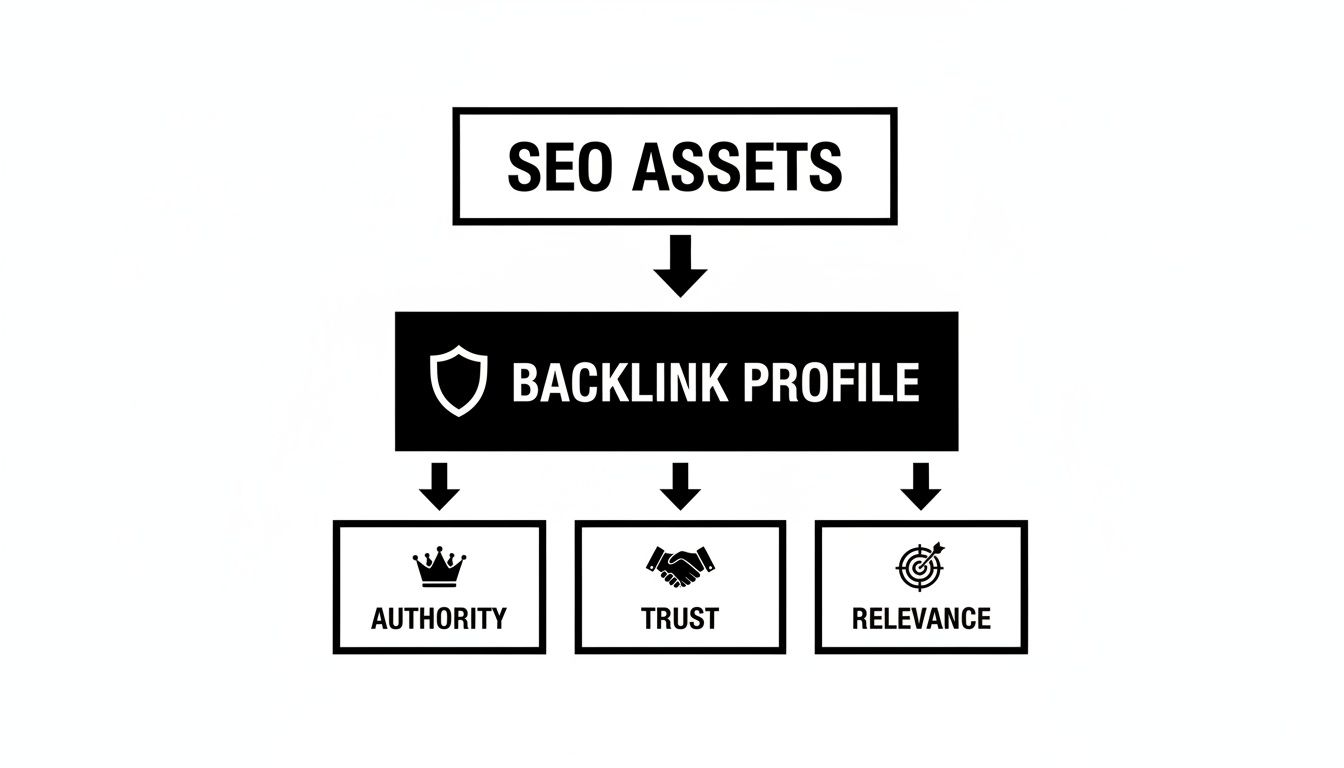
As you can see, those three pillars—authority, trust, and relevance—are all held up by the quality of your backlink profile.
Referring Domains: The Foundation of Diversity
The number of referring domains is simply the count of unique websites that link to you. It's about variety.
Imagine this: getting ten great reviews for your commercial oven from ten different, respected chefs is far more impressive than getting all ten reviews from a single person. Each new, high-quality domain that links to you is a fresh vote of confidence from a totally independent source.
Anchor Text: The Contextual Clues
Anchor text is the clickable text in a link. It’s a road sign for both users and search engines, giving them a hint about where the link is taking them. A healthy backlink profile has a natural mix of different anchor text types.
For a restaurant equipment supplier, this might look like:
- Branded: "Restaurant Equipment SEO"
- "Naked" URL: "restaurantequipmentseo.com"
- Generic: "click here" or "find out more"
- Topic-related: "guide to commercial refrigeration"
If every link uses the exact same keyword, like "best commercial oven," it looks completely unnatural and can actually trigger search engine penalties.
Link Quality: The Authority Signal
Let's be clear: not all links are created equal. The quality of a link is all about the authority and trustworthiness of the website it's coming from.
A single link from a major industry publication like Foodservice Equipment Reports can be worth more than a thousand links from sketchy, unknown blogs. It’s a huge signal. In fact, a recent study showed that 94% of link builders now focus on the authority of the linking site, not just the raw number of links.
Link Relevance: The Contextual Connection
Relevance is all about how closely the linking website's topic matches your own. For a food service supplier, a backlink from a culinary school's blog is gold—it's highly relevant. A link from a site about classic car repair? Not so much.
Google uses this connection to understand what your website is all about. The more relevant links you have, the clearer the signal you send that you're an expert in the restaurant equipment world.
A healthy backlink profile tells a consistent story. A link from a relevant, high-authority site is a powerful chapter in that story. A link from an irrelevant, spammy site is like a nonsensical sentence that just throws the whole narrative off.
Link Velocity: The Pace of Growth
Link velocity is the speed at which your website gets new backlinks. A natural profile grows at a steady, believable pace. A massive, sudden spike in hundreds of new links overnight looks incredibly suspicious to search engines and often gets flagged as a manipulative tactic.
Organic growth is what you're after. As you create great content and build real relationships, you should see a slow and steady increase in backlinks.
Dofollow vs. Nofollow Links: Guiding the Crawlers
Links can have attributes that tell search engines how to handle them. The two you’ll hear about most are "dofollow" and "nofollow."
- Dofollow links are the standard. They pass "link equity" (or authority) from their page to yours, directly boosting your SEO.
- Nofollow links have a tag telling search engines not to pass that authority. They're often used for paid links or comments sections.
While dofollow links carry more SEO weight, a natural profile has a mix of both. A good target ratio is around 70% dofollow to 30% nofollow. If you want to dive deeper, you can learn more about dofollow backlinks in our guide.
Link Toxicity: The Unwanted Associations
Finally, link toxicity refers to harmful backlinks from spammy, penalized, or just plain low-quality websites. These links can actively damage your site's reputation. It’s a bigger problem than you might think—up to three out of every ten backlinks could be potentially toxic.
Finding and removing (or "disavowing") these toxic links is like weeding a garden. You have to clear out the junk to let the good stuff grow.
How to Analyze Your Own Backlink Profile
Knowing what a backlink profile is is one thing. Actually digging into your own data? That's where the real competitive advantage lies.
Don't worry, analyzing your profile isn't some mystical, overly technical process. It's really about using the right tools to ask the right questions, and then turning that information into a clear action plan.
Think of it like a restaurant owner taking inventory. You wouldn't try to run a kitchen without knowing exactly what’s in your walk-in, how fresh your ingredients are, or which suppliers you can count on. A backlink audit is your digital inventory check—it reveals the strength, quality, and potential risks hiding in your online reputation.
Choosing Your Toolkit
First things first, you’ll need an SEO tool that can crawl the web and gather a complete list of links pointing to your site. Industry-standard platforms like Ahrefs, Semrush, and Moz are the top contenders, each offering powerful features to deconstruct your backlink profile. They are paid services, but most offer free trials or limited free versions that give you more than enough data for a solid first look.
For a quick peek, a free backlink checker tool can give you a high-level overview of the most important metrics.
This kind of snapshot gives you an instant health check, showing you essential data points like Domain Rating (DR), the total number of backlinks, and how many unique websites are linking to you.
Key Metrics to Focus On
When you run your first report, you’ll be hit with a lot of numbers. It can be a little overwhelming, but for a restaurant equipment supplier, these are the metrics that truly matter:
- Domain Rating (DR) or Domain Authority (DA): This is a score from 0-100 that estimates your website's ranking potential based on its backlink profile. A higher score means more authority. Simple as that.
- Referring Domains: This is the count of unique websites linking to you. Getting 10 links from 10 different sites is almost always better than 10 links from one site. You want to see this number grow steadily.
- Anchor Text Distribution: The report will break down the exact words and phrases people use to link to your site. You're looking for a natural, healthy mix of your brand name, generic terms ("click here"), and topic-related keywords.
- Top Linked Pages: This shows you which of your pages attract the most links. Are they your product pages for commercial refrigerators, your guide to choosing a convection oven, or your homepage? This tells you what content other websites find most valuable.
Once you get the hang of looking at your own site, the next step is a game-changer: you can analyze competitor backlink profiles. This lets you see exactly where your rivals get their authority and uncovers a goldmine of new link-building opportunities for you.
A Simple Audit Framework
Ready to dive in? Here’s a straightforward process to turn all that data into actionable insights.
- Run a Backlink Report: Enter your domain into your chosen tool (like Ahrefs or Semrush) and export a complete list of your backlinks.
- Assess Overall Authority: Check your Domain Rating (DR). How does it stack up against your direct competitors? This gives you an immediate benchmark.
- Review Referring Domains: Take a look at the actual websites linking to you. Are they relevant to the food service industry? Do they look like trustworthy sites, or are they spammy? If you're not sure how to find sites linking to your site, our guide can walk you through it.
- Analyze Anchor Text: Is your anchor text profile looking natural? If a huge percentage of your links use the exact same keyword anchor (e.g., "commercial ice machine"), that can look unnatural to search engines and raise a red flag.
A backlink audit isn't about chasing a perfect score. It's about identifying patterns, spotting opportunities, and catching potential problems before they can hurt your rankings. Think of it as preventative maintenance for your most valuable digital asset.
By regularly checking these key areas, a restaurant equipment supplier can stop guessing what works and start making data-driven decisions that build a much stronger, more resilient online presence.
Comparing Top Backlink Analysis Tools
Picking the right tool often comes down to your budget, your technical comfort level, and the specific data you're after. While there are many options, Ahrefs, Semrush, and Moz are the undisputed leaders in the space. Here’s a quick comparison to help you decide which platform might be the best fit for your business.
| Tool | Best For | Key Backlink Features | Price Point |
|---|---|---|---|
| Ahrefs | In-depth data and the largest link index | Site Explorer, Link Intersect, Broken Link Checker | Starts at $99/mo |
| Semrush | All-in-one SEO and marketing platform | Backlink Audit Tool, Toxicity Score, Link Building Tool | Starts at $129.95/mo |
| Moz | User-friendly interface and core metrics | Link Explorer, Spam Score, Domain Authority (DA) | Starts at $99/mo |
Ultimately, you can't go wrong with any of these three. They all provide the critical information you need to understand your backlink profile and start improving it. Many businesses start with a free trial to see which interface they prefer before committing.
Wrestling with Common Backlink Problems
No matter how well you manage your website, backlink issues can creep in over time. Spotting and fixing these problems isn't just about SEO tidiness—it's about defending your site's authority and its ability to rank. Think of this as your field guide to troubleshooting your online reputation.
Many of these issues can quietly sabotage your SEO, leading to stagnant rankings or even a drop that leaves you scratching your head. But once you know the warning signs, you can be proactive and keep your backlink profile healthy and working for you, not against you.
Problem 1: A High Toxicity Score
A high toxicity score is a genuine red flag. It’s a sign that too many of your backlinks are coming from spammy, irrelevant, or downright penalized websites. In Google’s view, these are bad references that can actively tarnish your reputation.
-
What It Looks Like: Your go-to SEO tool, like Semrush or Moz, is flashing a high "Toxicity Score" or "Spam Score." You might also see a sudden tank in rankings, especially after a Google update, or notice a weird influx of links from junk directories, gambling sites, or foreign-language websites totally unrelated to the food service industry.
-
How to Fix It: It's time for a link detox. The process involves carefully auditing your backlinks, singling out the toxic ones, and then telling Google to ignore them. You accomplish this by creating a "disavow file"—a simple text file listing the domains you want nothing to do with—and uploading it via Google Search Console. This is you telling Google, "Hey, don't hold those sketchy links against me."
Think of a backlink audit as weeding a garden. It’s not a one-and-done job. You have to regularly check for and disavow toxic links to stop them from choking out the healthy growth you've worked so hard to cultivate.
Problem 2: Over-Optimized Anchor Text
It might feel like a savvy move to have every backlink use your target keywords, like "commercial refrigeration units," but this is a massive red flag for search engines. An over-optimized anchor text profile screams "unnatural and manipulative" because real people just don't link that way. A healthy profile is a diverse mix.
-
What It Looks Like: Your backlink audit shows a huge chunk—say, over 60%—of your anchor text is exact-match keywords. You’ll see a glaring lack of branded anchors (e.g., "Your Company Name"), "naked" URLs (just your website address), or generic phrases like "click here" or "read more."
-
How to Fix It: You can't just go back and change old anchor text, so the strategy here is dilution. Your goal is to earn new links that use branded, URL, and generic anchors to create a more balanced, natural-looking profile. For instance, next time you write a guest post for a culinary blog, ask them to link back using your brand name or the full URL instead of cramming in another keyword.
Problem 3: A Sudden Drop in Referring Domains
Seeing the number of websites linking to you suddenly plummet can be jarring. This signals a direct loss of authority and can absolutely drag down your rankings. It often happens when a site that gave you a powerful link removes it, or when a website that linked to you multiple times simply goes dark.
-
What It Looks Like: You're looking at your SEO tool's dashboard and see a graph of your "Referring Domains" taking a nosedive.
-
How to Fix It: Put on your detective hat. First, figure out what happened. Use your backlink tool to identify which specific links disappeared. If a valuable link was removed, it’s worth sending a polite email to the site owner to ask what happened and if they’d consider putting it back. If the link is gone for good, the only real solution is to get back out there and ramp up your link-building efforts to replace that lost authority with fresh, high-quality links.
Strategies for Building a Winning Backlink Profile
So, you’ve audited your backlink profile and cleaned up the junk. What now? It’s time to shift from defense to offense and start proactively building a profile that gives you a real competitive edge. This isn't about finding quick tricks or loopholes; it's about creating genuine value that makes other authoritative sites want to link to you.
The fundamental idea is simple: become a resource. When your website is the go-to place for valuable information in the food service industry, others will naturally reference your work. This flips the script from chasing links to earning them.
Create Link-Worthy Content
Your content is the single most powerful tool you have for building links. Forget generic blog posts. The goal is to create deep, insightful resources that solve actual problems for restaurant owners, chefs, and facility managers. This is the kind of stuff that gets shared and linked to.
Think about developing assets like these:
- Comprehensive Buyer's Guides: Imagine a definitive guide to choosing commercial refrigerators. It could cover everything from capacity and energy efficiency to detailed brand comparisons. That's a resource people will reference for years.
- Original Research or Data: Why not survey a few hundred restaurant owners about their biggest food waste challenges and publish the findings? Unique data is a magnet for links from industry publications.
- Interactive Tools: A simple online calculator that helps a pizzeria owner figure out the perfect size for their next commercial oven is incredibly useful and highly linkable.
It all boils down to creating the best, most helpful answer on the internet for a very specific problem.
A natural backlink profile is the result of earning trust over time. It’s a signal to search engines that your website is a credible authority, built by providing real value, not by manipulating rankings.
Build Genuine Industry Relationships
At its heart, sustainable link building is all about relationships. The food service world is a pretty tight-knit community, and your digital network should be a reflection of that.
Start by mapping out the key players in your space:
- Industry Blogs and Publications: Identify the top culinary and restaurant management blogs. Don't just show up asking for a link; engage with their content, leave thoughtful comments, and build a rapport first.
- Manufacturers and Suppliers: Nurture strong connections with the manufacturers whose equipment you sell. They often have partner or distributor pages and might be happy to feature you as a trusted source.
- Industry Associations: Get involved with food service associations. This can open the door to listings in member directories and other natural link opportunities that your competitors might be overlooking.
These relationships lay the groundwork for earning the kind of natural, high-authority links that Google loves. For a deeper dive, check out our complete guide on how to build links for your business. When you focus on creating value and making real connections, you’ll build a backlink profile that does more than just boost rankings—it cements your reputation as a leader in the industry.
Frequently Asked Questions
So, How Many Backlinks Do I Actually Need to Rank?
That's the million-dollar question, isn't it? The honest answer is: there's no magic number. It's far more important to focus on the quality and relevance of your links than just racking up a high count. Think of it this way—a single, glowing recommendation from a top food industry publication is worth more than a hundred random links from unrelated blogs.
A great place to start is by looking at what's already working. Analyze the backlink profiles of the companies that are currently ranking on the first page for the keywords you're targeting. This doesn't mean you need to match them link-for-link, but it gives you a realistic benchmark for what it takes to compete.
The goal isn't to get the most links; it's to earn the best links. One link from an industry authority is more valuable than a hundred from irrelevant directories, proving your site's credibility.
How Long Until I See Results From Link Building?
Building links is a marathon, not a sprint. While you might spot a little positive movement in a few weeks, most SEOs agree it takes anywhere from 1 to 6 months to see a real, significant impact on your rankings from new, high-quality backlinks.
The key here is consistency. Building a powerful backlink profile is an ongoing process. It’s a lot like building a solid professional reputation in the real world—it happens gradually and compounds over time with steady effort.
Can Bad Backlinks Actually Hurt My SEO?
Yes, they absolutely can. A backlink profile full of toxic, spammy, or completely irrelevant links is a major red flag for Google and can lead to penalties. These penalties can tank your search rankings or, in the worst-case scenarios, get your site de-indexed from search results entirely.
This is precisely why running regular backlink audits is non-negotiable. If you find harmful links pointing to your site, you’ll want to use Google’s Disavow Tool. This is your way of telling search engines, "Hey, I don't endorse these links, please don't count them against me."
Ready to build a backlink profile that establishes you as a leader in the food service industry? The experts at Restaurant Equipment SEO use proven strategies to earn high-authority links that drive qualified traffic and grow your business. Discover our specialized link building services today!