
What Is Anchor Text in SEO and How Does It Affect Rankings?
Let’s get right to it. What exactly is anchor text? It’s simply the visible, clickable words in a hyperlink. Think of it as a signpost on the internet, pointing both people and search engines where a link is headed and what they’ll find when they get there. Its role in SEO is huge, and getting it right is non-negotiable.
What Is Anchor Text and Why Does It Matter for SEO?
Anchor text is all about context. It gives search engines powerful clues about the topic of the linked-to page, which directly influences how that page ranks.
Let’s say you’re a restaurant equipment supplier. A link from a popular food blog that says "high-performance commercial stand mixers" is gold. It tells Google precisely what your page is about. A link that just says "click here"? That’s a missed opportunity—it offers zero contextual information.
It wasn't always this way. Before Google's Penguin update completely changed the game in April 2012, the strategy was often blunt force. SEOs would cram their exact target keywords into their anchor text, and it worked. It wasn't uncommon to see sites dominate search results with over 50% of their links using the very same keyword phrase. Times have definitely changed.
The Power of Context
At its core, anchor text connects two separate pages with a clear, relevant bridge. When someone sees descriptive text, they know what to expect and can click with confidence. This simple act builds trust, improves the user's experience, and lowers the chances they'll immediately leave your site—all great signals for search engines.
Understanding anchor text is a key piece of the much larger puzzle of Search Engine Optimization (SEO), which is all about making a website more visible in search results.
In essence, every hyperlink on the web is a vote of confidence from one page to another. The anchor text is the reason for that vote, explaining to Google why the linked page is a valuable resource.
To help you build a natural link profile that Google will love, it's crucial to know the different kinds of anchor text you'll be working with. The table below breaks down the most common types.
Why Anchor Text Is a Critical Ranking Factor

Anchor text isn't just the clickable part of a link; it’s one of the most powerful signals you can send to a search engine about your content's relevance. Think of the internet as a massive, interconnected map. Your website is a destination, and backlinks are the roads leading to it.
The anchor text is the road sign telling Google exactly what that destination is all about.
A link pointing to your commercial freezer page with the anchor text “energy-efficient walk-in freezers” is an incredibly clear signal. It helps Google understand precisely what that page offers, making it more likely to show up when a restaurant owner searches for that exact term.
Building Topical Relevance and Authority
Every time another website links to you, it’s essentially casting a vote of confidence for your page. The anchor text is what gives that vote its context. A flood of links with relevant, descriptive anchors tells Google that your page is an authoritative resource for that specific subject.
This is a core part of off-page SEO. High-quality links from other sites are like endorsements, and the anchor text on those links reinforces your expertise. When Google’s algorithms crawl these links, they see a clear pattern of contextual signals, which directly helps your pages rank higher for those keywords.
Key Takeaway: Anchor text from other websites acts like a specific endorsement for a topic. The more relevant and authoritative these endorsements are, the higher you’re likely to rank for those terms.
For a link to pass on this ranking "juice," it typically needs to be a "do-follow" link. If you want to get into the nuts and bolts of how this works, our guide on do-follow backlinks breaks down how they transfer authority.
Enhancing User Experience and On-Site Metrics
Good anchor text does more than just talk to search engines—it sets clear expectations for your human visitors. When someone knows what they’re clicking on, it dramatically improves their experience, which has a ripple effect on key metrics that Google pays close attention to.
-
Reduces Bounce Rate: Users who know what to expect are far less likely to hit the "back" button. A lower bounce rate signals to Google that your page is a good answer to their query.
-
Improves Navigation: Within your own site, descriptive anchor text makes it easy for visitors to find what they need, guiding them logically from a blog post to a product category.
-
Increases Engagement: By sending users to highly relevant content, you keep them on your site longer. More time on site is a strong positive signal for search rankings.
Ultimately, smart anchor text creates a seamless journey for your potential customers. It guides them from a general interest article to a specific product page, all while feeding Google the exact information it needs to rank you well.
The Different Flavors of Anchor Text
To really get a handle on anchor text, you need to see all the different forms it can take. Each type sends a slightly different signal to search engines and plays a specific role in your overall SEO strategy. A healthy backlink profile isn't just one note; it's a symphony of different anchor text types working together to look natural and build authority.
Think of it like stocking a commercial kitchen. You wouldn't just buy a hundred spatulas. To be functional, you need a diverse mix of equipment—ovens, freezers, mixers, and yes, a few spatulas. Your anchor text portfolio is the same; it needs variety to be effective and keep you safe from search engine penalties.
Exact-Match and Partial-Match Anchors
These are the heavy hitters—the most keyword-focused types of anchors. When you use them right, they pack a serious punch for your rankings.
Exact-Match Anchor Text is exactly what it sounds like. The clickable text is the precise keyword you want that page to rank for. It's a loud and clear signal to Google about what the page is about.
- Example: A link with the text "commercial convection ovens" pointing directly to your product category page for those ovens.
Partial-Match Anchor Text is a close cousin. It includes your target keyword but mixes it with other words, making it sound more natural. This still gives Google strong clues without being quite as aggressive.
- Example: A link that says "this guide to commercial convection ovens" pointing to that same page.
A word of caution: while these are powerful, they must be used sparingly. Overdoing it with exact-match anchors is one of the biggest red flags for Google and a quick way to get penalized.
Branded and Naked URL Anchors
These anchors are your foundation for building brand authority and trust. For most businesses, these are the types of links you'll naturally get over time, and they are absolutely essential for a healthy link profile.
A Branded Anchor is simply your company's name used as the link text. It’s a huge trust signal that helps Google connect your brand name with your industry.
- Example: A link with the text "Restaurant Equipment SEO" pointing to our homepage.
A Naked URL Anchor is even simpler—it's just the URL itself as the clickable text. It doesn't get more direct than this, and it looks completely organic to search engines.
- Example: A link that looks just like this: https://restaurantequipmentseo.com
When Google sees a lot of branded and naked URL anchors pointing to your site, it tells them that real people and real businesses are talking about you—not that you're just trying to game the system with keywords.
Generic and Image Anchors
Finally, a couple of other common types help round out your profile and add to that natural, diverse look.
Generic Anchors are the everyday, non-descriptive phrases you see all over the web. They don't offer much keyword value on their own, but their presence is crucial for balancing out your more targeted anchors.
- Examples: "Click here," "Read more," "Learn more," or "Download now."
Image Anchors work a little differently. When an image is the link, Google looks to the image's alt text and uses that as the anchor text. This is why descriptive alt text is so important—it’s not just for user accessibility, it’s for SEO, too. If you're building links, it's also smart to know the ins and outs of an external hyperlink to make sure you're getting the most value.
By mixing and matching these different types, you can build a backlink profile that's not only powerful but also resilient, driving real rankings and traffic for your business.
How to Build a Natural Anchor Text Profile
Back in the early days of SEO, the game was simple: stuff as many exact-match anchor texts as you could into your backlinks and watch your rankings climb. It was a brute-force approach that worked for a while. Then came the Google Penguin update, and the game changed overnight.
That update was Google's way of telling the world to stop trying to manipulate its algorithm. It specifically targeted sites with unnatural, spammy-looking backlink profiles. The core lesson from that shake-up still holds true today: a healthy link profile is all about diversity and balance, not keyword stuffing. It needs to look like it was earned, not engineered.
The Shift to a Natural Link Profile
The goal now isn't to force keywords into every link. Instead, you want to build a profile that looks like real people are linking to your site because they find it valuable. Think about it—when someone naturally links to a helpful article, they're more likely to use your company's name or a simple phrase like "check this out" than a perfectly optimized keyword.
This means creating a healthy mix of branded terms, naked URLs, generic phrases, and only a tiny, strategic dose of keyword-rich anchors. Pushing too hard on exact-match keywords is now a huge red flag for search engines.
A natural anchor text profile is your best defense against algorithmic penalties. It focuses on building brand authority and user trust rather than chasing short-term keyword wins.
This approach does more than just keep you out of trouble with Google. It builds a rock-solid foundation for long-term growth. When your link profile looks organic, you’re playing the same game as Google—rewarding quality and authority. Of course, this all starts with solid link-building practices. If you need a refresher, our guide on how to build links is a great place to start.
Finding the Right Anchor Text Ratios
So, what does this "ideal balance" actually look like? While there's no single magic formula that works for every website, years of data have given us a pretty clear picture of what a healthy, penalty-proof profile entails.
The chart below gives a great visual breakdown. Notice how branded anchors are the star of the show, making up the largest slice of the pie.
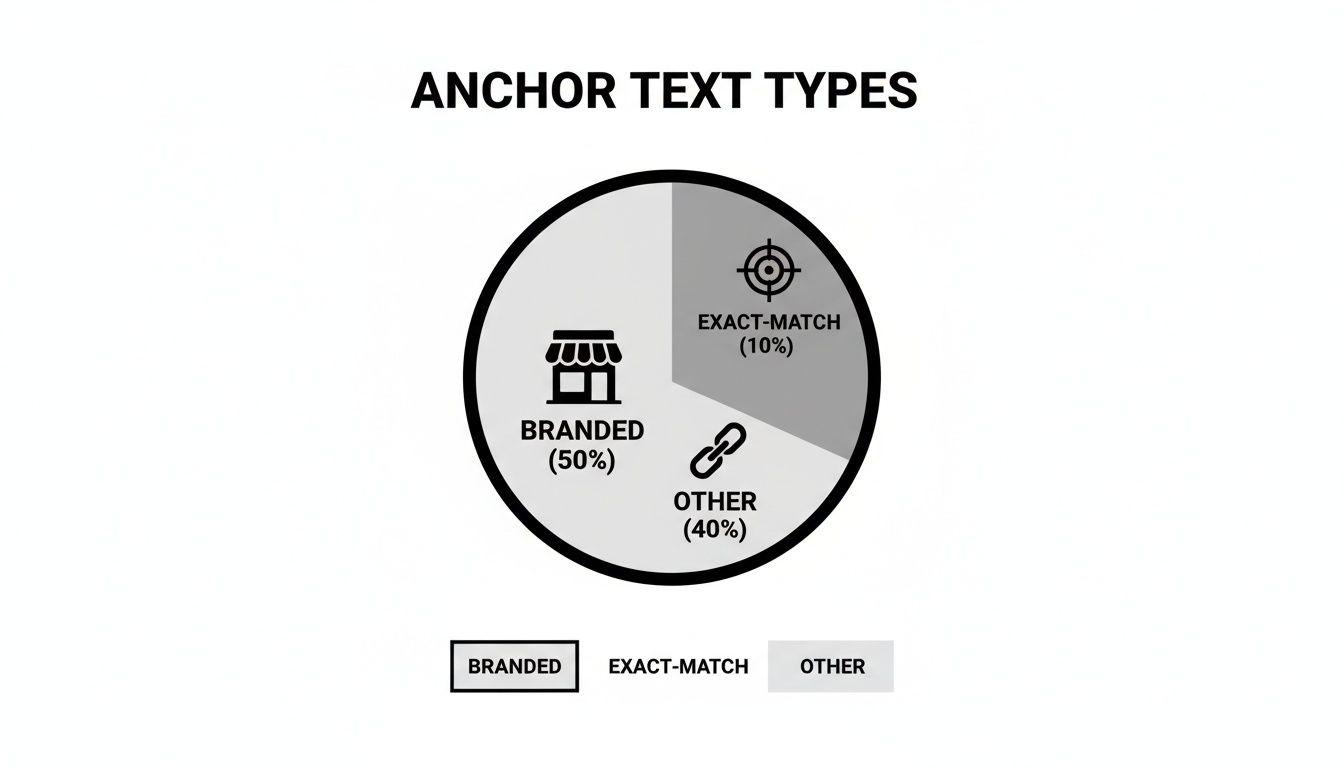
As you can see, keyword-specific anchors are used sparingly. The bulk of your links should be building up your brand's authority, which sends a powerful trust signal to search engines.
Recommended Anchor Text Distribution for a Healthy Profile
To put this into practice, here’s a guideline for the ideal percentage mix of different anchor text types. Following this model will help you maintain a natural and effective backlink profile that supports sustainable growth.
| Anchor Text Type | Recommended Percentage | Strategic Purpose |
|---|---|---|
| Branded | 45-50% | Builds brand authority and trust. This is the safest and most natural type of link. |
| Naked URL | 20-25% | Looks completely natural, as people often copy and paste URLs directly. |
| Generic | 15-20% | Adds variety and mimics natural linking patterns (e.g., "click here," "read more"). |
| Partial-Match | 5-10% | Provides keyword context without being overly aggressive. |
| Exact-Match | Less than 5% | Used sparingly on high-authority, relevant links to target specific keywords. |
This balanced approach is the key to building a profile that not only avoids penalties but actively works to improve your SEO performance over the long haul.
Analyzing and Optimizing Your Anchor Text Strategy

Knowing the theory behind anchor text is a great start, but the real gains happen when you roll up your sleeves and put it into practice. Your first move should always be a thorough audit of your current backlink profile. This is all about using SEO tools to get an honest, data-backed picture of how other websites are linking to yours.
Think of it as taking inventory of your digital reputation. You can’t plan a route forward until you know exactly where you stand. Tools like Ahrefs, Semrush, or Moz are non-negotiable here; they do the heavy lifting of compiling all your anchor text data into one place.
Conducting Your Anchor Text Audit
Once you’re in the data, you're on a mission to spot imbalances—the kind that might be holding your site back or, worse, putting you in Google's penalty box. The goal is to find those red flags before they turn into real SEO problems.
Your audit should zoom in on a few key issues:
- Over-Optimization: Do you see one specific keyword showing up way too often? A heavy lean on a single exact-match anchor is a classic sign of an unnatural profile that Google will eventually notice.
- Lack of Branded Terms: Are people linking to you using your actual business name? If not, you're missing out on powerful brand authority signals.
- Too Many Generic Anchors: Is your profile filled with links that just say “click here” or “read more”? A few are perfectly normal, but too many will seriously dilute the value and context of your backlinks.
Strategies for Optimization
With your audit done, you can finally build a data-driven plan to steer your anchor text strategy in the right direction. This means cleaning up what you can from the past and being much more intentional about your link-building efforts going forward.
Key Insight: The ultimate goal of optimization is to build a profile that looks completely natural. Focus on creating a diverse, balanced mix of anchors that builds authority and trust with search engines over the long haul.
When you’re working on new link-building campaigns, like writing a guest post, aim for a healthy blend of branded and partial-match anchors. So, if another site agrees to link to your page on commercial refrigerators, don't just ask for the anchor "commercial refrigerators." Instead, suggest something more natural, like "as this guide from [Your Brand] explains."
And don't forget about your own backyard: internal linking. This is one area where you have 100% control. Use descriptive, keyword-relevant anchor text on links within your own website to show Google how your pages are all connected. It’s a simple but powerful way to signal what your most important content is all about.
To take your content's performance even further, be sure to incorporate these essential SEO content writing best practices. When you combine a smart anchor text strategy with genuinely high-quality content, you've got a potent recipe for SEO success.
Common Anchor Text Questions Answered
As you start fine-tuning your link-building strategy, a few questions always seem to come up. Getting these details right is what separates a good strategy from a great one. Let's dig into some of the most common head-scratchers I hear from clients.
How Many Exact-Match Anchors Are Too Many?
This is the big one, isn't it? While there’s no single magic number that Google has published, the experienced SEO community has a pretty solid consensus: less is more. As a smart rule of thumb, keep your exact-match anchors to less than 5% of your total backlink profile.
Honestly, the tipping point isn't about hitting a specific number. It's about looking natural. If your link profile looks like you manually built every single link to target a keyword, you're waving a giant red flag at Google. You want your links to look like they happened organically, which means most of them will be branded terms or naked URLs.
Are Internal Link Anchors Different From External Ones?
Absolutely. They play by a completely different set of rules, and this is where you have a huge advantage. You have 100% control over your internal links, making them a fantastic tool for telling Google exactly what your pages are about.
Go ahead and be descriptive. Linking from a blog post about kitchen ventilation to your commercial hood category page with the anchor text "high-performance exhaust hoods" is a smart, effective move. It builds topical authority and helps Google connect the dots. But when it comes to external links (backlinks from other sites), your main goal has to be maintaining a natural, diverse profile to stay out of trouble.
Key Takeaway: Be specific and keyword-focused with your internal links to guide search engines. For external links, play it safe and aim for natural diversity, with a strong preference for branded anchors.
Can I Change the Anchor Text of an Existing Backlink?
It’s tricky, but not impossible. Since the link is on someone else's website, you can't just log in and edit it. Your only option is to reach out to the site owner or editor and ask for the change.
Whether they say yes often comes down to your relationship with them and how you frame the request. The best way to approach it is to show them what's in it for them and their audience. For example, you could explain that changing the anchor text to something more descriptive will add clarity for their readers, or you could point them to a newer, more relevant resource on your site.
What Should I Do if My Profile Is Over-Optimized?
First, don't panic. If you've run an audit and see a ton of exact-match anchors pointing to your site, the fix is to focus on dilution and diversification from this point forward.
- Build Branded Links: Make your brand name the hero of your next link-building campaign.
-
Go for Naked URLs: Links that are just your raw URL (like
https://www.yoursite.com) are your best friend right now. - Use Natural Language: When you have a say in the anchor text, push for partial-match phrases or even generic anchors that feel conversational.
This isn't an overnight fix. But over time, this approach will rebalance your anchor text ratios, lower the percentage of risky links, and build a much healthier, more resilient backlink profile.
Ready to build a powerful, penalty-proof anchor text strategy for your business? At Restaurant Equipment SEO, we specialize in creating targeted SEO campaigns that drive real results in the food service industry. Learn how we can boost your visibility today!