
What Is Organic Search Traffic A Complete Guide
Let's cut right to it. Organic search traffic is all the people who land on your website after finding you through a search engine like Google—without you paying for an ad. They typed in a question or a product name, saw your site in the search results, and clicked. Simple as that.
Think of it like this: your website is a specialized shop in a huge, bustling city. Organic traffic isn't from the giant, expensive billboard you bought on the main highway. It's from people who looked you up in the most trusted local guide, saw you recommended as the best place for what they need, and walked right through your front door.
These visitors are gold. They aren't just browsing; they have a specific problem to solve or a product to find. That active, high-intent mindset is what makes them so much more likely to engage with your content, request a quote, or make a purchase.
Why It's the Backbone of Your Online Presence
You can't buy this kind of traffic. You have to earn it. This is where a smart Search Engine Optimization (SEO) strategy comes into play. It’s the hard work of proving to search engines that your website has the most helpful, relevant, and trustworthy answers for your potential customers.
For a deeper dive into the mechanics of it all, check out our comprehensive guide to organic search traffic.
To help you quickly grasp the core idea, the table below breaks down the defining features of organic search traffic.
Key Characteristics of Organic Search Traffic
| Characteristic | Description |
|---|---|
| Origin | Comes from unpaid, natural listings on search engine results pages (SERPs). |
| Cost | It's considered "free" because you don't pay per click, but it requires an investment in SEO. |
| User Intent | Typically very high. Users are actively searching for information, solutions, or products. |
| Trust Factor | High. Users often trust organic results more than paid ads, seeing them as more authentic. |
| Sustainability | Once you rank, it can provide a consistent stream of traffic over the long term, unlike paid campaigns. |
In short, these characteristics show why organic traffic isn't just another number—it’s a powerful signal of your brand's authority and relevance in the market.
Just How Big is Organic Search?
It's difficult to overstate how dominant this channel is. Organic search drives a staggering 53% of all website traffic across the internet. That figure absolutely eclipses every other source, like social media or paid ads.
When one channel is responsible for more than half of all website visitors, you know it's where you need to be focusing your efforts. It's the key to predictable, long-term growth for your business.
So, what is organic search traffic at its core? It's the digital version of a stellar reputation. It’s a direct line to customers who are actively looking for exactly what you sell, built on a foundation of trust and relevance.
How Organic Traffic Compares to Other Sources
https://www.youtube.com/embed/wie29aRIZHM
To really appreciate what organic search traffic can do for your business, it’s helpful to see how it stacks up against the other ways people find your website. The reality is, not all traffic is the same. Each channel brings in a visitor with a different mindset and offers a unique kind of value.
Think of your website as a physical showroom for restaurant equipment. The different traffic sources are just the various ways customers might walk through your door.
The Rented Billboard vs. The Trusted Guide
Paid search traffic is like renting a giant, flashy billboard on the busiest highway in town. You pay top dollar for a premium spot, and you get immediate attention. The second you stop paying the rent, though, that billboard comes down, and the flood of visitors dries up. It’s a fantastic tool for quick results, but it’s a constant expense.
Organic search, on the other hand, is like being the number one recommendation in the city's most respected restaurant guide. You didn't pay for that spot; you earned it by consistently proving your expertise and building a solid reputation. People seek you out because they trust that recommendation. For a closer look at how these two powerful channels can work together, see our breakdown of the relationship between SEO and SEM.
Organic search traffic builds a sustainable business asset. Every piece of content you create is like buying a small piece of digital real estate that can attract customers for years, long after the initial work is done.
Social, Referral, and Direct Traffic
Other common traffic channels bring different types of visitors to your digital doorstep.
- Social Traffic: This is like striking up a conversation in a busy town square. People are there to chat and be entertained, not necessarily to make a big purchase. It’s great for building brand awareness, but visitors from social media are rarely in an active buying mode.
- Referral Traffic: Think of this as a direct, word-of-mouth endorsement. Someone lands on your site because another website they already trust sent them your way. This traffic is often high-quality because it comes with that built-in vote of confidence.
- Direct Traffic: These are your regulars—the loyal customers who know your brand so well they type your website address straight into their browser. While this is the best sign of a strong brand, it depends on people already knowing who you are.
Organic search is the engine of discovery. It’s how brand new, highly motivated customers find you right when they need you most.
This screenshot from Google Analytics shows exactly how these channels are separated, allowing you to track the performance of "Organic Search" against others like "Paid Search," "Direct," and "Social."
To make this even clearer, let's break down the key differences between these traffic sources.
Organic vs. Other Traffic Sources: A Comparison
This table highlights the core distinctions, showing why organic search holds such a unique and powerful position in a well-rounded marketing strategy.
| Traffic Source | User Intent | Cost Model | Long-Term Value |
|---|---|---|---|
| Organic Search | High. User is actively seeking solutions, products, or information. | Investment. Pay with time, expertise, and resources, not per click. | High. Builds a lasting asset that generates traffic over time. |
| Paid Search | High. User is actively looking to buy or take immediate action. | Pay-Per-Click (PPC). Pay for every visit; traffic stops when you do. | Low. No residual value after the campaign ends. |
| Social Media | Low. User is typically browsing for entertainment or connection. | Mixed. Organic reach is limited; paid ads are common. | Medium. Builds brand awareness and community, not direct leads. |
| Referral | Varies. Depends on the context of the referring link. | N/A. Earned through relationships or valuable content. | High. Acts as a strong endorsement, building credibility. |
| Direct | High. User already knows and trusts your brand. | N/A. Driven by brand recognition and customer loyalty. | High. Represents the strength of your brand equity. |
While all these channels have their place, organic search is the foundation for long-term, scalable growth. It consistently connects you with chefs, restaurant owners, and facility managers at the precise moment they are searching for the equipment you sell.
Why Organic Search Is Your Most Valuable Asset
So, we've covered the basics of what organic traffic is. Now let's get to the heart of it: why should you care so much? Why should it be your top priority?
Think of a high ranking on Google as more than just a marketing win. It's a powerful endorsement. It's Google itself telling a potential customer that your business is the most credible and relevant answer to their problem.
That kind of trust is something paid ads just can't buy. When a restaurant owner searches for a new commercial oven and sees your site listed at the top of the real results, they instantly see you as an authority. This perception is priceless and immediately elevates you above competitors who are simply paying to be there.
Investing in a Long-Term Business Asset
Here's a crucial mindset shift: SEO isn't just another marketing expense. It’s an investment in a durable business asset.
Unlike a paid ad that disappears the second you stop paying, a well-ranked blog post or product page can bring in leads and sales for years. It becomes a piece of digital real estate that appreciates in value, continuously attracting customers without a constant cost-per-click.
The numbers back this up in a big way. Organic results on Google capture an incredible 94% of all clicks, with paid ads fighting over the leftover 6%. And the higher you are, the better it gets—the top organic result alone gets about 39.8% of all clicks. It's easy to see why 49% of marketers say organic search gives them the best return on investment. If you want to dive deeper, you can find more great stats in this in-depth report on AIOSEO.com.
Connecting with High-Intent Customers
Maybe the biggest advantage of organic search is who it connects you with. These aren't people casually scrolling through a social media feed. They have a problem, right now, and they are actively looking for the solution.
When a potential customer types "commercial refrigeration repair" into Google, they aren't just window shopping. They have a critical, urgent problem. Ranking organically for that search puts your business directly in front of a highly motivated buyer at the precise moment they need you.
This high level of intent is a game-changer. It leads to better engagement on your site, much higher conversion rates, and a smoother sales process. Instead of you spending money to find customers, organic search flips the script and has your best customers find you. That simple shift is what fuels real, sustainable growth.
How to Measure Your Organic Traffic Performance
You can’t improve what you don’t measure. Knowing what organic traffic is is the first step, but the real magic happens when you track its impact. This isn’t about getting lost in charts and graphs; it’s about knowing which questions to ask and where to find the answers that actually matter to your bottom line.
Your go-to tool for this is Google Analytics 4 (GA4). Think of it as the dashboard for your website, showing you not just how many people are stopping by, but who they are and what they’re doing. By looking specifically at your organic traffic, you can see exactly how much value your SEO efforts are creating.
Finding Your Organic Data in GA4
First things first, you'll want to head over to the Traffic acquisition report in GA4. This is your command center for understanding where your visitors are coming from. From there, you can easily filter the data to show only the "Organic Search" channel.
Suddenly, all the noise is gone, and you’re left with a crystal-clear picture of your SEO performance.
Once you have that view, you can dig into a few key numbers:
- Users: How many unique individuals found your site through a search engine.
- Sessions: The total number of visits from those users. One person can be responsible for multiple sessions if they keep coming back.
- Engaged sessions: This tells you which visits were actually meaningful. Did someone stick around, scroll, or click on something?
- Conversions: The most important metric of all. This is how many times an organic visitor actually did what you wanted them to, like filling out a quote request form.
These numbers tell a story. For example, a ton of users but very few conversions could mean your content is attracting researchers, not buyers. Or maybe your product pages just aren't compelling enough to close the deal. For a deeper dive into interpreting this data, check out our guide on how to measure SEO performance.
Key Takeaway: Measuring organic traffic is about quality, not just quantity. A great SEO strategy doesn’t just bring in more eyeballs; it brings the right eyeballs—the restaurant owners and chefs who are ready to invest in new commercial kitchen equipment.
From Data to Decisions
When you analyze which pages and blog posts are driving the most qualified organic traffic, you can start making much smarter business decisions.
Let's say you notice an article on "how to choose a commercial convection oven" is bringing in dozens of leads every month. That’s your signal to create more content just like it, maybe a comparison guide or a video tutorial.
This is how you prove the ROI of your SEO work. It transforms your marketing from a guessing game into a data-driven strategy, letting you double down on what’s working and spot new opportunities for growth. It’s how you turn clicks into customers.
Proven Strategies to Increase Organic Traffic
Knowing what organic traffic is and actually growing it are two different ballgames. Boosting your website's visibility isn't about some secret "hack." It’s about building a solid, interconnected foundation across three key areas of SEO: your content, your site's technical health, and its authority in the industry.
When you get these three things right, you send powerful signals to search engines like Google. You’re telling them that your site is a trustworthy, valuable, and user-friendly resource for people buying restaurant equipment. This isn't just theory—it's the playbook for getting more qualified customers through your digital door.
Build a Powerful Content Strategy
Think of your content as the engine driving your SEO efforts. If you want to pull in organic traffic, you have to create genuinely helpful and relevant content that answers the specific questions your potential customers are asking. That means going way beyond basic product descriptions and becoming a real resource.
Start by putting yourself in your audience's shoes. What do they really need to know before buying a commercial walk-in freezer? What are the practical differences between a convection oven and a combi oven? Answering these kinds of questions builds trust and immediately positions you as an expert they can rely on.
This entire journey—from a user's initial question to a final sale—is a flow. A potential customer starts with a search (acquisition), interacts with your content (behavior), and hopefully becomes a paying customer (conversion).
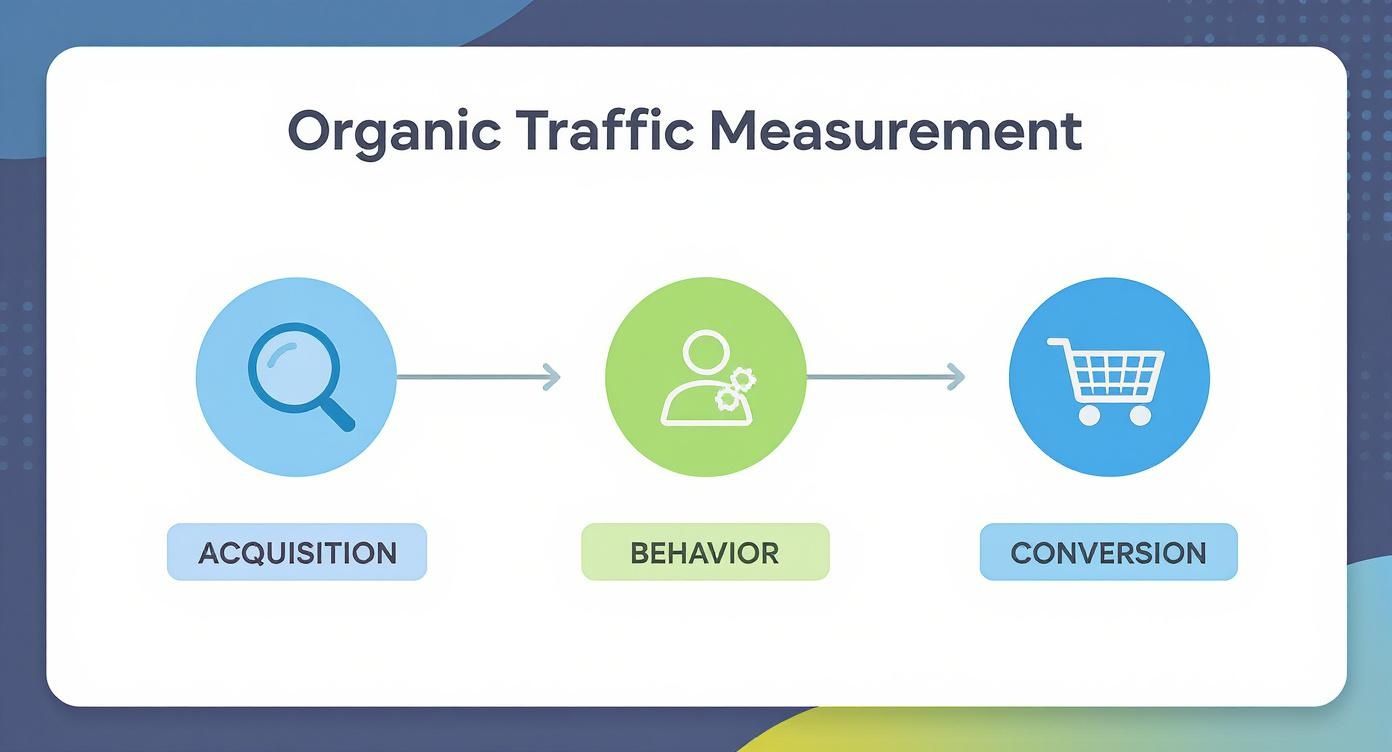
As you can see, every stage matters. Great content is the bridge that connects a curious visitor to a confident buyer, turning a simple search into a sale.
Strengthen Your Technical SEO Foundation
Technical SEO is all the work you do "under the hood" to make sure search engines can easily crawl, understand, and index your website. Here’s the hard truth: even the most brilliant content will fail to rank if your site is slow, has broken links, or isn't optimized for mobile.
It’s like the foundation of a building. It doesn't matter how amazing the interior design is if the foundation is cracked and crumbling.
Here are the absolute must-haves to get right:
- Site Speed: Your pages have to load fast. A slow website frustrates everyone and is a major red flag for Google. You should be aiming for a load time of under three seconds.
- Mobile-Friendliness: Your website must work flawlessly on smartphones and tablets. Google now uses mobile-first indexing, which means this is completely non-negotiable.
- Clean URL Structure: Keep your URLs simple, logical, and readable. This helps both users and search engines figure out what a page is about at a glance.
A technically sound website is the baseline requirement to even compete in today's search results. It ensures your amazing content actually gets a fair shot at being seen. Keeping that content up-to-date is just as important, which is why a good content refresh for SEO strategy is key to maintaining relevance and rankings.
Earn Authority with High-Quality Backlinks
Backlinks—which are just links from other websites pointing to yours—are like votes of confidence in the eyes of a search engine. When a reputable site links to your content, it’s a powerful signal that you’re a trustworthy source of information. This is how you build your site's authority over time.
But not all links are created equal. The real goal is to earn high-quality links from relevant, authoritative websites within the food service and restaurant industry. This is where creating exceptional content really pays off. In-depth guides, original data, and helpful tools are the kinds of things that other sites naturally want to link to.
This isn't just a niche tactic; it’s a fundamental part of a modern SEO strategy. By focusing on these three pillars—strong content, solid technical health, and earned authority—you can build a sustainable plan to bring a lot more organic search traffic to your website.
For a deeper dive into ethical and effective strategies, check out our complete guide to white hat SEO tactics that build lasting value.
Your Top Questions About Organic Search, Answered
As you start digging into organic search, a few questions always seem to pop up. It's completely normal. Let's tackle some of the most common ones head-on so you can move forward with a clear plan.
How Long Does This SEO Thing Actually Take?
Let’s be honest: SEO is a long game. It's more like tending a garden than flipping a switch. You'll likely start seeing the first green shoots of your efforts—maybe a few keywords inching up the rankings or a small bump in traffic—within 3 to 6 months. This is the phase where search engines are just starting to recognize and trust the changes you're making.
But for the kind of significant, business-changing traffic that comes from ranking for competitive terms? That usually takes a solid 6 to 12 months of consistent, smart work. The timeline really depends on factors like your website's history, how fierce your competition is, and the quality of your SEO strategy. Think of it as a long-term investment in a growth engine that, once running, keeps delivering value.
Can I DIY My SEO, or Do I Need to Call in a Pro?
You can absolutely get started on your own. For many business owners, especially those focused on a local market, learning the ropes of keyword research, on-page SEO, and creating useful content is totally doable. Mastering these fundamentals can get you surprisingly far and builds a great foundation.
The time to call for help is usually when things get more complex. As your business scales or you find yourself in a dog-eat-dog competitive space, the technical side of SEO, deep analytics, and strategic link building often demand a specialist. A lot of businesses find a sweet spot with a hybrid approach: they handle the day-to-day content and on-page tweaks in-house and bring in an expert for technical audits, high-level strategy, or big link-building pushes.
What's the Difference Between Organic and Direct Traffic?
This one’s simple but crucial. The difference tells you a lot about how people find you.
- Organic Traffic: These are the people who found you through a search engine like Google. They had a problem or a question, typed it in, and clicked on your site in the unpaid results.
- Direct Traffic: These visitors came to you on purpose. They either typed your website address directly into their browser or used a bookmark they'd saved. They already knew who you were.
Basically, organic traffic is a measure of your discoverability. Direct traffic is a measure of your brand recognition and customer loyalty.
Organic traffic is how new customers find you out of the blue. Direct traffic is how your loyal fans come straight back for more. You need both, but they play very different roles.
Is Organic Traffic Actually "Free"?
While it's true you aren't paying Google for every click like you do with ads, organic traffic is anything but free. Getting those high rankings requires a serious investment of either your time, your money, or (most likely) a combination of both.
The "cost" of SEO comes from multiple places. It's the hours and expertise that go into creating genuinely helpful content, the monthly fees for essential tools, the development costs for fixing technical site issues, and the strategic brainpower needed to outmaneuver competitors. The payoff, however, is that it's one of the most cost-effective channels out there. An investment made today can continue generating leads and sales for years to come, long after a paid ad campaign has been switched off.
Ready to turn these concepts into a real growth strategy for your business? At Restaurant Equipment SEO, we build powerful, data-backed SEO plans that get you in front of qualified buyers. Let us show you how a targeted approach can boost your organic traffic and your bottom line. Learn more about our SEO services.