
What Is Semantic SEO for Restaurant Equipment Suppliers
Semantic SEO goes beyond sprinkling keywords—it’s about helping search engines understand the full picture: your topics, product relationships, and what your potential customers really want. For restaurant equipment suppliers, this means showing Google how ovens, mixers, and prep tables fit together in a professional kitchen, so you attract the right buyers at the right time.
Understanding Semantic SEO Benefits
Search engines have gotten smarter. They no longer just look for exact keywords—they analyze context and intent to match queries with the most relevant content.
That evolution unlocks features like knowledge panels and featured snippets, giving restaurant equipment suppliers new ways to stand out in search results.
By weaving together entities, topic clusters, and structured data, you create a content ecosystem that speaks the same language as both Google and your audience.
Here’s what we’ll cover:
- Core concepts and component breakdown
- Step-by-step implementation for equipment suppliers
- Real-world case studies and tool recommendations
- FAQs addressing timelines, schema types, and scaling strategies
Evolution Of Search
A decade ago, SEO was all about repeating keywords exactly as typed. Today, algorithms like Hummingbird and BERT focus on meaning and context instead of exact matches.
That shift matters for restaurant equipment suppliers. Instead of optimizing separate pages for “commercial oven” and “kitchen oven,” you can build thematic clusters that highlight your full product range—from ovens to ventilation hoods—demonstrating true expertise.
When you group content around related themes, Google sees you as an authority, not just a vendor of individual items.
Semantic SEO Quick Overview
Below is a snapshot of the main semantic SEO concepts, their roles, and the impact they can have on your restaurant equipment business.
| Concept | Role | Impact |
|---|---|---|
| Entities | Identify products and brands | Improves relevance signals |
| Topic Clusters | Group related pages | Builds topical authority |
| Intent Mapping | Match user goals | Boosts conversion paths |
| Structured Data | Add schema markup | Enables rich results |
| Internal Linking | Connect content hubs | Enhances crawlability |
This table highlights how each element works together to boost visibility and guide qualified traffic to your site.
In the following sections, you’ll see how a supplier drove an 18% lift in organic traffic within three months by aligning content with user intent. We’ll also share the tools to handle entity extraction, intent analysis, and schema markup, plus the metrics you should track—like rich result impressions and entity coverage rate—to measure success.
Understanding The Key Concepts
Semantic SEO changes how search engines read a query. Instead of counting how often a keyword appears, they look for meaning and connections.
Imagine keywords as single ingredients on a countertop. Now picture entities and topics mixing together into a finished recipe.
For a restaurant equipment supplier, that shift means planning content around a kitchen ecosystem—not just one-off product pages.
When search engines spot relationships between concepts, they can serve users a menu of results that align with their true needs.
- Entities explain the “who, what, where” behind a user’s search
- Intent uncovers the goal driving each click
- Topic Relevance shows how deeply you cover a subject
- Knowledge Graph weaves together related ideas
A practical example: group pages on refrigeration, cooking appliances, and prep stations under a single hub. This way, Google sees the full kitchen picture.
As a result, niche pages for grills, ovens, and ventilation systems climb higher when searchers look for equipment solutions.
Defining Core Terms
- Entities are unique items like commercial ovens or stainless steel tables
- Intent tracks whether someone wants to learn, compare, or purchase
- Topic Relevance gauges how well your content explores connected themes
Entities and Intent now outperform exact-match keywords in search ranking.
Search algorithms have moved from keyword counting to understanding entity relationships and user goals. For deeper insights, check out the semantic SEO research on Niumatrix.
That means a restaurant equipment site should build in-depth guides instead of packing product pages with keyword phrases. These pages should go beyond simple product specs to tell a story.
You can create a content hub for ovens that links to detailed posts on dimensions, installation steps, and maintenance tips.
Why Meaning-Driven Ranking Matters
| Exact-Match SEO | Semantic SEO |
|---|---|
| Focus on single phrases | Emphasize topic depth |
| Isolated pages | Thematic content hubs |
| Limited context | Rich entity connections |
Master these ideas, and your equipment business wins better visibility over time.
A meaning-first approach creates content that resonates with Google’s algorithms and chefs making purchase decisions. It answers follow-up questions and covers related topics in one place.
- Audit existing pages for gaps in concept coverage
- Map topic clusters around categories like ovens, refrigeration, prep stations
- Use the Knowledge Graph to spot related brands, models, accessories
- Craft FAQs and subpages answering purchase queries such as “oven installation cost”
This framework shifts your strategy from chasing keywords to building topic-driven authority. It reorients planning around user needs and broader subjects.
Next, we’ll break down each semantic SEO component and outline a step-by-step implementation roadmap. You’ll get a clear path to bring these concepts into action.
A strong semantic foundation also improves internal linking and helps search bots crawl your site more efficiently. Your internal links will guide crawlers through a well-structured site.
Embracing these ideas ties ovens, mixers, and accessories into a cohesive content web. Each piece of content will reinforce the larger topic hub.
With clear organization, restaurant equipment suppliers can outrank competitors by delivering precise answers. Precise answers earn higher rankings and stronger customer trust.
This method paves the way for schema markup, entity mapping, and truly user-focused planning. It’s the next logical step for any team focused on SEO longevity.
Stay tuned further below.
Breaking Down Semantic SEO Components
Think of your website as a bustling city—each street, building, and signpost guides visitors and search engines to the right destination. In semantic SEO, we map out five core components that work together to create a seamless experience for humans and bots alike.
Below is a snapshot of how these elements translate on a restaurant equipment supplier site.
Components Comparison
Before we unpack each element in detail, here’s a side-by-side look at their roles and concrete examples:
| Component | Role | Example |
|---|---|---|
| Entities | Core landmarks defined by search intent | A page detailing full specs of a commercial oven |
| Topic Clusters | Neighborhoods grouping related content | A “Kitchen Appliance Hub” linking ovens, fridges, mixers |
| Intent Maps | Street signs guiding visitor journeys | Paths from “compare convection ovens” to buying guides |
| Structured Data | City grid informing the layout | JSON-LD schema highlighting product details and reviews |
| Internal Linking | Transit routes connecting hubs | Contextual links steering users from blog posts to product pages |
This table lays out each component’s role and a tangible example for your site. Keep it handy as we dive deeper.
Entities As Landmarks
Entities are the unique, unmistakable landmarks in your content city. They tell search engines exactly what products and brands you carry.
On a supplier website, entity-focused pages:
- List product names and detailed specifications
- Compare models side by side
- Highlight brand features and warranties
Clear entity definitions help Google match your offerings with specific queries, like “commercial deck oven maintenance.”
Tips:
- Build a product glossary for every new arrival.
- Include brand and model names along with attributes.
- Refresh pages when specs or inventory change.
Topic Clusters As Neighborhoods
Topic clusters are the neighborhoods where related pages live together. Each district signals expertise in a particular area—ovens, refrigeration, prep stations, and so on.
Grouping content into thematic clusters:
- Enhances crawl efficiency
- Demonstrates depth across equipment categories
- Encourages visitors to explore adjacent topics
Well-organized clusters boost dwell time and reinforce your authority.
To create a cohesive district:
- Link cluster pages to a central pillar page.
- Use clear, descriptive headings for each subtopic.
- Add internal FAQs in each neighborhood to answer common equipment questions.
Intent Maps As Street Signs
Intent maps act like street signs that guide users based on what they want to do—learn, compare, or buy. Aligning content with user intent smooths the path from curiosity to conversion.
Implementation steps:
- Identify top user intents: informational, comparative, transactional.
- Audit existing content for each intent stage.
- Develop pages to fill any gaps.
- Use support tickets or surveys to fine-tune your map.
Structured Data As City Grid
Think of structured data as the grid that organizes every block of your city. Schema markup lays out the blueprint for products, reviews, events, and FAQs.
On a supplier site:
- Product and Review schema can unlock rich snippets.
- Availability, pricing, and star ratings appear directly in search results.
Checklist:
- Apply JSON-LD on each product page.
- Validate with Google’s Rich Results Test.
- Track schema errors in Search Console.
- Leverage FAQ schema on category and FAQ pages.
85% of buyers compare specs online before making a purchase.
Internal Links As Transportation Routes
Internal links form the transportation network that connects landmarks and neighborhoods. A thoughtful linking strategy keeps users moving and spreads SEO value across your site.
Best practices:
- Embed contextual links within content.
- Implement breadcrumb trails for easy navigation.
- Offer sidebar or footer hubs to guide exploration.
- Use descriptive, keyword-rich anchor text—avoid over-optimization.
Learn more about optimizing on-page links in our guide on on-page optimization.
This city metaphor sets the stage for your next move: practical implementation. In the upcoming section, we’ll chart a step-by-step plan to build and refine your semantic SEO city.
Let’s get to work.
Implementation Steps For Equipment Suppliers
Start by sketching out what is semantic seo for your restaurant equipment lineup in a clear project plan. Having a detailed roadmap keeps you focused—every phase from research to reporting is accounted for.
Begin with entity research to pinpoint the key products, brands and concepts you sell. Tap into supplier glossaries, competitor catalogs and real customer questions to assemble a comprehensive list.
- Gather product names and specs for commercial ovens, mixers and refrigeration units.
- Identify related terms like “convection oven” and “walk-in freezer.”
- Tag attributes such as capacity, materials and energy ratings.
- Scan competitor sites to spot entity gaps and unique offerings.
Entity Research Checklist
- Verify brand names against manufacturer catalogs
- Confirm SKU attributes in a spreadsheet
- Cross-check synonyms and common abbreviations
- Document seasonal or regional equipment variations
A well-kept checklist makes sure your entity data stays consistent across every page.
Planning Content Hubs
With your entities in hand, sketch the framework for topic clusters—think cooking, storage and prep. Each cluster should answer the most pressing user questions and link all related pages together.
- Define a pillar page for each hub (for example, a “Commercial Oven Guide”).
- Link subpages covering specs, installation and maintenance.
- Organize FAQs and buying guides under each cluster.
- Schedule content creation and updates in your editorial calendar.
You might be interested in our guide on SEO content strategy for deeper planning: Check out our guide on SEO content strategy
Schema Markup Setup
Once your content hubs are mapped, add structured data so search engines understand your pages and entities. Proper schema boosts click-through rates by unlocking rich results.
- Implement Product schema with name, image, price and availability
- Add Review schema to showcase ratings and testimonials
- Use FAQ schema on hub pages to answer common queries
- Validate JSON-LD with Google’s Rich Results Test
In one agency project, structured data and semantically organized content drove a 12% increase in new users and an 18% rise in organic traffic within three months, proving how fast search engines reward clarity. Learn more about SEO statistics findings
The following infographic visualizes the three core semantic SEO components in a process flow and their sequence.
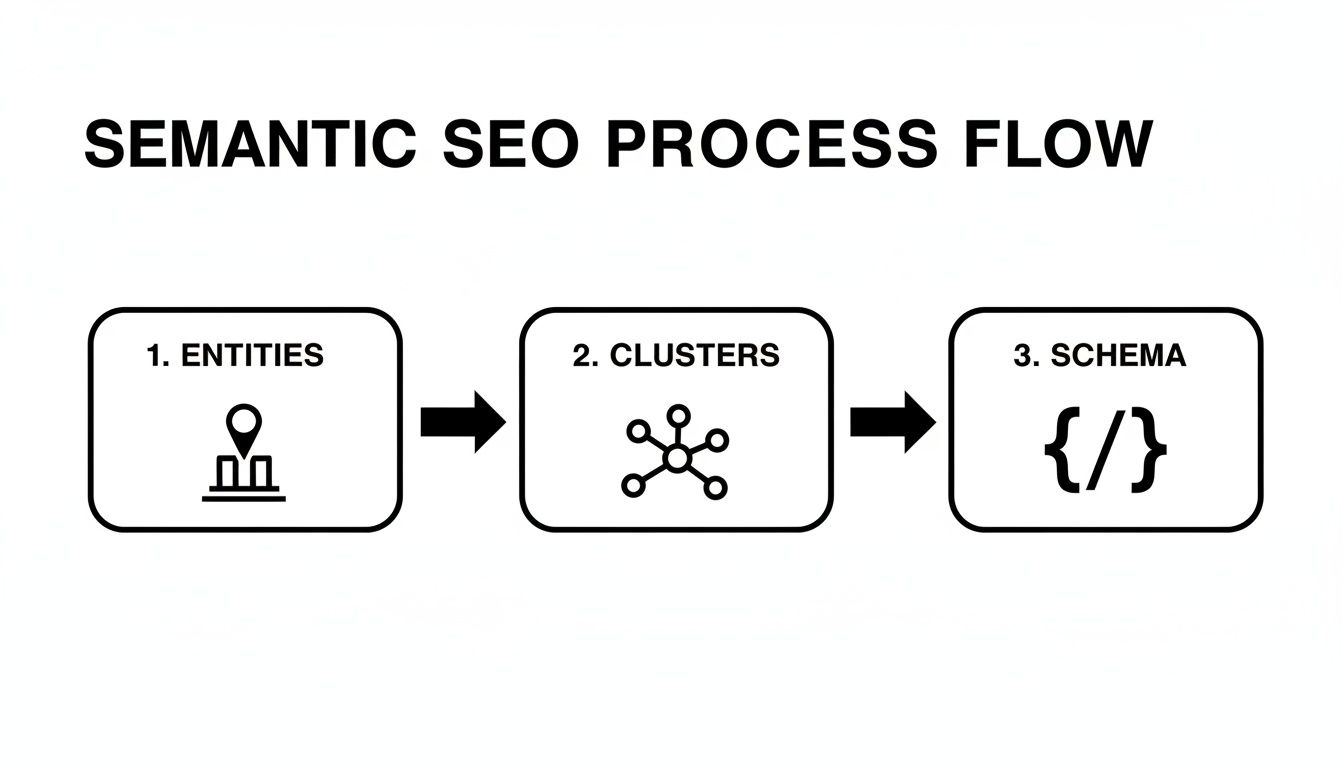
This graphic highlights the flow from entities to clusters to schema, showing how each stage feeds the next.
Mapping User Intent
For each page, match the content to a user’s intent stage—informational, comparative or transactional. Solid keyword research helps you sort queries and shape content that aligns with each stage.
Use customer surveys or support ticket logs to refine your intent mapping. That way, guides, comparison charts and product pages all serve clear user goals.
Building Internal Links
Think of your site as a city and internal links as streets guiding visitors and crawlers alike. A strategic link structure spreads authority and makes navigation smooth.
- Embed contextual links between entity pages and related hubs
- Use breadcrumb trails to reinforce site hierarchy
- Offer sidebar or footer menus linking to major clusters
- Apply descriptive anchor text that reflects page topics
Assign clear ownership for each linking task to keep the rollout organized.
Tracking Progress And Measuring Impact
Before launch, set up a measurement framework so you can see what’s working—and what isn’t.
- Create dashboards for monitoring organic traffic growth
- Track your entity coverage rate on a monthly basis
- Monitor rich result appearances and click-throughs
- Audit internal links regularly to maintain site health
Review these metrics every week to catch issues early and keep your semantic SEO strategy on track.
Real-World Examples For Restaurant Equipment Suppliers

Semantic SEO starts to make sense when you see it in action. Below, three restaurant equipment suppliers share how context and connections helped them climb search results.
These stories highlight:
- Commercial oven entity pages that landed featured snippets and boosted click-through rates
- Kitchen topic clusters that tied scattered articles into coherent guides
- Structured data markup that brought interactive product cards to the SERPs
Entity Page Wins
A mid-sized supplier was buried on page two for “commercial oven.” Their product listings mentioned ovens but didn’t explain why they mattered.
They decided to build a dedicated entity page that positioned ovens at the center of everything. On this page they:
- Defined each oven model as an entity, covering specs, brand history, and best-use scenarios
- Added a structured Q&A section on maintenance tips and feature comparisons
- Linked to deeper dives on installation guides and compatible accessories
They even followed the advice in our guide on optimizing for featured snippets.
“We saw a 32% jump in click-through rate and hit the #1 snippet slot in just six weeks.”
By the end of two months, traffic to the oven hub was up 45%, and their rankings moved from position 8 to position 1 for three high-value terms.
Cluster Model Implementation
Another supplier had a blog full of standalone posts on mixers, fryers, and sinks. Traffic trickled in, but nothing stuck.
They reorganized their content around a complete commercial kitchen concept. Think of it as a neighborhood where each street connects back to a main plaza.
Steps they took:
- Launched a pillar page called “Complete Commercial Kitchen Guide”
- Linked out to subtopics on cooking, refrigeration, prep, and cleaning
- Used uniform headings and keyword variations to reinforce related ideas
Clusters give users and search bots a logical journey through your expertise.
The results were immediate:
- 60% more page views across the cluster
- 22% drop in bounce rate on the pillar page
- An extra two minutes of dwell time per visitor
This approach also triggered new “People Also Ask” entries around kitchen setup questions.
Structured Data Conversion
A third supplier focused on product feeds but didn’t tap into enhanced search features. Their listings looked plain next to competitor rich cards.
They implemented JSON-LD schema for products, reviews, and availability—essentially the blueprint that tells Google what each page offers. Their actions included:
- Adding Product, Review, and Offer markup to every product URL
- Validating with the Google Rich Results Testing Tool
- Iterating based on validation errors and new product launches
After markup went live, interactive product cards started appearing across search results.
Inside a month, they saw:
| Metric | Change |
|---|---|
| Rich product cards displayed | +75% |
| Click-through rate on feeds | +28% |
| Rich snippet impressions | +50% |
Their product CTR climbed from 3.2% to 4.1%, and visibility for new models jumped 38%.
Measuring Your Gains
If you don’t measure, you won’t know what works. These suppliers set up weekly tracking to monitor:
- Organic traffic by entity and category
- Featured snippet count per topic
- Click-through and impression share for rich cards
Data is your compass for continuous semantic optimization.
Key Takeaways
These examples prove that semantic SEO isn’t just academic. When you:
- Build entity-focused pages, featured snippet wins follow
- Organize content into clusters, engagement grows
- Add structured data, your listings stand out in search
Use these stories as a template on your own site. Start small, track progress, and refine your signals over time.
Your next breakthrough could be right around the corner.
Recommended Tools And Metrics
If you’ve ever wondered how to spot hidden gaps in your content’s meaning, dedicated SEO tools act like a roadmap—revealing exactly where your pages fall short.
Suppliers often ask, “What is semantic SEO?” These platforms help you map searcher intent to the concepts and phrases Google expects.
Discover more insights about semantic SEO on Embryo
- SEMrush Entity Research: Scan your domain for missing concepts and see how you stack up against competitors.
- Ahrefs Topic Explorer: Uncover related questions, monthly search volumes, and overarching themes.
- Frase Content Briefs: Auto-generate outlines that weave in priority entities and subtopics.
- Schema App Markup Generator: Build ready-to-paste JSON-LD for products, FAQs, and reviews.
- Screaming Frog Site Audit: Crawl your site to detect missing schema attributes and broken links.
Here’s a screenshot showing the workflow for extracting entities from existing content.
This view highlights how entity coverage is tracked across your pages and flags areas that need extra attention.
Feature Comparison Table
| Tool | Core Function | Pricing Tier |
|---|---|---|
| Semrush | Topic Research, Schema | From $119.95/mo |
| Ahrefs | Topic Explorer, Metrics | From $99/mo |
| Frase | Content Intelligence | From $44.99/mo |
| Schema App | Schema Automation | Custom pricing |
| Screaming Frog | Technical SEO Audit | Free / £149/yr |
Each platform moves through a familiar four-step routine:
- Upload a list of URLs or seed keywords.
- Extract entities and related phrases.
- Analyze content gaps or clustering opportunities.
- Export data or code snippets for implementation.
These steps—much like a kitchen health inspection—ensure you cover every ingredient of your semantic strategy.
Essential Metrics To Track
- Rich Result Appearances: How often your site shows up in snippets, panels, or shopping carousels.
- Entity Coverage Rate: The percentage of pages that include all your priority entities.
- Organic Traffic Lift: Sessions gained after rolling out semantic updates.
- Internal Linking Health: Number of broken links and orphaned pages.
“Measuring entity coverage and rich result spikes helps SEO teams refine content strategy.”
You can stitch these metrics together in tools like Google Data Studio or SEMrush Analytics to see trends at a glance.
Setting Up Dashboards
- Connect Google Search Console and Analytics.
- Add custom widgets for entity coverage and schema errors.
- Create real-time alerts for sudden drops in rich result impressions.
- Schedule weekly performance reviews with your team.
Repeat your semantic audits monthly to stay on top of new gaps or markup issues.
Tools For Intent Analysis
- AnswerThePublic: Visualize popular questions and prepositions around your main terms.
- AlsoAsked: Map out question hierarchies and shifts in user intent.
- Clearscope and MarketMuse: Score your pages against intent-driven benchmarks.
- Google Trends: Spot emerging search patterns related to kitchen and equipment topics.
Tips For Using These Tools
- Plan quarterly site crawls with Screaming Frog to refresh internal linking.
- Use Ahrefs to update your topic clusters as new trends emerge.
- Pair Frase briefs with hands-on editorial tweaks.
- Sync Schema App code with your CMS for seamless deployment.
By weaving together semantic platforms and clear performance metrics, restaurant equipment suppliers create a feedback loop that drives continuous improvement. Monitor those trends, plug the gaps swiftly, and watch your organic presence grow.
Frequently Asked Questions
How Long Does It Take To See Results From Semantic SEO?
Most restaurant equipment suppliers begin to notice real movement in about 3–6 months. Your early focus on entity coverage and topic clusters pays off steadily, and you might even spot rich snippets popping up within a few weeks.
Which Schema Types Are Most Important For Product Pages?
Start by adding Product, Review, and Offer schemas. These three alone unlock powerful search features:
- Product: Displays the name, image, price, and SKU
- Review: Adds star ratings and customer testimonials
- Offer: Highlights stock levels and any discounts
“Structured data can lift click-through rates by 20% on average.”
Scaling Semantic Strategies
Can Small Suppliers Compete With Larger Brands?
Absolutely. Target niche equipment entities and drill down into hyper-specific queries. By creating in-depth content on those specialized topics, small sites often snag featured snippets before bigger competitors even notice.
How Do I Measure Entity Coverage On My Site?
Use your SEO tool’s entity audit feature to track how many pages include all your priority entities. Aim for 100% coverage in core product categories. Set up regular audits or dashboard alerts so you never miss a critical term—and keep every page speaking Google’s language.
Take your visibility to the next level with Restaurant Equipment SEO. Start your journey today.