
A Guide to Brand and Content Marketing for Equipment Sellers
Let's use a simple analogy: think of your business as the most talked-about restaurant in town.
Your brand is the entire experience—the buzz, the reputation, the feeling people get when they walk through the door. It’s the promise of an amazing meal and impeccable service. Your content, on the other hand, is the menu. It's the tangible, delicious proof that you can deliver on that promise, item by item.
How Your Brand Promise and Content Work Together
A stellar reputation (your brand) might get customers to make a reservation, but it's the incredible food (your content) that turns them into regulars who rave to their friends. For a restaurant equipment seller, these two things absolutely must work in harmony.
Your brand might promise durability and cutting-edge innovation. But that promise is just words until your content—like a detailed guide on preventative maintenance or a video showcasing your new oven's efficiency—proves it. Without a strong brand, your content gets lost in the noise. And without great content, your brand is just an empty slogan.
The real magic happens when you weave brand and content marketing together. This is how you stop being just another name on an invoice and start becoming a trusted partner in a restaurant owner's success. Every single piece of content you create should echo what your brand stands for.
The Relationship in Action
To really nail this, you have to see how these two forces feed each other. A great starting point is understanding the power of unifying branding and content marketing to build authority. When they're in sync, every interaction with a potential customer builds your reputation.
Here’s what that looks like in the real world:
- Content Delivers on Your Brand's Promise: Does your brand stand for "unbeatable customer support"? Then your content needs to back that up. Think detailed troubleshooting guides, quick how-to videos for common equipment fixes, and case studies that show exactly how you helped other restaurants solve a problem.
- Your Brand Gives Content a Recognizable Voice: Your brand's personality—whether it's seriously professional or friendly and down-to-earth—should come through in everything you publish. This consistent voice makes your content instantly familiar and helps build a genuine connection.
- Together, They Build Unshakeable Trust: You can't buy trust with an ad. You earn it by consistently providing real value. When your brand repeatedly delivers expert, helpful content, you build credibility that makes customers feel confident choosing you.
When you treat your brand and your content as two sides of the same coin, you shift from making one-off sales to building a loyal community. Customers will start to see you not just as a vendor, but as an indispensable expert in their corner.
Ultimately, great marketing in this industry isn't a choice between brand or content. It's about weaving them together so tightly that every blog post, video, and spec sheet acts as a powerful ambassador for your brand. This guide will walk you through exactly how to do that.
Laying a Strong Strategic Foundation
Great marketing—the kind that actually moves the needle—doesn't just happen. It's not about throwing random blog posts at the wall to see what sticks. It's about building a solid foundation where every piece of content, every ad, and every social media post is deliberately connected to your core business goals.
For a restaurant equipment seller, this means creating a clear roadmap. This foundation really comes down to three things: truly understanding your audience, defining what makes your brand different, and creating core content themes that hammer that message home again and again.
You can think of your business as the main structure, with your brand and your content as two essential pillars holding it up. They have to work together.
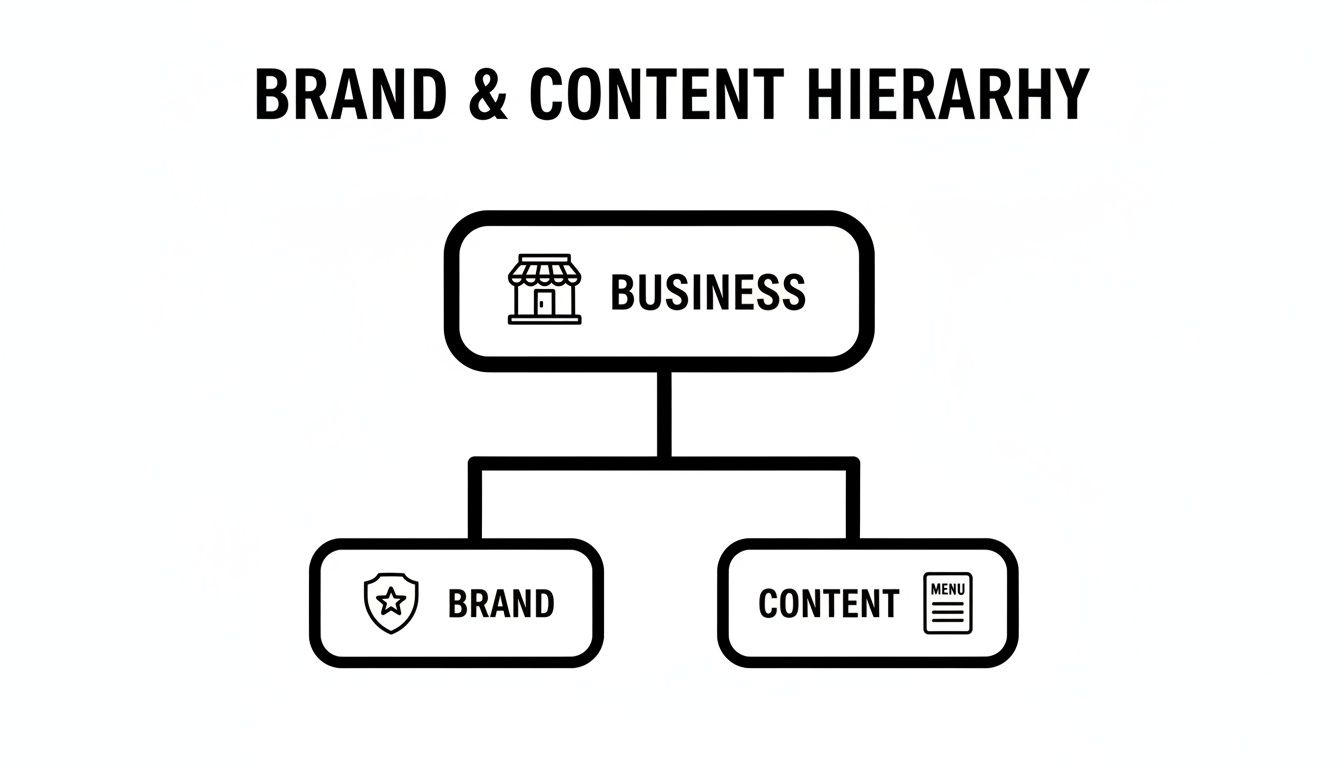
As you can see, both brand and content are critical supports. When they’re aligned, they make the entire business stronger.
Get to Know Your Ideal Customer
Before you write a single word, you have to know exactly who you're talking to. The restaurant industry isn't one big, uniform market. It’s a collection of unique segments, each with its own set of problems and priorities. A one-size-fits-all approach just doesn't cut it, especially when a staggering 73% of companies with a documented content plan report high levels of success.
The first step is to build out detailed customer personas. These aren't just job titles; they're sketches of your ideal buyers, complete with their goals, day-to-day frustrations, and what drives their decisions.
For example, you’re likely selling to a few different types of people:
- "Startup Sofia," the Independent Pizzeria Owner: She’s watching every penny and needs durable, reliable equipment that won’t drain her startup capital. Her biggest headache? Figuring out financing and installation. She’s looking for practical advice on how to get the best value for her money.
- "Procurement Paul," the Hotel Chain Manager: He thinks in spreadsheets and long-term ROI. He needs equipment that meets strict corporate standards for energy use and maintenance. He wants to see detailed spec sheets, case studies, and hard data comparing different models.
- "Executive Chef Elena," the Fine Dining Innovator: She's all about pushing culinary boundaries and needs specialized, top-of-the-line equipment to do it. Performance and precision are everything to her. She pays attention to what other top chefs are using and what the latest industry trends are.
Once you have these personas defined, you can stop creating generic content and start answering their specific questions.
Nail Down Your Unique Value Proposition
Okay, you know your audience. Now, why should they buy from you and not the dozens of other suppliers out there? This is where your Unique Value Proposition (UVP) comes in. It’s a clear, concise statement that explains the benefits you offer, how you solve your customer's problems, and what makes you different.
Your UVP is more than a catchy marketing slogan. It's the promise your brand makes to every customer, and it should be the north star for every piece of content you create.
A strong UVP for a restaurant equipment seller might sound something like this: "We provide independent restaurants with the most reliable, energy-efficient kitchen equipment, backed by expert installation and 24/7 support, so you can focus on your food, not your hardware."
This UVP works because it clearly names the target audience (independent restaurants), highlights key benefits (reliability, efficiency), and draws a line in the sand with a service promise (expert installation and support).
Establish Your Core Content Pillars
With your audience and UVP locked in, you can define your content pillars. These are the 3 to 5 main topics your brand will own. They flow directly from what your audience needs and what your UVP promises. Think of them as the foundational themes that ensure your content stays focused and consistently builds your authority.
For the equipment seller with the UVP we just crafted, the content pillars might be:
- Kitchen Efficiency & ROI: All content related to saving money, energy, and labor. Think articles on calculating the long-term value of an energy-efficient fryer or videos comparing convection oven cook times.
- Equipment Durability & Maintenance: This is where you prove your products are built to last. Create maintenance checklists, how-to repair guides, and testimonials about equipment that’s been running for years.
- Restaurant Startup Success: A pillar dedicated to helping new owners. This could include guides on kitchen layout planning, articles on navigating health codes, or webinars on financing options for new equipment.
These pillars become the backbone of your entire content plan. Every blog post, video, and social media update should tie back to one of them, creating a powerful, cohesive body of work that strengthens your brand and content marketing efforts.
Using Content to Build Brand Authority

Here's where the magic really happens. A smart content strategy is what elevates you from just another equipment seller to an indispensable industry partner. You see, authority isn't something you can just claim; you have to earn it, piece by piece, with every helpful article and video you create.
Think about it from your customer's perspective. A restaurant owner is up late, stressing about which convection oven to buy. They find your in-depth guide, "Choosing the Right Commercial Convection Oven," and suddenly, you're not just selling them a product. You're solving their problem and building trust before a dollar ever changes hands.
This move from "selling" to "serving" is the absolute heart of building a powerful brand. Each practical tip and detailed guide reinforces the idea that you are the go-to expert in the food service world.
From Content to Credibility
Building authority is a marathon, not a sprint. It’s a deliberate process of creating content that shows you understand the nitty-gritty operational headaches your customers face every single day. That's how you earn their trust for the long haul.
It's no secret that content is a game-changer for building real customer relationships. Recent data shows that a staggering 94% of marketers see a direct link between personalized content and a stronger brand. It just makes sense—when you tailor your expertise to solve their specific problems, you create a much deeper connection.
For example, a case study showing how your ice machine helped a local café slash its utility bills by 20% is worth more than a thousand sales pitches. It's real-world proof that you deliver on your promises.
Content Formats and Their Brand Impact
Not all content is created equal, and different formats work best for different goals. The trick is to use a variety of content types to showcase your expertise from every possible angle. Think of it like a toolkit, where each tool has a specific job in building your brand's reputation for being helpful and reliable.
Here’s a quick breakdown of how different formats can shape your brand's perception:
| Content Format | Primary Goal | Brand Perception Impact |
|---|---|---|
| In-Depth Guides | Educate customers on complex topics | Positions your brand as a knowledgeable teacher and industry expert. |
| Case Studies | Provide real-world proof of results | Builds trust by showing tangible success stories and ROI. |
| How-To Videos | Offer practical, actionable advice | Reinforces your brand as a supportive partner focused on customer success. |
| Comparison Articles | Help buyers make informed decisions | Establishes your brand as an honest broker, confident in its offerings. |
By using a mix of these formats, you make sure your expertise is front and center no matter where a customer is in their buying journey. To dive deeper into this, you can learn more by checking out our guide on branded content marketing.
True authority is achieved when customers see your brand as the answer to their questions, not just the source of a product. It's the ultimate outcome of a well-executed brand and content marketing strategy.
It all ties together in a powerful loop. Consistently publishing high-quality, problem-solving content boosts your SEO, which brings more chefs and owners to your site. They find your resources, see your expertise, and start to trust your brand. That's how you build the kind of loyalty that helps you thrive.
Putting Your Content Plan into Action
You've done the hard work of building a strategy. Now it's time to roll up your sleeves and actually create something. This is where the rubber meets the road—where your brand's promises of reliability and support become real, tangible content that helps your customers run a better business.
Let’s move from theory to practice and look at three specific examples of content you can create. Each one is designed for a different audience and a different goal, but they all work to reinforce your brand message. This is how you make sure every piece of content you produce is pulling its weight.
It's a straightforward process: turn your high-level ideas into valuable resources that attract new buyers, keep them engaged, and ultimately, get them to make a purchase.
Tactic 1: The SEO-Optimized Blog Post
Think of an SEO-focused blog post as your digital salesperson, working 24/7 to attract restaurant owners who are actively searching for answers online. It’s your best shot at becoming their go-to resource right when they need you most.
- Content Example: "Cubed vs. Nugget vs. Flake: Choosing the Right Commercial Ice Machine for Your Restaurant"
- Target Audience: New restaurant owners or managers figuring out how to upgrade their beverage service.
- Brand Message: This kind of article screams expertise and customer education. You’re not just trying to sell a machine; you're guiding them to the smartest investment, whether they run a high-volume bar or a tiny café.
- Marketing Goal: The main prize here is increasing organic search traffic. You want to show up when someone searches for "best commercial ice machine" or "types of restaurant ice makers." A secondary goal is generating leads by offering a free consultation at the end of the post.
By directly addressing a common headache—confusion over equipment choices—you immediately position your brand as the helpful expert in the room.
Tactic 2: The Practical How-To Video
Nothing beats video when you need to show, not just tell. A short, practical video can build a customer's confidence in your products and prove you understand the daily grind of a commercial kitchen. It’s no surprise that 72% of marketers find that content marketing is a great way to educate their audience.
- Content Example: A quick two-minute video titled, "Daily Deep Fryer Cleaning in 5 Easy Steps."
- Target Audience: Kitchen staff and managers who are on the hook for equipment maintenance.
- Brand Message: This video is a powerful way to communicate your brand's commitment to durability and ongoing support. It sends a clear signal that your relationship doesn't end at the checkout. You're invested in helping them keep their equipment running smoothly for the long haul.
- Marketing Goal: This is all about customer retention and brand loyalty. Providing useful, post-purchase content builds a much stronger bond with your clients. Plus, it’s perfect for sharing on social media to show potential customers how helpful you are.
This hands-on content proves your brand's commitment to the long-term success of its customers. It shifts the dynamic from a simple transaction to a supportive partnership.
Tactic 3: The High-Value Downloadable Checklist
A downloadable resource—often called a lead magnet—is a classic for a reason: it flat-out works. You offer a genuinely useful tool in exchange for an email address, allowing you to build a list of people who are serious about buying.
- Content Example: A downloadable PDF, "The Ultimate New Restaurant Kitchen Setup Checklist."
- Target Audience: Entrepreneurs who are in the thick of planning and opening a new restaurant.
- Brand Message: This checklist shows off your deep industry insight and forward-thinking innovation. It proves you understand the entire puzzle of building a functional kitchen, not just the individual pieces.
- Marketing Goal: The primary objective is crystal clear: lead generation. Every single download adds a motivated, high-intent prospect to your sales funnel. From there, you can follow up with more helpful advice and product suggestions.
By using these three distinct tactics, you create a really well-rounded content engine. You'll be attracting new prospects with SEO, supporting current customers with helpful videos, and capturing high-quality leads with valuable downloads—all while making your brand look like the industry leader it is.
Amplifying Your Content with SEO and Distribution
Creating a brilliant piece of content is just the first step. If that meticulously researched guide or helpful how-to video just sits on your website, it might as well not exist. The real work begins after you hit publish—making sure your valuable resources actually reach your target audience. This is where a smart distribution and SEO plan turns your content from a quiet library into a powerful lead-generation engine.
Think of it like this: your content is a perfectly plated signature dish. Distribution is the skilled waitstaff making sure it gets to the right table while it's still hot. Without a solid delivery plan, even the best dish gets cold in the kitchen. For a restaurant equipment seller, this means mastering search engines to put your expertise directly in front of buyers at the exact moment they're looking.
Optimizing Content for Search Engines
Search engine optimization (SEO) is all about making your content easy for people to find when they use search engines like Google. When a restaurant owner types "commercial kitchen ventilation requirements" or "best restaurant freezer for sale" into that search bar, you want your content to be the first thing they see. This isn't about luck; it's about strategy.
The smart money is on this approach. The fusion of brand and content marketing is reshaping how businesses connect with customers, especially as digital channels are projected to hit $1.16 trillion by 2030. A huge chunk of that growth comes from content-led strategies that focus on being helpful, not interruptive. Tellingly, websites, blogs, and SEO make up 16% of the top-performing marketing channels by ROI, proving they're incredibly effective at turning content into real business.
To make this work for you, every article, guide, or video you create should be built around specific keywords. These are simply the phrases your ideal customers are actually typing into Google. By weaving these terms naturally into your titles, headings, and paragraphs, you're sending a clear signal to search engines that your content is the best answer to that person's question.
Building Authority with Backlinks
In the world of SEO, not all websites are created equal. Search engines value authority, and one of the best ways to build it is by earning backlinks. A backlink is just a link from another website to yours. Think of it as a professional referral or a vote of confidence.
When a respected food industry blog or a well-known culinary publication links to your guide on "Choosing Energy-Efficient Ovens," they are essentially vouching for your expertise. This tells search engines that your brand is a credible and authoritative source of information.
Earning these powerful links requires getting out there and making it happen:
- Guest Posting: Offer to write an article for another industry blog and include a link back to a relevant resource on your own site.
- Create Link-Worthy Content: Develop unique reports, original data, or comprehensive guides that other publications will want to cite as a source.
- Build Relationships: Connect with industry journalists, bloggers, and influencers who might be interested in sharing your expertise with their audience.
Every quality backlink you get sends referral traffic your way and significantly boosts your website's overall authority, making it easier for all of your content to rank higher. A well-rounded approach is key, as we outline in our comprehensive guide to developing an SEO content strategy.
Winning with Local SEO and Citations
For most restaurant equipment sellers, the local market is everything. Local SEO is a specialized strategy focused on grabbing the attention of customers in your specific geographic area. When a local chef searches for "restaurant equipment repair near me," you absolutely have to show up.
The cornerstone of local SEO is your Google Business Profile (GBP). Think of this free listing as your digital storefront on Google Search and Maps. Keeping it optimized isn't optional; it's critical.
- Complete and Accurate Information: Make sure your business name, address, phone number (NAP), and hours are 100% correct and consistent everywhere online.
- Strategic Categories: Choose categories that precisely describe what you do, like "Restaurant Supply Store" and "Commercial Refrigeration Supplier."
- Regular Updates and Photos: Constantly add high-quality photos of your products, your showroom, and your team. Post updates about new inventory, sales, or events.
- Encourage Customer Reviews: Actively ask happy customers for reviews. A steady stream of positive feedback is a massive local ranking signal.
Beyond your GBP, you need to build local citations. A citation is any online mention of your business's name, address, and phone number on other websites, like local business directories or industry-specific listings. Consistency across these citations reinforces your location and legitimacy to search engines, cementing your status as the go-to local expert.
Measuring Your Marketing Success
Creating great content is only half the battle. If you don't know whether it's actually working, you're just throwing things at the wall and hoping something sticks. You need a solid way to track your key performance indicators (KPIs) to see the real impact of your brand and content marketing.
This is how you turn marketing from a line-item expense into a measurable investment. For restaurant equipment sellers, it's all about separating the "vanity metrics" that look nice from the numbers that actually drive your business forward. Focusing on the right data helps you fine-tune your strategy, double down on what’s working, and actually prove your marketing ROI.
Tracking Brand Growth
Building a brand is a marathon, not a sprint, but you can still see its effects if you know where to look. These metrics are the breadcrumbs that show how your reputation and name recognition are growing over time.
- Branded Search Volume: This is simply how many people are typing your company name straight into Google each month. When this number goes up, it’s a clear sign more people know who you are and are looking for you specifically.
- Direct Website Traffic: You'll find this in Google Analytics. It counts the visitors who type your website URL directly into their browser. An increase in direct traffic is a powerful signal of strong brand recall and loyalty.
These two indicators are proof that your content is doing its job—building a memorable brand that customers know, trust, and remember when they need you.
Measuring success isn't just about celebrating wins; it’s about gathering the intelligence needed to make smarter decisions tomorrow. It turns your marketing efforts into a feedback loop for continuous improvement.
Analyzing Content Performance
Content marketing, on the other hand, gives you more immediate and direct feedback. These KPIs show you exactly how well your articles, videos, and guides are attracting and converting the right people. For a deeper dive, understanding how to measure SEO performance is crucial for tying your content directly to business results.
Here are the key metrics you should have your eyes on:
- Organic Traffic Growth: Are more people finding you through Google? Consistent growth here is a tell-tale sign your SEO efforts are paying off.
- Keyword Ranking Improvements: Check Google Search Console to see if you're climbing the ranks for valuable terms like "commercial convection oven" or "restaurant freezer maintenance."
- Conversion Rates: Of the people who download your "Kitchen Setup Checklist," how many actually turn into qualified leads? This is the metric that connects a piece of content directly to a sales opportunity.
It's also essential to know how to track the performance of different formats, like measuring the success of your marketing videos. By keeping a close eye on both brand and content KPIs, you can build a powerful, data-driven strategy that consistently delivers.
Frequently Asked Questions
When you're trying to figure out brand and content marketing, it’s natural to have questions. Here are some of the most common ones we hear from restaurant equipment sellers, answered in plain English.
What’s the Real Difference Between Brand and Content Marketing?
Think of it this way: brand marketing is your reputation. It’s the feeling a chef gets when they see your logo—the promise of durability, reliability, and great service. It answers the question, "Why should I buy from these guys?"
Content marketing is how you prove you deserve that reputation. It’s the collection of practical guides, how-to videos, and comparison articles you create. Your brand makes the promise; your content delivers the proof.
I’m a Small Supplier. How Do I Even Start with Content Marketing?
You don't need a massive budget or a complicated strategy to get started. The easiest way to begin is to just answer the top 10 questions you get from customers every single week.
Take each question and turn the answer into a helpful blog post or a quick video. For example, an article like "3 Simple Ways to Extend the Life of Your Commercial Refrigerator" provides immediate value and solves a real problem for your audience.
The secret is to be consistently helpful, not just consistently present. One genuinely useful article a week is far more effective than pumping out mediocre content every day, especially when you're just starting with brand and content marketing.
This simple approach immediately establishes your expertise and starts building a foundation of trust.
How Do I Actually Measure the ROI of All This?
Measuring your return on investment (ROI) isn't about finding one magic number. It's about looking at a few key metrics together to understand the full story of your growth.
For your content marketing, you want to track the direct impact:
- Leads Generated: How many people downloaded your maintenance checklists or equipment-buying guides?
- Organic Traffic: Use a tool like Google Analytics to see how many new visitors are finding you through search engines.
- Keyword Rankings: Are you showing up higher for important search terms in Google Search Console?
For brand marketing, the results are more about long-term reputation, so you'll look at indirect signals:
- Branded Search Volume: Are more people searching for your company name directly?
- Direct Website Visitors: An uptick here means more people know your brand and are coming straight to you.
When you look at both sets of metrics, you get a clear and complete picture of how your marketing is really performing.
At Restaurant Equipment SEO, our entire focus is on helping you turn your deep industry knowledge into a marketing machine that actually grows your bottom line. We use targeted link building, expert article writing, and precise local citations to get your business in front of the right buyers. Ready to build a brand that people remember? Find out how we do it at https://restaurantequipmentseo.com.