
Branded Content Marketing for Restaurant Suppliers
Branded content isn’t about a hard sell. It’s a completely different game. The goal is to build an emotional connection with your audience, moving beyond a direct sales pitch. For a restaurant equipment supplier, this means telling stories that matter—stories about your values, your deep-seated expertise, and your commitment to the people who make the food service industry tick. It's how you become more than just a catalog of stainless steel.
Building Your Branded Content Foundation
Before you ever write a blog post or film a video, you need a solid foundation. This is the non-negotiable part. Jumping straight into content creation without this groundwork is like designing a commercial kitchen without knowing what kind of food will be cooked there. It’s a recipe for failure.
Good branded content starts with empathy, not advertising. This initial phase is all about getting inside the heads of the people signing the checks, from the independent cafe owner juggling a dozen roles to the procurement manager for a massive hotel chain.
Uncovering Your True Audience
Forget surface-level demographics. To really connect with restaurant professionals, you have to understand the pressures they face every single day. What keeps a head chef up at night? It’s not your new combi oven. It’s the fear of a walk-in freezer failing on a Saturday night, the sting of rising food costs on razor-thin margins, or the stress of another cook calling out sick.
To get a real-world picture of your audience, you have to dig for genuine insights.
- Tap into your sales team. They're on the front lines every day. They hear the raw, unfiltered frustrations about equipment that breaks down and the wish-list features that would make life easier. Ask them what questions they hear over and over again.
- Actually talk to your customers. Go deeper than a generic satisfaction survey. Ask an operations manager to walk you through their day. Where are the bottlenecks? What tedious tasks eat up their time? What would make their kitchen run smoother?
- Listen to online conversations. Dive into industry forums, LinkedIn groups, and Reddit threads. Pay attention to the specific language people use and the problems they’re trying to solve. This is where you find out what they really think.
With this research, you can build out detailed buyer personas that feel like real people. Give them names and job titles, but most importantly, document their specific challenges. For instance, "Carlos, the Multi-Unit Restaurant Owner," is obsessed with reducing energy consumption across his 15 locations. Meanwhile, "Chef Maria, the Executive Chef," is focused on equipment reliability and how easy it is to clean during a hectic dinner service.
The Big Idea: Your content needs to be the answer to a question they're already asking. Solve their problems, and you'll earn their trust long before they're even thinking about a purchase order.
Crafting Your Brand Story
Once you know exactly who you're talking to, you need to figure out what you're going to say. Your brand story is the thread that ties all of your content together. It’s not just a mission statement tacked onto your website; it’s the real reason your company exists, beyond making a profit.
For a food-service supplier, that story could be rooted in a few different places:
- Innovation: Maybe your founder was an engineer who saw a persistent flaw in traditional convection ovens and dedicated his life to building a better one.
- Reliability: Perhaps your brand’s legacy is built on pure resilience, with equipment that has powered local diners and five-star kitchens for generations. You’re the trusted workhorse.
- Partnership: Your story might be about how you’re more than a supplier—you’re a consultant, helping new restaurateurs design their first kitchen for maximum flow and efficiency.
This narrative gives your content a consistent, authentic voice. It ensures that whether you’re producing a video on preventative maintenance or writing an article on kitchen ergonomics, it all points back to a central idea your audience can actually connect with. This foundation is also crucial for a wider digital strategy. To see how this ties into getting found on Google, check out our detailed guide on building an SEO content strategy.
This whole foundational process—from persona to story to strategy—is a logical flow. The infographic below breaks it down.
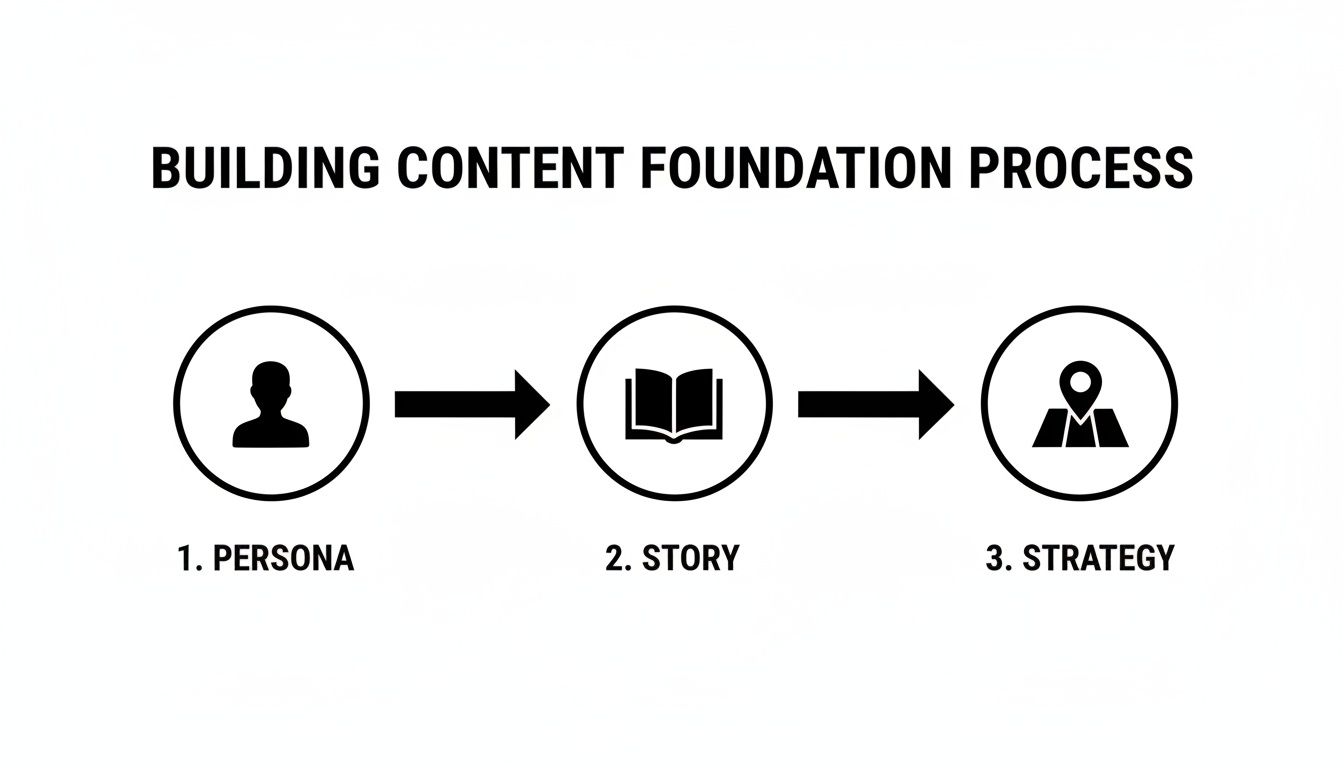
As you can see, a successful content program isn’t a series of one-off projects. It’s a cohesive effort where each step purposefully builds on the last.
Choosing Content Formats That Connect
Okay, you’ve done the foundational work. Now comes the fun part: picking the right tools for the job. In the B2B food-service world, a generic blog post just doesn't cut through the noise. Your audience—chefs, restaurant owners, and operations managers—are incredibly busy professionals who value utility over fluff. The content formats you choose have to deliver real value and speak directly to their daily grind.
Put simply, your content needs to solve a problem, prove your product’s worth, or make their demanding job a little bit easier. The right format makes that connection instantly.
Prioritize High-Impact Video Content
Let's be clear: video isn't a "nice-to-have" anymore. For equipment that’s complex, expensive, and absolutely critical to a kitchen's workflow, seeing is believing. A well-produced video demonstrates features and benefits in a way static text or photos never could.
You can get a lot of mileage out of video in a few key ways:
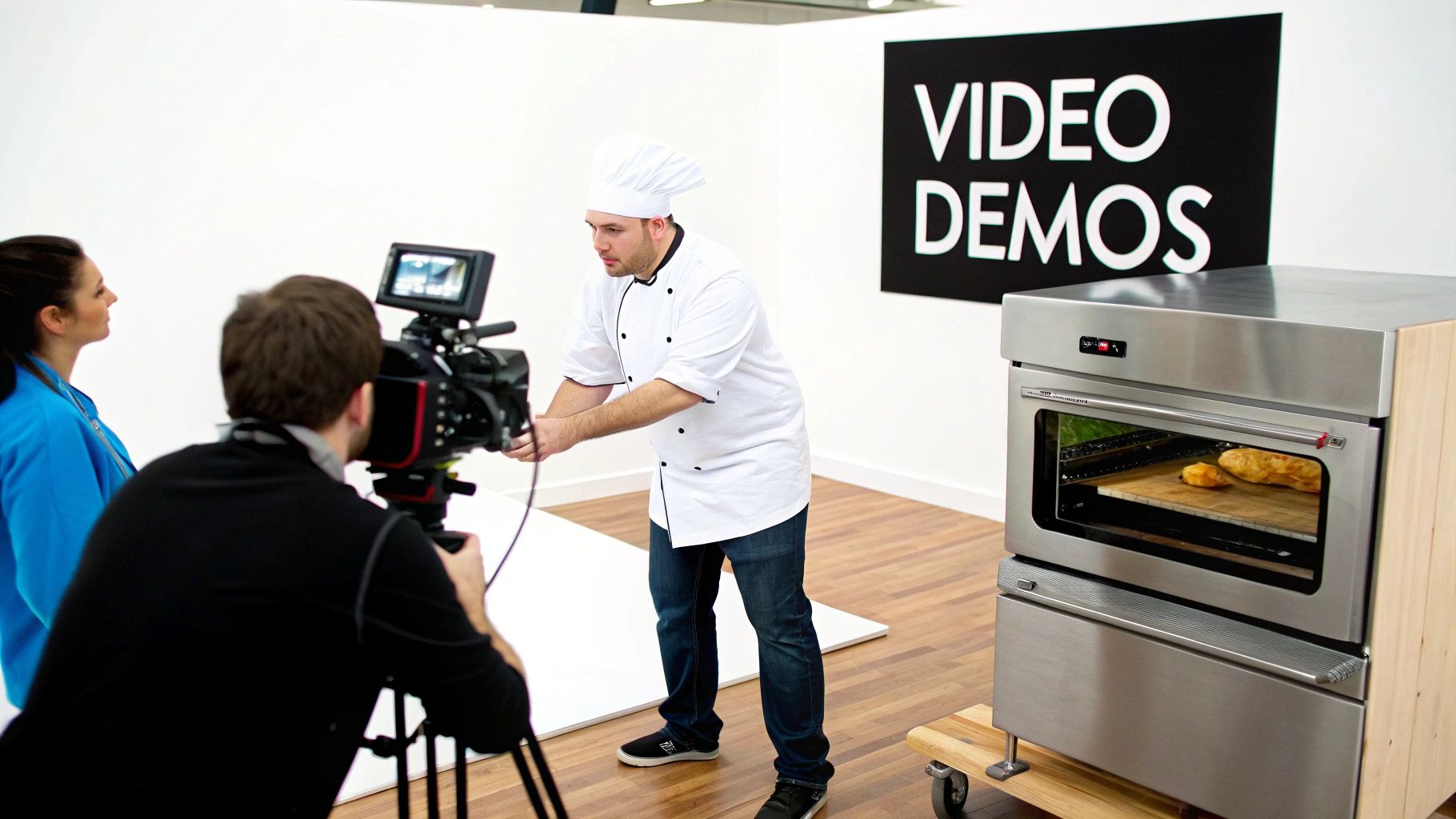
- Detailed Product Demos: Go beyond a simple feature list. Show your commercial dishwasher blasting a greasy rack clean in record time. Film a combi oven perfectly roasting multiple proteins at once. Let them see it in action.
- Behind-the-Scenes Tours: A peek inside your manufacturing facility can build immense trust. It’s a chance to showcase your commitment to quality control and the craftsmanship that goes into every single unit.
- Quick-Tip Maintenance Guides: Think about a series of short, two-minute videos showing technicians how to perform routine tasks, like changing a filter or calibrating a thermostat. This kind of practical content becomes an invaluable resource they’ll come back to again and again.
The momentum behind video is undeniable. Industry analysis shows that 49% of marketers now use video to explain their products. And brands are voting with their wallets—92% plan to increase their investment in content creators in 2024. This isn’t just a trend; it's a fundamental shift in how brands connect with their customers.
Leverage Industry Credibility with Influencers
In the food-service world, "influencers" aren't celebrities walking a red carpet. They're the respected executive chefs, the savvy operations directors, and the veteran service techs who have earned their stripes. Partnering with these authentic voices gives your brand instant credibility.
Just imagine a well-known local chef using your induction range in a tutorial on their popular Instagram channel. That single piece of content carries more weight than a dozen traditional ads because it comes from a trusted, peer-to-peer source.
Key Takeaway: The goal here isn't just exposure; it's borrowed trust. When you associate your equipment with professionals admired for their skill and expertise, you align your entire brand with that same level of excellence.
Develop Practical and Actionable Resources
Beyond video, your audience is hungry for content that helps them run their businesses more efficiently and profitably. Think about creating resources they can actually download, print out, and use in their day-to-day operations.
These formats are especially effective:
- In-Depth Equipment Guides: Create comprehensive guides on topics like "Maximizing the Lifespan of Your Commercial Fryer" or "A Guide to Energy-Efficient Refrigeration." This is the kind of cornerstone content that positions you as the go-to expert.
- Downloadable Checklists: A "Daily Kitchen Opening Checklist" or a "Quarterly Preventative Maintenance Checklist" that features your equipment is incredibly useful. It also keeps your brand top-of-mind in a helpful, non-intrusive way.
- Data-Backed Case Studies: Show a real restaurant how your high-efficiency ice machine saved them $2,500 a year in utility costs. Prove the ROI of your products with hard numbers and real-world testimonials.
As you explore these formats, you might also look into strategies for creating compelling user-generated content (UGC). Encouraging your actual customers to share their own success stories can be one of the most powerful forms of branded content you have.
Ultimately, the best approach is a mix of these formats. A compelling video grabs attention, a detailed guide educates, and a powerful case study provides the final proof needed to seal the deal. This multi-format strategy ensures your content connects at every single stage of the buyer's journey.
Getting Your Content in Front of the Right People

Let's be honest: creating great content is only half the job. That incredibly detailed case study or the slick product demo video? It's completely useless if the right people never see it.
This is where a smart distribution strategy comes in. It’s what turns your investment in branded content marketing into real business results, from building brand awareness to generating qualified leads. For food-service suppliers, this means getting way beyond the old "publish and pray" model. You need a deliberate, multi-channel plan that pulls together your owned, earned, and paid media efforts.
Master Niche SEO for Equipment Suppliers
Think of Search Engine Optimization (SEO) as your long-term engine for inbound leads. While your competitors are busy fighting over broad, expensive keywords like "commercial ovens," the real magic happens in the niches. You want to capture the high-intent, specific searches your best customers are actually typing into Google.
Get inside their heads. A busy restaurant owner isn’t just looking for a generic "blast chiller." They’re searching for solutions to their problems: "blast chiller energy efficiency," "how to reduce food waste with rapid cooling," or "best blast chiller for a small bakery."
Here’s how to put this into action:
- Go for Long-Tail Keywords: These are the longer, more specific phrases that signal someone is deep in the research phase and closer to buying. Tools like Ahrefs or Semrush are your best friends for uncovering these gold nuggets.
- Optimize for Specs: This is huge in our industry. Weave model numbers, energy ratings, and specific features right into your content, page titles, and meta descriptions. This is exactly how procurement managers and detail-obsessed chefs find what they need.
- Build Topic Clusters: Structure your site like an expert would. Create a major "pillar" page for a big category (like Commercial Refrigeration), then link out to more focused "cluster" articles that cover related topics (Walk-In Freezer Maintenance, Comparing Compressor Types, etc.). This tells search engines you're the authority on the subject.
This focused approach means you show up at the exact moment a potential customer is looking for what you sell.
Put Your Owned and Earned Channels to Work
Your owned channels—your website, blog, and social media accounts—are your home turf. You have total control and can use them to build a community that trusts you.
For B2B suppliers, LinkedIn is a powerhouse. It's where you can connect directly with the decision-makers: GMs, operations managers, and executives at major restaurant groups. This is the place to share data-driven case studies, ROI calculations, and join industry-specific group discussions to really plant your flag as an expert.
Instagram, on the other hand, is your visual showroom. It’s all about high-quality photos and short, punchy videos that show your equipment humming away in real kitchens. A behind-the-scenes look at a new install or a time-lapse of your gear handling the dinner rush can be incredibly persuasive.
Pro Tip: Squeeze every drop of value from your content. That detailed case study on your blog? It can be chopped up into a dozen LinkedIn posts, a slick infographic for Pinterest, and even the script for a short YouTube video. Don't create something once and forget it.
Beyond what you control, look for earned media. When another reputable site publishes your content, it’s like getting a five-star review from an expert. To get a handle on this, I'd recommend digging into the fundamentals of https://restaurantequipmentseo.com/blogs/restaurant-equipment-seo-blog/syndicated-content-seo to see how it can seriously expand your reach.
Amplify Your Best Stuff with Smart Paid Ads
Finally, paid distribution gives you a way to put your content directly in front of a hand-picked audience and speed up your results. This isn't about spamming the internet with ads; it's about surgical precision.
Here are a few paid tactics that work wonders in our space:
- Laser-Targeted Social Ads: LinkedIn's advertising platform is incredibly powerful. You can promote your best content to people with specific job titles (like "Executive Chef"), at companies of a certain size, or in a particular city or state.
- Sponsored Content Partnerships: Find the industry publications or blogs your customers already read and trust. Paying for a sponsored article or a feature in their newsletter puts your brand in a context where it's already welcome.
- Smart Retargeting: Ever feel like an ad is following you around? That's retargeting. By using a tracking pixel, you can show follow-up content to people who have already visited your site. If someone read your blog post on combi ovens, you can then show them a video demo or a case study to nudge them further along.
Once you start reaching a wider market, you open up all sorts of new possibilities. For example, you could even translate videos to reach a global audience and tap into new international markets. When you blend smart SEO, owned media, and paid distribution, you create a powerful system that drives a consistent flow of high-quality traffic and leads.
Measuring Your Branded Content Marketing Success
Creating great content is a huge win, but let's be honest—it's only half the battle. If you can't show how it's actually working, you'll have a tough time justifying the budget and proving its value. This is where solid measurement comes in. It’s what turns your branded content marketing from a fuzzy "cost center" into a clear driver of business growth.
This isn't about chasing vanity metrics like a random jump in social media followers. We're talking about connecting specific content—like that new combi oven guide—to real business outcomes, from catching a prospect's initial interest to influencing a final sale. You need a way to see the entire customer journey, not just the first click.
Connecting Content to Commercial Results
The holy grail here is tying actual revenue back to your content. To do that, you have to get your marketing and sales data talking to each other. The key is to connect a tool like Google Analytics with your Customer Relationship Management (CRM) system, whether that's HubSpot, Salesforce, or something similar.
This integration lets you see the whole story unfold. You can track a kitchen manager who first finds your brand by reading a blog post on "reducing kitchen energy costs," see them download a case study a week later, and finally watch them request a demo for one of your high-efficiency fryers. This kind of closed-loop reporting is exactly how you prove that content isn't just making noise—it's creating customers.
Key Takeaway: Real measurement isn't about counting views. It’s about tracking the path from the first blog post someone reads all the way to a signed purchase order in your CRM.
This focus on proving ROI is why so many businesses are all-in on content. By 2025, an estimated 91% of global brands were using content marketing, with the average share of marketing budgets for content climbing to about 26%. This isn't a fluke; it shows a clear understanding that high-quality content delivers long-term, measurable results. You can dig into more of these numbers and find additional content marketing statistics that really highlight this industry-wide shift.
Key Performance Indicators for Food Service Content Marketing
To get a clear, no-nonsense picture of performance, you need to track specific Key Performance Indicators (KPIs) at each stage of the marketing funnel. This approach helps you see what's working and what isn't, whether your goal is to build awareness or get more quote requests.
This table outlines essential metrics to track at each stage of the marketing funnel, helping you measure the true impact of your branded content.
| Funnel Stage | KPI | What It Measures | Example Tool |
|---|---|---|---|
| Top of Funnel (Awareness) | Organic Traffic & Keyword Rankings | How many new users find you via search and where you stand for key terms. | Google Search Console |
| Top of Funnel (Awareness) | Video View-Through Rate | The percentage of people who actually watch a meaningful chunk of your videos. | YouTube Analytics |
| Middle of Funnel (Consideration) | Lead Magnet Downloads | The number of people who trade their info for your checklists, guides, etc. | HubSpot / CRM |
| Middle of Funnel (Consideration) | Time on Page & Scroll Depth | How deeply users engage with your articles, which signals quality and relevance. | Google Analytics 4 |
| Bottom of Funnel (Decision) | Demo or Quote Requests | Direct sales inquiries that came from a specific piece of content. | CRM / Web Forms |
| Bottom of Funnel (Decision) | Content-Influenced Revenue | The dollar amount of sales where your content was part of the customer's journey. | CRM Analytics |
By organizing your reporting around these KPIs, you can build a simple monthly dashboard that tells a powerful story. It gives stakeholders a clear, concise view of how your content program is filling the pipeline, nurturing leads, and ultimately, adding to the company's bottom line.
Real-World Examples and Actionable Templates

It's one thing to talk about strategy, but it's another to see it work in the real world. This is where theory meets the pavement. Let's dig into some practical examples and give you the resources to start building your own branded content marketing with confidence.
Seeing how other suppliers have pulled this off isn't just for inspiration—it’s proof that this works for B2B food-service companies, not just big consumer brands.
Success Story: The Eco-Conscious Refrigeration Supplier
I once worked with a commercial refrigeration supplier trying to break into the eco-conscious restaurant market. Instead of just running ads boasting about their low-energy compressors, we went a different route. We created a high-quality video series called "The Sustainable Kitchen."
Each episode featured a different respected chef, not talking about the fridge, but about how cutting energy use helps the planet and slashes their operating costs. The supplier’s equipment was just there, naturally, in the background. The story was the hero.
- The Content: A six-part YouTube series packed with practical tips for energy efficiency in commercial kitchens.
- The Angle: Purely educational. We were solving a huge pain point for their audience—sky-high utility bills.
- The Result: The series didn't just get thousands of views from restaurant owners; it led to direct conversations and, eventually, contracts with two regional restaurant chains looking for sustainable partners.
This proves that when you provide real value, you pull in high-quality leads who are already on board with your brand's mission.
Branded Content Ideas for Restaurant Suppliers
To get your own ideas flowing, here’s a quick-reference table that breaks down different content formats we’ve seen work well in the food-service space.
| Content Format | Primary Goal | Best Channel(s) | Example Topic |
|---|---|---|---|
| Video Case Study | Build Trust & Prove ROI | Website, YouTube, LinkedIn | "How [Restaurant Name] Cut Food Prep Time by 30% with Our Combi Oven" |
| Downloadable Guide | Generate Leads & Educate | Blog, LinkedIn Ads, Email | "The Ultimate Checklist for Commercial Kitchen Preventative Maintenance" |
| Chef Tutorial Series | Boost Brand Awareness | Instagram Reels, TikTok, YouTube | "Three Advanced Techniques You Can Master with a Sous Vide Circulator" |
| Data-Backed Article | Establish Authority & SEO | Blog, Industry Publications | "Analyzing the True Cost of Equipment Downtime in Quick-Service Restaurants" |
As you can see, a balanced content plan uses different formats to achieve different goals. You wouldn't use a TikTok video to prove ROI, just as you wouldn't use a data-heavy article to build quick brand awareness.
Success Story: The Pro-Grade Cookware Brand
Here’s another great one. A high-end cookware brand wanted to connect with professional chefs on a deeper level. They knew these chefs lived on Instagram, constantly scrolling for new techniques and inspiration.
They found a handful of respected (but not celebrity-level) chefs and partnered with them to create Instagram tutorials. Each chef demonstrated a tricky technique, like crafting a perfect béarnaise or getting that flawless sear on a scallop, all while using the brand's pans.
The Key Insight: The videos were all about the chef's expertise. The cookware wasn't the star; it was the essential tool that enabled their mastery. This made the product placement feel authentic and earned, not like a clunky ad.
The brand didn't just sell pans; they built a community of culinary pros who viewed them as a partner in their craft. You can dive into more campaigns like this in our roundup of powerful content marketing examples from across the industry.
Your Actionable Toolkit
To help you hit the ground running, we've put together a few essential templates. Think of these as guardrails to keep your creative process on track so nothing important falls through the cracks.
- The B2B Content Calendar Template: This is more than a spreadsheet. It’s built to map out content around B2B product launches, seasonal industry trends, and trade shows, helping you plan your themes and channels months ahead.
- The Creative Brief for Video Production: A solid brief is non-negotiable before you hit "record." This template ensures you define your core message, audience, and tone, getting your production team and stakeholders on the same page from day one.
- The Pre-Publish SEO Checklist: SEO can't be an afterthought. This is a simple checklist to run through before any blog post goes live, covering everything from keywords and meta descriptions to internal links and image alt text.
These tools are designed to take the guesswork out of your branded content marketing, so you can focus on creating genuinely helpful content that resonates with your audience and grows your business.
Common Questions About Branded Content
Jumping into something new always brings up a few questions. For busy restaurant equipment suppliers, you need straight answers before you sink your time and money into a new marketing strategy. Let's tackle some of the most common things we get asked about building a branded content program.
These are the practical hurdles that can stop a great idea in its tracks. Getting some clarity here will help you move forward with confidence.
What's a Realistic Budget for a Smaller Business?
This is the big one, isn't it? Lots of smaller suppliers see "branded content" and immediately think it's a game only for huge companies with massive marketing departments. The good news? That’s not true at all. You don’t need a Hollywood-sized budget to make a real impact.
A realistic starting point for a small to mid-sized business can be anywhere from $2,500 to $7,500 per month. This isn't just a number pulled out of thin air; it’s based on what it actually takes to create high-quality, consistent content that gets results.
So, what does that kind of investment get you?
- Content Creation: This could cover something like one high-quality video (think a product demo or a customer story) and a couple of in-depth, SEO-friendly blog posts each month.
- Distribution: You’ll want to earmark some of that for paid promotion on social media, especially on a platform like LinkedIn, to make sure your content gets in front of the right decision-makers.
- Tools & Talent: This accounts for essential software and maybe bringing on a freelance writer or videographer who actually gets the food service industry.
The key is to start small and be strategic. Don't try to do everything at once. Pick one or two content formats you can do really well, prove they work, and then scale from there.
How Does This Actually Work with My Sales Team?
Your content and your sales team should be best friends, not ships passing in the night. When they're in sync, your content becomes a powerful tool that helps reps build trust and close deals faster. It’s not complicated to get them working together, but it does need a clear process.
Key Takeaway: The goal here is to arm your sales team with valuable content they can use as a resource. This shifts their role from just being a seller to becoming a trusted advisor.
Imagine a prospect asks a detailed question about the energy efficiency of a specific walk-in freezer. Instead of typing out a long email, a salesperson can immediately share a data-backed blog post or a case study on that exact topic. This move is brilliant for a few reasons:
- It answers their question thoroughly, showing off your deep expertise.
- It saves the salesperson a ton of time and repetitive work.
- It keeps the prospect engaged with your brand in a helpful, non-salesy way.
You should also encourage your sales team to share content on their personal LinkedIn profiles. When they post a genuinely useful guide or an insightful video, they’re not just extending the reach of your content—they're building their own credibility. This simple habit can turn your entire sales force into an incredibly effective distribution channel.
At Restaurant Equipment SEO, we specialize in building branded content strategies that drive real business for food service suppliers. If you're ready to turn your expertise into your most powerful sales tool, let's connect and build a plan that works for you.