
A Guide to Syndicated Content SEO That Actually Works
Let's get one thing straight. The biggest myth holding people back from content syndication is the fear of a "duplicate content penalty." Frankly, that's not really a thing, especially if you know what you're doing. When you syndicate your content the right way, you're not creating a problem for search engines; you're giving them a clear roadmap that points right back to you as the original author.
How Syndicated Content and SEO Work Together

At its core, content syndication is simple: you're strategically republishing an article from your blog onto another website. It’s a content-sharing partnership. For a restaurant equipment supplier, this could look like your deep-dive on commercial oven maintenance getting featured on a top-tier food industry publication.
Suddenly, your expertise is in front of their established audience. But getting more eyeballs on your work is just the beginning. A smart syndication play can do so much more.
- Explode Your Brand Visibility: You get to tap into new, highly relevant audiences on platforms that would have taken years to build yourself.
- Build Authoritative Backlinks: Reputable syndication partners will almost always link back to your original post, sending powerful authority signals to your domain.
- Drive Ready-to-Engage Traffic: Readers who love your syndicated article are much more likely to click through to your site, bringing you warm, qualified traffic.
The Technical Details That Make or Break Your Strategy
Here's where the rubber meets the road. Without the right technical signals in place, you risk confusing search engines. When Google can't figure out which version is the original, it might rank the syndicated copy on the bigger, more authoritative site instead of yours. All that SEO equity you built? Gone.
That's why proper technical implementation is everything. Clear signals, like canonical tags and attribution links, are non-negotiable. They tell search engines exactly which piece of content is the source of truth, ensuring all ranking power flows back to your website. If you'd like to dig deeper into the specifics, IMP Digital has a solid breakdown of SEO for syndicated content.
The Bottom Line: Your goal isn't just getting your content republished. It's about making sure every ounce of SEO value—from backlinks to ranking signals—is credited to the original article on your site. The
rel="canonical"tag is your most important tool for this job.
To help you keep these technical signals straight, here's a quick rundown of what they do and how they impact your SEO.
Syndication Signals and Their SEO Impact
| Technical Signal | Primary Purpose | SEO Impact |
|---|---|---|
rel="canonical" |
Tells search engines that a page is a copy and specifies the URL of the original version. | Excellent. Consolidates all ranking signals (links, content value) to your original URL, preventing duplicate content issues. This is the gold standard. |
noindex Tag |
Instructs search engines not to index the syndicated page at all. | Good. Prevents the partner's page from competing with yours in search results, but you lose out on the consolidated link equity a canonical tag provides. |
| Attribution Link | A standard backlink to your original article, often with anchor text like "originally appeared on." | Fair. Better than nothing. It provides a backlink but offers no direct instruction to search engines about content duplication, creating a risk of the syndicated version outranking yours. |
Ultimately, choosing the right signal depends on your agreement with the syndication partner, but you should always push for a canonical tag.
Remember, syndication is just one of many powerful content repurposing strategies you can use to squeeze more value out of every article you create. Now, let's get into how to set up these partnerships for maximum impact.
How to Find High-Value Syndication Partners
Your content syndication strategy lives and dies by the partners you choose. Blasting your articles out to anyone who will take them is a waste of time. The real goal is to team up with sites that actually boost your reach and send the right kind of authority signals back to your own website. It’s all about quality over quantity.
A great partner isn't just a website with a ton of traffic. It's a platform with an engaged, relevant audience that actually cares about what you have to say. For someone selling restaurant equipment, a feature in a respected culinary trade journal is worlds better than a spot on a generic business blog, even if that blog boasts more monthly visitors. The magic is in audience alignment—getting your expertise in front of people who can become customers.
Vetting Partners Through an SEO Lens
Before you even draft an outreach email, you need to put on your SEO hat and do some serious digging. Surface-level metrics can be really deceiving. A site's Domain Authority (DA) or Domain Rating (DR) is a decent starting point, but it's far from the whole story.
Fire up your favorite SEO tool and really analyze a potential partner's backlink profile and organic traffic. Are they getting links from other legit sites in the restaurant world? Is their organic traffic on an upward trend, or has it been tanking for months? A steady decline is a major red flag that their content just isn't hitting the mark with search engines or readers.
A great syndication partner acts like a megaphone, not an echo chamber. They should have an established audience that you don't, bringing fresh eyes to your brand and sending meaningful referral traffic back to your site.
Key Criteria for Sizing Up Syndication Opportunities
I recommend creating a simple checklist to keep your evaluation process consistent and objective. This prevents you from getting starry-eyed about a big name that ultimately won't deliver the results you need.
Here’s what to look for:
- Audience Overlap: Is their readership your ideal customer? Skim their most popular articles and read the comments to get a real feel for who hangs out there.
- Content Quality and Editorial Standards: Look at their recent posts. Is this the kind of quality you want your brand associated with? A site full of thin, poorly written content will do you more harm than good, no matter its traffic numbers.
-
Technical SEO Policies: This one is a deal-breaker. You have to ask them directly about their policy on
rel=canonicaltags. If they can't or won't use them, find out if they'll use anoindextag instead. A simple attribution link is your absolute last resort.
For a deeper dive into the actual outreach process, our guide on mastering guest posting outreach has a ton of tactics that work just as well for landing syndication deals.
Finding the Right Partners in Your Niche
Now for the fun part: a little detective work. A fantastic starting point is to see where your competitors are getting featured. SEO tools can quickly show you their backlinks and brand mentions, which often uncovers publications that are already open to these kinds of partnerships.
Another great trick is to use advanced Google search operators. Try searching for phrases that signal a site already syndicates content from others:
"originally published on" + restaurant equipment"republished with permission" + commercial kitchen design
This method helps you find sites that already get it. They understand how syndication works, so your pitch has a much better chance of landing.
This careful selection process is more critical than ever. As the digital space gets more crowded, smart partnerships are what set brands apart. By mid-2025, syndication has become a key driver for audience growth; in the U.S., for instance, up to 50% of new web audiences are reached this way by businesses that carefully select publishing partners on high-authority platforms. To learn more about this trend, you can explore the latest data on content syndication growth. This really drives home how important it is to choose the right partners to grow your digital footprint.
Getting the Technical SEO Right for Syndication
You’ve landed a great syndication partner. That’s a huge win, but the work isn't over. In fact, the most critical part is next: the technical setup.
Getting this right is what separates a successful syndication strategy from an SEO disaster. It's how you tell search engines, in no uncertain terms, which version of your article is the original. This ensures all that delicious link equity and authority flows straight back to your website, where it belongs.
If you skip this, you're leaving it up to Google to guess which page to rank. And let’s be honest, if your syndication partner has a higher domain authority, it's a gamble you’re almost guaranteed to lose.
So, let's walk through the three main ways to handle this, from best to worst.
Your Best Friend: The rel=canonical Tag
The rel="canonical" tag is, without a doubt, the gold standard for syndication. Think of it as a signpost you plant in the HTML <head> of the republished article. It points directly at your original piece and tells search engine crawlers, "Hey, this page is just a copy. The real deal—the one you should credit and rank—is over here."
This simple line of code is your most powerful tool. It lets the partner's audience see and share the content, while all the SEO value—backlinks, authority signals, the works—gets consolidated back to your original post. It’s the ultimate win-win.
On the syndicated page, the code looks like this:<link rel="canonical" href="https://yourwebsite.com/your-original-article/" />
Key Takeaway: Always, always push for a canonical tag first. It's the cleanest, most effective method recognized by all search engines for handling republished content across different domains. Any partner who knows their SEO will understand why this is non-negotiable.
The Reliable Backup: The noindex Tag
What if your partner can't use a canonical tag? It happens more often than you'd think. Some large media outlets or sites with rigid content management systems (CMS) just don't have the flexibility.
In this situation, your next best move is the noindex tag.
This is another simple instruction you add to the HTML <head> of the syndicated article. It’s even more direct than the canonical: it tells search engines to completely ignore the page and not include it in their search results.
Here’s the snippet you'd want them to use:<meta name="robots" content="noindex, follow" />
Let's break down why that little follow part is so important.
-
noindex: This prevents the syndicated version from ever appearing in search results, completely eliminating the risk of it competing with your original. -
follow: This tells search engines to still crawl the links on the page. This is crucial because it ensures the attribution link back to your site still passes along its SEO value.
While you don't get the perfect consolidation of ranking signals like you do with a canonical, this method is an incredibly safe and effective alternative. In fact, some SEOs prefer it because it guarantees the syndicated copy won't get indexed by mistake.
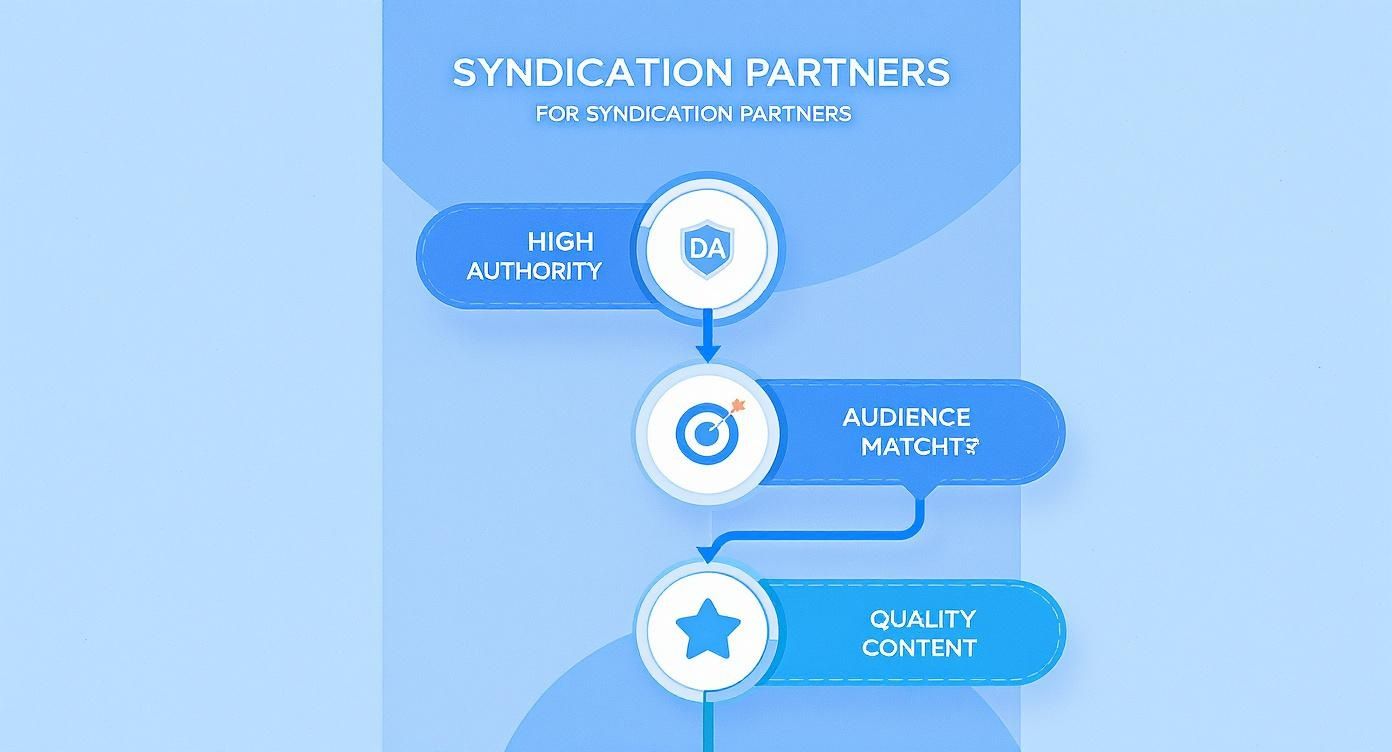
As you can see, the partner's technical capability to implement one of these tags is just as important as their audience and authority.
The Last Resort: A Simple Attribution Link
Okay, so what if a partner can't do a canonical or a noindex tag? Now you're in last-resort territory. The only tool left in your belt is a clear, crawlable link back to your original article.
This is the bare minimum you should ever accept.
Usually, it's a short line of text at the top or bottom of the article, like, “This piece was originally published on [Your Website].”
Here's the catch: while this does give you a backlink, it offers zero direct instructions to Google about which page is the original. You’re just hoping the algorithm figures it out. If the partner site is a high-authority powerhouse, their version could easily outrank yours. It’s a serious risk.
The only time to even consider this is if the partner offers massive brand exposure to your ideal audience. Even then, you have to weigh that exposure against the potential SEO damage. And if you ever need to change the URL of your original post down the line, managing the fallout can get messy. Our guide on how to do a 301 redirect can be a lifesaver in those situations.
Choosing the right technical approach is a crucial step in any syndication partnership. To make it clearer, here’s a quick breakdown of the three methods.
Comparison of Syndication SEO Methods
| Method | Best For | SEO Benefit | Key Consideration |
|---|---|---|---|
| Rel=Canonical | The ideal scenario. Best for consolidating all ranking signals and authority. | Passes all link equity and authority to the original URL, preventing duplicate content issues. | Your syndication partner must be willing and able to implement it correctly in the HTML head. |
| Noindex, Follow | When a canonical tag is not possible. A very safe alternative. | Prevents the syndicated version from competing in search, while still passing value from the backlink. | You don't get the full authority consolidation of a canonical, but it completely removes ranking risk. |
| Attribution Link | The last resort, used only for high-value brand exposure opportunities. | Provides a simple backlink, which has some value. | Offers no protection against the syndicated copy outranking your original. A significant SEO risk. |
Ultimately, your goal is to protect your original asset. Always aim for the canonical tag, but have the noindex tag ready as a solid fallback. Avoid relying on just an attribution link unless the trade-off is truly exceptional.
Measuring the ROI of Your Syndicated Content
Syndicating your content feels great, but if you can't prove its value, you're just hoping for the best. Forget about vanity metrics like page views for a moment. To really understand what your syndicated content SEO is doing for your business, you need to tie your efforts back to cold, hard numbers.
We're talking about tangible results: referral traffic, new backlinks, and a bump in keyword rankings for your original article. When you approach it with data, you can clearly see which partnerships are pulling their weight and justify every minute you spend on them.
Tracking Referral Traffic with UTM Parameters
The clearest, most direct way to see what a syndication partner is doing for you is to track the traffic they send your way. For this, UTM parameters are your best friend. These are just simple little tags you add to the end of a URL that tell your analytics platform exactly where that click came from.
It's not as complicated as it sounds. When you give a partner the link back to your original article, you just add a few specific tags to it.
-
utm_source: This is who's sending the traffic. Thinkfoodservice-weekly. -
utm_medium: This is the channel. I usually usesyndicationorreferral. -
utm_campaign: Give the campaign a name, likecommercial-oven-guide-2025.
With this simple setup, you can hop into Google Analytics 4 and see the traffic from each partner completely isolated. Now you know not just how many people they sent, but what those people did. Did they leave right away, or did they stick around and check out your product pages?
By giving each syndication partner their own unique UTM parameters, you get a clean, undeniable record of their performance. It cuts out all the guesswork and tells you exactly which relationships are paying off.
Monitoring Backlinks and Their SEO Impact
Referral traffic is a great immediate win, but the real long-term SEO gold from syndication comes from quality backlinks. Every time a respectable site republishes your work and links back to you, it’s a powerful signal to search engines.
To keep an eye on this, you'll need an SEO tool like Ahrefs or Semrush. I recommend setting up alerts that ping you every time your original article gets a new backlink. This lets you watch a few key things:
- New Linking Domains: Are you actually reaching new sites and expanding your backlink profile?
- Authority of Partners: Are the links coming from sites with a high Domain Rating (DR) or Authority Score (AS)? These are the ones that really move the needle.
- Anchor Text Usage: Is the link text relevant to your article's topic? This helps Google understand what your page is all about.
Seeing a steady flow of backlinks from relevant, high-authority partners is exactly what Google wants to see. It tells the algorithm your content is a go-to resource, and that authority boost is a huge part of your syndication ROI.
Connecting Syndication to Keyword Rankings
Ultimately, all of this SEO work is about ranking higher for the keywords that matter to your business. The authority and backlinks you build through syndication should directly fuel that goal. After you get a piece of content syndicated on a couple of solid sites, it's time to start watching your rank tracker.
Look for upward movement on your main keywords. Did your guide on "commercial refrigeration maintenance" suddenly jump from page two to the top of page one a few weeks after that big industry blog picked it up? That's your ROI right there. For a deeper dive into this, check out our full guide on how to measure SEO performance.
Drawing a straight line from your syndication efforts to better rankings is the proof you need to show that the strategy is working. It’s a fantastic way to demonstrate real business value. In fact, about 43% of B2B brands are already using syndication to tap into new audiences, and 23% are using it to replace lead generation channels that just weren't cutting it. It’s clear that syndication delivers both powerful SEO gains and real-world results. You can discover more insights about B2B content syndication to see how it drives everything from domain authority to actual conversions.
A Syndication Plan in Action for B2B Tech
Theory is great, but let's get our hands dirty. The real learning happens when you see a strategy come to life. So, we're going to walk through a practical syndication plan for a fictional B2B tech company I'll call "InnovateAI."
Imagine InnovateAI just published a killer, in-depth guide: "Implementing AI in Your Customer Support Workflow." Their goal is to get this guide in front of IT managers and customer experience (CX) directors—the people who actually write the checks. Just letting it sit on their blog is a waste. They need a proactive plan to get it out there and build authority, making syndicated content SEO a core part of their launch.
This isn't just a hypothetical exercise. You can take this exact blueprint and adapt it for your own business, whether you're selling software or commercial kitchen equipment.

Identifying the Perfect Syndication Partners
InnovateAI can't just spray and pray their content across the internet. Success hinges on finding partners whose audience is a dead ringer for their target buyers. A generic "tech news" site is okay, but a niche publication that their ideal customer reads religiously? That's gold.
To focus their energy, they'll create a tiered outreach list.
-
Tier 1 (The Dream Partners): These are the heavy hitters—high-authority industry publications like CX Today or IT Pro. Getting published here means massive credibility and a powerful backlink. For these, the technical setup has to be perfect, making a
rel=canonicaltag absolutely non-negotiable. -
Tier 2 (Niche Blogs & Influencers): Think of the respected blogs run by well-known figures in the customer support tech space. These folks have smaller, but incredibly engaged, audiences. If a canonical tag is a no-go, a
noindextag is the next best thing. -
Tier 3 (Community Platforms): We're talking about industry forums or specific LinkedIn Groups where IT managers hang out to discuss new tech. Here, the strategy shifts. They won't post the full guide. Instead, they’ll share a genuinely helpful excerpt and link back to their original article to pull readers to their site.
It's also worth looking at how B2B influencer marketing strategies work. The principles of finding and engaging with key people often overlap, giving you fresh ideas for identifying potential partners who can champion your content.
Crafting Outreach That Gets a Reply
I've seen it a thousand times: generic outreach emails get deleted on sight. InnovateAI has to personalize every single message to show they've actually done their homework. Editors at top-tier publications are swamped, and they need a clear, compelling reason to even consider a pitch.
Here’s an outreach template that actually stands a chance with a Tier 1 partner:
Subject: Content for your readers: A guide to AI in customer support
Hi [Editor's Name],
I've been following your coverage on emerging CX technologies in CX Today for a while, and your recent piece on chatbot limitations really stood out. It aligns perfectly with a comprehensive guide we just published on implementing AI throughout the entire customer support workflow.
It's a data-backed, 3,000-word resource that covers everything from initial setup to measuring ROI. I believe it would provide immense value to your audience of CX leaders.
Would you be open to republishing it? We'd be happy to provide the content in any format you need and would only ask for a canonical tag pointing back to our original post to handle the SEO side correctly.
Thanks for your time,
[Your Name] at InnovateAI
Why does this work? It’s specific. It proves they read the publication. Most importantly, it gets straight to the point, states the value, and clarifies the technical requirement right from the start. No games.
Adapting the Content for Different Audiences
While the core of the guide is solid, a little customization can make a huge difference. InnovateAI won't just fire off the raw HTML and expect magic to happen. The goal is to make the editor's job as easy as possible.
Here's how they'll tweak the introduction for two very different partners:
-
For IT Pro (The Technical Crowd): They'll rewrite the intro to lead with the nitty-gritty technical challenges of AI integration. It will immediately hit on pain points like data security, system compatibility, and API headaches that keep an IT manager up at night.
-
For a CX Leadership Blog (The Strategic Crowd): The intro here will be all about business outcomes. It will open by highlighting AI's impact on crucial metrics like customer satisfaction (CSAT) scores, agent efficiency, and shrinking those dreaded support ticket backlogs.
These are small changes, but they reframe the entire article to resonate instantly with each specific audience. By tailoring the hook, InnovateAI dramatically increases the odds that the content will perform well, making the partnership a win-win for everyone. It’s what separates simple republishing from true strategic content placement.
Your Syndicated Content Questions, Answered
Even when you have a solid plan, syndication can bring up some tricky questions. It's a nuanced part of SEO, and the small details often make or break your success. Let's tackle some of the most common questions I hear from clients to clear up any confusion.
Think of this as your quick-reference guide for navigating those "what if" moments.
Will Syndication Give Me a Duplicate Content Penalty?
This is the number one concern, and thankfully, the answer is no. Google doesn't really have a "duplicate content penalty." The real risk isn't a penalty; it's confusion.
When Google finds the same article in multiple places without a clear signal telling it which one is the original, it gets confused. It might split the ranking signals between the two versions, diluting your authority. Or worse, it might decide the syndicated version on the bigger, more authoritative site is the one to rank. That means all your hard-earned traffic goes to them, not you.
The
rel=canonicaltag is your silver bullet. It's a simple line of code that points back to your original article, telling search engines, "Hey, this is just a copy. Send all the SEO credit over there." This is how you prevent confusion and make sure all that link juice flows back to your site.
What if a Partner Can't Use a Canonical Tag?
You'll run into this a lot, especially with big media outlets that have strict publishing rules. If they tell you rel=canonical is a no-go, don't panic. You have a backup plan.
Your next best move is to ask them to put a noindex tag on their version. This tells search engines to ignore their page and not include it in search results. It effectively takes their copy out of the competition, leaving your original as the only one that can rank.
If they can't do that either, the absolute bare minimum you should accept is a clean, dofollow backlink that clearly attributes the article to you. It's not ideal for consolidating authority, but it's better than nothing.
How Long Does it Take to See SEO Results from Syndication?
This is where you need a little patience, as the benefits roll in over time. It’s not an overnight switch, but a gradual build.
Here's a realistic timeline based on what I've seen:
- Right Away (Days): As soon as the partner publishes and shares the article, you can see a nice little bump in referral traffic.
- Short Term (Weeks): Within a few weeks, as search engines find and process the new backlink, you might notice some early movement in your keyword rankings.
- Long Term (Months): The real magic happens over the next few months. This is when the full authority from those syndicated links really settles in, contributing to a more significant, lasting lift in your site's overall authority.
Should I Syndicate the Full Article or Just a Snippet?
For pure SEO power, syndicating the full article with a canonical tag is the way to go. It's the cleanest way to consolidate all the ranking value back to your original piece.
But that doesn't mean a snippet is a bad idea—it just serves a different purpose. Syndicating a short excerpt with a "read more" link back to your site is fantastic for driving referral traffic. You're giving their audience a taste and making them click over to your site for the full story.
So, which one is better? It all comes down to your goal for that specific partnership. Are you chasing link equity or immediate traffic?
At Restaurant Equipment SEO, we specialize in turning your expert content into a powerful engine for organic growth.
Discover how our targeted article writing and link-building services can expand your reach