
Branding and Content Marketing for Food Service Suppliers
Branding and content marketing isn't just a buzzword; it's the core of how you connect with customers today. It’s about clearly defining who you are as a company and then creating genuinely helpful content that attracts and builds lasting trust with your audience.
For a restaurant equipment supplier, this means shifting your focus. Instead of just listing product specs, you become the go-to expert that chefs and restaurateurs depend on for real-world advice and solutions.
Building Your Brand in the Food Service Industry
Before you ever write a blog post or schedule a social media update, you need to lay a solid foundation. This upfront work is what separates the suppliers that get forgotten from the ones that become indispensable partners. This is where you stop just selling equipment and start building a memorable brand that connects with your customers on a deeper level.
Taking the time to do this ensures every piece of content you create is sharp, relevant, and actually drives business. It’s the difference between shouting into an empty room and having a meaningful conversation with someone who needs exactly what you offer.
Define Your Brand Voice and Positioning
First things first: who are you? Your brand voice is the personality that comes through in everything you do. Are you the seasoned, authoritative expert? The friendly, approachable guide? Or the innovative, tech-focused pioneer? A great voice for an equipment supplier often finds that sweet spot between deep technical expertise and a genuine understanding of the chaos of a professional kitchen.
Think about how you want customers to see you. Are you the most rugged, durable option on the market? The best value for a brand-new restaurant? The one with all the latest smart-kitchen tech? Your positioning is your stake in the ground, declaring that unique value. For any food service business, a clear identity is key, and these Actionable Small Business Branding Tips offer a fantastic starting point for defining your brand's core.
Pro Tip: Your brand voice isn't just what you say; it's how you say it. It needs to be consistent everywhere—from your website and product descriptions to your social media replies and even your sales team's emails.
Craft Detailed Buyer Personas
You can’t solve your customers' problems if you don't truly understand them. That's where buyer personas come in. These aren't just generic labels; they're detailed, semi-fictional profiles of your ideal customers, built from real data and market research.
Don't just aim for "Restaurant Owner." Get granular.
- "Startup Steve": He’s a first-time restaurateur, completely swamped by health codes and working with a shoestring budget. He needs practical advice on essential, affordable equipment.
- "Executive Chef Elena": She runs a busy, high-end kitchen. Her world revolves around workflow efficiency, equipment durability, and tools that can take a beating day in and day out.
- "Franchise Frank": As a multi-location owner, his priorities are consistency across all his restaurants, energy efficiency, and equipment with minimal long-term maintenance costs.
When you map out their daily frustrations, their biggest challenges, and their ultimate goals, you can create content that feels like it was written just for them. A guide to "Maximizing Small Kitchen Layouts" will hit home for Startup Steve, while Executive Chef Elena would jump on a detailed comparison of induction versus gas cooktops. This focused approach turns your marketing from a generic broadcast into a helpful, personal conversation.
Developing Content That Solves Real Kitchen Problems
Let's be honest, effective content isn't a thinly veiled sales pitch. It’s a resource. For restaurant equipment suppliers, the smartest way to approach branding and content marketing is to become the go-to problem-solver for everyone from the head chef to the first-time owner. This means you have to stop talking so much about product features and start focusing on the real-world headaches your audience deals with every single day.
The trick is to build your content around a few core pillars—these are the big-picture topics your brand is going to own. Think of them as the foundation of your entire content strategy. They ensure everything you publish is on-point, relevant, and builds your reputation as an industry expert. These pillars should come directly from the pain points of the people you're trying to sell to.
Build Your Foundational Content Pillars
Instead of throwing content at the wall and hoping something sticks, you need to organize your expertise around a few high-value themes. This makes planning so much easier and guarantees you're consistently creating content people are actually looking for.
Try building pillars around the major challenges of running a kitchen:
- Maximizing Kitchen Efficiency: This is a goldmine. You can cover everything from smart kitchen layouts that improve workflow to choosing equipment that shaves minutes off prep time. Think practical guides on cutting down ticket times or case studies showing how a kitchen redesign transformed a restaurant's service.
- Navigating Food Safety & Compliance: Restaurant owners live in fear of the health inspector. You can be their lifeline with articles on HACCP compliance, guides to choosing easy-to-clean equipment, or simple checklists for daily sanitation that they can print out and stick on the wall.
- Choosing Cost-Saving Equipment: The bottom line is king. This pillar is all about ROI. Create content that breaks down the long-term energy savings between different types of ovens or calculates the real financial upside of upgrading to a high-efficiency dishwasher.
When you focus on these core areas, you're not just selling equipment anymore. You're building a library of genuinely useful information that positions your brand as a trusted advisor.
Match Content Formats to Your Goals
Once your pillars are set, the next step is to figure out the best way to present that information. Different formats work for different stages of the buying journey. A deep-dive blog post is fantastic for grabbing attention through Google searches, but a downloadable checklist is what you need to capture a lead. If you want to get more ideas on this, exploring different content creation strategies can give you a ton of inspiration.
Your goal should be to create resources so indispensable that they become a permanent part of your clients' operations. I'm talking about a laminated maintenance schedule, with your logo on it, pinned to the wall right next to the oven you sold them. That’s the kind of value you should be aiming for.
To help you connect the dots, here’s a look at how you can match your pillars with specific content formats designed to get results.
Content Pillar and Format Matrix for Equipment Suppliers
This table breaks down how to align your core content themes with the right formats to hit your marketing goals and connect with different people in the kitchen hierarchy.
| Content Pillar | Target Audience Segment | Primary Goal | Recommended Content Format |
|---|---|---|---|
| Maximizing Kitchen Efficiency | Executive Chefs, Kitchen Managers | Attract & Educate | In-depth guides like "The Ultimate Guide to Commercial Refrigeration" or comparison articles such as "Induction vs. Gas Cooktops". |
| Food Safety Compliance | Restaurant Owners, General Managers | Build Trust & Capture Leads | Downloadable maintenance checklists, how-to videos on equipment cleaning, or articles explaining new health code regulations. |
| Choosing Cost-Saving Equipment | Startup Owners, Franchisees | Drive Conversions | ROI calculators, detailed equipment spec sheets, and customer case studies that highlight tangible financial savings. |
Taking this methodical approach means every blog post, video, and guide you create has a clear purpose and speaks directly to a specific need. To see how some of the top suppliers are already winning with this playbook, check out these excellent branding and content marketing content marketing examples for restaurant equipment suppliers and get inspired.
Building Your Content Promotion and SEO Blueprint
Let’s be honest: creating great content is only half the job. If you write the world's best guide to choosing a commercial combi oven and no one sees it, it doesn't do you—or your potential customers—any good. This is where we pivot from creation to promotion. It's time to build a smart, multi-channel plan to get your content in front of the right restaurant owners, exactly when they're looking for answers.
At the heart of this plan is a realistic editorial calendar. This isn't just a to-do list of blog posts. Think of it as a strategic schedule that maps out your content for the weeks and months ahead. For example, you might plan a deep-dive, evergreen guide on commercial refrigeration maintenance, but also schedule a timely article like "Prepping Your Walk-In for the Holiday Rush" to catch that seasonal search traffic.
Get Your Content Seen: A Multi-Channel Approach
To really make an impact, you need to meet your audience where they are. While SEO is your long-game for consistent, organic traffic, other channels are critical for building relationships and establishing your authority. The goal is to create a marketing ecosystem where every channel works together.
Your promotion strategy should absolutely include:
- Search Engine Optimization (SEO): This is non-negotiable. Every piece of content needs to be optimized for the keywords your customers are actually typing into Google. A solid restaurant equipment SEO strategy is the foundation for getting found.
- Email Newsletters: You have a list of leads and past customers, right? Use it. Sending your latest guides, case studies, or special offers directly to their inbox is a powerful way to stay top-of-mind.
- A Strong LinkedIn Presence: This is where the decision-makers hang out. Share your more authoritative content—think detailed equipment comparisons, ROI calculators, or industry trend reports—to build credibility and engage directly with professionals in the foodservice space.
This simple flow chart really breaks down how your strategy comes together, moving from big-picture ideas to a concrete promotional plan.
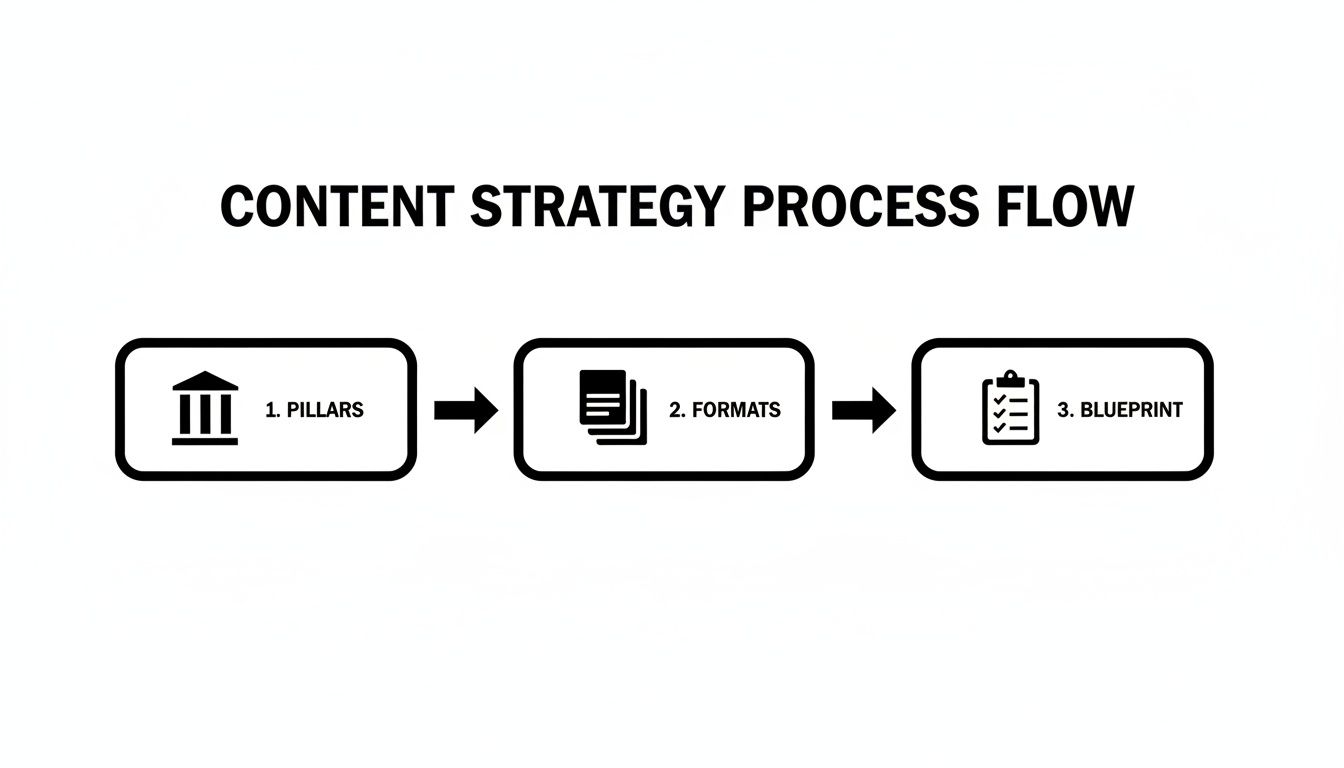
As you can see, a successful blueprint isn't just pulled out of thin air. It’s built on well-defined content pillars and a mix of formats that all work toward a cohesive promotion plan.
Own Your Backyard with Local Search
For any equipment supplier, attracting local restaurants, cafes, and bars is the bread and butter of the business. This is where local SEO becomes your secret weapon. With Google holding a staggering 91.4% search market share as of January 2024, your Google Business Profile is your most valuable piece of digital real estate. When a local chef’s fryer goes down mid-service, their first move is a frantic "commercial kitchen repair near me" search on their phone. You need to be the first result they see.
Think of your Google Business Profile as your digital storefront. Keep it meticulously updated with high-quality photos of your equipment, glowing customer reviews, and perfectly accurate contact information. It’s often the first—and most important—impression a local restaurant owner will have of your business.
By weaving together broad content marketing with a laser focus on local SEO, you create a powerful one-two punch. You'll build your brand's authority across the industry while making sure you’re the go-to supplier for every restaurant in your area.
Using Personalization to Nurture Leads and Close Sales
If you’re just broadcasting generic content, you’re essentially shouting into an empty stadium. It's time to stop talking at your audience and start having real conversations with them. This is where you turn your content into a magnet, pulling in qualified leads by showing you understand their world.
You can get started with a tool you already have: your CRM. Simply segmenting your audience based on their behaviors, past purchases, or even the type of restaurant they run allows you to shift from a one-to-many blast to a one-to-one conversation. This is the foundation of powerful branding and content marketing because it proves you're paying attention to their specific challenges.
From General Content to Targeted Solutions
Let’s get practical. Imagine sending a detailed guide on 'Extending the Life of Your Commercial Fryer' only to customers who have previously bought one from you. How about a case study on 'Reducing Energy Costs in Pizzerias' that you send exclusively to pizza shop owners in your database?
That’s what personalization really is. It’s about delivering the right information at the perfect moment, making your content feel less like a sales pitch and more like genuinely helpful advice. This simple act builds incredible trust and positions you as a partner, not just another supplier.
The best content feels like a direct answer to a question a customer was just thinking about. Real personalization isn't about using their first name in an email—it's about understanding their problems and offering a solution before they even have to ask.
Using Content as a Lead Nurturing Tool
Your most valuable content—think downloadable spec sheets, ROI calculators, or detailed maintenance checklists—should do double duty as your best lead-capture tools. The moment a potential buyer downloads your guide on convection ovens, you’ve got a massive signal of their interest.
That's your cue to kick off a targeted follow-up sequence.
- First Touch: Send an immediate email with the guide they requested, maybe adding a link to a related video on proper oven cleaning.
- Second Touch: A few days later, follow up with a case study about a similar business that saw huge gains after upgrading their ovens.
- Final Nudge: Offer a direct, no-pressure consultation to talk through their kitchen's specific needs.
This kind of focused approach directly addresses a prospect's known needs, which can seriously shorten the sales cycle. Personalization is a huge deal in the food service world. A Technomic study found that 47% of consumers pick restaurants with mobile ordering, and 56% prefer app-based platforms where relevant content boosts their experience. As a supplier, this principle is your key to delivering hyper-relevant resources that push decision-makers to act. You can read more about these tech trends on this restaurant tech blog post from tripleseat.com.
By creating a seamless, personalized journey, you completely change how people interact with your brand online. A great place to start is with user experience optimization for your website. This makes sure that once your killer content brings them to your site, the path to becoming a customer is clear, easy, and builds a stronger, more profitable relationship.
Measuring Content Marketing Success with a Sales Focus

Let's be honest. Investing time and money into branding and content marketing only makes sense if it's actually making you money. It's easy to get distracted by a spike in website visits or a bunch of likes on a social media post, but those are "vanity metrics." They feel good, but they don't pay the bills.
The real challenge—and where you’ll see the payoff—is connecting your content directly to business outcomes. We need to move the conversation from "did people see it?" to "did it help close a deal?"
Focus on Revenue-Driving KPIs
The only way to prove your content works is to track metrics that have a direct line to revenue. Instead of getting excited about a blog post that got a lot of general traffic, you should be obsessing over the performance of a guide that captures high-intent leads.
Here are the sales-focused KPIs that actually matter:
- Keyword Rankings for High-Intent Searches: Don't just track your ranking for "commercial ovens." The real gold is in terms like "commercial convection oven quote" or "restaurant ice machine financing." These are phrases people use when they have their wallets out.
- Conversion Rates on Key Forms: So, someone read your "Induction vs. Gas Cooktop" comparison guide. Great. But how many of those readers actually filled out your quote request form? That’s the number that connects your content to a real sales action.
- Volume of Marketing Qualified Leads (MQLs): You need to measure how many leads from your content—like checklist downloads or webinar sign-ups—are good enough to pass along to your sales team. This is about quality, not just quantity.
Your content isn't just a marketing asset; it's a sales tool. Every guide, checklist, and case study should be built with the primary purpose of moving a potential customer one step closer to making a purchase.
Tracking Beyond the First Sale
Great content does more than just bring in new business; it helps you keep the customers you already have. The impact of your branding and content marketing doesn't stop at the first transaction. A strong content library builds loyalty and keeps them coming back.
We see this work in real-time with our clients. For instance, restaurants that installed digital menu boards saw a 1-2% sales uplift just by showing high-quality images and timely promotions. That's a perfect example of how targeted content influences buying decisions right at the point of sale. You can find more data on how technology impacts restaurants on this RestoLabs blog post.
To really understand the full value, you need to look at a different set of metrics.
Gauging Long-Term Customer Value
- Content's Impact on Customer Lifetime Value (CLV): Do customers who engage with your maintenance guides or efficiency calculators end up spending more with you over time? Tracking this can prove your content is creating more valuable, long-term relationships.
- Repeat Purchase Rate: Dig into your data and see if customers who subscribe to your newsletter or regularly read your blog are more likely to make repeat purchases. This is a clear sign that your content is successfully nurturing your customer base.
When you start tying every piece of content to real business outcomes, your marketing stops being a cost center. It becomes a predictable, revenue-generating engine. This data-driven approach is what lets you make smarter decisions, prove your value, and build a foundation for sustainable growth.
Got Questions About Content Marketing in the Food Service World?
Jumping into a full-on branding and content marketing plan can feel like a massive undertaking, especially for B2B folks in the food service equipment game. I've seen a lot of suppliers get stuck on the same practical questions when they're just starting out. Let's tackle those common hurdles head-on.
This isn't about lofty marketing theory. It's about getting straight to the point with guidance that actually works for your business and connects with the professionals running busy kitchens.
How Long Does This Content Stuff Actually Take to Generate Leads?
This is the big one, right? Let's be real: you won't see a flood of new leads overnight. But with a steady, SEO-smart content strategy, you can expect to see real, noticeable bumps in traffic and leads within 6 to 12 months.
Your first wins will likely come from ranking for super-specific, long-tail keywords—the kind of phrases people type in when they’re serious about buying. Think of it like this: paid ads are like renting an audience, but building a library of solid content is like owning an asset that pays dividends for years. An in-depth guide you publish today can keep pulling in qualified leads long after you’ve forgotten about it. Building true authority in a niche like ours is a marathon, not a sprint, but the results stick around and are way more cost-effective in the long run.
Should I Worry About Branding or Content First?
It's the classic chicken-or-the-egg dilemma. The simple answer? You have to do both at the same time. They're two sides of the same coin. Your brand is your reputation—it's who you are and what you stand for. Your content is how you prove it.
You can’t create effective content without a clear brand to give it a voice and a purpose. On the flip side, a great brand without content is like a silent expert—full of incredible knowledge but unable to reach the customers who desperately need it.
A smart strategy weaves your core brand message into every single blog post, video, and case study you create. They have to grow together.
Do Busy Restaurant Owners Really Have Time to Read Blogs?
Yes, but with a giant asterisk. They only read content that solves a painful, immediate problem. A chef-owner couldn't care less about an article on "The History of Commercial Ovens." But you can bet they will stop and read a guide titled "5 Ways to Cut Your Commercial Oven's Energy Bill by 30%."
The secret is to make your content hyper-practical and incredibly easy to digest. It’s not entertainment; it’s a business tool. Your articles need to help them save money, make their kitchen run smoother, or just reduce some of the daily chaos.
Here’s how you make content that a time-crunched pro will actually read:
- Write headlines that promise a clear solution. No fluff.
- Break up your text. Use bolding for key points and keep paragraphs short.
- Lean on bullet points and checklists. They're perfect for quick scanning and reference.
Can I Just Focus on SEO and Skip the Rest?
Starting with SEO is a great move—it's absolutely critical. But thinking of it in isolation is a missed opportunity. SEO gets people to your website; it puts you in the game. It's your high-quality content—the deep-dive guides, the honest equipment comparisons, the real-world case studies—that builds the trust needed to turn a visitor into a customer.
Think of it as a connected system. SEO brings in the traffic. But when you share that same great content on LinkedIn or in your email newsletter, you expand its reach, nurture those leads, and actually send positive signals back to Google that boost your rankings. Each piece of the puzzle makes the others stronger, creating a marketing engine that builds on itself.
At Restaurant Equipment SEO, we specialize in building these powerful, sales-focused content engines for suppliers like you. Learn how we can help you turn your expertise into your best marketing asset.