
Content that Converts: content marketing for b2b companies for qualified leads
When it comes to content marketing for B2B companies, especially in a niche like restaurant equipment, the goal isn't just to make noise. It's to become the answer your customer is desperately searching for.
We're talking about creating and sharing genuinely useful content—technical guides, nitty-gritty case studies, and honest comparison articles—to pull in a very specific business audience. For a restaurant equipment supplier, this means being the trusted resource a frantic kitchen manager stumbles upon at 10 PM while trying to fix a problem or plan a new kitchen layout.
Building Your B2B Content Marketing Foundation
Before you even think about writing a blog post or designing an infographic, you need to lay the groundwork. Great content marketing doesn't start with content; it starts with a deep, almost obsessive, understanding of who you're talking to and what they're looking for.
Rushing this stage is like building a commercial kitchen on a shaky foundation. It's a recipe for disaster. The two pillars of a solid content strategy are getting inside your audience's head to understand their real-world problems and identifying the exact words they use to describe them online. Nailing this ensures every piece of content you create is targeted, valuable, and actually gets found.
Go Deeper Than Generic Personas
Let's be honest, vague personas like "Restaurant Owner, age 45-60" are useless. To create content that actually resonates, you have to dig into the specific, day-to-day headaches of the real people making purchasing decisions.
Think about who is actually in the trenches:
- The Executive Chef: This person lives and dies by consistency, performance, and kitchen workflow. They aren’t just buying a combi oven; they’re buying a tool that must deliver perfectly cooked salmon during a chaotic Saturday night dinner rush. Their biggest fear? Equipment that fails mid-service or produces inconsistent results, killing ticket times and food quality.
- The Restaurant Owner/Operator: They’re all about the bottom line. Their mind is constantly churning with thoughts of energy bills, labor efficiency, and ROI. They need to know precisely how a new ice machine's ENERGY STAR rating translates into monthly savings or how an automated fryer can slash labor costs.
- The Kitchen Manager: This is your hands-on problem solver, dealing with maintenance schedules, staff training, and daily operations. They're searching for practical, actionable advice. Think "walk-in cooler maintenance checklist" or "how to properly clean a commercial deep fryer," because their job is to prevent costly downtime and keep the kitchen humming.
When you zero in on these distinct roles and their unique challenges, your content transforms. You stop being a salesperson pushing products and become an indispensable problem-solver, offering solutions that speak directly to their professional anxieties and ambitions.
Uncovering Keywords That Scream "I'm Ready to Buy"
Once you're clear on their pain points, the next step is to find the exact phrases they're typing into Google. This isn't your typical keyword research. For a specialized B2B audience, you're hunting for long-tail keywords—longer, more specific phrases that signal a strong intent to research or purchase.
Forget about broad, high-competition terms like "restaurant equipment." Instead, get granular with the kind of queries that show someone has a real problem to solve:
best commercial deep fryer for high volumeenergy efficient commercial refrigeration comparisonRobot Coupe vs Hobart food processorcombi oven cleaning and maintenance guide
These phrases tell a story. Someone searching for a "high volume" fryer has an immediate business need. A person comparing two specific brands is deep in the consideration phase, close to making a decision. For a deeper look at how this fits into the bigger picture, you can see how brand and content marketing work hand-in-hand.
To make sure this valuable content reaches the right people, it’s also crucial to build a sharp LinkedIn marketing strategy for B2B, targeting decision-makers where they’re already looking for professional insights.
By building your content around these high-intent keywords, you attract qualified traffic—the right people who are actively searching for the solutions you sell. Your website stops being a simple online catalog and becomes a powerful lead-generation engine.
Structuring Your Content with Topic Clusters
If you want to be seen as the go-to expert in the restaurant equipment space, a scattered approach to blogging just won't cut it. A blog post here, a guide there—it's not enough to build real authority. To truly own your niche in search results, you need a plan. That's where the topic cluster model comes in.
This isn't just about SEO jargon; it's a strategic shift. Instead of chasing dozens of disconnected keywords, you focus on owning an entire subject. Think of it as building a library on a specific topic, not just writing a single book.
The whole setup is designed to be loved by both your customers and search engines like Google. You create a central, comprehensive "Pillar Page" on a broad topic. Then, you surround it with more detailed "Cluster Content" that dives deep into specific subtopics, with each piece linking back to the main pillar.
This creates a powerful network of internal links that screams "expertise" to Google. When search engines see you've covered a topic like commercial refrigeration from every possible angle, they start to see your website as the definitive resource. The result? Higher rankings for a whole group of related search terms.
Defining Your Pillar and Cluster Content
So, what does this look like in practice?
Your Pillar Page is the big one—the ultimate guide to a core business category, like "Commercial Refrigeration." This is a long-form, foundational resource that covers all the high-level points a restaurant owner needs to know. It’s the hub of your content wheel.
Your Cluster Content is where you get specific. These are the deep-dive articles that branch off from your pillar, exploring individual facets in much greater detail. Every cluster piece links back to the main pillar page, which reinforces its importance and helps pass authority. This structure is the backbone of effective content marketing for B2B companies.
This entire strategy is built on the foundation you've already laid: your deep understanding of your audience and the keywords they use.
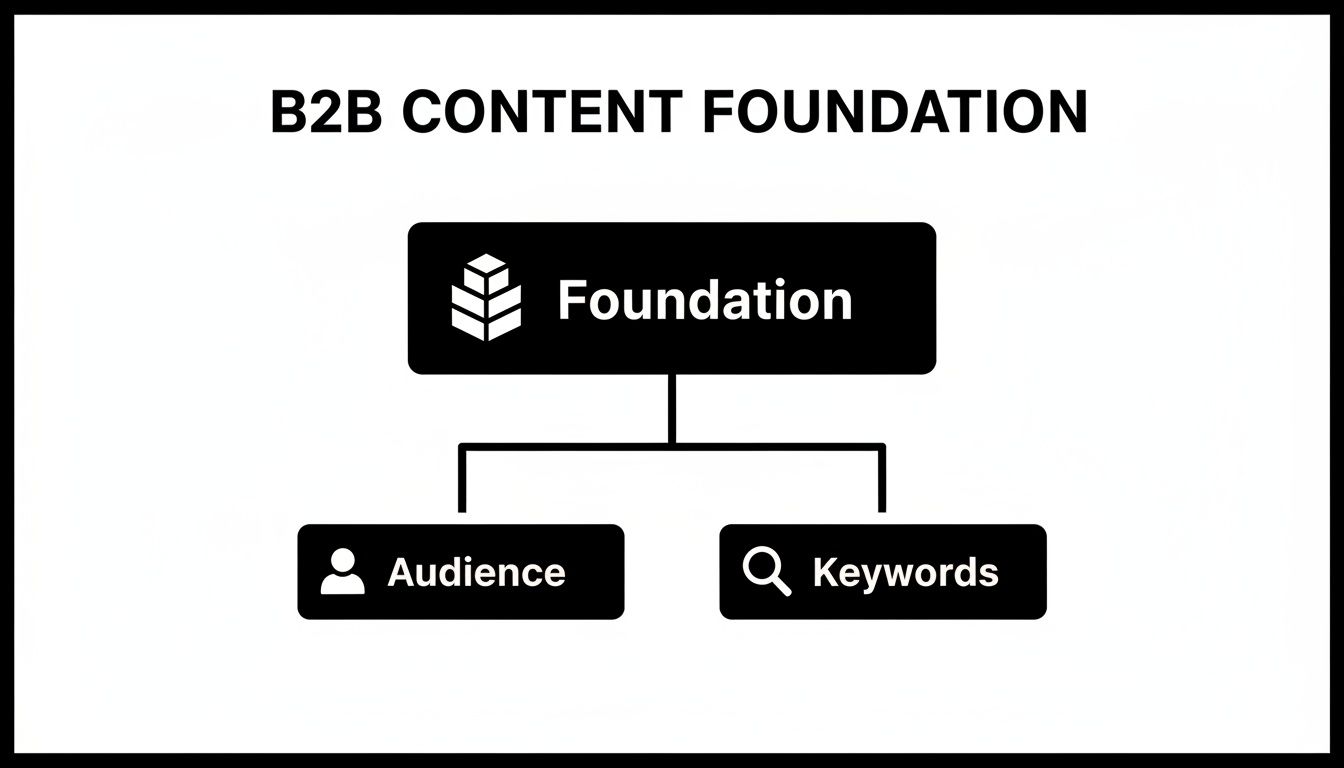
As you can see, knowing your customer and what they search for is what makes this whole thing work.
A Practical Example for Restaurant Equipment
Let's make this real. Here’s a topic cluster plan a restaurant equipment supplier could build out right now for commercial refrigeration. This isn't just theory—it's an actionable roadmap.
To illustrate, here’s a sample table outlining how a pillar page on commercial refrigeration could be supported by targeted cluster content.
Example Topic Cluster for a Restaurant Equipment Supplier
| Content Type | Topic / Title | Target Keyword | Target Audience Stage |
|---|---|---|---|
| Pillar Page | The Ultimate Guide to Commercial Refrigeration | commercial refrigeration guide | Consideration |
| Cluster Content | How to Choose the Right Walk-In Freezer | walk-in freezer buying guide | Decision |
| Cluster Content | 5 Common Reach-In Cooler Problems & Fixes | reach-in cooler troubleshooting | Awareness |
| Cluster Content | Energy-Efficient Ice Machine Comparison | best energy efficient ice machine | Decision |
| Cluster Content | Commercial Refrigerator Maintenance Checklist | commercial refrigerator maintenance | Awareness / Retention |
This table shows how each piece of content has a distinct purpose, keyword, and target audience, yet they all work together to support the main pillar.
By building out this ecosystem of content, you create multiple entry points for potential customers, no matter where they are in their buying journey. A kitchen manager frantically searching for a quick fix might find your troubleshooting post. From there, they discover your ultimate guide, and suddenly, your brand is the expert they trust.
When you adopt this model, your blog stops being a simple publication and becomes a strategic business asset. Every single article you create has a job to do, working in concert with the others to build unshakable topical authority and, most importantly, drive qualified leads. You’re no longer just answering one-off questions; you’re becoming the definitive answer for an entire category.
Creating Content That Actually Converts Customers
In the world of restaurant equipment, your audience doesn't have time for fluff. A kitchen manager staring down a failing walk-in cooler or a chef planning a new layout needs practical, trustworthy information—and they need it now. This is where your content marketing for b2b companies needs to shift from generic advice to specific, problem-solving resources.
The goal isn't just to sell. It's to create content so genuinely useful that it becomes an essential tool for your customers' day-to-day operations. When you're the one providing the exact technical specs, a clear troubleshooting guide, or a compelling case study, you're building the kind of trust that has to exist before any significant B2B purchase.
Go Beyond Basic Product Pages
Let's be honest: standard product pages with a few bullet points and a price tag just don't cut it anymore. Your buyers are sophisticated, and they need deep, technical information to make the right call. This is your chance to prove you truly understand their world.
Think of your website as a digital library of expertise. You should be creating:
- Detailed Technical Guides: Build out comprehensive guides for complex equipment like combi ovens or blast chillers. Don't just regurgitate the manufacturer's manual. Include practical tips on installation, daily operation, and the cleaning protocols that prevent common breakdowns.
- Actionable Troubleshooting Content: When a commercial ice machine dies mid-service, your customer is frantically searching for answers. Content that targets specific error codes or symptoms—like "Why is my Hoshizaki ice machine beeping?"—positions you as an indispensable resource right in the middle of a crisis.
Create Unbiased Product Comparisons
B2B buyers deep in the consideration stage are actively weighing their options. This is where you can intercept them. Side-by-side product comparisons are one of the most powerful content formats you can create to capture this high-intent audience.
A search for "Robot-Coupe vs. Hobart food processors" is a screaming signal of a customer who is close to making a decision. Your job is to provide an honest, detailed breakdown that helps them choose the right tool for their specific kitchen, not just the one you want to sell.
Here’s how a winning comparison page might look:
| Feature Comparison | Robot-Coupe R2N | Hobart FP250 |
|---|---|---|
| Capacity | 3 Quarts | 2.5 Quarts |
| Motor Power | 1 HP | 1 HP |
| Best Use Case | High-volume prep, sauces | Medium-volume, chopping |
| Cleaning & Maint. | Dishwasher-safe bowl | Sealed housing, easy wipe-down |
| Price Point | $$$ | $$ |
This simple format gives busy professionals the at-a-glance information they need. It builds enormous trust by showing you’re focused on helping them find the best solution, not just pushing one brand over another. Our deep dive on building an SEO content strategy can give you more ideas on how to structure these valuable pages.
Tell a Compelling Story with Case Studies
Nothing is more persuasive than a real-world success story. Case studies are your chance to move beyond product features and demonstrate tangible business impact. For a restaurant owner, seeing how a peer solved a problem just like theirs is incredibly powerful.
But a good case study isn't just a glowing testimonial. It's a data-driven story that outlines a clear problem, the solution you provided, and the measurable results that followed.
Key Takeaway: A great case study isn't about your product; it's about your customer's success. Focus on the transformation. Show how your equipment helped a local pizzeria cut its energy bills by 20% or enabled a catering company to increase its production capacity by 50%.
Frame your case studies with a clear narrative flow:
- The Challenge: Detail the specific operational pain point the customer was facing. (e.g., "High-volume frying was creating a bottleneck during peak hours, increasing ticket times.")
- The Solution: Explain why a specific piece of equipment was the answer and how it was implemented. (e.g., "We recommended the Pitco Solstice Supreme high-efficiency fryer to handle their volume and reduce recovery time.")
- The Results: Quantify the outcome with hard numbers. (e.g., "They successfully reduced average ticket times by 3 minutes and lowered their monthly gas bill by $250.")
These content types—technical guides, comparisons, and case studies—are the real workhorses of a successful B2B content marketing program. They directly address the questions and concerns of your audience at every stage of their journey, establishing your company not just as a seller, but as a trusted partner in their success.
Amplifying Your Reach with Smart Distribution
You’ve just published a killer technical guide or a truly compelling case study. That’s a huge win, but don't pop the champagne just yet. Hitting "publish" isn't the finish line; it's the starting gun.
The hard truth about content marketing for b2b companies is that even the most brilliant content is worthless if your ideal customer never sees it. This is where smart distribution comes in. It’s how you turn a static piece of content into an active tool that actually drives conversations and, ultimately, revenue.
This isn't about just blasting your new article across every social media channel you can think of. It's a calculated strategy to squeeze every drop of value from your hard work, making sure it lands in front of the right people, on the platforms they actually use. It’s also about handing your sales team the exact resources they need to close more deals.

Work Smarter with Content Repurposing
The secret to a powerful distribution strategy? Repurposing. The concept is simple: take one high-effort asset and break it down into a dozen smaller pieces, each perfectly suited for a different platform. This extends the life of your original work and gets it in front of more eyeballs without you having to start from scratch every single time.
Let's say you just published a massive guide on "The Ultimate Guide to Combi Oven Maintenance." That single blog post is a content goldmine.
Here’s how you could spin that gold:
- A quick demo video for LinkedIn. Pull three crucial maintenance tips from the guide. Film a simple, 90-second video showing each one. It’s visual, it’s fast, and it’s perfect for grabbing the attention of busy kitchen managers scrolling their feeds.
- An infographic for your newsletter. Condense the main checklist into a clean, visually engaging infographic. This is fantastic "value-add" content for your email list—something they can easily scan and save. And it works; 71% of B2B marketers lean on their email newsletters.
- Talking points for the sales team. Extract the most compelling data points and ROI arguments. Put them into a one-page brief for your sales reps. Now, when they’re on a call, they can say, "We actually have a guide that shows how proper daily cleaning can reduce service calls by 40%."
By repurposing one big asset, you're not just making more "stuff." You're creating content that’s perfectly formatted for the context of each channel. You're respecting your audience's time and delivering expertise in the way they actually want to consume it.
Bridge the Gap Between Marketing and Sales
Your content shouldn't live on an island. It should be one of the sharpest tools in your sales team’s kit—a strategy we call sales enablement. The content you’re creating is tailor-made to handle customer objections, answer tough technical questions, and build the credibility your sales reps need.
When marketing and sales are truly aligned, magic happens. Marketing creates the assets, and sales provides direct feedback from the field on what customers are actually asking. This creates a powerful loop that makes every piece of future content even better.
Here are a few ways to make this happen:
- Use case studies as proof. When a prospect is on the fence about the investment, a sales rep can send them a case study showing how a similar restaurant solved the exact same problem with your equipment. You're not just telling them about ROI; you're showing them.
- Leverage spec sheets for nurturing. A potential customer downloading a spec sheet for a walk-in freezer is a massive buying signal. That action should immediately trigger a targeted email sequence offering more help, like a comparison guide or an installation checklist, gently nudging them down the funnel.
- Share blog posts to answer questions. A prospect asks about energy efficiency? Your salesperson can follow up with a link to your blog post comparing different commercial refrigerator models. Suddenly, they’re not just a product pusher; they’re a helpful expert.
When you weave your content directly into the sales cycle, every article and guide you create starts working harder. It stops being "just marketing" and becomes a critical part of the conversation that turns interested leads into loyal customers.
Using AI as a Force Multiplier in Your Workflow
Let's be real: AI is no longer some far-off concept. It’s a tool that’s already in your marketing kit, and the big question isn't if you should use it, but how you can use it to get more done without sounding like a machine.
The data tells a fascinating story here. A whopping 95% of B2B marketers are using AI, yet only 39% are actually seeing better performance from it. That's a huge gap. While 87% of users report a boost in productivity, the results just aren't always there. The full content marketing statistics research highlights this disconnect perfectly.
So, what's the secret? Think of AI as a hyper-efficient assistant, not the author. Its job is to handle the tedious, time-consuming parts of content creation. This frees up your human experts—the people who actually know the ins and outs of restaurant equipment—to add the critical details, technical accuracy, and real-world experience that builds trust.
AI as Your Creative Ideation Partner
One of the best ways to get started with AI is to use it to conquer the blank page. Instead of struggling to come up with ideas, you can have a list of solid starting points in seconds. It's a fantastic way to get the creative ball rolling.
Here are a few ways we use it to kick things off:
- Brainstorming Blog Topics: Give a prompt like, "Generate 10 blog post ideas for a kitchen manager struggling with combi oven maintenance." You'll instantly get a list of relevant, problem-focused topics.
- Outlining Technical Guides: Try asking it to, "Create a detailed outline for a technical guide on choosing an energy-efficient commercial walk-in cooler." It will give you a logical structure to build upon.
- Finding Creative Angles: A prompt like, "What are three creative angles for a case study about a pizzeria that upgraded its deck oven?" can uncover storytelling ideas you hadn't considered.
The goal is not to copy and paste the output. The goal is to get a solid, structured first draft that your team can then infuse with their deep industry knowledge. AI provides the skeleton; your experts provide the soul.
From First Draft to Final Polish
Once you have that AI-generated foundation, the real work begins. This is where your human expertise becomes a massive competitive advantage in content marketing for b2b companies.
An AI can write a generic description of a commercial fryer, sure. But it can’t explain how that fryer's specific recovery time makes a tangible difference in a busy kitchen during a chaotic Friday night dinner rush. Only a human can do that.
Here’s a practical workflow that combines AI speed with human insight:
- Generate the First Draft: Let the AI handle the initial heavy lifting. Use it to write a first pass of a product page, a short blog post, or an email.
- Inject Technical Specificity: Hand the draft over to your product expert or engineer. They’ll layer in the precise specs, correct any subtle inaccuracies, and add the industry-specific language your audience expects.
- Add Your Brand Voice: Next, your editor polishes the text to make sure it sounds like you. They’ll align the tone to be helpful, authoritative, or whatever your brand voice is.
- Optimize for SEO: The final step is to ensure the content is optimized for search. To really make this work, knowing some practical applications like how to use ChatGPT for SEO optimization can turn AI into a true asset.
This process lets you produce more content, faster, without ever sacrificing the accuracy and authenticity your professional audience demands.
Measuring Success and Proving Your ROI
You’ve invested a ton of time and resources into creating high-value content. But is it actually doing anything? In the world of content marketing for B2B companies, proving that value isn’t about chasing vanity metrics like page views or social media likes. It’s about drawing a straight, undeniable line from your content directly to your bottom line.
This means you have to start focusing on the numbers that actually matter to a restaurant equipment business. Are your technical guides generating qualified leads? Are your comparison articles pushing people to request a demo? Can you confidently tell your CEO that a specific blog post led directly to the sale of a high-margin combi oven?
Answering those questions is how you transform your content program from a "cost center" into a proven revenue driver.
Moving Beyond Vanity Metrics
Look, it’s easy to get excited when a blog post hits a thousand views. We’ve all been there. But if none of those viewers are potential buyers, it’s just noise. True success in a B2B setting comes from tracking the actions that signal real commercial interest.
Instead of getting bogged down by surface-level data, you need to zero in on the metrics that have a real business impact.
- Qualified Leads from Content: How many people are downloading your spec sheets, maintenance checklists, or buying guides? These aren't just random visitors; they are prospects actively researching a purchase.
- Demo Requests from Content: Dive into your analytics. See how many people read a specific case study and then immediately fill out your "Request a Demo" form. That’s a direct link between content consumption and sales intent.
- Keyword Ranking Improvements: Keep a close eye on your search rankings for high-value, commercial-intent keywords like "best high-volume commercial fryer." When you start climbing the ranks for these terms, you're getting your products in front of more qualified traffic.
The ultimate goal here is to connect content engagement directly to your sales pipeline. When you can show that the top five most-read articles on your blog also influenced 15% of closed deals last quarter, you've made an undeniable business case for your strategy.
This approach isn’t just more effective—it’s also way more efficient. The data shows that content marketing costs 62% less than traditional marketing efforts while generating three times as many leads. For restaurant equipment suppliers in a tight market, that kind of cost-effectiveness is a game-changer. You can dig into more of these B2B content marketing trends to see how they impact profitability.
Connecting Content to Your Sales Pipeline
The real magic happens when you bridge the gap between your website analytics and your Customer Relationship Management (CRM) system. This connection is what allows you to see the entire customer journey, from the first blog post they ever read to the final signed contract.
And honestly, it's not as complicated as it sounds. Most modern marketing platforms and CRMs are built to talk to each other, giving you a clear view of which content pieces are your heavy hitters in moving prospects down the sales funnel. For a more technical breakdown of what to track, check out our guide on how to measure SEO performance.
By tracking these critical touchpoints, you build a data-driven story that proves your value. You can walk into any budget meeting and show not just how many people read your content, but how much revenue that content helped generate. This is the final, crucial step in building a content marketing machine that actually fuels business growth.
At Restaurant Equipment SEO, we specialize in building these powerful content engines for the food service industry. We don't just write articles; we create strategic assets that attract qualified leads and drive measurable sales.
Ready to see how a targeted content strategy can transform your business? Learn more about our services.