
how many keywords should i use for seo: Find the balance
Forget what you've heard about hitting a magic number of keywords. In modern SEO, the goal isn't just to count—it's to create meaning. The sweet spot is a focused, strategic approach: aim for one primary keyword per page, backed by a group of 2-4 closely related secondary keywords and a handful of long-tail variations.
This method shifts the focus from simple repetition to building deep topical authority, which is exactly what search engines like Google are designed to reward.
A Smarter Way to Think About Keyword Quantity

The best way to think about keywords is to imagine you're having a focused conversation with your reader. Each page on your site should be built around a "keyword cluster" that works together to completely answer a user's question.
Your primary keyword is the main topic of that conversation. It sets the stage. The secondary keywords are your key talking points—they add necessary depth and context. And the long-tail keywords are all the specific, detailed questions you'd answer to make sure you've covered every angle.
This strategy mirrors how today’s search engines actually work. They’ve moved way beyond simple word matching. Now, they analyze context, relationships between concepts, and user intent to reward pages that show a deep understanding of a subject.
It's About Topical Authority, Not Keyword Density
The days of "keyword stuffing" are thankfully long behind us. Chasing a specific keyword density is an outdated tactic. Today, the real prize is topical authority. You want to prove to search engines that your page is the definitive resource for a specific topic.
Of course, this all starts with choosing the best keywords for SEO in the first place. Once you have your terms, building a smart keyword cluster is how you signal that authority.
By covering a topic from multiple angles with a variety of related terms, you signal expertise and relevance. This is far more powerful than repeating a single keyword over and over.
This cluster approach also helps you naturally sidestep "keyword cannibalization." That's the frustrating problem where multiple pages on your own site end up competing for the same search term, which just confuses Google and hurts everyone's rankings. When each page has its own distinct keyword cluster, your content starts working together, not against itself.
The Right Blend for a Single Page
So, what does this actually look like in practice? Here’s a quick summary of the structure we recommend for each piece of content.
Keyword Strategy Per Page At-a-Glance
| Keyword Type | Quantity Per Page | Purpose & Role |
|---|---|---|
| Primary Keyword | 1 | The core focus of the page; its main ranking target. |
| Secondary Keywords | 2-4 | Closely related terms that add context and support the primary keyword. |
| Long-Tail Keywords | 3-10+ | Highly specific, question-based phrases that capture niche user intent. |
This tiered structure allows you to build a comprehensive page that serves a wide range of related search queries without feeling forced or unnatural.
While the old idea of keyword density is less important, it’s still helpful to have a benchmark. Modern best practices suggest keeping the density of any single term below 3%. In a 3,000-word article, that gives you plenty of room to naturally weave in over 20 different strategic search terms. The key is to place them where they matter most—in your title, headings, and opening paragraph—not to hit an arbitrary count.
By building your content around smart keyword clusters, you create pages that are genuinely helpful for your audience and perfectly optimized for how search engines understand content today. It's a true win-win that builds lasting authority.
Why User Intent Is the Real King, Not Keyword Count

If you're still asking "how many keywords should I use for SEO," you're asking the wrong question. It's an outdated way of thinking that misses the entire point of how modern search engines operate. Google stopped being a simple word-matching game years ago.
Today, it's a sophisticated understanding engine. Its prime directive? Figure out the user intent—the why behind every single search—and deliver the best possible answer.
So, instead of just stuffing keywords, we need to think like our customers. What problem are they trying to solve right now? This shift is precisely why a single page that comprehensively covers a topic (and its related keywords) will always outperform a page narrowly focused on one or two terms. You're giving the user what they actually want.
The Four Flavors of Search Intent
To create content that hits the mark, you first have to decode what a searcher is trying to do. Their goals typically fall into one of four main categories.
- Informational Intent: They need information. Think "how to clean a commercial deep fryer." They want a guide, a video, a checklist—anything that teaches them something.
- Navigational Intent: They're trying to get to a specific place online. A search for "Restaurant Equipment SEO blog" is a perfect example. They already know the destination.
- Commercial Intent: They're in research mode, kicking the tires before a potential purchase. You'll see queries like "best commercial convection oven reviews" or "True vs. Avantco refrigerators."
- Transactional Intent: They have their wallet out and are ready to buy. These are the money terms, like "buy Hoshizaki ice machine online."
Keep in mind, these intents often blend together. Someone searching a commercial term like "best commercial convection oven reviews" is also looking for informational content—they want to understand the features, compare brands, and read user feedback before making a decision.
A great page doesn't just answer the first question; it anticipates the next three. When you become the go-to resource that solves the user's entire problem in one place, you're creating the exact kind of comprehensive, valuable content that search engines are built to reward.
This user-first approach is the most reliable way to improve your website's performance. When you truly satisfy a searcher's intent, you attract the right people and keep them on your site, which is the whole secret to driving valuable organic traffic to your website.
Mastering Your Keyword Hierarchy
To really get a handle on how many keywords to aim for, you have to think like a strategist. It's all about organizing your terms into a clear hierarchy.
Picture it like building a pyramid. Your primary keyword is the big, sturdy base. The middle layers supporting it are your secondary keywords. And at the very top, you have a collection of super-specific long-tail keywords. Each one has a job to do.
Your primary keyword is the foundation—the single, core idea your page is all about. If you're a restaurant equipment supplier, a solid primary keyword might be "commercial refrigerators." It’s a high-volume term that instantly tells everyone what the page is about. Every single page should have exactly one primary keyword. This keeps it focused for both your visitors and for Google.
Building Depth with Secondary Keywords
Next up are your secondary keywords. These are the terms that add crucial context and depth, expanding on your main topic. Think of them as the main talking points in your conversation.
Sticking with our "commercial refrigerators" example, your secondary keywords could be things like:
- Undercounter commercial refrigerator
- Walk-in commercial coolers
- Restaurant refrigeration units
Weaving in two to four of these helps you show up for a wider range of related searches. It’s a strong signal to Google that your page is a comprehensive resource, not just a thin overview. Plus, they make for great subheadings, which helps break up your content and make it easier for people to read.
Capturing High-Intent Traffic with Long-Tail Keywords
Finally, we get to the long-tail keywords. This is where the real conversion magic happens. These are longer, highly specific phrases that people type in when they're much closer to making a purchase.
Individually, they don't get a ton of searches. But their specificity means you face way less competition, and the people searching for them are serious buyers. Figuring out which ones to use is a key skill, and you can dive deeper into how to determine the search volume for keywords in our detailed guide.
A great long-tail example? "Two-door stainless steel under-counter refrigerator for sale." The person searching that knows exactly what they're looking for.
Long-tail keywords are the unsung heroes of SEO. While they seem small, they collectively drive the most qualified traffic to your site because they perfectly match a user's specific need.
The data doesn't lie. Long-tail keywords account for a massive 91.8% of all search queries. Not only that, but they also boast conversion rates 2.5 times higher than shorter, more generic terms.
This makes sense when you consider that 56% of buyers use search queries with three or more words, directly showing their specific intent. This is precisely why a smart strategy needs to embrace the entire keyword pyramid to succeed.
How to Build a Strategic Keyword Map
Once you've got a handle on the different types of keywords, the real work begins: organizing them. Without a solid plan, your SEO efforts can quickly turn into a chaotic mess where your own pages are competing against each other for the same traffic. It’s a classic case of the left hand not knowing what the right is doing.
This is where a keyword map becomes your best friend. Think of it as the architectural blueprint for your website’s entire SEO strategy.
A keyword map is essentially a spreadsheet that assigns a specific keyword cluster to every important page on your site. This simple act of organization is a game-changer. It stops internal competition in its tracks, gives every piece of content a clear job to do, and helps you systematically build up your authority on the topics that matter most to your business.
This process also helps you visualize how customers find you, moving from a broad search all the way to a specific purchase.
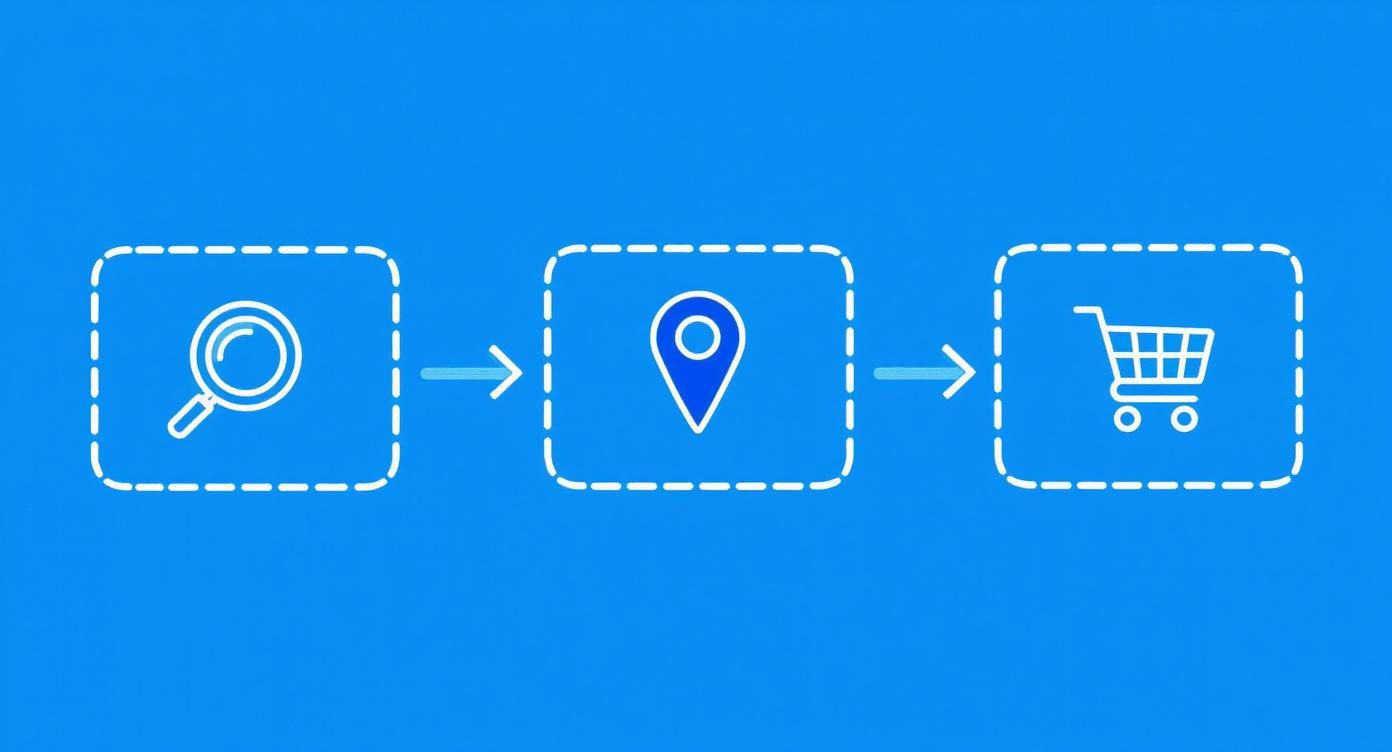
This flow shows how your keyword map should guide users, starting with their initial general questions, leading them to specific product categories, and finally, to making a purchase.
Step 1: Identify Your Core Topics
Before you even think about opening a keyword research tool, start with what you know best: your business. What are the main buckets of products or services you offer? For a restaurant equipment supplier, these are your big-picture, "pillar" topics.
- Commercial Refrigeration
- Cooking Equipment
- Food Preparation
- Warewashing
- Beverage Equipment
These pillars are the foundation of your keyword map. Each one will anchor a major section of your website and will target those broad, high-volume primary keywords we talked about earlier.
Step 2: Research and Cluster Your Keywords
With your core topics locked in, it's time to build out the keyword clusters for each one. For every pillar topic, you’ll dive into research to find a healthy mix of primary, secondary, and long-tail terms.
The key here is to group keywords by user intent. Don't just lump them together randomly. For instance, under your "Cooking Equipment" pillar, you'd gather all the terms related to convection ovens into one tight group:
- Primary: "commercial convection ovens"
- Secondary: "gas convection oven," "electric countertop convection oven"
- Long-Tail: "what size convection oven do I need," "Blodgett convection oven reviews"
Now you have a focused cluster of keywords that can all be targeted on a single, highly relevant page.
Step 3: Assign Clusters to URLs
This is where the map really comes to life. You're going to connect each keyword cluster to a specific URL on your website—this could be a page that already exists or a new one you plan to create. This is the most critical step for avoiding keyword cannibalization.
By assigning one unique keyword cluster to one unique URL, you give every page a distinct job. Your category page for ovens isn't competing with your blog post about choosing the right oven—they work together to capture different types of searchers at different stages of their journey.
This structured approach also makes it far easier to manage your content pipeline and see what’s working. Once your map is built, you’ll have a clear framework for everything you publish and can learn how to track keyword rankings to measure the real-world impact.
Step 4: Determine the Right Content Type
Finally, for each cluster, you need to decide what kind of content will best serve the searcher's intent. This isn't a one-size-fits-all situation.
- Transactional/Commercial Intent: Keywords like "buy commercial oven" are for people ready to pull out their wallets. These belong on your product pages and category pages.
- Informational Intent: Keywords like "how to clean a convection oven" are for people looking for answers. This is perfect fodder for blog posts, detailed guides, or FAQ pages.
Getting this last step right ensures that when a visitor lands on your page, the content meets their exact expectations. That leads to a much better user experience, builds trust, and ultimately, drives more sales.
Here's a simplified example of what a keyword map might look like for a restaurant equipment supplier. This template provides a clear structure for organizing your SEO efforts.
Sample Keyword Map for a Restaurant Equipment Supplier
| Page URL | Content Type | Primary Keyword | Secondary Keywords | Long-Tail Keywords |
|---|---|---|---|---|
| /commercial-refrigeration/reach-in-refrigerators | Category Page | reach-in refrigerator | commercial refrigerator, restaurant fridge | best two-door reach-in refrigerator for a small kitchen |
| /cooking-equipment/commercial-convection-ovens | Category Page | commercial convection ovens | countertop convection oven, gas convection oven | what size convection oven do I need for a bakery |
| /blog/how-to-choose-a-commercial-ice-machine | Blog Post | how to choose a commercial ice machine | commercial ice maker types, ice machine buying guide | what kind of ice machine do I need for a bar |
| /food-preparation/commercial-mixers/hobart-n50 | Product Page | Hobart N50 | 5 quart commercial mixer, Hobart countertop mixer | Hobart N50 mixer reviews, Hobart N50 price |
This table shows how each page gets a unique mission. The category page targets broad buying terms, the blog post answers specific questions, and the product page hones in on a particular model. By mapping everything out, you create a cohesive site structure where every page supports the others.
Common Keyword Mistakes to Avoid
Figuring out the right number of keywords is a huge step, but it’s not the whole game. Even the most perfectly planned keyword map can fall apart if you stumble into a few common traps. Let's walk through the big ones so you can sidestep them and make sure your strategy actually works.
One of the most common issues I see is keyword cannibalization. This is what happens when you have multiple pages on your site all trying to rank for the same primary keyword and the same search intent. Think of it like sending two of your best salespeople to compete for the same client—it’s confusing, inefficient, and ultimately weakens both of their chances.
When Google sees several of your pages duking it out for one keyword, it gets confused, too. It doesn't know which page is the "right" one, so it often ends up ranking all of them lower. Every page needs its own clear job to do, centered around its own unique keyword cluster.
Overlooking the Importance of User Intent
This next mistake is a big one: completely missing the user's intent. This is all about the why behind a search. You run into trouble when the content you create doesn't match the reason someone typed that query into Google in the first place.
For instance, writing a long, detailed blog post for the keyword "buy commercial convection oven" is a classic mismatch. That keyword screams transactional intent—the person is ready to pull out their credit card. They want to see product pages, not read a history of convection cooking.
Mismatching content to intent is like showing up to a sales meeting with a history textbook. You might have great information, but it's completely irrelevant to what the other person needs right now, and you'll quickly lose their attention.
Aligning your content with the user's goal isn't just a good idea; it's a non-negotiable part of modern SEO.
Avoiding Old-School SEO Traps
Finally, a couple of old habits die hard in SEO, and they can still tank an otherwise solid strategy. The first is keyword stuffing. This is the outdated practice of jamming your keywords into your content over and over until it sounds like a robot wrote it. Search engines are way too smart for that now and reward natural, helpful language.
The second trap is getting obsessed with high-volume "vanity" keywords. Sure, a term with 50,000 monthly searches looks great on paper, but the competition is usually insane, and the intent is often vague. You're better off targeting specific, long-tail keywords. They may have less traffic, but they often have much higher conversion rates because the searcher knows exactly what they're looking for. A good strategy balances the big head terms with these high-intent, money-making phrases.
Your Top Keyword Questions, Answered
Alright, even with a solid plan, you're bound to run into some specific questions once you start digging into the details. Let's tackle some of the most common ones I hear from clients to help you move forward with confidence.
Should Every Single Page on My Site Target Keywords?
Just about, yes. If you want a page to be found on Google, it needs a keyword focus. That goes for your homepage, your service and product pages, and definitely your blog posts. Think of it this way: giving each page its own keyword cluster gives it a job to do and a clear path for search engines to send traffic its way.
The only pages you can really skip are the ones that don't need to rank in the first place—think your privacy policy, "Contact Us" page, or a customer login screen. For everything else, not targeting keywords is like leaving money on the table.
How Many Keywords Should I Target for a Whole SEO Campaign?
This is a classic question, but there's a better way to frame it. Instead of aiming for a total number, think in terms of topic clusters. How many you need really depends on the size of your business. A local restaurant equipment supplier might kick things off by targeting 3-5 core topics. Each of those topics would have a main "money" keyword, plus dozens of related secondary and long-tail keywords supporting it.
On the other hand, a huge national e-commerce site could be juggling hundreds of these clusters. The goal isn't hitting some magic number; it's about building deep, undeniable authority around the subjects that matter most to your customers.
How Often Should I Revisit My Keyword Strategy?
SEO isn't a crockpot—you can't just set it and forget it. A good rule of thumb is to give your keyword strategy a thorough review at least quarterly. Search trends shift, new competitors pop up, and your own business goals will change.
A regular check-in lets you double down on what's working, spot new opportunities in the latest data, and cut your losses on keywords that just aren't performing. Staying on top of these adjustments is key to keeping your visibility on an upward trend.
This proactive mindset is what separates strategies that fizzle out from those that dominate for years.
Can I Target the Same Keyword on a Blog Post and a Product Page?
I'd strongly advise against it. When you do this, you create a problem called keyword cannibalization. You’re essentially making your own pages compete against each other in Google, which usually means neither of them ranks as well as they could. You split your authority and confuse the search engine.
Here’s the right way to handle it:
- Product/Category Page: This is where your direct, commercial keywords belong. A term like "buy commercial convection ovens" should point directly to the page where someone can actually buy one.
- Blog Post: Use the blog to target a related informational keyword. This captures a different search intent. For instance, a post titled "how to choose a commercial convection oven" or "best convection oven maintenance tips" is a perfect fit.
This approach lets your pages work together, not against each other. You capture people at every stage of the buying journey, from their initial research right through to the moment they're ready to pull out their credit card. It creates a much stronger, more cohesive website.
Ready to stop guessing and start ranking? Restaurant Equipment SEO builds keyword strategies that drive real results for suppliers. Discover how we can increase your organic traffic by visiting https://restaurantequipmentseo.com.