
How to Build a Keyword List for Food Service Suppliers
Every solid keyword list begins with what you already know, not with a fancy SEO tool. The real trick is to take your everyday business knowledge—your products, your customers, your sales conversations—and translate it into the words people are actually typing into Google.
This approach grounds your entire strategy in reality, making sure you're targeting the actual language used by restaurant owners, chefs, and purchasing managers, not just chasing algorithms.
Start With Your Business, Not a Blank Search Bar
Before you even think about logging into a keyword research platform, take a step back. The most powerful keyword ideas are sitting right inside your own business, waiting to be discovered. So many suppliers make the mistake of jumping straight to the data, which often leads them down a rabbit hole of irrelevant terms.
I like to think of it as building a recipe. You don’t just start grabbing random ingredients from the pantry; you decide what dish you want to make first. In this case, your products, your customers' problems, and your sales team's insights are the core ingredients for a successful keyword strategy.
Uncover Keywords from Your Product Catalog
Your product inventory is a goldmine. Seriously. It's the most direct and obvious source for seed keywords, yet it's often skimmed over too quickly. Go beyond just the basic product names and think about all the different ways a potential buyer might search.
- Product Categories: Start broad. List out your main categories like "Commercial Refrigeration," "Commercial Cooking Equipment," and "Food Prep Supplies."
- Specific Product Types: Now, get granular. Think about terms like "undercounter ice machines," "double-stack convection ovens," or "48-inch stainless steel work table."
- Brands and Model Numbers: This is where the magic happens. Your customers are absolutely searching for specific brands like "Hobart," "Vulcan," or "True Refrigeration." And don't ever forget model numbers. A search for a specific model screams high purchase intent.
This initial brainstorm gives you a solid, tangible list of product-focused terms. This is the bedrock of your entire keyword strategy.
Listen to Your Customers and Sales Team
Your customer-facing teams hear it all, every single day. They know the exact words, phrases, and questions customers use when they're trying to solve a problem or make a purchase. Their insights are pure gold because they uncover the kind of problem-aware keywords that SEO tools often miss.
Have a conversation with them. Ask these kinds of questions:
- What are the top 3 questions customers always ask before buying a new oven?
- What specific problems or frustrations do our products solve? (This can lead to keywords like "how to improve kitchen workflow" or "energy-efficient commercial freezer.")
- What words do you use on a sales call to describe the benefits of a product?
This is where you add a human layer to your keyword list, moving beyond simple product names to capture the why behind a customer's search.
My Pro Tip: The goal here isn't to build a list of 1,000 keywords. Not yet. You're aiming to create a "seed list" of 10-20 core concepts that come directly from your business. We'll plant these seeds in our SEO tools later to grow them into a massive list of opportunities.
This brainstorming process is a simple, structured way to get started. I've put together a framework to help organize your thoughts.
Seed Keyword Brainstorming Framework
This table gives you a structured way to think through the different facets of your business and pull out those initial keyword ideas.
| Category | Description | Example Seed Keywords for a Supplier |
|---|---|---|
| Products & Categories | The actual items you sell, from broad to specific. |
commercial refrigerator, convection oven, ice machine
|
| Brands & Models | The manufacturer names and specific SKUs you stock. |
True T-49, Hobart mixer, Vulcan stove
|
| Customer Problems | The pain points your products solve for your clients. |
slow food prep, high energy bills kitchen, small kitchen storage
|
| Use Cases | How and where your equipment is used. |
restaurant kitchen layout, catering equipment, bar outfitting
|
| Customer Type | The job titles or business types you serve. |
equipment for new restaurant, pizzeria ovens, deli slicers
|
Using a simple framework like this ensures you don't miss any obvious starting points before you dive into the more technical side of keyword research.
Here’s a simple visual that shows how these internal sources—your products, customers, and sales insights—flow into your initial keyword list.
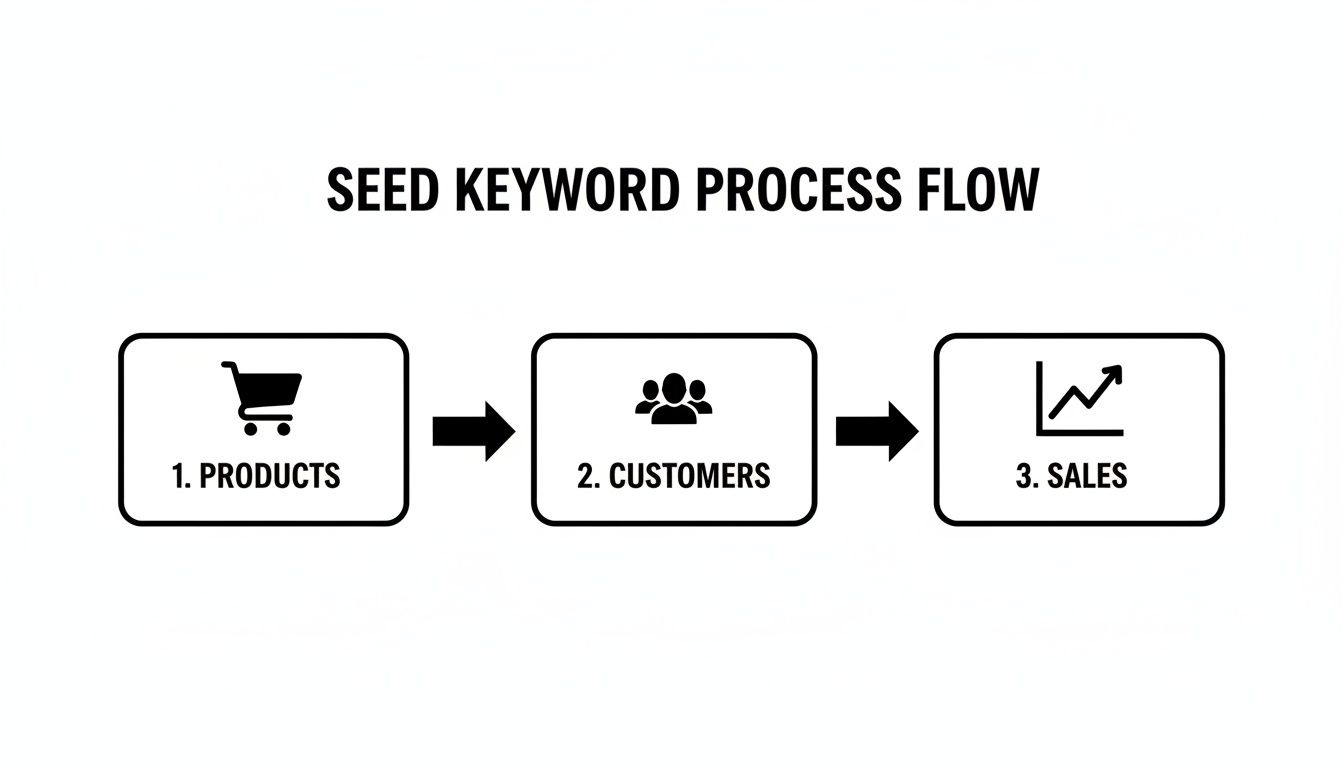
This just reinforces the idea that the strongest strategies start from within your own four walls.
It's a process of discovery, starting broad and then getting incredibly specific. And that's where the real opportunity is. Industry data shows that a minuscule fraction of keywords—around 0.0008%—get more than 100,000 searches per month. The real money is in the long-tail keywords, which make up a staggering 70% of all search traffic.
While we're focused on building your list right now, you can find a comprehensive guide on how to conduct keyword research that covers the entire process from start to finish. These foundational steps are especially vital if you're targeting specific cities or regions. To get deeper into that, check out our guide on https://restaurantequipmentseo.com/blogs/restaurant-equipment-seo-blog/local-keyword-research.
Getting this internal research right from the start makes every other step in the process more effective, ensuring your SEO and content efforts are perfectly aligned with what your customers actually need.
Find Hidden Gems in Your Competitors' Playbook
Your seed list is a great foundation, but why start from scratch? Your competitors have already done a lot of the heavy lifting, figuring out which keywords bring in qualified buyers. It's time to legally and ethically peek at their playbook.
This goes way beyond just glancing at their homepage titles. We're going to strategically reverse-engineer their success to find valuable terms you might have completely missed. Think of it as a treasure map where "X" marks the spot on profitable, high-intent keywords.

Run a Content Gap Analysis
One of the most powerful moves you can make is a content gap analysis. The goal is straightforward: identify the keywords your competitors are ranking for that you aren't. This instantly shines a light on your blind spots and hands you a list of topics your audience is already looking for.
SEO tools like Semrush or Ahrefs make this surprisingly simple. You just plug in your domain and a few of your top competitors, and the tool will spit out a report showing you exactly where you overlap—and more importantly, where the gaps are.
For a restaurant equipment supplier, this process can unearth some real winners:
- "commercial kitchen ventilation requirements": Maybe your competitor has a comprehensive guide ranking for this, while you only have product pages. That's a huge opportunity.
- "walk-in cooler vs. reach-in freezer comparison": This is a classic "consideration stage" query that catches buyers as they're weighing their options.
- "how to clean a commercial deep fryer": An informational keyword like this builds trust and gets your brand in front of the right people, even if they aren't ready to buy today.
This analysis gives you a clear, data-backed roadmap for your content. If you want to really get into the weeds on this, we break down the whole process in our dedicated guide to SEO competitor analysis.
Uncover Industry-Specific Jargon
Don't just stop at the high-level analysis. Your competitors' content is a goldmine of the nuanced language your B2B audience actually uses every day. Put on your detective hat and start digging through their case studies, blog posts, and even their product descriptions.
Look for the phrases that go beyond the obvious. Instead of just "commercial oven," you might find a competitor is ranking for specific model numbers ("Blodgett DFG-100") or technical terms like "ventless convection oven technology." These long-tail keywords are often far less competitive and attract highly qualified buyers who know exactly what they need.
When you're building out your keyword list, always prioritize with data. Google holds roughly 89–90% of the global search market, so it’s crucial that your competitive benchmarks are based on Google-derived metrics. This massive market share means your research should always start with Google-specific volume and intent data to get an accurate picture of potential traffic. You can find more insights on Google's search market over at Semrush.
Mine Forums and Trade Publications
Your research shouldn't be limited to direct competitors. The entire industry is a source of intel. You need to go where your customers go.
- Industry Forums: Places like ChefTalk are filled with real-world conversations. A thread titled "Issues with my Hoshizaki ice machine" can reveal dozens of long-tail keywords about troubleshooting, maintenance, and replacement parts that you'd never find in a tool.
- Trade Publications: Online magazines like Foodservice Equipment & Supplies or Restaurant Business are written in the exact language that resonates with industry pros. Their article headlines and section titles are often perfectly phrased, high-intent keywords ready for you to target.
By pulling from these sources, you build a keyword list that reflects how your customers actually talk and search. This adds a layer of authenticity that generic research often misses, moving you from being just another supplier to becoming a trusted industry resource.
Use SEO Tools to Scale Your Keyword List
Now that you've got a solid foundation of seed keywords and competitor insights, it's time to pour some gasoline on the fire. Brainstorming and spying on the competition are great starting points, but they'll only get you so far. To build a truly comprehensive keyword list, you need to bring in the big guns: data-driven SEO tools.
This is where you graduate from a handful of good ideas to thousands of strategic opportunities. Tools like Ahrefs or Semrush act as a force multiplier. You feed them one of your core terms—say, "commercial convection oven"—and they spit back a treasure trove of related searches, long-tail variations, and actual customer questions you’d never dream up on your own.
Turning Good Ideas into a Data-Backed Strategy
The process itself is refreshingly simple. Just take one of your main seed keywords and plug it into the tool's keyword explorer. Instantly, you’ll get a report loaded with hundreds, sometimes thousands, of related phrases.
Let’s stick with the example of "commercial ice machine." Running that through a tool might uncover keywords like:
- Question-based searches: "how to clean a Hoshizaki ice machine"
- Specific, long-tail variations: "undercounter commercial ice machine for bar"
- Comparison keywords: "Manitowoc vs Scotsman ice machine"
- Problem-solving terms: "commercial ice machine not making ice"
This is where the magic really happens. You're moving beyond the obvious product names and tapping into the exact language your customers use at every stage of their journey, from early-stage research to troubleshooting a machine they already own. For a deeper dive, check out this guide on the best keyword research tools to find the right platform for you.
Getting a Handle on the Key Metrics
Your keyword list is about to explode in size, and with it comes a lot of data. Don't let it intimidate you. To sift through the noise and find the gold, you only need to focus on three core metrics.
- Search Volume: This is the estimated number of times a keyword gets searched each month. It’s tempting to chase high-volume terms, but they’re almost always the most competitive. We have a complete guide that explains how to determine search volume for keywords in more detail.
- Keyword Difficulty (KD): Usually shown as a score from 0-100, this metric gauges how tough it will be to crack the first page of Google for a given term. Lower scores mean less competition and represent the low-hanging fruit.
- Cost Per Click (CPC): This shows what advertisers are paying for a single click on their Google Ads. A high CPC is a fantastic indicator of commercial intent—it tells you people searching for that term are serious about buying.
Expert Tip: The goal isn't just to find keywords with the highest search volume. The real sweet spot is a term with decent search volume, a manageable KD score, and a CPC that signals someone is ready to pull out their wallet.
Smart Filtering: From Data Dump to Action Plan
A raw export of 5,000 keywords isn't helpful; it's just noise. But a filtered list of 500 high-potential keywords? That's a strategic asset you can build a content plan around.
This is where you use the tool's filters to trim the fat and zero in on what matters. For a typical restaurant equipment supplier, a good starting point for filtering might look something like this:
- Set a minimum monthly search volume of 50.
- Filter for a maximum keyword difficulty of 30.
- Include only keywords with a CPC of at least $1.00.
Of course, these numbers aren't set in stone. You’ll need to adjust them based on how established your own website is and how competitive your specific niche is. This filtering step is what transforms a massive spreadsheet into a focused, actionable roadmap, ensuring every keyword you decide to target has a real shot at bringing in valuable traffic.
Prioritize Keywords Based on Search Intent
Okay, so you've done the hard work. You've brainstormed, spied on competitors, and used the tools to build a massive keyword list. It probably feels like you've struck gold. But right now, what you have is just a mountain of raw data, not a strategy. The real magic happens when we start sorting this list by a simple, powerful concept: search intent.
Think of search intent as the "why" behind the search. It’s what separates a line cook daydreaming about a new combi oven from a restaurant owner who needs to buy one today. If you get the intent wrong, you're basically trying to sell a new walk-in freezer to someone who just wanted to know how to defrost their old one. You're in the right ballpark, but you're not even in the game.

The Four Main Flavors of Search Intent
Every single keyword on your list fits into one of four main buckets. Getting a feel for these is probably the most valuable skill you can develop in SEO, because it tells you exactly what kind of content you need to create.
- Informational Intent: These are the "how-to," "what-is," and "why" questions. The searcher is looking for an answer, not a product page. They're your future customers, and right now, your job is to be the expert who helps them.
- Navigational Intent: This one's simple. The user wants to go to a specific website. Think "WebstaurantStore login" or "Vollrath contact." You can't really target these unless they're for your own brand.
- Commercial Intent: Here's where things get interesting. The searcher is doing their homework before they buy. They're comparing, researching, and looking for the "best" or "top-rated" options. They're very close to making a decision.
- Transactional Intent: This is the bottom of the funnel. The searcher has their wallet out. They're using words like "buy," "for sale," or a specific model number like "Blodgett DFG-100." They want a product page, a price, and a checkout button.
Mapping your keywords to these intent types is the first step in turning that giant spreadsheet into a real content plan.
Keyword Intent and Content Mapping
Connecting the dots between what someone searches for and what you show them is crucial. This table breaks down how different intents lead to specific content types within the food-service industry.
| Search Intent | Primary Goal | Content Type | Keyword Example |
|---|---|---|---|
| Informational | To learn or solve a problem | Blog Posts, How-To Guides, Videos | "how to calibrate a commercial oven" |
| Commercial | To research and compare options | Comparison Guides, Product Reviews, Top 10 Lists | "best commercial ice machines 2024" |
| Transactional | To make a purchase | Product Pages, Category Pages, E-commerce | "buy Hoshizaki KM-515MAH" |
| Navigational | To find a specific brand/site | Homepage, Login Page | "parts town official site" |
Seeing it laid out like this makes it clear: a blog post won't work for a transactional query, and a product page will fail for an informational one. Matching the content to the intent is non-negotiable.
Building Your Priority Score
Now, let's bring it all together. You have keywords, search volume, keyword difficulty (KD), and now, intent. It's time to find the low-hanging fruit.
I like to create a simple priority score in my spreadsheet. You don't need a complex formula; you're just looking for the sweet spot. A high-priority keyword usually looks like this:
- Intent: High commercial or transactional intent.
- Volume: Has a decent number of monthly searches (maybe 50+ to start).
- Difficulty: Has a low, achievable KD score (under 30 is a great target).
Filtering your list this way instantly highlights your "quick wins"—the terms that can drive real business with a reasonable amount of effort. Suddenly, you're not just staring at a spreadsheet of 10,000 keywords. You're looking at a prioritized action plan.
Pro Tip: Your keyword list should directly feed your content calendar. Once you’ve sorted by intent and priority, you’ll have a clear view of what needs to be a blog post, what should be a product category page, and what demands a deep-dive buying guide. You've officially moved from just collecting keywords to building a content engine for your business.
Organize Your Keywords into Content Clusters
Alright, you've done the heavy lifting. You've dug through the data, spied on competitors, and now you're sitting on a powerful, prioritized list of keywords. But let's be honest, a raw list—no matter how well-filtered—is just a pile of potential. It's not a strategy.
This next step is where the real magic happens. We're going to bring order to the chaos by grouping your keywords into logical "topic clusters." This is the secret sauce that turns a bunch of disconnected blog posts and product pages into an authority-building machine. It’s how you signal to Google that you’re not just an expert on one specific term, but on the entire subject.
The Pillar-and-Cluster Model Explained
The concept is beautifully simple. You pick a broad, high-level topic to be your "pillar page," which acts as the ultimate guide or central hub of information. Then, you create a series of more specific articles and pages, called "cluster pages," that dive deep into individual keywords related to that main pillar.
Think of it like a wheel. Your pillar page is the hub, and all the cluster pages are the spokes. Each spoke supports the main topic and, crucially, links back to the hub.
For a restaurant equipment supplier, a real-world example might look like this:
- Pillar Topic: The Ultimate Guide to Commercial Ice Machines
-
Cluster Keywords (and their content):
- "Hoshizaki ice machine maintenance" becomes a detailed how-to blog post.
- "undercounter ice maker reviews" turns into a comparison guide.
- "how much does a commercial ice machine cost" is perfect for an informational article.
- "Manitowoc ice machine for sale" is a clear fit for a product category page.
See how that works? Every cluster keyword gets its own dedicated piece of content, and all of them link back to the main "Commercial Ice Machines" pillar page. This structure is incredibly effective for demonstrating your expertise.
Why This is a Game-Changer for SEO
Organizing your keyword list this way does a lot more than just keep your spreadsheet looking neat. It has a direct, tangible impact on your SEO performance.
For starters, it helps you avoid keyword cannibalization. This is what happens when multiple pages on your site are accidentally competing for the same keyword. It confuses search engines and splits your ranking potential. By assigning each specific keyword to a unique page within a cluster, you’re giving Google a crystal-clear signal about which page is the most relevant for any given search.
Beyond that, this method screams expertise. When search engines crawl your site and find a well-organized hub of interlinked content that covers a topic from every conceivable angle, they see you as a comprehensive, authoritative resource. That builds trust, and trust is a massive ranking factor.
Grouping keywords into topic clusters transforms your content from a collection of one-off articles into a strategic library. This interconnected web of information makes it easier for both users and search engines to understand the depth of your knowledge on a subject.
How to Build Your Clusters in a Spreadsheet
This is where all your research finally becomes a concrete content plan. You can do this entire organizational step right in the spreadsheet you've been working in.
Kick things off by creating a new tab or section dedicated to your clusters. From there, it's a straightforward process.
-
Spot Your Pillar Topics: First, scan your prioritized keyword list. You're looking for the broad, overarching themes—those higher-volume, more general terms like "commercial refrigeration," "restaurant ranges," or "food prep tables." These are your pillar topics.
-
Group the Supporting Keywords: Go through your list, pillar by pillar, and pull out all the related long-tail keywords, questions, and specific product terms. These become your cluster keywords. Don't overthink it at this stage; if a keyword feels like it belongs, group it. You can always refine it later.
-
Assign a Content Type: Now, look at each cluster keyword and decide what kind of content would best serve the user's intent. Is someone looking for a "how-to" guide? A product comparison? Or are they ready to buy, meaning it should go on a category page? Jot this down next to each keyword.
-
Map Everything to a URL: Finally, give each piece of content a home by assigning it a target URL. If you're creating something new, this will be the URL you plan to use. If you already have a page that fits, this is your chance to map new keywords to existing content, identifying opportunities for an update or expansion.
Once you’re done, you’ll have a clear, actionable roadmap. You'll know exactly which pages you need to create, what topics they'll cover, and how they all fit together to build a truly dominant presence in your niche.
Answering Common Questions About Keyword Research
Even with a solid game plan, you're bound to run into questions once you start digging into keyword research. It’s a field with a lot of moving parts, and what works today might need a tweak tomorrow. Let’s tackle some of the most common questions I hear from food service suppliers when they first get started.
Getting these answers right is what turns a good process into a great, repeatable strategy. The goal is to move from just following steps to truly understanding the "why" behind each decision, which is where the real, long-term results come from.

How Often Should I Refresh My Keyword List?
This is a big one. The short answer? Your keyword list should never be a static "set it and forget it" document. Think of it as a living, breathing part of your marketing strategy that needs regular check-ups.
As a general rule, you should plan for a major review and refresh every 6 to 12 months. This is where you go through the whole discovery process again—peeking at competitors, looking for new industry trends, and updating your content clusters. But that doesn't mean you ignore it in between.
- Quarterly Check-ins: Every three months or so, I like to pop into Google Search Console. Are new questions showing up in the Performance report? Have any competitors launched new product lines that I need to get ahead of?
- New Product Launches: This is an immediate trigger. Any time you add a new piece of equipment or bring on a new brand, you need to do targeted keyword research for that specific category right away.
This two-pronged approach keeps your strategy sharp and relevant without forcing you into a massive, time-consuming overhaul every month.
What Is the Real Difference Between Head and Long-Tail Keywords?
It's easy to get tangled up in the jargon, but understanding the difference between head terms and long-tail keywords is absolutely critical. It’s all about balancing broad visibility with high-intent, targeted traffic.
Head Terms are the big, popular keywords, usually just one or two words long.
- Example: "commercial ovens"
- Pros: They get a ton of search volume and are great for general brand awareness.
- Cons: The competition is fierce, and the user's intent is often vague and purely informational.
Long-Tail Keywords are the longer, more descriptive phrases of three or more words.
- Example: "double stack ventless convection oven for small kitchen"
- Pros: Competition is low, and the person searching is often ready to buy.
- Cons: Each individual keyword has a tiny search volume.
Here's the secret: while each long-tail keyword seems small, together they make up the lion's share—around 70%—of all search traffic. Only chasing competitive head terms is like buying lottery tickets. Building a strategy around long-tail keywords is like creating a diversified investment portfolio that pays off consistently.
How Do I Find Keywords for a Specific Local Area?
If you offer service, repair, or installation, local keywords aren't just important—they're everything. Targeting a specific city, state, or region requires a slight shift in your research to capture customers who need a solution right here, right now.
The easiest place to start is by tacking local modifiers onto your existing keyword list. Just take a core service term and add the geographic info.
Here are a few patterns that work time and time again:
- [Service] + [City]: "commercial refrigeration repair Houston"
- [Product] + "near me": "restaurant equipment supply near me" (Google figures this one out based on the user's location)
- [City] + [Product Category]: "Chicago commercial kitchen design"
- [Service] + [Neighborhood/Zip Code]: "walk-in cooler installation 77002"
Once you have a list of local variations, run them through your SEO tool to see which ones have search volume. The next step is crucial: search for them yourself. If Google shows a map pack at the top of the results, that’s a massive signal of local intent. It tells you that optimizing your Google Business Profile for that term is a must.
Building a strategic keyword list is the foundation of any SEO campaign that actually works. At Restaurant Equipment SEO, we specialize in digging deep into the food service industry to find the exact terms that drive qualified traffic and generate real leads. Ready to turn searches into sales? Learn more at https://restaurantequipmentseo.com.