
Boost Your Traffic: how to increase organic search traffic
If you want to pull in more organic search traffic, you have to systematically show search engines that your website is the go-to authority. This really boils down to three core efforts: figuring out the high-intent keywords your customers are actually typing into Google, creating genuinely helpful content that answers their questions, and making sure your website is technically solid and easy for people to use. Nail these, and your site will start attracting qualified buyers like a magnet.
Why Organic Search Is Your Most Powerful Sales Channel
For restaurant equipment suppliers, organic search isn't just another marketing line item—it's the engine for real, sustainable growth. Think about it: when a chef is launching a new ghost kitchen or a procurement manager for a national chain needs to source new freezers, where do they go first? Google.
These aren't just casual looky-loos. They are professionals in the middle of making critical business decisions, and your website needs to be the definitive resource they find. Getting a handle on https://restaurantequipmentseo.com/blogs/restaurant-equipment-seo-blog/what-is-organic-traffic is the crucial first step to grabbing their attention and, ultimately, their business.
Unlocking a Trillion-Dollar Opportunity
The financial upside here is enormous. Across the B2B supply industry, we consistently see SEO driving 40–60% of total website sessions. Now, consider that the restaurant sector is projected to hit $1.1 trillion in sales by 2025. Even a small bump in your organic visibility for the right terms can funnel millions in equipment demand directly to you.
As the market gets more crowded, more and more operators are doing their homework online before ever picking up the phone. To get ahead, you'll need a solid plan that includes proven SEO, content, and promotion strategies to increase website traffic.
"For equipment suppliers, every high-ranking page acts as a digital salesperson working 24/7. It's not just about traffic; it's about attracting buyers at the exact moment they're ready to make a purchasing decision."
The Proof Is in the Performance
This isn't just theory. We’ve seen firsthand what happens when suppliers get serious about aligning their content with what buyers are searching for. The results can be dramatic.
For one client, we drove a 390% increase in organic traffic in just 11 months by implementing this very playbook. We didn't just go after random keywords; we strategically targeted high-value terms across their category pages, brand pages, and helpful articles like "2025 food service equipment trends." This kind of holistic approach is what multiplies discovery and shows the real-world power of a well-executed plan. For more on industry trends, check out the National Restaurant Association’s 2025 outlook.
Develop a Keyword Blueprint Your Competitors Have Missed

Alright, let's get tactical. A generic approach to keywords just doesn't work in the specialized world of B2B equipment. Your competitors are almost certainly targeting the obvious, high-volume terms like "commercial oven." But the real money? It’s in understanding the specific language of a buyer who’s ready to pull the trigger.
This is where you can build a real advantage. We're talking about getting inside the head of a chef or manager who has a problem and needs a solution now. The goal is to uncover those high-intent phrases that signal they're past the "just looking" phase and are actively seeking to buy. These are the queries that drive sales.
Uncovering High-Intent Buyer Keywords
Think about it: broad terms attract researchers, but specific, long-tail keywords attract actual buyers. You want to capture the person searching for "best combi oven for a small bakery," not just "combi oven." The first query is loaded with commercial context and specific needs, signaling much higher purchase intent.
What problems do your customers have? A broken ice machine doesn't just lead to a search for "ice machines." It sparks urgent queries like "Hoshizaki ice machine repair near me" or "financing for a new Manitowoc ice maker." These are the granular, problem-solving keywords that actually convert.
Get started by brainstorming keywords that fall into these buckets:
- Problem/Solution: "how to prevent commercial freezer burnout"
- Product Comparisons: "True T-49F vs Turbo Air M3F49-2"
- Specific Use Cases: "best low-boy prep table for a sandwich shop"
- Financial Queries: "used restaurant equipment financing options"
Diving this deep is what separates a good keyword strategy from a great one. For a detailed framework on pulling these terms together, check out our guide on https://restaurantequipmentseo.com/blogs/restaurant-equipment-seo-blog/how-to-build-a-keyword-list.
Mapping Keywords to the Buyer's Journey
Once you’ve got a solid list of high-intent keywords, the next move is to map them strategically across your site. This isn't about just stuffing keywords onto a page. It's about architecting a logical path that guides a potential customer from their initial research right through to purchase, building the kind of topical authority Google loves to reward.
Your website should function like a well-organized library. Category pages are the main sections, product pages are the individual books, and your blog posts are the in-depth guides. Every piece of content has a job.
A well-structured website answers every potential customer question before they even have to ask. Your keyword map is the architectural plan that makes this possible, turning your site into an indispensable resource for your industry.
A simple mapping structure might look something like this:
| Page Type | Keyword Intent | Example Keyword |
|---|---|---|
| Blog Post | Informational | "How to choose a walk-in cooler" |
| Category Page | Navigational | "Commercial refrigeration" |
| Product Page | Transactional | "True T-49 2-door reach-in refrigerator" |
| Brand Page | Navigational/Transactional | "Hobart kitchen equipment" |
This organized approach ensures you have dedicated content ready for users no matter where they are in their decision-making process.
Leveraging AI for a Competitive Edge
Keyword research isn't what it used to be. Today, understanding how language models interpret search queries is a huge piece of the puzzle. As you build out your keyword blueprint, looking into specific ChatGPT ranking factors can give you a serious leg up on the competition.
These insights help you craft content that’s not only optimized for traditional search engines but is also perfectly positioned for AI-driven search. For instance, focusing on conversational questions and providing direct, clear answers can dramatically improve your visibility in new search formats. It’s a forward-thinking approach that helps build a keyword strategy that will actually last.
Create Content That Closes Deals with Chefs and Managers
Let's be honest: chefs and restaurant managers are some of the busiest people on the planet. When they're looking to drop five figures on a new piece of equipment, they have zero time for generic marketing fluff. They need hard facts, real-world proof, and content that helps them solve a nagging problem in their kitchen, right now.
This is where your content stops being marketing and starts being a direct sales tool. The whole idea is to create resources that not only rank on Google but also cement your reputation as the go-to expert. By genuinely helping your audience, you turn clicks into loyal, high-value customers who trust you.
Go Way Beyond the Spec Sheet on Product Pages
Think of your product pages as your digital showroom. It's where the final handshake happens, and simply copying and pasting manufacturer specs won't cut it. A discerning chef or a cost-conscious manager needs more to be convinced.
Put yourself in their shoes. They aren't just buying a stainless steel box; they're buying reliability, efficiency, and the peace of mind that comes from a smart investment. Your product page has to reflect that.
Here are a few ways to add some serious value and build trust:
- Operator Video Testimonials: Get a real chef on camera for 90 seconds explaining how that specific combi oven actually improved their kitchen's workflow. It’s more powerful than any sales copy you could ever write.
- Detailed ROI Calculators: Build a simple, interactive tool on the page. Let a manager plug in their numbers and see exactly how a new ice machine will pay for itself in water and energy savings over 18 months.
- Comprehensive Cleaning Guides: Offer a downloadable PDF—with photos—that details daily, weekly, and monthly cleaning protocols. This small gesture shows you're a long-term partner, not just a one-time seller.
Adding these elements proves you get the day-to-day grind of a commercial kitchen. That level of detail is exactly what helps you increase organic search traffic for those high-intent, bottom-of-funnel keywords.
A great product page does more than describe a product; it demonstrates its value in the real world. By showing how your equipment solves tangible kitchen problems, you’re not just selling a machine—you’re selling a solution.
Solve Real-World Kitchen Problems
While product pages are there to close the deal, your blog posts and guides are what get people in the door in the first place. This is your chance to build authority and become a trusted advisor before they're even ready to buy. The key is to stop writing generic articles and start solving specific, painful problems.
Forget the fluffy blog posts. Zero in on the topics that prove you have deep industry expertise—the kind of stuff that answers the questions keeping kitchen managers up at night.
Consider these kinds of high-impact content ideas:
- Comparison Guides: Write an exhaustive breakdown comparing two heavyweights, like "True T-49F vs. Turbo Air M3F49-2." Dig into performance data, energy ratings, and the ideal kitchen environments for each.
- Problem-Solving Articles: Target a very specific pain point. An article titled "Choosing a Walk-In Cooler for High-Humidity Climates" instantly connects with a niche but urgent need.
- Workflow Optimization Posts: Show how your equipment is part of a bigger picture with content like "How to Optimize Kitchen Workflow with the Right Prep Tables."
This is the kind of content that naturally attracts high-quality backlinks from industry publications. More importantly, it builds the topical authority that Google loves, which in turn lifts the rankings for all your high-priority product and category pages.
A Framework for High-Impact Content
To consistently create content that people actually want to read, you need a plan. Whether it's a product page or a blog post, every piece of content should be built around the end user's needs. This isn't just good for the user; it's a core principle of modern SEO.
The table below breaks down the kind of content you should be creating to attract and convert buyers at every stage of their journey.
High-Impact Content Ideas for Equipment Suppliers
| Funnel Stage | Content Type | Example Topic | Primary Goal |
|---|---|---|---|
| Awareness (Top) | Informational Guide | "A Chef's Guide to Combi Oven Technology" | Attract new prospects, build authority |
| Consideration (Middle) | Comparison Post | "Blodgett vs. Vulcan Convection Ovens" | Help buyers evaluate their options |
| Decision (Bottom) | Product Page Enrichment | Video of a Hobart mixer in action | Close the sale, build confidence |
By mapping your content to the buyer's journey, you create a seamless path that guides a potential customer from a simple question to a confident purchase. This approach ensures every piece of content serves a clear purpose and contributes directly to your bottom line.
Dominate Your Service Area with Local SEO
For restaurant equipment suppliers, local search is where the real action is. Think about it: when a chef's walk-in freezer dies on a Friday night, they aren't casually browsing national websites. They're grabbing their phone and frantically searching for "commercial refrigeration repair near me" or "restaurant equipment supply Houston."
This is where you come in. Capturing that high-intent, time-sensitive traffic is how you turn your physical warehouse into a digital powerhouse that drives immediate sales. It's about being the most visible, trusted, and responsive option when a local operator is in a bind. Their emergency is your opportunity, and a sharp local SEO strategy ensures you're the first call they make.
Your Google Business Profile is Your Digital Storefront
Your Google Business Profile (GBP) is, without a doubt, your most critical local SEO asset. It's your online business card, your digital storefront, and the first impression for most local customers. A neglected profile is a huge missed opportunity, while a fully optimized one can generate phone calls and foot traffic right from the search results.
You have to go way beyond just listing your address and phone number. Your GBP should be a dynamic, informative hub that truly showcases what you sell and the expertise you offer.
- Actually Use the 'Products' Feature: Don't just list a generic category like "refrigeration." Add specific models like the "True T-49 Two-Door Reach-In," complete with high-quality photos, a price range, and a direct link to that product's page on your site. This simple step turns a basic listing into a sales tool.
- Keep it Fresh with Google Posts: Got a new line of Hobart mixers? Offering special financing? Post about it. These act like mini-ads that appear right in your search listing, keeping your profile active and engaging.
- Answer Questions Before They're Asked: Jump into the Q&A section and proactively answer common questions. For example, add a question like, "Do you offer delivery and installation?" and provide a thorough answer. This builds immediate trust and saves everyone time.
To really get this right, you need a solid grasp of all the moving parts. Our deep dive into what is local SEO gives you the foundational knowledge to build a winning strategy from the ground up.
Build a Web of Powerful Local Citations
Beyond Google, your business information needs to be consistent and visible all over the web. These mentions of your business's name, address, and phone number (NAP) are called local citations. Every consistent citation on a relevant directory or website reinforces your location and legitimacy to search engines, which directly helps boost your local ranking authority.
Systematically building these is key. Cleaning up your existing NAP data and earning location-specific backlinks from places like regional restaurant associations or local culinary schools can significantly improve your visibility in the local map pack. We've seen this kind of visibility convert at double-digit rates for high-intent searches.
Local intent is a massive driver for equipment suppliers because buyers often want to see, service, or quickly receive heavy equipment. The expectations they have for restaurants—up-to-date profiles and fast communication—are carried directly into their B2B purchasing decisions.
Industry data backs this up, showing that responsiveness pays off in a big way. For instance, 71% of customers are more likely to recommend a brand that responds quickly on social media. Applying that same sense of urgency to your B2B interactions can really set you apart. For more on where the industry is heading, discover more about evolving food service equipment trends.
When you combine a solid citation-building plan with content that speaks to your local market, you turn local relevance into a real, scalable advantage.
Build Real Authority with Strategic Link Building
Great content is the foundation, but it won't get you to the top of Google on its own. To really cement your status as an industry leader, you need other credible voices in the food service world to vouch for you. This is where link building comes in, and for restaurant equipment suppliers, it’s all about building real relationships, not just collecting links.
Think of backlinks as a vote of confidence. When a respected publication like Foodservice Equipment & Supplies or a well-known restaurant consultant links to your website, they're essentially telling Google, "These guys are the real deal." Over time, these votes build your site's Domain Authority, giving you a serious edge for those high-value keywords you’re targeting.
It’s About Relationships, Not Transactions
Let's get one thing straight: the old-school approach of blasting out generic "please link to me" emails is dead. It doesn't work, and in the tight-knit food service industry, it can even hurt your reputation. The most valuable links grow from genuine partnerships where everyone benefits.
Your goal shouldn't be to just get a link. It should be to become an indispensable resource for the community. When you shift your thinking from "What can I get?" to "What can I give their audience?", you'll find opportunities start to open up everywhere.
This is the long game. It builds a protective barrier around your brand that fly-by-night competitors can't even touch, which is how you sustainably increase organic search traffic for years to come.
Get Featured in Industry Trade Publications
Earning a feature in a top-tier trade publication is one of the fastest ways to build serious authority. The people reading Restaurant Business or FES Magazine are the exact buyers and decision-makers you want to reach. A single link from one of these sites can be more powerful than a hundred generic directory listings.
So, how do you get on their radar?
- Bring them unique data. Have you noticed a trend in the most reliable walk-in cooler brands based on your service calls? Did you survey local chefs about their go-to combi ovens? Package this insight into a compelling story and give a journalist the exclusive.
- Be the go-to expert. Journalists are always on deadline, hunting for expert quotes. Follow industry reporters on LinkedIn or X (formerly Twitter). Be ready to jump in with a sharp, insightful comment when news breaks or a new trend emerges.
- Showcase a great success story. Did you help a local restaurant group completely redesign their kitchen flow for better efficiency? With your client's permission, write up a detailed case study. Lay out the problem, your solution, and the bottom-line results. This is exactly the kind of practical content that trade publications love.
A backlink from a major industry publication isn't just an SEO play; it's powerful digital PR. It drives referral traffic that’s already warmed up and solidifies your reputation as a market leader.
Partner Up with Culinary Schools and Consultants
Think about who really influences purchasing decisions in the restaurant world. It's the culinary school instructors training new chefs and the seasoned consultants guiding million-dollar build-outs. Building genuine relationships here can lead to some of the most relevant, high-authority backlinks imaginable.
You could, for instance, offer to supply a specific piece of equipment to a local culinary school's training kitchen. In exchange, they might add you to their "Industry Partners" page or write a blog post about their shiny new facilities, complete with a link back to you.
Another smart move is connecting with influential restaurant consultants. Offer them an exclusive demo of a new, innovative piece of equipment you carry. If they love it, an in-depth review on their blog that links to your product page is pure gold. You get social proof and a high-authority backlink all at once, helping you increase organic search traffic from an audience that is ready to make a purchase.
Track the Metrics That Actually Drive Revenue
So, how do you know if all this SEO work is actually making a difference? The answer isn't hidden in some overly complicated spreadsheet. It’s about knowing which numbers to watch—the ones that tie directly back to your sales and revenue.
It's easy to get caught up in vanity metrics, like a big spike in overall organic traffic. While it feels great to see those numbers climb, that traffic doesn't necessarily pay the bills. For a restaurant equipment supplier, 10 highly qualified clicks on a product page for a commercial oven are infinitely more valuable than 1,000 random clicks on a blog post about kitchen cleaning tips. We're aiming for profitable growth, not just more website visitors.
Focus on Revenue-Driven KPIs
To get a real, unfiltered look at your SEO performance, you need to track Key Performance Indicators (KPIs) that tell the story of customer acquisition. This means shifting your focus from broad, general traffic to the specific actions people take when they're getting ready to make a purchase.
You can get started by keeping a close eye on these core metrics:
- Keyword Rankings for “Money” Terms: Where do you stand for high-value, transactional keywords? Think "True T-49 freezer for sale" or "commercial kitchen financing." Just jumping from page two to the top three spots for a term like that can have a direct and immediate impact on sales.
- Organic Lead Conversions: Set up goals in Google Analytics 4 to track how many organic visitors fill out a quote request, download a spec sheet, or call your sales line. This is probably the clearest signal of SEO’s direct contribution to your sales pipeline.
- User Engagement on Product Pages: Are potential customers actually spending time on your most important product pages, or are they hitting the back button right away? High engagement is a great sign that your content is doing its job by answering questions and building their confidence to buy.
Chasing raw traffic numbers is a surefire way to burn through your marketing budget. The real win is seeing a steady increase in qualified leads from organic search. That's how you know you're getting the right clicks, not just more of them.
Keep Your Reporting Simple and Actionable
You don’t need a ridiculously complex dashboard to see what’s working. A straightforward monthly review focused on a handful of core metrics will give you all the insight you need to make smart decisions. By consistently tracking conversions and rankings for your most profitable product lines, you can double down on what’s effective and adjust your strategy accordingly.
This process flow shows how all the pieces—from relationship building to partnerships—come together to build the kind of authority that drives these key metrics forward.
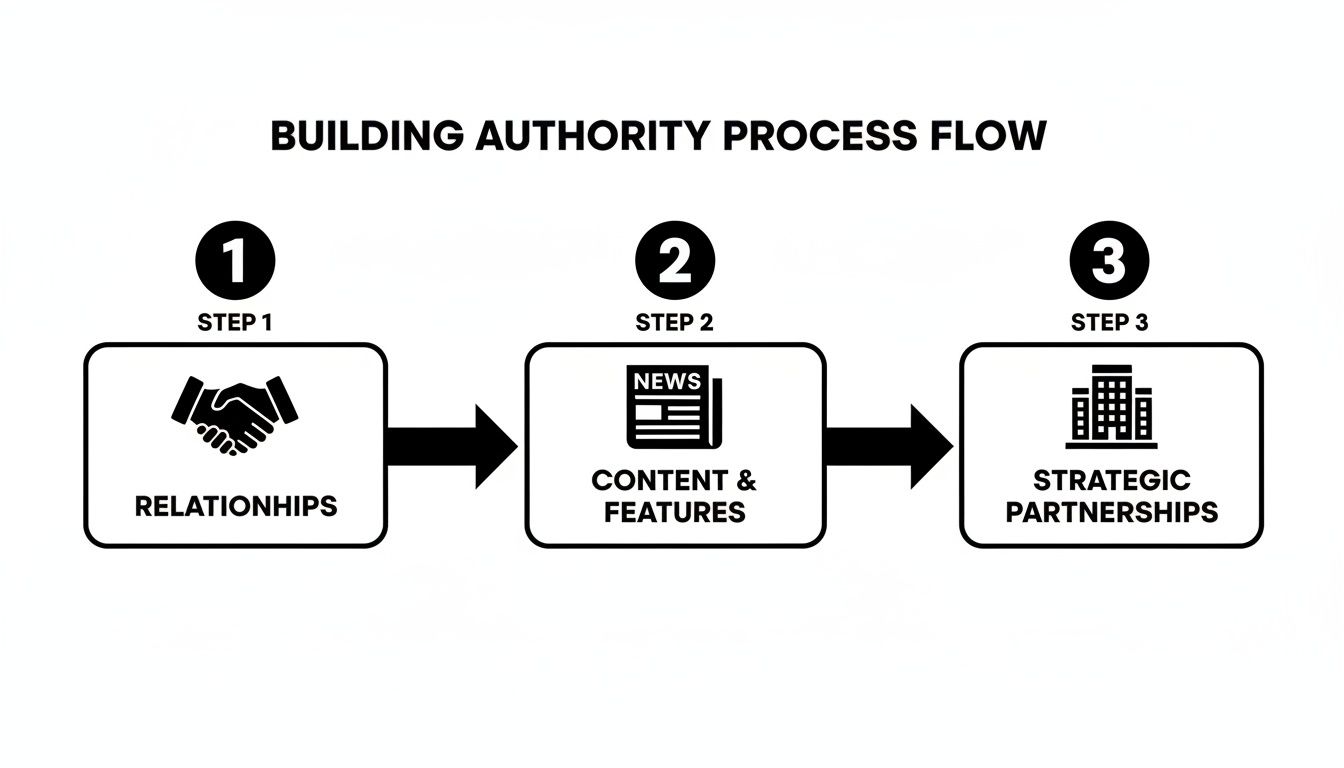
It all comes down to a simple truth: genuine authority isn't built overnight or with a single tactic. It's the result of cultivating relationships, creating valuable content, and forming strategic partnerships. This approach ensures you're not just increasing traffic, but attracting customers who are genuinely ready to invest in new equipment.
Essential SEO KPIs for Equipment Suppliers
To make tracking even easier, here’s a quick-reference table of the metrics that truly matter. This isn't an exhaustive list, but it's the perfect starting point for proving the value of your SEO efforts to your team or stakeholders.
| Metric | What It Measures | Why It Matters | Tool to Use |
|---|---|---|---|
| Organic Conversions | The number of leads (quote requests, calls, form fills) from organic search. | This is the most direct link between SEO activity and potential revenue. It shows you're attracting qualified buyers. | Google Analytics 4 |
| Keyword Rankings (Top 10) | Your website's position in search results for high-intent keywords. | Ranking on page one for "money" terms dramatically increases visibility and the likelihood of clicks from ready-to-buy customers. | Semrush or Ahrefs |
| Conversion Rate by Landing Page | The percentage of organic visitors who convert on a specific page. | Helps identify your most persuasive product and category pages—and which ones need optimization work. | Google Analytics 4 |
| Assisted Conversions | Instances where organic search was part of the customer journey but not the final click. | Shows SEO's role in nurturing leads who may convert later through another channel, proving its value beyond last-click attribution. | Google Analytics 4 |
Focusing on these KPIs will give you a clear, data-backed view of how SEO is contributing to business growth, moving the conversation away from vague traffic numbers and toward concrete results.
Frequently Asked Questions
When you start digging into SEO, a lot of questions pop up. It's only natural. Here are a few of the most common ones I hear from restaurant equipment suppliers, with some straight-to-the-point answers to help you out.
How Long Does It Take to See Real SEO Results?
This is the big one, and the honest answer is, "it depends." For quick wins in your local market—think getting your Google Business Profile tuned up—you can start seeing more calls and better visibility in local map searches within 1-3 months.
But if you're trying to rank nationally for something really competitive like "commercial convection ovens," that's a different ballgame. That's a marathon. You should realistically expect to see significant, bottom-line-moving results after 6-12 months of consistent, smart work. SEO isn't a magic button; it's the long-term project of building a reliable sales pipeline.
Should I Focus on SEO for Specific Brands I Carry?
Yes, one hundred percent. This is a tactic I see so many suppliers miss out on. Creating dedicated pages for the big names you carry—True, Hobart, Vulcan, you name it—is a goldmine. Chefs and seasoned operators often search for the brands they already know and trust.
When you optimize for a search like "Hobart mixer for sale" or "True T-49 freezer price," you're catching a buyer who is right at the finish line. Take it a step further by building out comparison pages ("Blodgett vs. Vulcan ovens") or deep-dive guides on popular models. This strategy not only pulls in highly qualified traffic but also proves to Google that you're an authority on these products.
Here's a pro tip: Don't just make your brand pages a glorified product list. Turn them into resource hubs. Add model comparisons, offer maintenance advice, and feature operator reviews. This way, you'll capture searchers no matter where they are in their buying process.
Is a Blog Really Necessary for My Equipment Business?
It is, but let's stop calling it a "blog." Think of it as your "Resource Center" or "Learning Hub." You're not writing fluff pieces. You're strategically answering every single question your customers have about choosing equipment, maintaining it, and getting the best ROI.
This kind of content is a powerhouse. Here's what it does for you:
- It grabs the attention of buyers who are still in the early research phase, getting your name in front of them first.
- It builds incredible trust. You become the expert, not just another vendor.
- It naturally attracts links from other industry websites, which gives your entire site a major authority boost.
When you have a killer resource center, Google sees your website as a definitive source of information. That authority then helps your money-making product and category pages climb higher in the search results.
Ready to turn your website into your most effective sales machine? At Restaurant Equipment SEO, we craft strategies based on real data to put you in front of the buyers who matter. Let's talk about growing your business.