
How to Start a Restaurant Business From Dream to Grand Opening
Starting a restaurant isn't just about cooking great food. It involves building a detailed business plan, securing the right funding, navigating a maze of legal requirements, equipping a professional kitchen, hiring a solid team, and marketing your launch effectively.
It all kicks off with a powerful concept and a solid roadmap that guides every single decision, from the menu to the location. This planning ensures you step into a competitive market with a clear, winning strategy.
Crafting Your Restaurant Concept and Business Plan
Every successful restaurant starts long before the first meal is served—it begins on paper. This is the crucial first phase where you nail down your unique vision and create the strategic blueprint that will guide every future move. Think of it as the architectural plan for your entire business, turning a passion for food into a viable, profitable enterprise.
The first real step is moving from a vague idea to a concrete restaurant concept. This is so much more than just the type of cuisine you'll serve; it's the entire experience you're promising your guests. Are you picturing a quick, health-conscious spot for professionals on their lunch break? A cozy, family-style Italian diner? Or maybe a high-end, experimental tasting menu for adventurous foodies? Your concept dictates everything: your brand, your target customer, your service style, and even the color of the walls.
Solidifying Your Vision
To really get this right, you have to answer some fundamental questions about who you are and what you're building. Getting this clarity upfront will save you from expensive mistakes and painful pivots down the road.
- Define Your Niche: What specific gap in the local market are you going to fill? Instead of just being "another pizza place," maybe you're "a ghost kitchen specializing in authentic, wood-fired Neapolitan pizza exclusively for delivery."
- Identify Your Ideal Customer: Who are you really cooking for? Create a detailed profile of your ideal guest—their age, income, dining habits, and what they value. This helps you tailor everything from the menu and pricing to your marketing messages.
- Establish Your Unique Selling Proposition (USP): What makes you stand out from the crowd? Your USP could be a one-of-a-kind signature dish, a fierce commitment to locally sourced ingredients, or a level of customer service that people can't stop talking about.
This flow chart gives a great visual of how these foundational steps connect, taking you from a simple idea to a plan that's ready for investors.
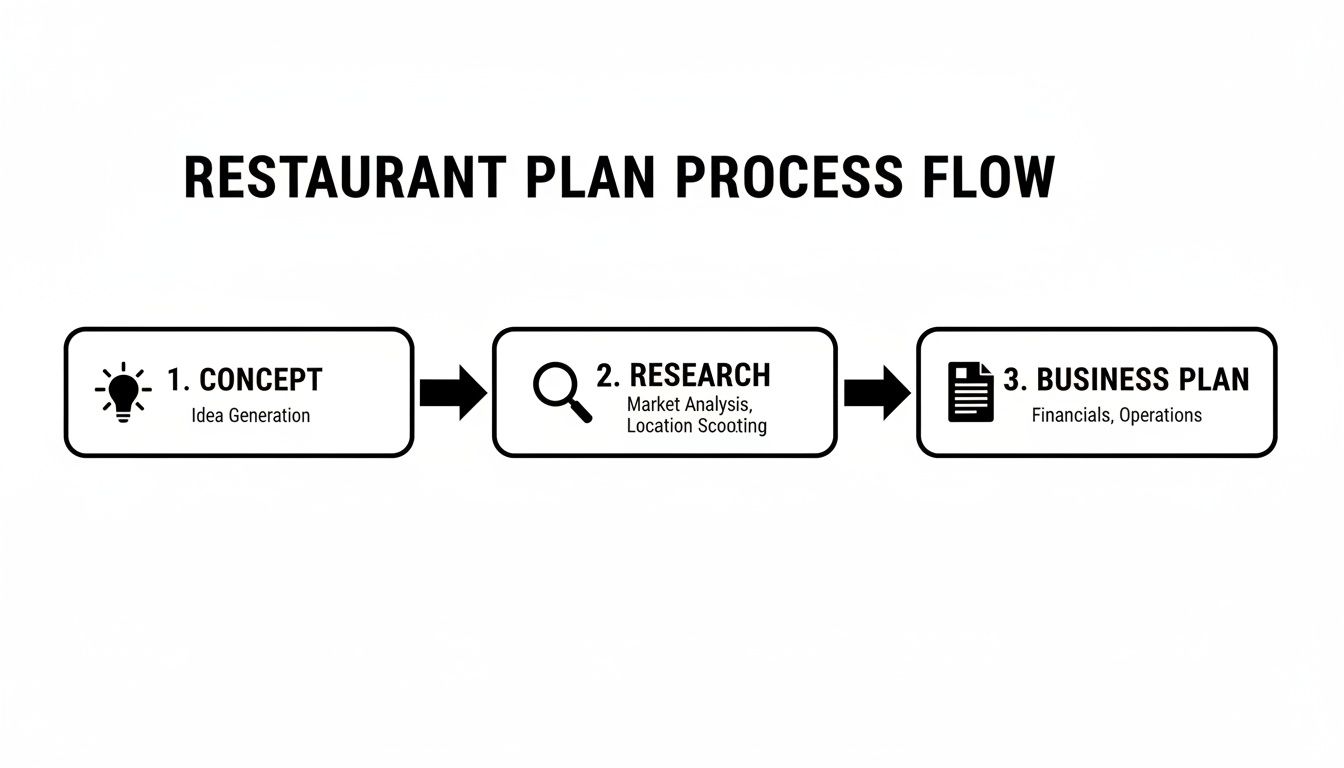
As you can see, a solid business plan isn't some formality you rush through at the end. It's the natural result of a well-defined concept and some serious market research.
Building a Business Plan That Gets Funded
Once your concept is crystal clear, it’s time to get it all down in a comprehensive business plan. This document is your number one tool for securing loans and attracting investors. More importantly, it forces you to think critically about every single part of your operation, from staffing schedules to your financial forecasts.
Your business plan is your strategy, your operational playbook, and your sales pitch to investors—all rolled into one. It proves you have not only a passion for food but also a serious, organized approach to building a sustainable business.
You're tapping into a massive global foodservice market valued at $3.09 trillion, which is expected to hit $4.14 trillion by 2033. But don't let the big numbers fool you. In the US, the number of single-location full-service restaurants has only grown at 0.6% annually since 2019. That tells you the competition is incredibly stiff, and a data-driven business plan is your best defense.
To make sure your plan is rock-solid, it needs to cover a few non-negotiable sections.
Key Elements of a Restaurant Business Plan
Your business plan is the story of your restaurant, from its core idea to its financial future. Here's a breakdown of the essential chapters every investor and lender will be looking for.
| Component | What to Include | Why It's Critical |
|---|---|---|
| Executive Summary | A concise, powerful overview of your entire plan—the "elevator pitch." | It’s the first (and sometimes only) section people read. It has to grab their attention immediately. |
| Company Description | Your mission, vision, legal structure, and what makes your restaurant unique (your USP). | This sets the stage, defining who you are and what you stand for in the market. |
| Market Analysis | Deep research on your target audience, local competitors, and current industry trends. | Shows you've done your homework and understand the landscape you're entering. |
| Operations Plan | Details on daily workflows, staffing roles, suppliers, and the technology you'll use. | Lenders need to see you have a practical plan for day-to-day execution. |
| Financial Projections | Realistic forecasts for startup costs, break-even analysis, revenue, and profitability for 3-5 years. | This is the bottom line. It proves your concept is not just a great idea, but a financially viable one. |
Each of these components builds on the last, creating a complete and convincing argument for your restaurant's success.
To get a better handle on the market forces at play, our guide on food service industry trends can give you some valuable context.
And if you're dreaming of something a bit more intimate, there's great, specific advice on how to start a small restaurant from scratch. Ultimately, a powerful business plan is what proves your concept is not just a dream, but a calculated and profitable reality waiting to happen.
Getting Your Finances and Paperwork in Order
Okay, so you’ve got a killer concept and a business plan that feels solid. Now for the hard part: turning that vision into a real, operating restaurant. This is where you need two things above all else: capital and compliance.Getting your funding and legal paperwork sorted out isn't the glamorous part of opening a restaurant, but it's the foundation everything else is built on. Trust me, tackling these financial and legal hurdles early will save you from massive headaches and costly delays down the road.
Your startup capital is what gets the lights on and the doors open. It covers everything from the security deposit on your lease and construction costs to stocking the walk-in and making that first payroll. The exact amount you'll need can vary wildly, but most new owners find that weaving together a few different funding sources gives them the best shot at success.
Finding the Money to Make It Happen
It’s a common myth that you need to have a giant pile of cash saved up to get started. The truth is, most successful restaurants are launched with a smart mix of loans, investor money, and targeted financing. What lenders and investors really want to see is a well-researched plan with realistic financial projections. You have to prove you know your market inside and out and have a clear, believable path to becoming profitable.
The good news? The restaurant industry is booming. After the pandemic, U.S. sales are projected to hit a staggering $1.6 trillion, which is an 82% jump since 2020. This is part of a massive global foodservice market expected to reach $4.03 trillion. That kind of growth makes a well-planned restaurant a very attractive investment, especially when your business plan shows how smart equipment choices will boost efficiency from day one.
Here are a few of the most common paths to securing funding:
- SBA Loans: These are often the go-to for new restaurateurs. Because they’re backed by the Small Business Administration, they usually have better terms than a conventional bank loan. An SBA loan can potentially cover 70-90% of your total startup costs, which is a huge help for those big-ticket initial expenses.
- Equipment Financing: Your kitchen package is one of your biggest line items. Instead of draining your cash reserves to buy ovens, coolers, and prep tables outright, you can finance them. This keeps your cash liquid for the things you can’t finance, like payroll, marketing, and your first food order.
- Private Investors: Don't underestimate the power of a great story. A compelling business plan can catch the eye of private or angel investors who believe in your vision. In exchange for a piece of the business, they provide the capital you need—and often, they bring priceless industry connections and mentorship to the table.
Untangling the Web of Permits and Licenses
Securing your funding feels like a huge win, but your work isn't done. Navigating the maze of permits and licenses is just as critical. It can feel overwhelming, but the best approach is to treat it like a non-negotiable checklist. Get this wrong, and you could be facing hefty fines or even a forced shutdown before you’ve served a single meal.
Think of permits and licenses as your restaurant's official permission to operate. Each one is a building block that ensures you're compliant with health, safety, and business regulations, protecting both your customers and your investment.
The single best piece of advice I can give you is to start this process immediately. Some of these licenses can take months to get approved. Your first stop should be your local city or county clerk's office—they can give you a comprehensive list of exactly what you'll need for your specific location.
While it varies, you'll almost certainly need these:
- Business License: This is the basic requirement to legally operate any kind of business in your town.
- Health Department Permit: You absolutely cannot open without this. It involves a thorough inspection to make sure your space, equipment, and procedures meet all food safety and sanitation codes.
- Food Handler Certifications: In most places, you and your entire staff will need to pass a food safety course to get certified.
- Liquor License: Planning to serve alcohol? Start the application right now. This can be a very long, complicated, and expensive process.
- Signage Permit: Before you hang that awesome sign you designed, you’ll probably need a permit to make sure it complies with local zoning rules.
Finally, to make sure you're protected when things go wrong—and they will—you need to understand the different small business insurance requirements. This typically includes general liability, workers' compensation, and property insurance to shield your new business from the unexpected.
Designing Your Space and Equipping Your Kitchen
Alright, you've got the funding sorted and the legal side is moving along. Now for the fun part—bringing the physical space to life. This is where your restaurant truly begins to take shape. Your layout and kitchen equipment aren't just details; they are the engine of your entire operation, directly impacting efficiency, the guest experience, and, most importantly, your profitability.
Let's be real: this phase has high stakes. The restaurant industry is notoriously tough. You've probably heard the scary numbers—around 60% of restaurants don't make it past their first year, and 80% are gone within five. A smart equipment strategy is one of your best defenses against becoming a statistic.
Why? Because equipment can influence up to 40% of your operational costs. Think about it: a single refrigeration failure can wipe out up to 25% of your inventory overnight. This is why prioritizing scalable, commercial-grade gear from day one is non-negotiable. For a broader look at industry benchmarks, you can check out the latest data on global restaurant trends.
Planning an Efficient Kitchen Workflow
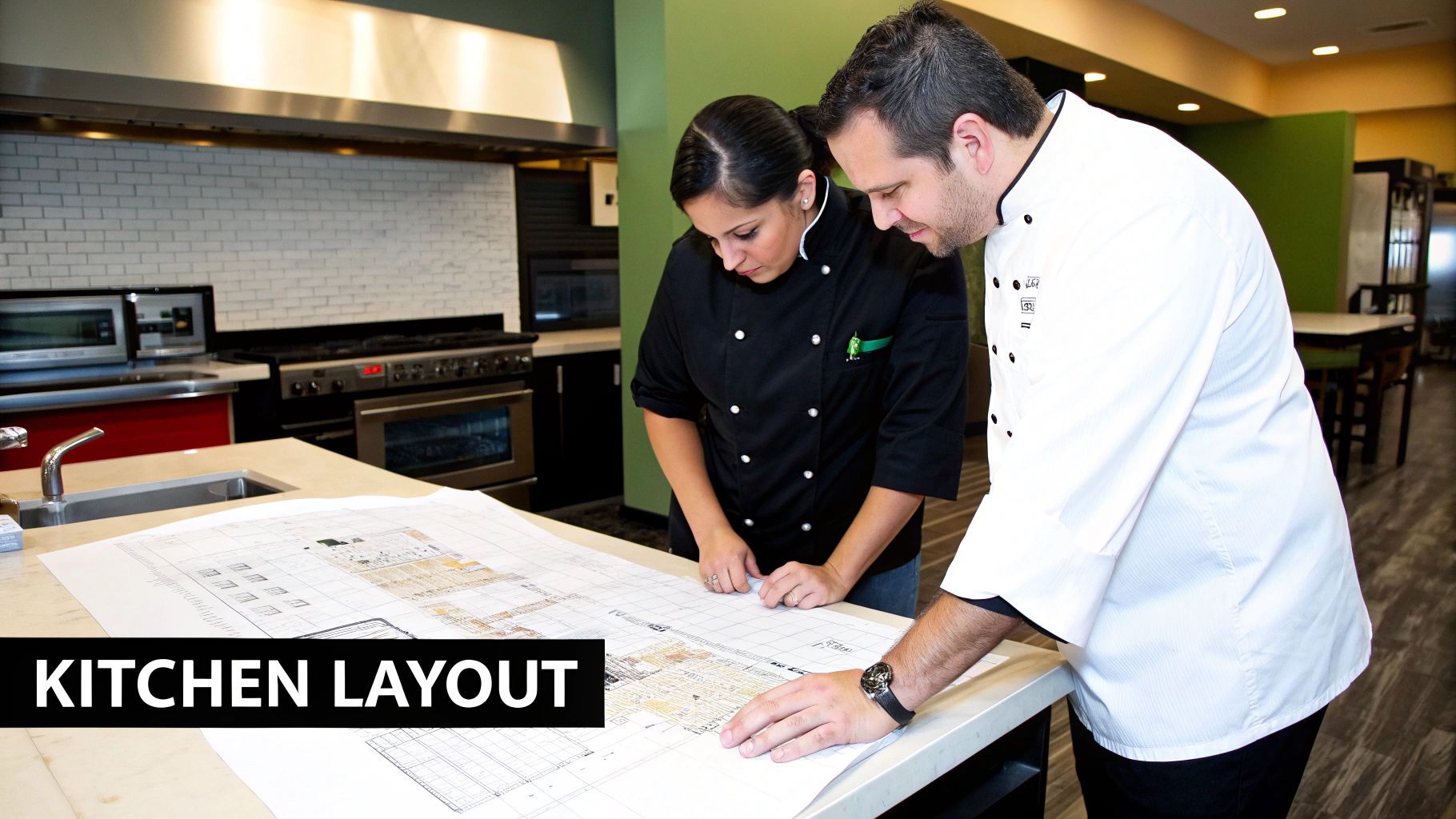
Before you even think about buying a single piece of steel, you need a blueprint. A poorly planned kitchen is a recipe for disaster—it creates bottlenecks, slows down service, and is a safety hazard waiting to happen. Your goal is to create a seamless, logical flow that follows a dish from raw ingredient to the finished plate.
A well-designed kitchen cuts down on the steps your staff has to take. For example, your cook line—ranges, ovens, fryers—should be right near the pass-through window to get hot food out fast. It seems obvious, but you’d be surprised how many layouts get it wrong. Likewise, the dish pit should be well away from food prep stations to avoid cross-contamination and traffic jams.
Feeling a bit overwhelmed by the spatial puzzle? Our detailed guide on commercial kitchen design and layout has a ton of strategies and sample floor plans to help you make the most of every square foot.
A great kitchen design is like a perfectly choreographed dance. Every station has its purpose, every movement is efficient, and the result is a seamless performance that keeps both your staff and your customers happy.
Choosing Your Essential Commercial Equipment
With a solid layout in hand, it's time to pick your tools. Your menu is the ultimate guide here. If you're opening a pizzeria, a powerful deck oven is your crown jewel. If it's a smoothie bar, you need high-performance blenders that can take a beating.
Don't fall into the trap of buying every shiny new gadget. Start with the absolute must-haves and expand later.
Here’s a quick rundown of what you’ll be looking at:
- Cooking Equipment: The heart of it all. This covers your ranges, ovens (convection, combi, deck), grills, and fryers.
- Refrigeration: Commercial fridges and freezers are non-negotiable for food safety. A walk-in cooler is a game-changer for high-volume spots, while smaller reach-in units are perfect for the line.
- Food Preparation: Think stainless steel prep tables, commercial mixers, food processors, and slicers. Durability and ease of cleaning are everything here.
- Storage and Shelving: To meet health codes, you'll need NSF-certified shelving for organizing dry goods, cookware, and everything in between.
- Dishwashing: A high-temperature commercial dishwasher is your best friend for sanitation and speed. It can clean a full rack in just a couple of minutes.
Essential Kitchen Equipment Checklist
To help you get started, here's a table breaking down the essential equipment categories and what to look for when you're deciding what to source.
| Equipment Category | Must-Have Items | Key Purchase Consideration |
|---|---|---|
| Cooking | Range, Oven(s), Grill/Griddle, Fryer | Energy efficiency (gas vs. electric), footprint, and whether it matches your menu's demands. |
| Refrigeration | Walk-in or Reach-in Cooler, Freezer | Capacity vs. available space, energy star ratings to lower utility bills, and door configuration. |
| Food Prep | Stainless Steel Tables, Sinks, Mixer, Slicer | NSF certification is a must. Prioritize durable, easy-to-clean surfaces and ergonomic design. |
| Storage | Dry Storage Shelving, Dunnage Racks | Material (stainless steel vs. polymer), weight capacity, and adjustability for different items. |
| Dishwashing | 3-Compartment Sink, Commercial Dishwasher | Water usage, cycle time, and whether you need a high-temp (sanitizing) or low-temp (chemical) unit. |
This checklist is a starting point. Your final list will be unique to your concept, but these categories are universal to almost any foodservice operation.
To Buy or to Lease? That Is the Question
One of the biggest financial forks in the road is deciding whether to buy your equipment outright or lease it. I've seen successful operators do both. The right answer for you comes down to your available capital and long-term vision.
Let's break down the pros and cons.
| Factor | Buying Equipment | Leasing Equipment |
|---|---|---|
| Upfront Cost | Very high; requires significant capital investment. | Low; minimal initial cash outlay. |
| Ownership | You own the asset and can sell it later. | You never own the equipment; you return it at the end of the term. |
| Maintenance | You are responsible for all repairs and maintenance costs. | Maintenance is often included in the lease agreement. |
| Flexibility | Less flexible; you are committed to the equipment you buy. | More flexible; you can upgrade to newer models when the lease ends. |
Honestly, a hybrid approach often works best. You could buy the core, long-lasting workhorses like your range and walk-in cooler. Then, you might lease items that get updated frequently or are prone to breaking down, like an ice machine or your POS system. This gives you a nice balance between building long-term assets and preserving that all-important cash flow.
Ultimately, remember that every dollar you spend equipping your kitchen is an investment in your restaurant's future. Choose durable, energy-efficient gear that’s the right size for your space. It will pay you back for years to come with lower utility bills, less downtime, and a happy, productive kitchen team.
Bringing Your Restaurant to Life: Your Team and Your Menu
With your location sorted and your kitchen layout planned, it's time to focus on what truly gives a restaurant its soul: the people and the food. These aren't just line items in a business plan; they're the heart and soul of your operation. A smartly designed menu can be your secret weapon for profitability, while a fantastic team is what brings your vision to life for every single guest who walks through the door.
Your menu isn't just a list of things you sell. It's your most powerful sales tool, capable of guiding customer choices, bumping up check averages, and making your kitchen run like a well-oiled machine. At the same time, finding and keeping the right people in a tough hiring market is the key to creating a culture that makes first-time visitors feel like regulars.
Designing a Menu That Makes Money
A great menu is a careful mix of dishes people already love and unique, high-margin items that become your signature. The process of getting this balance right is called menu engineering. It’s a straightforward, data-driven way to look at what you’re selling and figure out what’s working.
Think about your menu items in four buckets:
- Stars: These are your rockstars—popular and profitable. They’re the dishes you want to show off and feature prominently.
- Plow Horses: Everyone loves these, but they don't make you much money. The trick here is to see if you can tweak the recipe to lower costs or slightly increase the price without anyone batting an eye.
- Puzzles: These are goldmines, but for some reason, they aren't selling. Maybe they need a better description, a new photo, or a little push from your servers to get them noticed.
- Dogs: These are the duds. They aren't popular, and they aren't profitable. It’s usually best to cut them loose to simplify your inventory and kitchen workload.
Before you can do any of that, you have to know your food cost for every single item on the menu. The goal is to keep your overall food cost percentage somewhere between 25-35%. That's the industry sweet spot for healthy profit margins. This simple math keeps you from pushing a popular dish that's secretly bleeding you dry.
Your menu isn't just a list of what you sell; it's a strategic guide that tells customers what to buy. Smart design and pricing psychology can gently steer them toward your most profitable items, boosting your bottom line with every order.
Don't underestimate the little psychological tricks, either. People’s eyes naturally drift to the top-right corner of a menu, so that’s a great place for a high-profit "Star." Using words like "farm-fresh," "house-made," or "handcrafted" also does wonders for making a dish seem more valuable and enticing.
Assembling Your Opening Day Crew
Your team is everything. They are the face, voice, and engine of your restaurant. In today's labor market, finding good people is one of the toughest parts of the job. The secret to attracting and keeping them is building a positive, supportive culture right from the very beginning.
First things first, you need to know exactly who you're looking for. Write up clear, detailed job descriptions for every role in the house.
Key Roles to Hire:
- Back-of-House (BOH): Executive Chef, Sous Chef, Line Cooks, Prep Cooks, Dishwashers.
- Front-of-House (FOH): General Manager, Servers, Bartenders, Hosts, Bussers.
When you're interviewing, look for more than just a good resume. You want to gauge their attitude, see if they’re reliable, and figure out how they handle pressure. I'd take a line cook with a great attitude and a willingness to learn over a seasoned-but-cynical chef any day of the week.
Once you’ve made your hires, training is absolutely essential. Don't just throw them into the fire and hope for the best. A solid training program should cover everything from your steps of service and menu details to your restaurant's values and safety rules. Putting in this effort upfront pays off massively—it ensures a consistent experience for your guests and gives your team the confidence they need to shine from day one.
Marketing Your Restaurant for a Successful Launch
You can have the most incredible restaurant concept in the world, but an empty dining room doesn't pay the bills. Marketing is what connects your culinary vision to a community of hungry, loyal customers. The most successful launches I've seen start building that audience long before the doors ever open.
Let's be real: attracting and keeping customers is a massive challenge for 79% of restaurant operators. This section is your playbook for cutting through the noise, drumming up genuine excitement, and making sure you have a steady stream of guests from day one.
Building Buzz Before You Open
Your marketing push shouldn't kick off on opening day—it needs to start months ahead of time. The whole point of a pre-launch campaign is to build anticipation and gather a following of people who are genuinely excited to try your food. Think of it as creating a fan club before the show even starts.
First, grab your social media handles on platforms where your ideal customers hang out, whether that’s Instagram, Facebook, or even TikTok. Then, start sharing your story. Post behind-the-scenes shots of the renovation, introduce your chef, and talk about what inspired your concept. This kind of authentic storytelling makes people feel like they're part of your journey.
Another killer pre-launch tactic is reaching out to local food bloggers and influencers. But don't just blast out a generic press release. Build real relationships. Invite a small, select group for a private tasting before you open, letting them meet the team and experience your vision firsthand. Their early praise can set off a wave of word-of-mouth that money just can't buy.
Mastering Your Digital Footprint
These days, your online presence is your new front door. When someone in your neighborhood searches "best tacos near me," you absolutely have to show up. That’s where local search engine optimization (SEO) becomes your best friend.
Your most powerful tool here is your Google Business Profile (GBP). It's the free listing that pops up in Google Maps and local search results, showing customers your address, hours, phone number, and—most importantly—your reviews. Having a fully built-out profile isn't optional; it's essential.
Think of your Google Business Profile as your digital storefront. A neglected profile with outdated information and no recent reviews is the online equivalent of a restaurant with dusty windows and a flickering sign.
To make your GBP a customer magnet, you need to be meticulous.
- Fill Out Everything: Get your business name, address, phone number (NAP), website, hours, and categories perfect. Accuracy is key.
- Use High-Quality Photos: Show off your best dishes, the ambiance of your dining room, and your friendly staff. Make people hungry with your pictures.
- Encourage and Reply to Reviews: Actively ask happy customers to leave a review. Then, make sure you respond to all of them, good and bad. It shows you care and are paying attention.
Getting this right is so fundamental that we've created a dedicated resource to guide you. For a detailed walkthrough, check out our guide on how to get a Google Business listing and put it to work for your restaurant.
Launching with a Memorable Grand Opening
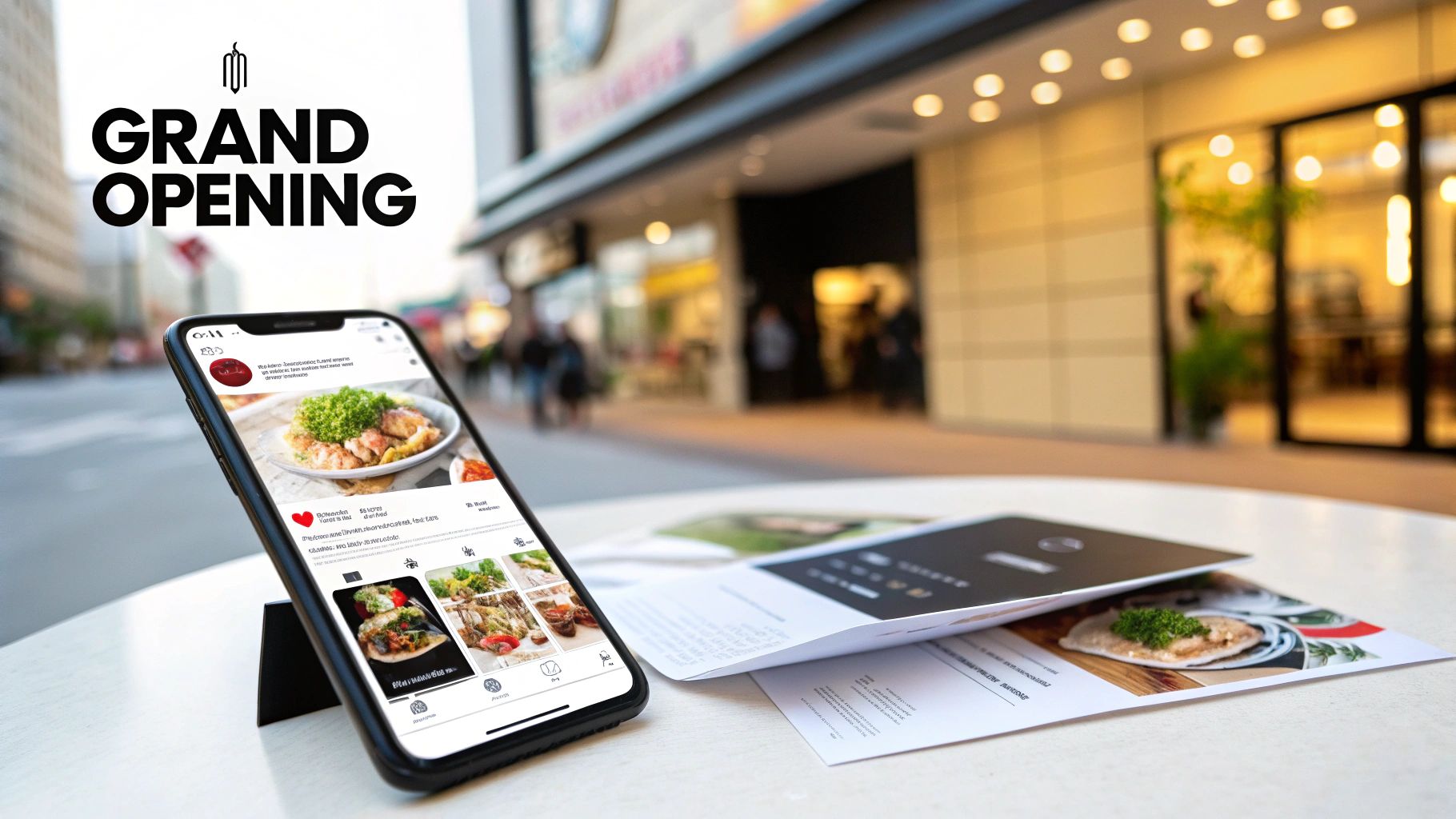
Your grand opening is your big debut. It's your chance to make a splash and announce your arrival to the community. The goal isn’t just a single busy night; it’s to create an event that people talk about for weeks and that brings them back for more.
Plan your grand opening promotions with care. A simple discount might attract deal-chasers, but a more creative offer can build real loyalty.
| Promotion Type | Example | Why It Works |
|---|---|---|
| First-Timers Offer | Free signature appetizer for the first 100 guests. | Creates urgency and rewards early adopters. |
| Community Partnership | Donate 10% of opening night sales to a local charity. | Generates positive PR and shows community investment. |
| Media & Influencer Event | Host a VIP preview night before the public opening. | Secures valuable press coverage and social proof. |
The secret is to make the event feel special. A live band, a ribbon-cutting ceremony with the mayor, or a unique themed menu can elevate the experience from just another restaurant opening to a can't-miss community event.
Keeping the Momentum Going
The buzz from a grand opening eventually quiets down. That’s why you need a long-term plan to keep people walking through the door. This is where loyalty programs and ongoing community engagement become your workhorses.
A simple loyalty program can do wonders. Whether it’s a digital punch card or a points-based system, rewarding repeat business is one of the smartest things you can do. After all, it costs far less to keep a customer than to find a new one.
Finally, weave your restaurant into the fabric of your neighborhood. Sponsor a local little league team, host a weekend farmers' market in your parking lot, or offer your space for community meetings. When you become a true part of the community, your customers become your biggest advocates, proudly supporting you for years to come.
Frequently Asked Questions About Starting a Restaurant
Thinking about opening a restaurant brings up a ton of questions. It's a massive undertaking, and it's easy to feel lost. To give you some clarity, I've tackled a few of the biggest questions I hear from aspiring restaurateurs, based on years of experience in this industry.
How Much Does It Really Cost to Start a Restaurant?
Let's get straight to it: the numbers can be intimidating. For a standard, mid-sized restaurant, you're realistically looking at an investment somewhere between $500,000 and $1 million. That number can swing wildly depending on your city, concept, and the condition of the space you lease.
Where does all that money go? Think big-ticket items like lease deposits, major renovations to get the space up to code, a mountain of licenses and permits, and your initial inventory. And then there's the heart of the operation: your commercial kitchen equipment. That alone can easily eat up 30-40% of your entire startup budget.
If that sounds out of reach, don't despair. Savvy entrepreneurs are finding leaner ways in. A food truck, for example, can often get rolling for somewhere in the $50,000 to $100,000 range, offering a much lower barrier to entry.
What Is the Most Common Reason New Restaurants Fail?
It’s a tough business, and the truth is, most failures boil down to two things: running out of money and poor management. Too many new owners, full of passion for food, simply underestimate the brutal reality of day-to-day operating costs. Before they know it, they're in a cash flow crisis they can't escape.
But it's not just about the money. Several other missteps can sink a promising new spot:
- Bad Location: A great restaurant in a hidden spot with no foot traffic is just a well-kept secret. And secrets don't pay the bills.
- Zero Marketing Buzz: You could have the best food in town, but if nobody knows you exist, your dining room will stay empty.
- A Muddled Concept: If you can't clearly explain what makes your restaurant special, you'll get lost in the noise of a crowded market.
- Ignoring the Margins: This industry operates on razor-thin profit margins, often just 3-5%. If you're not obsessively managing your food and labor costs, you're not going to make it.
Should I Buy New or Used Restaurant Equipment?
This is a classic dilemma, and there's no single right answer. The smartest operators I know almost always use a mix-and-match strategy based on their budget and what the equipment actually does.
New equipment is a beautiful thing. It comes with reliability, a solid warranty, and modern energy efficiency that can save you a bundle on utilities down the road. The catch, of course, is the hefty upfront price tag. On the flip side, used equipment can be a lifesaver for your startup capital, often costing 50-70% less. But you're rolling the dice on reliability and you've got no warranty to fall back on.
My advice? Buy new where it counts the most. Your refrigeration and primary cooking line—your ovens, your ranges—are the lifeblood of your kitchen. A failure there is catastrophic. For things like stainless steel prep tables, shelving, or sinks, you can find high-quality used pieces and save a significant amount of cash.
How Important Is a Website for a New Restaurant?
It’s not just important; it’s non-negotiable. In this day and age, your website is your front door. It’s the first impression most people will ever have of your restaurant.
Think about it—what’s the first thing you do when you want to try a new place? You Google it. A clean, professional, mobile-friendly website that shows off your menu, hours, and location is table stakes for even showing up in local search results.
Combine that with an active social media feed and a well-maintained Google Business Profile, and you have a powerful engine for building a loyal following. People research before they dine, and a strong online presence is essential for survival and growth.
At Restaurant Equipment SEO, we help foodservice businesses get found by the people who matter most. If you're ready to make sure your ideal customers can find you online, check out our specialized SEO services for the restaurant industry.