
Is Seo Worth It - is seo worth it for your business?
For a restaurant equipment seller, the question isn't just if SEO is worth it, but how much you're leaving on the table without it. The short answer is a resounding yes, it's worth the investment.
Think of it this way: paid ads are like renting a high-traffic booth at a trade show. The moment you stop paying the rent, your booth disappears, and so do the visitors. SEO, on the other hand, is like building your own permanent, flagship showroom in the busiest part of town. It takes work to build, but once it's up, it attracts qualified buyers around the clock, for years to come.
It's a long-term asset that generates compounding returns.
What Is SEO, Really? (And Why It Matters for Your Business)
At its heart, Search Engine Optimization (SEO) is the process of making your website the best, most obvious answer when a potential customer uses a search engine like Google.
Imagine a new cafe owner typing "best commercial espresso machine" or a seasoned chef searching for "commercial combi oven reviews." SEO is what puts your website at the top of those results. It's not about gaming the system; it's about systematically proving to search engines that you are the most helpful and authoritative resource for that person's needs.
The real magic of SEO is that it builds a sustainable pipeline of high-intent traffic. These aren't just random clicks. These are people actively looking for the exact equipment you sell. Unlike paid ads, which demand a constant flow of cash to stay visible, a well-optimized page can continue generating leads and sales long after the initial work is done. You're essentially creating a powerful, self-sustaining marketing engine.
You're Building Equity, Not Just Renting Attention
Every piece of content you publish, every link you earn, and every technical improvement you make is like laying another brick in the foundation of your digital presence. Over time, that foundation becomes so solid that it naturally and consistently attracts organic traffic—without you having to pay for every single click. This is the core difference between building a business asset and just renting temporary attention.
For those running online stores, understanding the specific tactics that turn search traffic into sales is crucial. It’s worth digging into the mechanics of SEO for Shopify and Ecommerce to see how these principles apply directly to product pages and collections.
SEO is one of the only marketing channels that truly has compounding returns. With most advertising, if you put $100 in, you get a predictable, linear result back. With SEO, the effort you put in today can deliver ten times the return a year from now as your authority grows.
This compounding effect is why simply asking "is SEO worth it?" can miss the bigger picture. The better question might be: can you really afford to ignore the most powerful customer acquisition channel available to your business?
Let’s put SEO and paid ads side-by-side to see how they stack up for an equipment seller.
SEO vs. Paid Ads: A Quick Comparison for Equipment Sellers
This table breaks down the fundamental differences between investing in SEO and spending on paid advertising, tailored for the B2B equipment sales context.
| Factor | SEO (Building an Asset) | Paid Ads (Renting Attention) |
|---|---|---|
| Cost Over Time | Higher upfront investment, but the cost per lead decreases over time. | Consistent and often increasing costs per click. Budget is always on. |
| Longevity | Results are durable and can generate traffic and leads for years. | Traffic and leads stop the moment you stop paying. |
| Audience Intent | Catches buyers who are actively searching for solutions and equipment. | Targets users based on demographics, interests, or past behavior. |
| Credibility | Organic rankings are seen as more trustworthy and build brand authority. | Users know it's a paid placement, which can lead to skepticism. |
Ultimately, while paid ads offer immediate visibility, SEO builds a lasting competitive advantage. It's the difference between a short-term sprint and a long-term strategy for market leadership.
Calculating the True ROI of SEO in Your Niche
Alright, let's move past the marketing talk and get down to what really matters: the numbers. When you're selling high-ticket items like commercial ovens or walk-in freezers, you can't rely on fuzzy metrics. You need to know, in plain dollars and cents, what your return on investment (ROI) will be.
Figuring out SEO ROI isn't as complicated as it sounds. At its heart, it's a simple question: for every dollar you put in, how many are you getting back? The big difference is that a paid ad gives you a quick, one-time return. SEO is different. It’s an investment that builds on itself, month after month, eventually turning your marketing budget into a predictable profit engine.
The basic formula is pretty straightforward:
(Value of Conversions - Cost of SEO Investment) / Cost of SEO Investment = SEO ROI
Let's put that into perspective. Say you invest $15,000 in SEO over six months and it brings in $75,000 in new profit from organic leads. Your ROI is a massive 400%. This isn't just a number pulled from thin air; it’s a realistic outcome for businesses that stick with a solid strategy.
It's Not Just About Clicks—It's About Customer Value
One of the biggest mistakes I see businesses make is getting hung up on website traffic alone. The real financial power of SEO comes from lowering your Customer Acquisition Cost (CAC) while increasing your Customer Lifetime Value (CLV).
Think about it. A restaurant owner who finds your website by searching "best commercial deep fryer" is a golden lead. They aren't just window shopping; they have an immediate problem and are actively looking to spend money to solve it.
This dynamic creates some serious financial wins:
- Lower CAC: As your website climbs the search rankings, you start getting leads without paying for every single click. This organically drives down the average cost to land a new customer.
- Higher CLV: SEO connects you with customers who trust you because you gave them the best answer to their problem. These aren't one-and-done buyers. They’re the ones who come back for more equipment, sign up for service contracts, and refer you to other business owners.
- Better Lead Quality: Leads from search have already done their research. They show up ready to talk specifics, which means your sales team spends less time educating and more time closing deals. The sales cycle shortens, and you waste less energy on tire-kickers.
This is the key shift: you stop "renting" traffic from ads and start "owning" a consistent source of high-quality leads. That’s where the real money is made.
Industry Benchmarks and What to Expect
While every business's journey is unique, industry data gives us a solid idea of what a well-run SEO campaign can achieve. The numbers don't lie: SEO delivers substantial, measurable returns over the long haul. Multiple industry studies estimate the average ROI is somewhere between 300% and 1,000%+, with most businesses hitting their break-even point within 6–13 months. Specifically for B2B industries like ours, some reports show returns topping 700%. You can dig into more SEO ROI statistics and benchmarks on FirstPageSage.com.
The pattern is clear. When you commit to a strategy and measure it properly, the returns are significant. Those first few months are all about laying a strong foundation, but the explosive growth that follows is where your investment truly pays off.
Turning SEO Data into a Business Case
To make a smart decision, you have to connect SEO metrics to your company's bottom line. It's not about rankings for the sake of rankings; it's about revenue and sustainable growth. By focusing on the right key performance indicators (KPIs), you can build a rock-solid business case that justifies your marketing spend.
You need a clear line of sight from the first click all the way to the final sale. If you're not sure where to begin, our guide on how to measure SEO performance breaks down the specific metrics that actually matter. This knowledge gives you the power to see exactly how SEO is fueling your company's success, transforming it from a simple expense into a core driver of your business.
How SEO Delivers More Value Per Dollar Than Paid Ads
When you're trying to figure out where to put your marketing budget, every single dollar counts. So, how is it that a dollar spent on SEO often goes so much further than one spent on paid ads? The answer gets right down to the fundamental difference between building a lasting asset and simply renting someone's attention for a little while.
I like to use a farming analogy. Paid advertising is like leasing a plot of land for just one harvest. You pay the fee, you plant your seeds, and you get to keep what grows. But come next season? You have to pay that rent all over again just to use the same piece of dirt. The second you stop paying, your access is gone.
SEO, on the other hand, is like buying that farmland. Sure, the upfront investment might feel a bit bigger, and it definitely takes time to cultivate the soil and plant the first real crops. But here's the kicker: you own it. Every improvement you make—every piece of content, every backlink—increases the land's value and its future yield, delivering returns season after season.
The Long-Term Cost Advantage of SEO
Paid advertising runs on a pay-per-click (PPC) model. You bid on keywords, and every single time someone clicks your ad, your account gets charged. This can bring in traffic fast, but it creates a relentless cycle of dependency. If you have a monthly ad budget of $5,000, you're spending that every month just to stay in the game. Stop paying, and your traffic can drop to zero overnight.
This is what a lot of us in the industry call "paid ad addiction." Your entire lead flow is tethered to your continuous spending.
SEO just works differently. The first few months require a lot of heavy lifting—technical audits, creating helpful content, and building your site's authority. But once a page starts ranking for a money keyword like "commercial ice machine financing," it can pull in qualified buyers for months, or even years, with very little ongoing cost. This is exactly how you slash your customer acquisition cost (CAC) over time.
Each blog post or product guide becomes a self-sustaining asset, working for you 24/7. To get a better handle on how this works, you can read our deep dive into what is organic traffic.
Data-Backed ROI: SEO vs. Paid Ads
This isn't just theory; the real-world numbers back it up. In head-to-head comparisons, SEO consistently beats paid ads on both return and cost-per-customer. One analysis of the trades sector found that for every $1 spent, SEO generated $19.90 in revenue. Paid ads? They brought back just $4.40.
That’s a nearly 5x difference in return on ad spend (ROAS) and a dramatically lower cost to acquire a new customer ($126 for SEO vs. $553 for paid ads). You can dig into more of this data on CI Web Group's blog.
This chart really drives the point home, showing the powerful return on investment that SEO can deliver across different B2B and e-commerce industries.
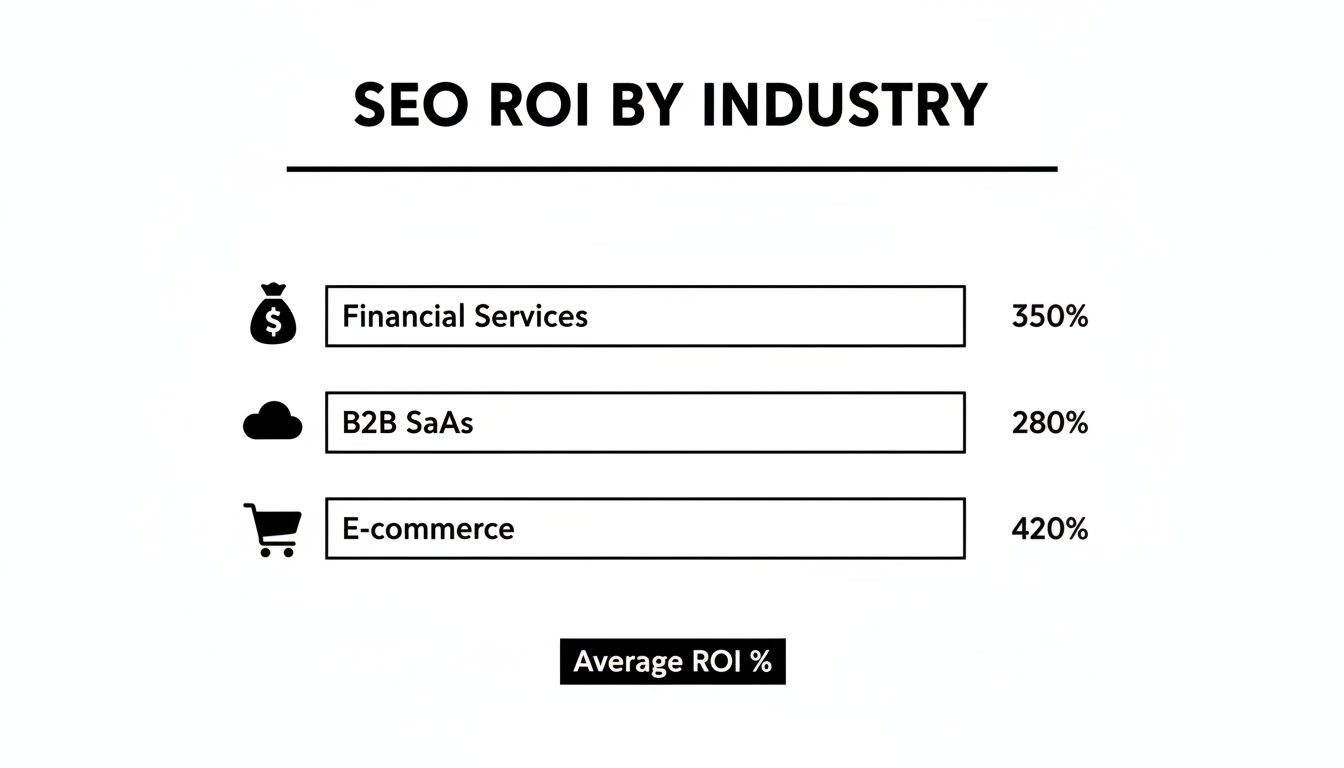
As you can see, sustained SEO campaigns consistently produce returns in the hundreds of percent, cementing its role as a long-term growth engine.
The core takeaway is simple: Paid ads buy you traffic today. SEO earns you traffic for years. One is an ongoing expense; the other is a capital investment in your business's future.
Ultimately, deciding if SEO is worth it comes down to what you're trying to achieve. If you need a quick, short-term burst of traffic, ads can be a great tool. But if you're serious about building a sustainable, profitable business for the long haul, the value proposition of SEO is almost impossible to beat.
Attracting High-Quality Buyers, Not Just Window Shoppers

Let’s be honest: not all website traffic is created equal. A thousand people who just stumbled onto your site are far less valuable than ten serious buyers who are ready to pull the trigger. This is where SEO really shows its worth, acting like a powerful filter to bring in qualified prospects instead of just random clicks.
The secret sauce here is something called search intent. When a restaurant owner goes to Google, they aren't just typing words; they’re expressing a specific need at a specific moment. Someone searching for "restaurant design ideas" is in a completely different headspace than the person typing "Hoshizaki KM-600MAJ ice machine price."
A smart SEO strategy is built to target that second person—the one with high commercial intent who is actively looking to buy a solution. This is a complete flip from traditional marketing, which often feels like interrupting people who aren't looking for you. With SEO, you connect with prospects who are already raising their hands for help.
Tapping into Active Buyer Journeys
Think about the detailed, nitty-gritty questions your best customers ask. They aren't just searching for "commercial ovens." They're hunting for very specific solutions to the real-world problems they face every day in their kitchen.
These detailed searches, often called long-tail keywords, are goldmines for high-quality leads. They’re a huge signal that a buyer has moved past casual browsing and is deep into the evaluation or purchase phase. We dive deep into this in our guide to long-tail keyword research, but the core idea is simple: be the answer to their most specific questions.
Here are a few real-world examples of searches that scream "I'm ready to buy":
- Problem-Aware Searches: "how to reduce kitchen ventilation noise"
- Solution Comparison: "True T-49F vs Turbo Air M3F49-2"
- Purchase-Ready Queries: "commercial combi oven financing options"
By creating content that directly answers these types of questions, you intercept buyers at the most critical moments of their decision-making process.
Why SEO Leads Convert at a Higher Rate
The quality of a lead directly impacts your bottom line—it’s that simple. When someone finds you through a search engine, they arrive with a level of trust you just can't get from an ad. They didn't get interrupted; they found you because Google presented your business as the best solution to their specific problem.
This built-in relevance and trust translates into serious business outcomes. Inbound leads from SEO are much more likely to become customers because they initiated the entire conversation. They already know they have a need and are actively hunting for the right partner.
The difference in conversion potential is staggering. Studies show SEO leads can have a close rate as high as 14.6%. Meanwhile, outbound methods like cold calling often struggle just to hit a 1.7% close rate.
That massive gap is why the whole "is SEO worth it?" question almost always comes down to lead quality. Higher conversion rates mean a more efficient sales team, shorter sales cycles, and a lot less time wasted on prospects who were never going to buy anyway. You're not just getting more leads; you're getting better ones.
Of course, getting them to your site is only half the battle. To really seal the deal, you have to focus on crafting effective SEO product descriptions that don't just rank well but also persuade and convert. After all, those pages are often the final stop before a purchase. A great SEO strategy doesn't just drive traffic—it drives revenue by connecting you with customers ready to invest in the right equipment.
A Realistic Timeline and Budget for SEO Success
One of the biggest hurdles in answering the "is SEO worth it?" question is managing expectations. Let's be clear: SEO is not an overnight fix. It’s a long-term investment in a valuable business asset.
I like to compare it to planting an orchard. You don't get a truckload of fruit the day after you plant a sapling. The first few months are all about preparing the soil and nurturing early growth. The real harvest comes later.
This means you absolutely need a clear roadmap. Diving into SEO without a realistic timeline and budget is like trying to build a new restaurant without a blueprint or funding—it’s a recipe for frustration and failure. So, let’s walk through what a successful SEO campaign actually looks like for a restaurant equipment seller.
The Foundational First Quarter
The first 1-3 months are dedicated almost entirely to groundwork. This is the crucial discovery and strategy phase where we set the stage for all future growth. Rushing this step is probably the most common—and most costly—mistake I see businesses make.
Here’s what’s happening behind the scenes:
- Comprehensive Technical Audit: We're essentially getting under the hood of your website to find and fix anything that could hold you back in Google’s eyes, like slow page speeds or broken links.
- Deep Keyword Research: This is about uncovering the exact terms your ideal customers are typing into search engines, from broad queries like "commercial refrigeration" to hyper-specific product models.
- Competitor Analysis: We need to know what your top competitors are doing right. By analyzing their strategies, we can find gaps and opportunities for you to outmaneuver them.
- Content Strategy Development: This is the blueprint. We'll map out the articles, buyer's guides, and product pages needed to attract and convert customers at every stage of their journey.
During these initial months, you won't see a huge spike in traffic. That's not the point. The goal here is to build a rock-solid foundation for everything that comes next.
Gaining Momentum in Months 4 to 6
This is where the rubber meets the road. With the strategy locked in, the focus shifts to consistent execution. We'll start creating and publishing the high-quality, targeted content we planned out—things like detailed product comparisons, maintenance guides, or articles answering common industry questions.
During this period, you’ll start seeing the first real signs of life. Keywords will begin creeping into the top 100, then the top 50. You’ll notice small but encouraging upticks in organic traffic. This is the proof that the plan is working.
This is also when we'll focus on building your website's authority through ethical link-building and promoting your content. Think of each new blog post or guide as another fishing line in the water; each one has the potential to catch new customers.
Achieving Significant Growth and ROI
From month seven onward, the compounding power of SEO really kicks in. The content you created months ago continues to climb the rankings, and your site’s overall authority grows stronger. This is when you finally see those significant, meaningful increases in organic traffic, leads, and sales.
At this stage, your early investment starts paying real dividends. Your website transforms from a simple online catalog into a powerful, lead-generating machine that works for you 24/7. The key is consistency. Continuing to publish valuable content and build authority ensures that your growth doesn't just continue—it accelerates.
When SEO Might Not Be the Right Move for Your Business
Look, as much as we believe in the power of SEO for long-term growth, it’s not a cure-all. An honest conversation about whether SEO is worth it means admitting that sometimes, it’s just not the right play—at least, not right now. Jumping into an SEO campaign under the wrong circumstances is a surefire way to burn through your budget and end up frustrated.
Think of SEO as planting an orchard. It takes time, care, and patience before you get to enjoy the fruit, but once it starts producing, it can feed you for years. If you're starving today, you don't have time to wait for an apple to grow. You need to go to the store.
You're in a "We Need Sales Yesterday" Situation
This is the big one. If your business is struggling to make payroll next month, you simply can't afford to wait for organic search rankings to kick in. SEO is a slow burn, often taking six months or more to deliver a meaningful return. When cash flow is tight and you need leads hitting your inbox this week, your marketing dollars have to go toward channels that work faster.
In a cash crunch, you should be looking at things like:
- Pay-Per-Click (PPC) Ads: Want to be at the top of Google tomorrow? You can. You'll just have to pay for every single click. It's not cheap, but it's immediate.
- Paid Social Media Ads: Platforms like Facebook and LinkedIn are great for getting your products in front of very specific restaurant owners or chefs, fast.
- Old-Fashioned Sales: Never underestimate the power of picking up the phone or sending a direct email. Sometimes the quickest path to a sale is a straight line.
Once you’ve got some breathing room and the business is on more stable ground, you absolutely should circle back and build your long-term SEO foundation. But when you're in survival mode, speed is everything.
SEO is an investment in your business’s future, not a band-aid for a cash flow crisis today. Using it as a quick fix is like planting a sapling when you need firewood for the night.
Your Team is Already Spread Too Thin
A successful SEO campaign needs more than just a check. It needs your time and attention. Real partnership is required. If your team is already running on fumes and doesn't have the bandwidth to review content, provide feedback on strategy, or get technical changes made on the website, the whole effort is going to sputter out.
It also comes down to company culture. If your leadership lives and dies by quarterly reports and demands immediate results, the slow, compounding nature of SEO is going to cause a lot of friction. SEO works best when everyone understands it's a strategic, long-term asset that builds value month after month.
Without that buy-in and a little bit of patience from the inside, even the most brilliant SEO plan is doomed. Before you ask if SEO is worth it, you have to ask if your business is truly ready for it.
Common Questions We Hear About SEO
Even after laying out the strategy, it's natural to have some "what ifs" and practical questions pop up. It’s one thing to see the plan on paper, but another to picture how it works day-to-day. Let’s tackle some of the most common questions we get from restaurant equipment sellers, with straight, no-fluff answers.
The goal here is to iron out any last wrinkles of doubt so you can move forward with confidence.
How Much Content Do We Really Need to Create?
This is easily the question we hear most often. The honest answer? It’s far more about quality and consistency than it is about sheer volume. Yes, a weekly blog post gives you more chances to show up in search results, but the real magic is in the value you provide.
A single, deeply researched, and well-optimized article each month will blow four generic, rushed posts out of the water every time. You're not trying to flood the internet; you're trying to create the single best answer to your customer's most important questions.
Think of it this way: each piece of content is like a digital salesperson working for you around the clock. Would you rather have one amazing salesperson who consistently closes deals, or a dozen who just stand around looking busy? Start with a schedule you can actually stick to—even if it's just one or two killer articles a month—and make them the most helpful resources anyone can find on that topic.
What’s More Important: On-Page or Off-Page SEO?
Ah, the classic chicken-and-egg debate of SEO. The truth is, you absolutely need both. They aren't in competition; they work together in a specific order to get you results.
- On-Page SEO is your foundation. This is everything happening on your website—your keywords, content quality, site speed, and how easy it is for visitors to use. If this foundation is cracked, any effort you put into off-page SEO will just crumble.
- Off-Page SEO builds your authority. This is mostly about earning backlinks (links from other reputable websites pointing to yours). Google sees these links as votes of confidence, signaling that your site is a trustworthy authority in the industry.
You have to start by getting your on-page SEO dialed in. Once your website is a finely tuned machine, you pour gas on the fire with a smart off-page strategy. Trying to do one without the other is like having a powerful V8 engine in a car with no wheels. It makes a lot of noise but isn't going anywhere. For many, deciding is SEO worth it comes down to understanding you have to commit to both.
How Do We Choose the Right SEO Partner?
Picking an agency or a consultant is a huge decision, and you should treat it like hiring a key employee. You're looking for a partner who values transparency, takes the time to educate you, and genuinely understands the nitty-gritty of the restaurant equipment industry.
Be very skeptical of anyone who promises "guaranteed #1 rankings" or "instant results." Those are giant red flags in the SEO world.
A great partner won't just talk about rankings; they'll show you exactly how their strategy connects back to your actual business goals—more qualified leads and more revenue. They should feel like an extension of your team, not just another vendor sending you an invoice.
Ready to turn your website into a lead-generation machine that works for you 24/7? The team at Restaurant Equipment SEO has a proven track record of helping businesses like yours dominate the search results. Book a discovery call today and let's build your long-term growth strategy.