
Long Tail Keyword Research for Kitchen Equipment
Long-tail keyword research is all about finding those super-specific, multi-word phrases people type into Google when they're getting serious about buying. Forget trying to rank for a vague term like "commercial oven." Instead, think about targeting a precise query like "energy-efficient double deck gas convection oven for small bakery." This strategy puts you directly in front of buyers who know exactly what they want, which almost always means higher conversion rates.
Why Long Tail Keywords Are Your Secret Ingredient
Chasing big, broad keywords like ‘commercial refrigerator’ can feel like you're shouting into a crowded stadium. You’re up against the huge national suppliers with marketing budgets to match, making it a tough, expensive battle to win. This is where a much smarter approach comes in: focusing on long-tail keywords can completely change the game for your restaurant equipment business.

These longer, more detailed phrases give you a direct window into a customer's mind. They’re a clear signal that someone has moved past the window-shopping phase and is now deep into the evaluation stage, getting ready to make a decision.
The Power of Specificity and Intent
Just think about the typical buyer's journey. Someone searching for "commercial freezer" is probably just dipping their toes in the water. But a search for "2-door stainless steel reach-in freezer for a small cafe"—that’s a buyer with a credit card in hand. They know what they need, and they're looking for a supplier. Long-tail keywords are your ticket to capturing that high-intent traffic.
And these aren't just niche searches. In fact, over 70% of all web searches are long-tail keywords. For many businesses, this represents a huge, untapped goldmine of potential customers.
The real magic of long-tail keyword research is its efficiency. You stop burning cash fighting for vanity keywords and start attracting customers who are actively searching for the exact products on your shelves. This means a better ROI and a sales pipeline full of qualified leads.
Understanding The Core Differences
Seeing the direct comparison between broad and specific terms really makes the concept click. Here's a quick look at how they stack up.
| Attribute | Short Tail Keyword ('commercial refrigerator') | Long Tail Keyword ('stainless steel 2-door reach-in commercial refrigerator') |
|---|---|---|
| Specificity | Very broad, could mean anything | Extremely specific, details size, material, and type |
| User Intent | Informational (browsing, research) | Transactional (ready to compare and buy) |
| Search Volume | Very High | Very Low |
| Competition | Extremely High | Low |
| Conversion Rate | Low | High |
The takeaway is clear: while short-tail keywords cast a wide net, long-tail keywords are the precision tools of a smart SEO strategy.
To really get this right, it helps to understand the foundational principles. If you're looking for a deeper dive, a good primer on Mastering Search Engine Optimisation for Your Site can fill in the gaps.
At the end of the day, the difference boils down to a few key advantages:
- Lower Competition: Far fewer competitors are trying to rank for "used 6-burner gas range with convection oven" than for the generic "gas range."
- Higher Conversion Rates: A user who types in a detailed phrase is much, much closer to making a purchase.
- Better Qualified Traffic: You bring visitors to your site who need exactly what you sell, which means they’re more likely to stick around and less likely to bounce.
Uncovering High-Intent Long Tail Keywords
This is where the rubber meets the road. Finding those game-changing, long-tail phrases isn't about pulling ideas out of thin air. It's about becoming a detective, piecing together the digital breadcrumbs your customers leave all over the internet. The mission is to find the exact language they use when they're past the window-shopping stage and are ready to solve a real problem.
But before we dig into the specialized tactics for restaurant equipment, it's worth getting a handle on the general keyword research principles that form the foundation of this work. Understanding the bigger picture helps you see why these specific methods are so incredibly effective.
Leveraging Google’s Free Intelligence
You don't need a massive budget to start uncovering valuable keywords. Some of the best intel comes directly from Google itself, and it’s completely free. This is your direct line to what real customers are actually searching for.
-
Google Autocomplete: This is your first and easiest stop. Start typing a broad term like "commercial pizza oven" into the search bar. Watch what Google suggests: "commercial pizza oven for food truck," "commercial pizza oven countertop electric." These aren't random guesses; they're popular, real-world searches.
-
People Also Ask (PAA): See those collapsible question boxes in the search results? That's a goldmine. A search for "commercial ice machine" might bring up questions like "how much does a commercial ice machine cost?" or "what size commercial ice machine do I need?" Every one of those questions is a perfect topic for a blog post or a detailed FAQ section on a product page.
-
Related Searches: Scroll all the way to the bottom of the search results page. Google hands you a list of eight to ten related queries. These often point to different angles or more specific needs. For instance, a search for "restaurant deep fryer" could lead you to related searches like "ventless commercial deep fryer" or "2 basket commercial deep fryer," revealing the exact features your customers care about.
These free methods are an amazing starting point, giving you raw, unfiltered insights straight from the source.
Advanced Discovery with SEO Tools
While the free stuff is great for getting your bearings, dedicated SEO tools like Semrush or Ahrefs are what let you do this at scale. They give you hard data on search volume, competition, and hundreds of related terms you’d never find on your own.
For a restaurant equipment seller, this is huge. You can plug in a seed keyword like "commercial griddle" and almost instantly get a massive list of long-tail variations.
The real power comes from the filters. You can narrow down that huge list to find the true gems. Try filtering for keywords with four or more words and a low keyword difficulty score. This instantly surfaces phrases that are both super-specific and much easier to rank for.
Thinking Like Your Customer Personas
Good keyword research is more than just data—it’s about empathy. You have to get inside the heads of your different customers. The owner of a high-volume pizzeria thinks and talks very differently from a fine-dining chef or the manager of a small-town cafe.
Let’s put ourselves in their shoes:
- The Pizzeria Owner: They’re probably searching for things like "high-temperature deck pizza oven for Neapolitan style" or "best commercial dough mixer for high-hydration dough."
- The Cafe Owner: Their needs are different. Think "compact countertop espresso machine for small space" or "under counter refrigerator with glass door."
- The Ghost Kitchen Operator: They’re all about efficiency and footprint. Their searches might look like "stackable commercial convection oven for limited footprint" or "multi-functional combi oven for diverse menu."
When you brainstorm keywords based on these specific personas, you start targeting the unique pain points of each audience segment. Your content stops being generic and starts speaking directly to their needs.
By aligning your keyword strategy with distinct customer personas, you move beyond generic marketing and start having targeted conversations. You’re not just selling equipment; you're providing precise solutions to specific business problems.
Mining Niche Communities for Authentic Language
Want to find the most authentic, high-intent keywords? Go where your customers hang out online. Forums and online communities are absolute treasure troves of the real language people use when they're talking shop.
Websites like Reddit are fantastic for this. Subreddits like r/KitchenConfidential or r/restaurantowners are filled with candid, unfiltered conversations. You'll find a chef asking, "What's a reliable workhorse immersion blender that won't die on me during a busy service?" That's not just a keyword—it's practically a ready-made content brief, dripping with user intent.
This is also a brilliant way to unearth locally-focused keywords. If you’re trying to attract customers in a specific city or state, knowing how to perform effective local keyword research for restaurant equipment is absolutely critical for capturing those high-value, nearby buyers.
When you blend the hard data from SEO tools with the human insights from these online communities, you build a powerful, comprehensive keyword list that will drive the right kind of traffic to your site.
How to Analyze and Prioritize Your Keyword List
So, you’ve got a massive spreadsheet brimming with long-tail keywords. That's a great start, but it's just raw material, not a strategy. The real work begins now: refining that list to turn a jumble of phrases into an actionable roadmap for your content and product pages. This is where we separate the high-impact opportunities from all the digital noise.
Your goal is to look at each keyword through three critical lenses: relevance, search volume, and competition. The sweet spot is finding a keyword that hits the mark on all three, but the true skill is in balancing them to drive real business results, not just empty traffic stats.
Decoding Buyer Intent: The Most Crucial Factor
Before you even glance at search volume or difficulty scores, you have to get inside the searcher's head. What do they really want? Are they just kicking tires and looking for information, or do they have their company credit card out, ready to buy? This distinction is everything.
-
Informational Intent: These are your "how-to" or "what-is" questions. Think of a search like "how to clean a commercial deep fryer." This person needs guidance, not a new fryer... yet. It’s the perfect opening for a helpful blog post or a downloadable cleaning checklist.
-
Transactional Intent: This is the money. These searches show a clear, urgent need to purchase. When someone types in "buy Garland Xpress Grill GXG13" or "Hoshizaki ice machine price," they are at the very bottom of the sales funnel. These become your top-priority keywords for product and category pages.
Getting this right is paramount. Long-tail keywords have a much higher conversion potential than short, generic ones. In fact, users searching with these specific phrases are often much further along in the buyer’s journey, leading to conversion rates that can be 2-3 times higher than for broad terms. You can find more insights on this from the team at Semrush.
Balancing Volume with Competition
Once you’ve grouped your keywords by intent, it’s time to look at the numbers. The magic often happens when you find terms with a decent amount of search volume and relatively low competition.
Search volume tells you how many people are looking for a term each month. While a huge number looks impressive, it almost always comes with brutal competition from established players. If you need a refresher, check out our guide on how to determine search volume for keywords.
Don't dismiss keywords with low search volume (e.g., 10-50 searches per month). A hyper-specific phrase like "single phase commercial convection oven for bakery" might not get many searches, but I can guarantee that every single person searching for it is a perfectly qualified lead for that exact product.
Competition, often shown as "Keyword Difficulty" in SEO tools, tells you how hard it will be to crack the first page of Google. By targeting low-difficulty keywords first, you can score some quick wins, build up your site's authority, and gain momentum while you chip away at the more competitive terms over the long haul.
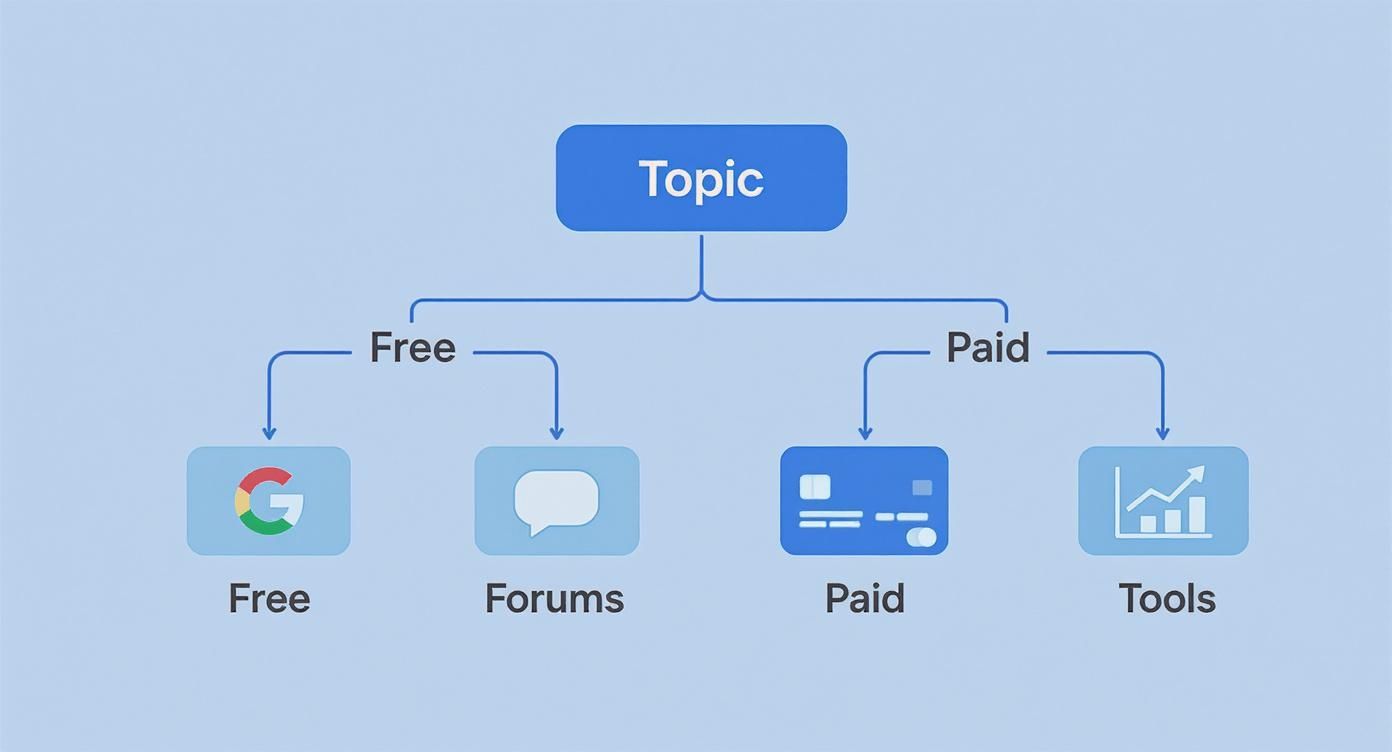
This flowchart just reinforces the idea: whether you start with free resources like forums or paid tools, the end goal is always to uncover those specific user needs.
Creating a Keyword Prioritization Matrix
To take the guesswork out of this, I strongly recommend creating a simple scoring model right in your spreadsheet. This forces you to be objective and rank your opportunities based on data, not just a gut feeling.
Here's a sample table showing how you can score keywords.
Keyword Prioritization Matrix
| Long Tail Keyword Example | Monthly Search Volume | Keyword Difficulty | Buyer Intent (1-5) | Priority Score |
|---|---|---|---|---|
| best undercounter ice machine for bar | 150 | 18 | 4 | 77 |
| vulcan 36c-6b24g price | 50 | 12 | 5 | 88 |
| how to calibrate a commercial oven | 90 | 25 | 2 | 52 |
| walk-in freezer installation cost | 200 | 35 | 3 | 55 |
The Priority Score is a simple calculation that weighs these factors. For example, you could add Volume + Intent Score - Difficulty. The exact formula doesn't matter as much as having a consistent system.
The keywords with the highest scores are your immediate targets—the low-hanging fruit that can start bringing in valuable traffic and sales right away. This systematic approach ensures every piece of content you create and every product page you optimize is aimed squarely at what will make the biggest impact on your bottom line.
Putting Your Long Tail Keywords into Action
Alright, you've done the hard work. You’ve dug through the data and now you have a killer, prioritized list of long-tail keywords. So, what's next? This is where the rubber meets the road—where your research goes from a spreadsheet to actual sales.
It's time to strategically weave these high-intent phrases into the very fabric of your website. We're not just stuffing keywords in for the sake of it. Think of it as joining a conversation. Your potential customer typed a very specific question into Google, and your website needs to be the best, clearest, and most direct answer they find.

This mindset applies everywhere, from the deepest product page to your most helpful blog post. Let’s get to work.
Optimizing Your Product and Category Pages
Your product pages are where the money is made, making them the prime real estate for your transactional long-tail keywords. The goal here is simple: describe your products with the same precision your most discerning customers use. This one shift can dramatically improve the quality of traffic hitting your site.
Let’s take a common piece of equipment. A generic page might just be called "Charbroiler," but that’s not going to catch anyone who knows what they want.
-
Before Optimization:
- Page Title: Charbroiler
- H1 Heading: Vulcan Charbroiler
- Description: A high-quality charbroiler for commercial kitchens.
-
After Long Tail Optimization:
- Page Title: Vulcan VCRH24 24-Inch Gas Countertop Charbroiler | Restaurant Equipment
- H1 Heading: Vulcan VCRH24 24" Gas Countertop Charbroiler
- Description: The Vulcan VCRH24 is a durable 24-inch gas countertop charbroiler designed for high-volume restaurants. This model features heavy-duty cast iron radiants, making it an energy-efficient commercial charbroiler for steakhouses and cafes.
See the difference? The "after" version is now perfectly teed up to rank for dozens of specific searches like "Vulcan 24 inch charbroiler" or "gas countertop charbroiler for restaurants." It immediately tells a searcher they've landed in the right spot.
When done right, great product page optimization doesn't even feel like SEO. It just feels like you're providing excellent, detailed customer service by describing your products with the specificity a real buyer would use.
Creating Content That Answers Specific Questions
Product pages handle the buyers who are ready to pull the trigger. But what about everyone else? Your blog and resource center are where you capture customers in the research phase—the ones asking questions before they're ready to buy.
Your long-tail keyword research is basically a ready-made content calendar. Every question you uncovered is a chance to prove your expertise.
-
Keyword: "what is the best commercial ice machine for a busy bar?"
- Content Idea: Create a blog post titled, "The 5 Best Commercial Ice Machines for High-Volume Bars in 2024." In it, you can compare models by production capacity, footprint, and ice type, linking directly to the products you sell.
-
Keyword: "how to choose an energy-efficient commercial convection oven"
- Content Idea: Write a comprehensive "Buyer's Guide to Energy-Efficient Commercial Convection Ovens." This is your chance to explain ENERGY STAR ratings, break down different heating technologies, and even offer a framework for calculating long-term savings.
This isn’t just about traffic. This kind of content builds trust and positions your brand as a go-to expert. When it’s finally time for that reader to make a purchase, guess who they’re going to remember?
Capturing Local Buyers with Geographic Modifiers
For most equipment dealers, local customers are the lifeblood of the business. This is where adding geographic modifiers to your long-tail keywords becomes a superpower. Simply tacking on a city, state, or even a neighborhood to your keywords connects you with searchers who have an immediate, local need.
Consider the intent behind these two searches. "Commercial kitchen supplies" is broad. But "commercial kitchen supplies in Austin TX"? That person is looking to buy, and they're looking to buy now.
Putting this into practice is straightforward.
- Homepage Title: Make your main heading something like "Your Source for Commercial Kitchen Supplies in Austin."
- Service Area Pages: Build out dedicated landing pages for the key cities and regions you serve.
- Blog Content: Write articles that solve local problems. A piece on "Navigating Dallas Health Code Requirements for Ghost Kitchens" will attract exactly the right kind of local reader.
By applying your keyword research across your product pages, blog, and local pages, you're building a complete web presence. You're not just showing up; you're providing the perfect answer to the right person at the exact moment they need it.
Measuring the Success of Your SEO Strategy
Getting your long-tail keyword strategy off the ground is a fantastic start, but it's really only half the job. The real magic happens when you can clearly see what's working and, just as importantly, what’s falling flat. Without measuring, you’re flying blind—pouring time and money into tactics without knowing which ones are actually ringing the cash register.
This is the point where you pivot from a one-and-done project to a continuous cycle of improvement. By tracking the right numbers, you can fine-tune your approach, pour more fuel on the fire for keywords that are performing well, and demonstrate the real-world impact of your SEO work.
Setting Up Your Measurement Toolkit
First things first, you can't track what you can't see. You need the right tools installed and ready to go. The great news? The two most essential platforms for this are completely free: Google Analytics and Google Search Console.
Think of Google Search Console as your eye on Google itself. It shows you how people find you, which search queries bring them to your site, and where you rank. Google Analytics picks up where Search Console leaves off, telling you what visitors do after they land on your website—which pages they look at, how long they stick around, and if they end up buying something.
Getting these two platforms set up isn't optional; it's the foundation of any serious SEO campaign. They provide the hard data needed to make smart decisions.
Key Performance Indicators That Actually Matter
It’s easy to get distracted by flashy numbers like "total website visitors," but those are often just vanity metrics. To know if your strategy is genuinely moving the needle, you have to focus on Key Performance Indicators (KPIs) that tie directly back to your business goals. For a restaurant equipment seller, these are the stats that count.
- Organic Traffic Growth: Are more people finding your website through Google? A steady climb in organic traffic is the first green flag that your content is starting to resonate.
- Keyword Ranking Improvements: Remember those specific long-tail phrases you targeted? You need to know if you're actually climbing the search results for them. This is where Google Search Console becomes your best friend.
- Click-Through Rate (CTR): This tells you what percentage of people who see your page in the search results actually click on it. If your CTR is going up for target keywords, it means your page titles and descriptions are hitting the mark.
- Conversion Rate from Organic Traffic: This is the big one. Are the people finding you via these long-tail keywords actually buying equipment, requesting a quote, or calling your sales team? This metric connects your SEO efforts directly to revenue.
The screenshot below from a Google Analytics dashboard shows you exactly how to see where your traffic comes from, allowing you to zero in on organic search.
This view lets you isolate the visitors who arrived from a search engine and analyze exactly how they behave and whether they convert.
Interpreting the Data and Refining Your Strategy
Here’s something you have to remember: SEO is a marathon, not a sprint. You're not going to see game-changing results in a week. It can often take 3-6 months for Google to fully index, understand, and reward your new, high-quality content. Patience is a virtue here.
Check in on your data regularly, but don't panic over small daily or weekly dips. You're looking for the bigger picture—the trends unfolding over months. For a much deeper look at this entire process, check out our complete guide on how to measure SEO performance.
The whole point of tracking isn't just to see if you got a passing grade. It's to gather intelligence. The data tells you a story about what your customers are searching for, what problems they have, and what information they value.
As you analyze your performance, start asking sharp questions. Are blog posts about "how to choose a commercial oven" bringing in more qualified leads than simple product comparisons? Did adding local terms like "in Dallas" to your product pages make a noticeable impact on local sales?
The answers to these questions are pure gold. They tell you exactly how to adjust your content plan and optimize your product pages moving forward. This creates a powerful feedback loop where you continuously refine your strategy based on what actually works, driving sustainable growth for your business.
Common Questions About Long-Tail Keyword Research
Even the most seasoned pros hit a few snags when they get into the weeds of long-tail keyword research. It's one thing to understand the theory, but putting it into practice for a niche like restaurant equipment always surfaces some tricky questions.
Let's tackle some of the most common ones I hear. This is the stuff that trips people up when they move from the spreadsheet to the real world.
How Long Is a "Long-Tail" Keyword, Really?
Forget the word count. While the general rule of thumb is three or more words, the length is the least important part of the equation. What truly matters is specificity.
A long-tail keyword tells you a story. "Commercial oven" is a head term—it's vague. But "used Blodgett double stack convection oven" is a long-tail keyword. It tells you the buyer knows the brand, the type, the configuration, and is likely budget-conscious. That's a customer who is ready to buy, not just browse.
The real test of a long-tail keyword isn't its length; it's the clarity of the searcher's intent. Stop counting words and start decoding what the phrase tells you about their specific need.
Should I Actually Target Keywords with Zero Search Volume?
This one feels wrong, I know. But for our industry, the answer is an enthusiastic yes. When your keyword tool shows "0" or "10" for a search volume, don't immediately discard it. Here's why that data is often misleading.
- Tools Are Imperfect: General SEO tools like Ahrefs or Semrush are great, but they often miss the tiny trickles of traffic from thousands of ultra-specific B2B queries. They just don't have enough data to register it accurately.
- Intent Is Through the Roof: Someone searching for a "replacement thermostat for a Vulcan VCRH24 charbroiler" isn't window shopping. They have a broken piece of equipment and a pressing need. That one visitor is infinitely more valuable than 100 people who searched for "restaurant grills."
- It All Adds Up: A single, detailed product page or a well-written guide can rank for hundreds of these "zero-search" variations. Individually, they're a drop in the bucket. Collectively, they create a steady stream of highly qualified, ready-to-buy traffic.
Think of it this way: there’s virtually no competition for these terms. It's a low-risk, high-reward play where every click is a perfectly matched lead.
How Many Long-Tail Keywords Can I Put on One Page?
The old days of cramming as many keywords as possible onto a page are thankfully long gone. Today, it’s about creating a comprehensive resource for a single, focused topic.
Here’s how to approach it:
- Pick one primary long-tail keyword. This is your page's North Star. It should perfectly describe the page's purpose, like "how to choose an energy-efficient commercial convection oven." This goes in your page title, H1 heading, and intro.
- Find a handful of supporting keywords. These are closely related variations that add depth, such as "commercial convection oven ENERGY STAR ratings" or "best electric convection oven for bakery."
- Weave them in naturally. These supporting phrases belong in your subheadings (H2s, H3s) and throughout your text, but only where they feel completely natural. They should support the main idea, not feel forced.
Your goal isn't to hit a keyword quota. It's to create the absolute best, most helpful page on the internet for that specific topic. When you do that, you'll naturally use all the right phrases, and search engines will reward your expertise.
Ready to stop guessing and start ranking for the keywords that drive sales? The team at Restaurant Equipment SEO uses data-driven strategies to connect you with buyers who are actively searching for your products. Discover how our specialized services can transform your online visibility at https://restaurantequipmentseo.com.