
Link Acquisition Strategy for Food Service & Equipment
A link acquisition strategy is simply your game plan for earning links from other websites back to your own. Think of it like building a network of roads leading to your online store. The more high-quality roads you build, the more trust you earn from search engines like Google, which translates directly into more customer traffic.
Why A Link Strategy Is Your Most Important Ingredient
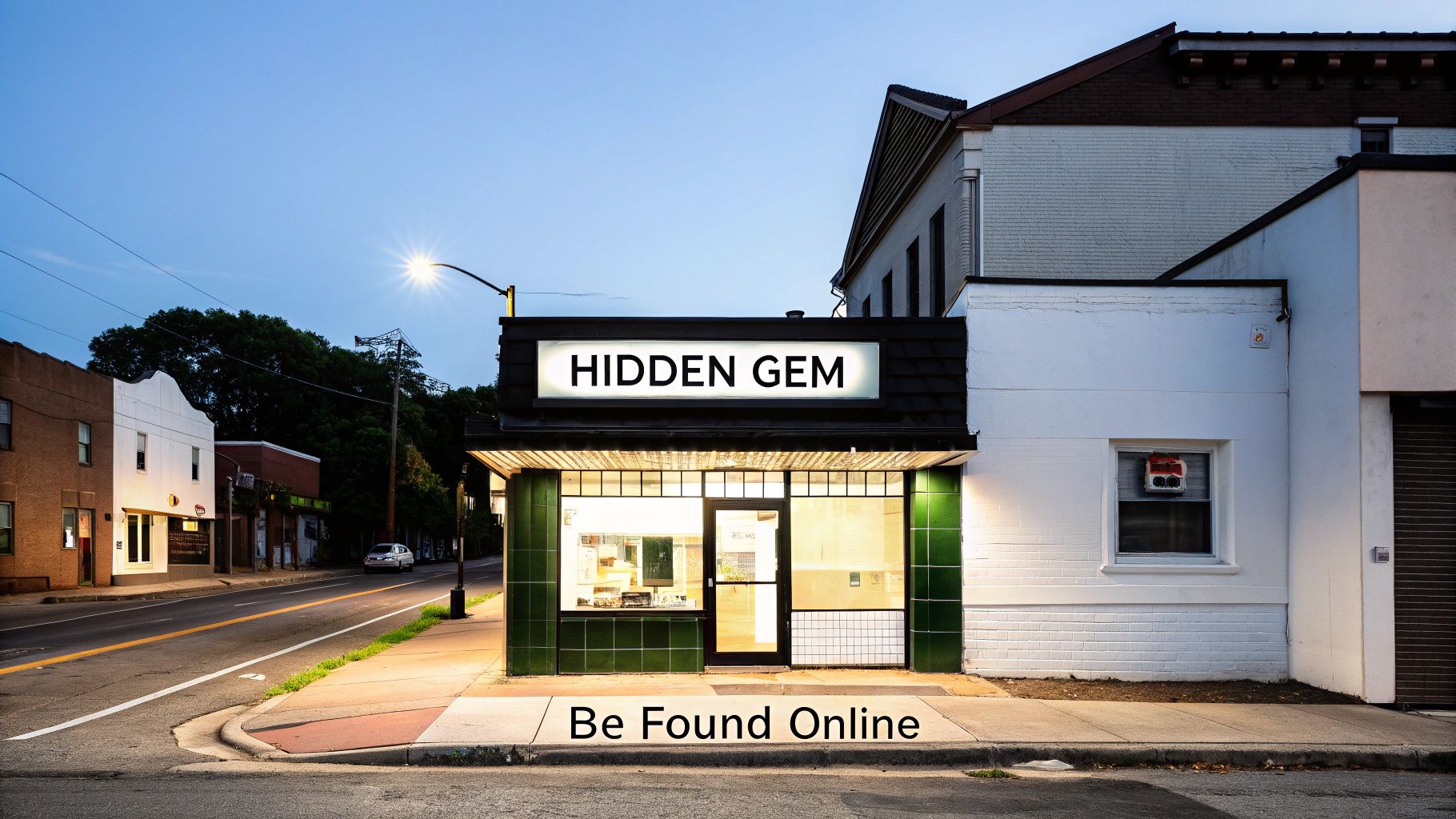
Imagine opening a fantastic restaurant on an unmarked road with zero signs. You could have the best commercial kitchen equipment money can buy, but no one would ever find you. A website without backlinks is that hidden restaurant—it exists, but it's invisible to the chefs and restaurateurs actively looking for it online.
A link acquisition strategy is the map you draw to guide those customers straight to your digital front door.
In the world of SEO, every link from another website acts as a referral or a "vote of confidence." When a respected food blogger, equipment manufacturer, or industry magazine links to your product page for a commercial convection oven, they are effectively telling Google, "Hey, this business knows their stuff and is a trustworthy source."
The more of these high-quality votes you get, the higher Google will rank your site in search results. This isn't just a small adjustment; it’s a critical part of being found online at all. In fact, a shocking 99.5% of all websites get zero traffic from Google, and a huge reason for this is a lack of quality backlinks. This makes having a plan to build links not just a good idea, but essential for survival.
The Foundation of Digital Visibility
An effective link strategy doesn't operate in a silo. It's a key part of the bigger picture of modern digital marketing strategies for small businesses and works best when combined with great content, strong industry relationships, and savvy public relations. For a restaurant equipment seller, this means creating a plan that plays to your strengths within the food service industry.
Your link acquisition strategy is the blueprint for turning your website from a lonely digital outpost into a bustling hub of industry activity. It’s about building relationships, demonstrating expertise, and earning the digital trust that drives real-world sales.
For your specific niche, a successful approach will always involve a mix of tactics tailored to the people you want to reach—from independent cafe owners to large-scale institutional buyers. To get started, let's break down the essential components into a few core pillars.
Core Pillars of a Restaurant Equipment Link Strategy
This table summarizes the essential components of a successful link acquisition strategy designed specifically for the food service equipment industry.
| Strategy Pillar | Description | Example Tactic |
|---|---|---|
| Content Creation | Developing valuable resources that people in the industry naturally want to share and link to. | Creating a "Commercial Refrigerator Buying Guide" that helps restaurant owners make an informed decision. |
| Partnership Building | Using existing relationships with manufacturers, suppliers, and happy customers to earn relevant backlinks. | Asking a brand whose ovens you carry to link to your product page from their "Authorized Dealers" list. |
| Community Engagement | Becoming a recognized voice in local business circles and food service trade groups to attract links. | Sponsoring a local food festival and getting a link from the event's website. |
By focusing on these pillars, you create a sustainable system that consistently attracts qualified buyers and cements your brand's authority in the market.
Creating Content Worthy of Industry Attention

Before you can earn a single backlink, you have to create something that’s actually worth linking to. It sounds obvious, but this simple truth is the engine that drives any real link acquisition strategy. We call these resources linkable assets, and they're what separates actively building authority from just hoping someone notices you.
Think of it like a chef creating a signature dish. A generic burger on the menu won't get food bloggers buzzing. But an inventive, perfectly executed dish? That becomes a destination. Your content needs to be that signature dish—an indispensable resource that journalists, industry pros, and partners feel compelled to share.
This means you have to shift your thinking. You're not just "writing articles" anymore; you're building foundational pillars for the entire food service industry. It's a sobering fact that over 96% of web pages get zero traffic from Google. Linkable assets are specifically designed to beat those odds by delivering overwhelming value.
Moving Beyond Standard Blog Posts
A quick blog post on "5 Tips for Cleaning Your Fryer" might get a few clicks, but it’s not going to attract high-authority links. It’s helpful, sure, but it's not essential. To build a powerful link profile, your content has to be far more ambitious.
Instead of pumping out short, disposable articles, your focus should be on creating deep, comprehensive resources that solve major headaches for your customers. These assets become the cornerstones of your website, drawing in links and traffic for years to come.
A linkable asset isn't just content; it's a tool. It should save your audience time, help them make smarter financial decisions, or teach them something so thoroughly that they see you as the expert on the topic.
Here are a few types of linkable assets that really deliver in the restaurant equipment world:
- Comprehensive Content Hubs: Think of these as massive, multi-part guides that cover a complex topic from every conceivable angle. They become the one-stop shop for anyone researching that subject.
- Interactive Tools and Calculators: Nothing provides value like a practical tool. They are incredibly shareable and frequently get referenced in articles about budgeting, planning, and operations.
- Original Data and Research: When you conduct your own surveys or analyze industry data, you become the primary source. This makes getting links from trade publications and news outlets infinitely easier.
Building Your First Linkable Assets
Let's get practical. How does this translate to a restaurant equipment seller? The goal is to create something so undeniably useful that another website owner would feel like they’re doing their audience a favor by linking to it.
Example 1: The Content Hub
Instead of a brief post, you build "The Ultimate Guide to Commercial Kitchen Ventilation." This isn't an article; it's an encyclopedia. It would need detailed chapters on:
- Understanding Ventilation Types: Break down Type I vs. Type II hoods, makeup air units, and exhaust fans, complete with clear diagrams.
- Navigating Local Fire Codes: A state-by-state resource outlining common requirements with links to the official codes.
- Calculating CFM Requirements: A deep dive into the formulas needed to size a system correctly for different kitchen layouts.
- Maintenance Checklists: Offer downloadable schedules and step-by-step guides for routine cleaning and inspections.
A resource like this instantly becomes the go-to reference for any restaurateur or contractor dealing with ventilation, making it a natural magnet for links.
Example 2: The Interactive Tool
A "Commercial Oven ROI Calculator" sounds simple, but it’s a link-building powerhouse. A restaurant owner can punch in the oven's cost, their local energy rates, expected food output, and labor savings to get a clear projection of when the investment pays for itself.
This kind of utility is pure gold. There are many real-world examples of interactive calculators that attract massive traffic and earn tons of attention. By building one, you stop being just a seller and become a vital business planning partner.
These are just a couple of starting points. For more ideas, take a look at other successful content marketing examples for restaurant equipment sellers to see what’s already working. The key is to think bigger, be genuinely helpful, and build assets that are meant to last.
Tapping into Your Built-In Network for Easy Wins
Most people think link building has to start with cold-emailing strangers. The truth? Your most powerful link opportunities are probably hiding in plain sight, right within your existing business relationships.
This is the low-hanging fruit. We're talking about tapping into a warm network that already knows you, trusts you, and works with you every day. Think about your manufacturers, your suppliers, and even your best customers. These aren't just names in your CRM; they're an entire ecosystem of potential link partners.
Activating this network is almost always faster and more effective than starting from scratch. It’s not about asking for a favor—it’s about strengthening the partnerships you already have and creating value for everyone involved. These are the "easy wins" that will build a solid foundation for your backlink profile before you even think about sending a cold pitch.
Forge Partnerships with Manufacturers and Vendors
Your strongest allies are the very brands whose equipment you sell. They have authoritative websites, and they have a direct financial interest in your success. After all, when you succeed, they succeed.
Start by going through the websites of every single brand you carry. Look for pages like "Where to Buy," "Find a Dealer," or "Authorized Retailers." If your business isn't listed, you have a perfect, no-brainer reason to get in touch. Getting added to these dealer locators is often one of the quickest ways to land a high-authority, super-relevant backlink.
Frame your request as a win for their customers. By listing you, they're helping buyers connect with a trusted partner, which makes their brand look even better. You’re not asking for a link; you’re helping them improve their customer experience.
But don't just stop at dealer locators. Think bigger and explore other ways to collaborate. These kinds of partnerships can generate incredible links while giving your marketing a serious boost.
- Co-Marketing Campaigns: Pitch a joint promotion or a co-branded guide. Imagine creating a "Complete Guide to Maintaining Brand X Convection Ovens" and having them link to it directly from their product pages.
- Product Launch Support: When a manufacturer drops a new product line, be the first to offer to create an in-depth review or a video tutorial. In exchange, ask them to feature your content and link back to your site as an expert resource.
- Shared Press Releases: Did you hit a major sales milestone with a certain brand? Or maybe you became their top seller in the region? Suggest a joint press release. This can earn you links from the manufacturer and industry news outlets.
This proactive approach turns a simple supplier relationship into a powerful part of your SEO strategy. It drives qualified referral traffic and builds your site's authority at the same time. With link building costs on the rise, focusing on these warm relationships is a smart move. In fact, while 80.9% of SEOs report that link building costs are increasing, a solid 57.1% still see tangible results within the first three months when they use smart tactics like these. You can find more data about the rising link building costs at Linkjuiceclub.com.
Turn Customers and Suppliers into Link Advocates
Your network doesn't end with manufacturers. It extends to every business you work with, from your happiest customers to the vendors you buy supplies from. Every positive relationship is a potential backlink waiting to happen.
Leveraging Customer Testimonials
When a restaurant owner raves about the new commercial range you sold them, that's more than just a nice email—it's a link opportunity. Many restaurants, culinary schools, and catering companies have their own websites and blogs.
Here's a simple way to turn that praise into a link:
- Thank Them: First, just say thanks! Let them know how much you appreciate their business and feedback.
- Ask for a Testimonial: Ask if they’d be willing to let you feature their quote on your website. Most happy customers will gladly agree.
- Propose the Link Swap: Once they say yes, make a counter-offer. Suggest you feature their business in a "Customer Spotlight" on your blog, complete with a link to their site. Then, gently ask if they might add a link to you on their "Our Partners" or "Suppliers" page.
This frames it as a mutually beneficial promotion, not a one-sided ask.
Engaging Your Own Suppliers
This same logic works in reverse. Think about the companies you buy from—the local farm that supplies your test kitchen or the company that makes your shipping boxes. They often have sections on their websites featuring their clients.
Get in touch with your account manager or their marketing team. Tell them you're a proud customer and would be thrilled to be featured in a testimonial or case study on their site. This gives them great social proof for their business and earns you a relevant backlink in the process, cementing your place in the local food service community.
Becoming an Authority in Local and Trade Media
Building a solid network with partners and customers is a great start, but a truly powerful link strategy needs to look outward. It's time to build your brand’s reputation where future customers are already looking: local community groups and trusted industry publications.
Think of it this way: you've built your inner circle, and now it's time to step into the public square. These channels let you establish credibility on a much bigger scale. You'll earn links that show Google you’re not just another seller—you're a recognized authority in the food service world. This is all about smart public relations and getting involved in your community.
Master Your Local SEO Footprint
For any business selling physical equipment, your local community is a goldmine for relevant, high-impact backlinks. Local SEO isn't just about getting listed online; it's about weaving your brand into the very fabric of your local area.
One of the best ways to get started is by participating in community events, especially anything food-related. Sponsoring a local food festival, a chili cook-off, or a farmer's market charity event is a fantastic move. These sponsorships almost always come with a high-authority backlink from the event's website—a link that is both topically and geographically relevant, which is a powerful combo for SEO.
Another great local tactic is partnering with nearby culinary schools or community colleges.
Offer to give a guest lecture on commercial kitchen efficiency, or maybe donate a piece of equipment to their training program. In exchange, you can often land a link from a highly trusted ".edu" domain on their partners or resources page.
Finally, make sure your business information—Name, Address, and Phone number (NAP)—is 100% consistent everywhere. Check every local directory, from Yelp to your local Chamber of Commerce. Inconsistent NAP data can confuse search engines and weaken your local SEO efforts.
Become the Go-To Expert in Trade Media
While local links build your reputation in your region, getting featured in industry trade media establishes you as a national expert. This is where digital Public Relations (PR) shines, helping you land mentions and links in the publications your ideal customers read every day.
One of the most valuable tools for this is a service called Help a Reporter Out (HARO). It’s a free platform connecting journalists with expert sources for their stories. Reporters from major food service magazines and business publications post queries daily, looking for quotes and insights—and you can provide them.
Landing just one quote in a major trade publication can earn you a powerful backlink that sends referral traffic your way and boosts your entire site's authority. The secret is to respond quickly with genuine, helpful expertise, not a sales pitch.
Beyond HARO, you can also pitch your own ideas proactively. Keep an eye on industry trends, like new sustainability practices for commercial kitchens or the growing need for ghost kitchen equipment. Write a compelling article with a unique perspective and pitch it to editors at relevant publications. While it shares some DNA with guest posting, the goal here is to establish yourself as a thought leader. Our guide on guest blogging for backlinks dives deeper into the specifics of this tactic.
By combining a strong local presence with strategic media outreach, you’ll build a diverse and powerful backlink profile that cements your status as a trusted industry leader.
How to Execute Outreach and Measure Your Results
Even the most brilliant linkable content and partnership ideas are just that—ideas—until you put them into action. A great link acquisition strategy really comes down to two things: the quality of your outreach and how you measure what’s working. This is where your plan turns into real, tangible SEO results.
Think of it like a chef launching a new menu. They don’t just cook the food and hope for the best. They carefully plan the plating and presentation (that’s your outreach) and then meticulously track which dishes are selling (that’s your measurement). Without both, the menu is just a hopeful guess. Your link building needs that same professional touch.
The secret to outreach that actually works? Personalization. Generic, mass-blasted email templates are the junk mail of the link building world. They get ignored, deleted, and sometimes even marked as spam. Your goal is to start a genuine conversation with another person, showing them you’ve done your homework and you respect their time.
Crafting Outreach That Gets a Response
Whether you're contacting a manufacturer, a popular food blogger, or a trade publication, your email needs to cut through the noise. It should be concise, offer clear value, and make it incredibly easy for them to say "yes." Don't ever make them guess what you want or why you're in their inbox.
Here are a couple of proven templates you can adapt for your own use.
1. The "Partner" Request (For Manufacturers/Vendors)
This approach is effective because you're framing it as a mutual benefit, not just a one-sided request for a link. You're helping them help their customers.
Subject: Quick question about [Manufacturer Name]'s dealer page
Hi [Contact Name],
My name is [Your Name] and I'm the owner of [Your Company]. We're proud to be an authorized dealer for [Manufacturer Name] and have seen great success with your [Specific Product Line] line.
I was just on your "Where to Buy" page and noticed we weren't listed for the [Your City/State] area. Adding us would make it easier for local customers to find your excellent products.
Can we get our business added? Here is our information for the listing:
- [Your Company Name]
- [Your Website URL]
- [Your Address & Phone]
Thanks for your help!
Best,
[Your Name]
2. The "Resource" Pitch (For Guest Posts/Content Features)
This template positions your awesome content as a valuable resource for their audience, making it a no-brainer for them to share.
Subject: Idea for your readers at [Blog Name]
Hi [Contact Name],
I've been a longtime reader of [Blog Name]—your recent article on commercial kitchen efficiency was fantastic.
I noticed you often write about helping restaurateurs make smart financial decisions. My team just published a comprehensive guide, "[Title of Your Linkable Asset]," that includes an ROI calculator for new commercial ovens. It might be a really useful tool for your audience.
Would you be open to mentioning it in a future article? No worries if not, just thought it would be a great fit.
Either way, keep up the amazing work!
Cheers,
[Your Name]
Tracking the Metrics That Actually Matter
Once your outreach emails are flying, you need a way to know if they're landing. It's easy to get distracted by "vanity metrics" that look impressive but don't actually move your business forward. The total number of backlinks, for instance, is far less important than the quality and relevance of those links.
A successful link acquisition strategy zeroes in on Key Performance Indicators (KPIs) that tie directly back to business goals. Knowing what to measure is critical. For a complete breakdown, our guide on how to measure SEO performance is a great place to start.
For now, focus on tracking these core metrics:
- New Referring Domains: This is the number of unique websites linking back to you. Earning ten links from ten different relevant sites is exponentially more valuable than getting ten links from a single website.
- Link Authority and Relevance: Use tools like Ahrefs or Moz to check the Domain Rating (DR) or Domain Authority (DA) of the sites you earn links from. A single link from a high-authority site like a major industry publication is worth more than dozens of links from unknown blogs.
- Organic Traffic Growth: This is the ultimate test. Are more potential customers finding your site through Google?
- Keyword Ranking Improvements: Keep a close eye on your search result positions for your money-making keywords, like "buy commercial freezer" or "restaurant oven for sale."
To ensure your tracking is aligned with your strategy, it's helpful to match specific KPIs to your goals.
Matching KPIs to Your Link Acquisition Goals
This table helps you measure the success of your link building efforts by aligning key performance indicators (KPIs) with specific strategic objectives.
| Strategic Goal | Primary KPI | Secondary KPI | Why It Matters |
|---|---|---|---|
| Increase Brand Authority | New Referring Domains from high-DR sites | Branded Search Volume | Earning links from respected industry sites builds trust with both Google and customers. |
| Drive Commercial Traffic | Organic Traffic to key product/category pages | Conversion Rate | Links should ultimately lead to more potential buyers on the pages that matter most. |
| Improve Keyword Rankings | Rank increases for target commercial keywords | Click-Through Rate (CTR) | The goal is to appear higher in search results for queries that lead to sales. |
| Build Local Relevance | Number of quality local citations acquired | Local Pack Rankings | Strong local links signal to Google that you are the go-to supplier in your service area. |
By focusing on these KPIs, you can prove the real-world value of your link building and make smarter decisions about where to invest your time. The data backs this up: some link building tactics, like digital PR, can have an effectiveness rate as high as 48.6%, while guest posting is closer to 12%. And yet, 54% of SEOs still find big wins by analyzing their competitors. These link building statistics from Linkquest.co.uk confirm that a measured, adaptable strategy is always the key to winning.
Your Step-by-Step Link Acquisition Roadmap
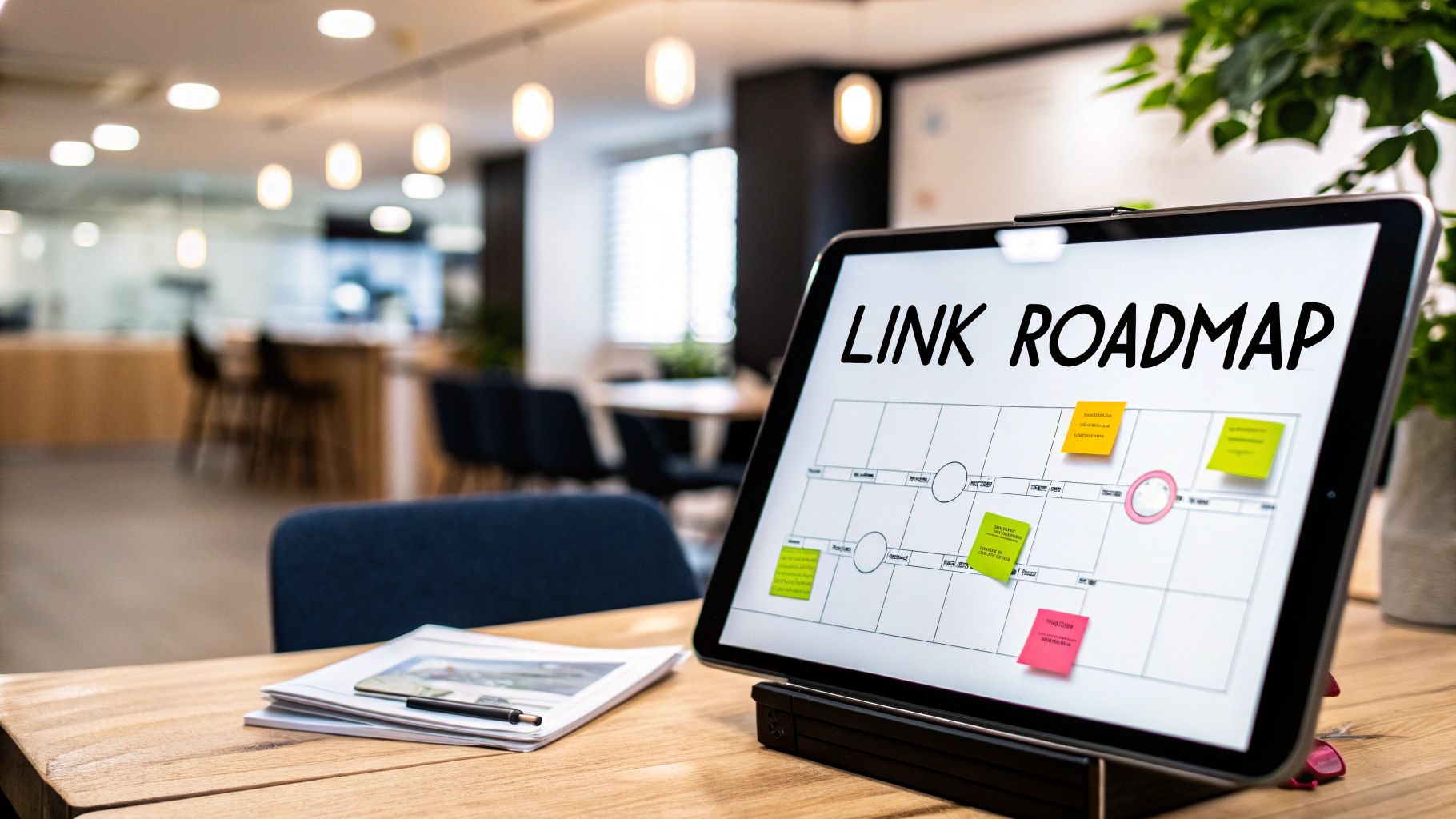
Jumping into a full-blown link acquisition strategy can feel like trying to cook for a dinner rush with no prep. The key is to break it down into manageable steps. Think of it less like a one-off project and more like a core business process you’re building over time.
This simple, three-phase plan is designed to build momentum and get you real, lasting results. Each phase builds on the last, turning what feels like a complicated SEO task into a series of clear, achievable actions. Follow these steps, and you’ll create a system for consistently earning the kinds of backlinks that actually grow your business.
Phase One: Foundational Quick Wins (Months 1–3)
For the first 1-3 months, your entire focus should be on the low-hanging fruit. We're talking about the easiest link opportunities that are probably sitting right under your nose, deep within your existing network.
The goal here is simple: build a solid base of relevant links without having to create a ton of new content or send hundreds of cold emails. This early work gives you a quick boost and starts establishing your authority from day one.
Here’s what to do first:
- Audit Your Partners: Make a list of every single manufacturer and vendor you work with. Go to their websites and find their "dealer locator" or "where to buy" pages. Make absolutely sure you’re listed with a correct, working link back to your site.
- Activate Happy Customers: Think of your top 5-10 customers who have their own websites. Shoot them a friendly email offering to feature them in a customer spotlight on your blog. In return, you can ask for a link from their "suppliers" or "partners" page. It's a win-win.
- Claim Local Citations: Get your business listed correctly on the big local directories. We’re talking about Yelp, your local Chamber of Commerce, and any industry-specific sites. Consistency in your business name, address, and phone number is crucial here.
This initial phase is all about cashing in on the trust and relationships you've already built. These aren't cold, spammy requests; they are genuine collaborations that strengthen your business ties while giving you immediate SEO value.
Phase Two: Scaled Outreach and Asset Creation (Months 4–9)
Alright, now that you've secured the easy wins, it's time to expand your efforts. From months 4-9, we shift from tapping into your inner circle to proactively reaching out to people who don't know you yet.
This is where you start to position your brand as a real expert in the commercial kitchen space, and you’ll do it by creating something genuinely valuable.
Your focus will be on:
- Build a Linkable Asset: It's time to create your first big piece of content—something so useful that other websites want to link to it. This could be something like "The Ultimate Guide to Commercial Kitchen Ventilation" or maybe an interactive calculator that helps restaurants figure out the ROI on a new combi oven.
- Start Digital PR: Sign up for a service like Help a Reporter Out (HARO). You’ll get daily emails with queries from journalists and bloggers looking for experts in the food service industry. A quick, helpful response can land you a link from a major publication.
- Targeted Outreach: Now that you have your amazing new guide or calculator, it's time to show it off. Identify 20-30 high-quality industry blogs or trade publications and pitch your new asset as a fantastic resource for their readers.
This phase definitely requires more elbow grease. But the reward is worth it—these are the kinds of powerful, authoritative links that will make a serious difference in your search rankings.
Frequently Asked Questions
Even with the best roadmap in hand, it's natural to have questions when you're just getting started. Let's tackle a few of the most common ones we hear from restaurant equipment sellers to help you set the right expectations from day one.
How Many Backlinks Do I Actually Need?
That's a bit like asking a chef, "How much salt should I use?" There's no single number. The real answer is all about the quality and purpose of each ingredient—or in this case, each link.
A single, high-quality backlink from a major food service publication can be worth more than a hundred low-quality links from random blogs. So, instead of getting hung up on a specific number, focus on consistency. The goal is to steadily earn new links from relevant, authoritative websites month after month. This slow and steady growth shows Google that you're a consistently trusted resource in your industry.
Think quality over quantity, always. One link from a trusted industry partner or a well-regarded culinary blog will do more for your SEO than 50 links from generic directories.
Is It Safe to Buy Backlinks?
Let me be direct: absolutely not. Buying backlinks is a clear violation of Google's Webmaster Guidelines and a shortcut that almost always backfires.
Sure, you might see a quick, temporary bump, but the risk is massive. Search engines are incredibly smart and have become experts at spotting unnatural link schemes. Getting caught can lead to severe penalties, from a nosedive in your rankings to being completely de-indexed from search results. A solid link acquisition strategy is about earning trust, not buying it.
How Long Does This Really Take?
Link building is a marathon, not a sprint. While you can get some quick wins from foundational tactics, like grabbing those easy links from partners, building real, lasting authority takes patience and persistence.
Here's a realistic timeline of what to expect:
- Initial Traction (1-3 Months): You should start to see the first new links trickle in. You might even notice some small, positive shifts in your keyword rankings.
- Significant Impact (6-12 Months): With consistent, dedicated effort, this is when the magic really starts to happen. You should see a noticeable increase in organic traffic and much stronger rankings for your most important keywords.
Ready to build a link acquisition strategy that drives real growth? Restaurant Equipment SEO specializes in creating targeted campaigns for the food service industry. Learn how we can help you at https://restaurantequipmentseo.com.