
Build Link Building Programs That Drive Real Growth
A link building program isn't just about occasionally asking for links. It's a structured, ongoing campaign designed to earn backlinks that build your site's authority and, ultimately, its organic rankings. For restaurant equipment suppliers, a real program means creating a repeatable system to get your brand featured on high-authority food blogs, industry publications, and even culinary school websites.
Building Your Link Building Program Foundation
So, where do you start? Hint: it’s not with a cold email.
Any link building program worth its salt starts with a solid foundation. This means digging into your competitors' strategies, setting crystal-clear goals, and getting the right tech in place. If you skip this groundwork, you're just throwing spaghetti at the wall—your outreach will feel random, and you'll waste a ton of time and money. For anyone in the restaurant equipment space, this means understanding not just who is linking to your competitors, but digging deep into the why.
This initial planning is what separates a campaign that fizzles out after a few mediocre links from a program that consistently builds domain authority and drives real, qualified traffic. It’s all about being strategic before you get tactical.
Analyze The Competitive Landscape
Before anything else, you need to become an expert on what your competitors are doing right (and wrong). This isn't just about counting their backlinks. It's about analyzing the quality and type of sites that are propping them up. Are they getting mentioned on influential chef blogs? Featured in respected trade journals like Foodservice Equipment & Supplies? Or are they just getting links from a bunch of local restaurant review sites?
A great way to begin is by understanding the different 10 Key Types of Links that can build a healthy backlink profile. This knowledge helps you spot patterns. For instance, if you see a competitor has dozens of links from catering blogs but has completely ignored institutional food service sites, you’ve just found a strategic gap you can drive a truck through.
This simple, three-part process shows how to lay that groundwork.
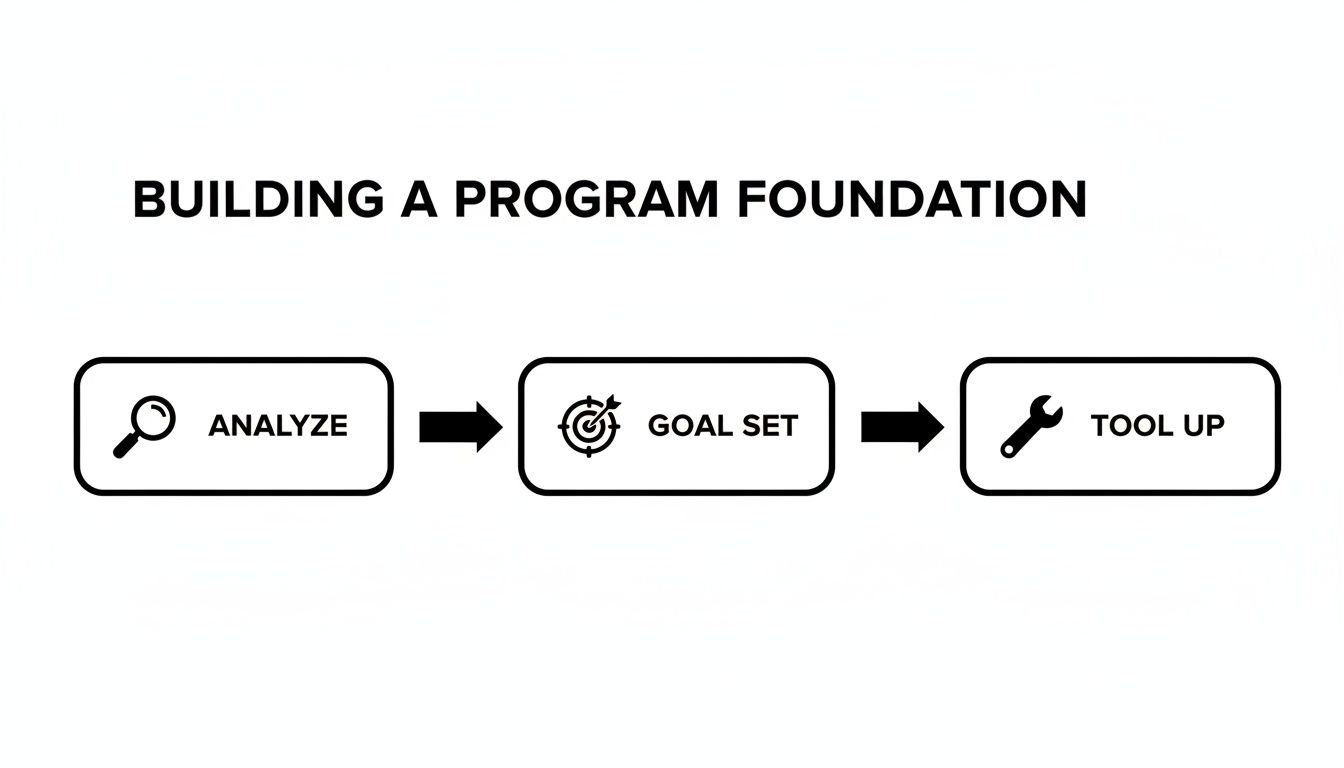
As you can see, the analysis directly informs your goals, which then tells you exactly which tools you'll need to get the job done.
Set Clear and Measurable Goals
Your goals are your north star. Vague objectives like "get more links" are completely useless. You need to define specific, measurable outcomes that actually tie back to your business's bottom line.
Here are a few examples of what good goals look like:
- Boost Product Category Authority: "Increase the number of referring domains to our commercial refrigeration category pages by 20% in the next quarter."
- Increase Qualified Referral Traffic: "Drive 500 new sessions per month from links on food service industry blogs and forums."
- Improve Keyword Rankings: "Move our top 10 keywords for 'commercial ovens' from page two to page one of Google within six months."
A critical mistake is treating all links as equal. A single link from a top-tier culinary publication can be more valuable than 50 links from low-authority directories. Your goals should reflect this relentless focus on quality over sheer quantity.
This strategic approach is a core part of any effective off-page SEO service; it’s about acquiring links that directly contribute to growth.
Equip Yourself With The Right Tools
Trying to manage a link building program with just a spreadsheet is a recipe for disaster. It's slow, messy, and you’ll inevitably make mistakes. Investing in the right tools for prospecting, outreach, and tracking is non-negotiable if you're serious about results.
You're not alone in this, either. Budgets for link building are on the rise because more companies are finally recognizing its long-term value. In fact, recent research shows 61% of link builders plan to increase their spending. This is backed by 65% of organizations that now see it as a core marketing strategy.
To hit the ground running, you need a solid toolkit.
Your Essential Link Building Program Toolkit
This table breaks down the must-have tools for any food-service supplier looking to launch or scale a link building program.
| Tool Category | Primary Use Case | Recommended Tools | Why It's Critical |
|---|---|---|---|
| Backlink Analysis | Sizing up your competitors' backlink profiles and finding your own link gaps. | Ahrefs, SEMrush, Moz Pro | You can't build a strategy without knowing where the bar is set. These tools show you who links to your rivals and why. |
| Prospecting | Finding new, relevant websites and contact information to reach out to. | Hunter, Pitchbox, BuzzStream | Manually searching for prospects is a massive time-sink. These tools help you build targeted lists at scale. |
| Outreach & CRM | Managing email campaigns, tracking conversations, and automating follow-ups. | Pitchbox, Mailshake, BuzzStream | Keeps your outreach organized and prevents you from sending the same email twice. Essential for managing relationships. |
| Project Management | Tracking link building tasks, deadlines, and team responsibilities. | Asana, Trello, Monday.com | A central place to manage your entire workflow, ensuring nothing falls through the cracks from prospecting to a live link. |
Having these tools in your corner transforms link building from a chaotic mess into a streamlined, repeatable process that drives measurable results.
Finding High-Value Link Opportunities
Once your foundation is solid, the real hunt begins. An effective link building program isn't about blasting emails to hundreds of generic websites; it’s about surgically identifying high-quality, relevant targets that can actually move the needle.
For a restaurant equipment supplier, this means finding the digital equivalent of trusted industry voices—the culinary blogs, hospitality management resources, and trade publications your ideal customers already read and respect. This is where you shift from planning to action, building a curated, high-potential prospect list. Every website on it should be a genuine opportunity.

Reverse-Engineer Competitor Success
Honestly, one of the fastest ways to find proven link opportunities is to see who’s already linking to your direct competitors. This isn't about copying them; it's about uncovering sites that are already interested in our niche. Using a tool like Ahrefs or Semrush, you can pull a list of your top three competitors' backlink profiles.
From there, you start filtering to find the gold. Look for patterns. Are they consistently getting links from places like:
- Culinary School Resource Pages: Websites for culinary programs often list recommended suppliers.
- Restaurant Business Blogs: Publications that cover the business side of running a restaurant are prime targets.
- Food Safety and Compliance Sites: These sites frequently link to equipment guides that help owners meet regulations.
- Chef and Influencer Blogs: Established chefs who review or recommend specific types of equipment.
This simple analysis hands you a ready-made list of "warm" prospects. These sites have already shown they’re willing to link to a business just like yours, which gives you a much better shot. It's a foundational tactic for anyone trying to find sites linking to your site and, more importantly, your competitors.
Hunt for Unlinked Brand Mentions
Unlinked brand mentions are the lowest-hanging fruit in link building, bar none. This happens anytime a website mentions your company, a specific product (like your "ArcticFreeze Pro Walk-in Cooler"), or even a key executive, but forgets to link back to your site.
Think about it: they already like you enough to mention you. All you have to do is give them a gentle nudge to add the link.
You can find these opportunities using tools like Google Alerts or the alert features in most major SEO platforms. Just set up alerts for your brand name, unique product names, and the names of key people in your company.
When you find one, the outreach is simple. You thank them for the feature and politely ask if they'd consider adding a link to provide more context for their readers. The conversion rate on these requests is incredibly high because the value is clear and it’s an easy "yes" for them.
Don't just look for your brand name. Set up alerts for common misspellings or variations. You'd be surprised how many link opportunities are hiding behind a simple typo that your competitors are missing.
This simple tactic is a powerful way to turn passive mentions into active, authority-building signals for your website.
Adopt the "Dream 100" Mindset
A powerful way to focus your efforts is to borrow the "Dream 100" concept. Instead of chasing thousands of mediocre links, sit down and identify the top 100 websites in the food-service world you would dream of getting a link from. This list becomes your North Star.
Your Dream 100 isn't just about high Domain Authority. It’s about relevance and influence. For every potential site, ask yourself a simple question: "If we got a link here, would it realistically send us qualified referral traffic or drive a conversion?"
That one filter immediately eliminates the vast majority of low-value sites. It forces you to think about links not just as an SEO metric, but as a genuine business driver. Your list might include top-tier publications like Restaurant Business Magazine, influential food bloggers, or the resource pages of major hospitality associations.
Building relationships with these sites is a long game, but a single link from one of them can be worth more than dozens from lesser-known blogs. This quality-over-quantity approach is what separates a mature, effective link building program from the noise.
Creating Content That Actually Earns Links
Let's be honest. In the food-service world, another generic "Top 10 Kitchen Gadgets" post isn't going to move the needle. It won't get you featured on top industry sites, and it certainly won't build the kind of authority that drives real business.
If you want your link building program to work, you need to think beyond standard blog posts and start creating what we call linkable assets. These are pieces of content so genuinely useful, so packed with value, that other websites want to link to them.
This simple shift changes the entire outreach dynamic. You're no longer a stranger asking for a favor. You're a colleague offering a valuable resource that makes their content better. It's a total game-changer.
Go Beyond the Standard Blog Post
How-to guides and listicles have their place—they're great for traffic. But they rarely attract the kind of high-authority links that boost your rankings. True link bait needs to be something people can reference, cite, and point to as a definitive source.
It has to provide what SEOs call "information gain"—offering something new and valuable that can't be found just anywhere.
Instead of another article, think bigger. Consider these powerhouse formats:
- Ultimate Guides: I’m talking about a true, single-source-of-truth guide on a complex topic. Think "The Complete Guide to Commercial Kitchen Ventilation" or "A Supplier's Playbook for HACCP Compliance." Make it the best resource on the internet for that topic.
- Data-Backed Reports: Original research is link-building gold. A report like "The State of Sustainable Restaurant Operations in 2025," filled with fresh stats, gives journalists and bloggers concrete data to cite.
- Interactive Tools: Calculators and checklists that solve a real problem are incredibly linkable. Imagine a "Commercial Freezer ROI Calculator" on your site—it provides instant, tangible value that a simple product page never could.
- Downloadable Resources: Everyone loves a good template. A "New Restaurant Health Inspection Checklist" is a perfect example. It's practical, helpful, and something other sites will happily share with their audience of aspiring restaurateurs.
These assets are magnets for links from industry publications, culinary schools, and business blogs because they serve a real purpose.
Identify Your Pillar Content Topics
To create content that resonates, you first have to get inside the heads of restaurant owners, kitchen managers, and chefs. What keeps them up at night? What problems are they trying to solve?
A great place to start is by spying on your competitors. Use an SEO tool like Ahrefs or Semrush to see which of their pages have earned the most backlinks. The goal isn't to copy them, but to find proven topics and then create something 10x better.
For example, you might find a competitor has a popular but slightly outdated article on commercial dishwasher maintenance. That's your opening. You can create a new-and-improved version that includes:
- Video tutorials showing how to perform common maintenance tasks.
- A downloadable maintenance schedule template.
- An interactive troubleshooting guide to help diagnose common issues on the spot.
This approach ensures you’re not just guessing; you’re investing in content that has a proven track record of earning links in your niche.
Here's a quick litmus test I use for any content idea: the "referral traffic principle." Ask yourself, "If a top culinary blog linked to this, would it actually send us qualified traffic or a potential lead?" This one question can weed out 80% of bad ideas.
Create Assets That Support Arguments
Think about why one site links to another. It's usually to back up a claim, cite a statistic, or reference a study. Your job is to create the content they need to cite.
When you're planning your next big content piece, intentionally build in these "linkable hooks."
| Content Type | Linkable Hook Example | Why It Works |
|---|---|---|
| Industry Report | "Our new study found that 72% of restaurants plan to invest in energy-efficient equipment this year." | Journalists and bloggers are desperate for specific, compelling statistics to add credibility to their articles. |
| Ultimate Guide | A detailed infographic showing the ideal workflow layout for a commercial kitchen. | Visuals are highly shareable. Other sites can easily embed them, and they'll link back to you as the source. |
| Interactive Tool | A calculator showing a restaurant how much they could save by switching to a specific type of fryer. | A unique tool provides interactive value that can't be found elsewhere, making it a natural magnet for links. |
This is the difference between creating passive content and building an active link-earning machine. You’re not just writing another article. You’re engineering a resource designed from the ground up to attract authority and climb the search rankings. When you focus on creating genuinely useful assets, your outreach gets easier, your industry relationships get stronger, and your backlink profile becomes a serious competitive advantage.
Mastering Your Outreach and Pitch
Okay, you've created a genuinely useful piece of content. Now for the hard part: getting it in front of the right people. This is where your strategy meets the real world. Your outreach email is that first handshake, and it can either open a door or get you sent straight to the trash folder.
Let's be clear: this isn't about spray-and-pray email blasting. That approach died years ago. To get any real traction in the food-service industry, your outreach has to be personal, add real value, and be the start of a genuine relationship.
Finding The Right Contact Person
Honestly, the biggest mistake I see people make is sending a brilliant email to a generic info@ or contact@ address. Those inboxes are where link requests go to die. You absolutely have to find the right person—an editor, a content manager, or the journalist who actually covers your topic.
Here’s how to hunt down the decision-maker:
- Check the 'About Us' or 'Team' Page: This is always your first stop. Look for titles like "Managing Editor," "Content Lead," or "Head of Marketing." It’s the easiest win.
- Dig Around on LinkedIn: This is my go-to. Search for the publication on LinkedIn, then filter their employee list by relevant job titles. It's incredibly powerful for finding the exact person who runs the blog or resource center.
- Look at Author Bylines: If you're hoping to get a link in a specific article, the author is your best shot. Once you have their name, you can use a tool like Hunter or RocketReach to figure out their email address.
Spending an extra five minutes to find the right person can literally increase your response rate by ten times. It proves you've done your homework and aren't just spamming them.
Crafting a Subject Line That Demands Attention
Your subject line is the gatekeeper. The average office worker gets over 120 emails a day, so a bland subject line means your pitch is dead on arrival. It has to be specific, intriguing, and professional all at once.
To get your emails opened, you'll need to learn how to write effective cold emails that connect with busy editors.
Here are a few subject line formulas that work well in the food-service space:
- The Resource Angle: "Resource for your Commercial Kitchen Guide"
- The Specific Question: "Quick question about your post on restaurant ventilation"
- The Value Proposition: "Data for your article on sustainable restaurant trends"
See how they're direct and give instant context? Steer clear of clickbait or generic junk like "Link Request" or "Content Suggestion." Those are immediate red flags for spam.
A great subject line makes a promise that the email body delivers on. If you promise a valuable resource, make sure the first sentence of your email gets straight to the point and provides that value. Don't bury the lede.
The Rise of Digital PR Over Guest Posting
The old-school way of thinking was all about guest posting—writing a full article for another site just to snag a link. And while it can still have its place, modern Digital PR is proving to be way more effective. Instead of just offering a guest post, you're providing something newsworthy: original data, expert commentary, or a unique story that a publication can build their own content around.
This shift from "asking for a link" to "providing a story" is a game-changer for any serious link building program.
The numbers don't lie. Digital PR has become the most effective link building tactic, with 48.6% of SEO professionals rating it as their top choice. But here's the opportunity: despite its power, only 17.7% of marketers are using it consistently. And get this—a massive 89.6% of users say Digital PR is best specifically for backlinks over any other goal. It's the new gold standard for high-impact links.
The Art of the Follow-Up
People are busy. It's a fact of life. Your first email might get buried, flagged for later, or just forgotten. Not following up is like leaving cash on the table. A simple, polite follow-up is often what separates a successful link from radio silence.
Here’s a simple, non-annoying follow-up plan:
- First Nudge (3-4 business days later): This is just a gentle bump. Reply directly to your original email and ask if they had a chance to see your first note. Keep it short, sweet, and friendly.
- Final Check-in (5-7 business days after that): Try a slightly different angle or offer another piece of value. If you still don't hear back, it's time to respectfully move on.
Persistence is good; pestering is not. Two follow-ups is the sweet spot. Any more than that and you risk getting marked as spam, which can burn that bridge forever.
How To Measure Your Link Building ROI
Running a link building campaign without tracking its performance is like operating a restaurant without looking at your sales numbers. You're spending time and money, but you have no clue if it's actually working. To know if your investment is paying off and to make your strategy smarter over time, you have to look past the fluff and focus on the numbers that show a real impact on your business.
Proving your work's value isn't just about handing over a list of new links. It's about drawing a clear line from those links to things that matter: more traffic, better rankings, and ultimately, more leads.
Key Metrics That Actually Matter
First things first: forget about obsessing over the total number of backlinks. That’s an old-school metric that’s easy to fake and says nothing about quality. Instead, you need to track the metrics that Google actually respects.
Here’s what I look at to gauge the health of a link building program:
- Growth in Unique Referring Domains: This is your north star. Getting links from new, relevant websites is a huge signal to search engines. It's far better than getting ten more links from a site that already links to you. It shows you're earning trust all over the food-service industry.
- Keyword Ranking Improvements: Pick a basket of important, non-branded keywords—think "commercial convection ovens" or "restaurant walk-in coolers"—and watch them closely. Are those pages climbing out of the search result abyss and onto page one? That’s a direct sign your links are giving those pages the authority they need.
- Increase in Organic Traffic to Target Pages: Better rankings should lead to more clicks. You should see a real lift in the organic search traffic hitting the specific pages you’re building links for. This means more potential customers are finding you.
- Referral Traffic: This number is usually smaller, but it’s pure gold. When a popular food blog links to your guide on kitchen ventilation and sends you 50 visitors who are genuinely interested, that’s a massive win. It’s a sign of a truly great link placement.
Connecting Links to Business Goals
At the end of the day, it's all about how link building helps your bottom line. You need to connect the dots between SEO wins and business results like quote requests and sales. For instance, if organic traffic to a key product category jumps by 40%, you should be able to show a related increase in leads coming from that exact page.
The connection between links and rankings is undeniable. Time and again, data shows that pages in the #1 spot have, on average, 3.8x more backlinks than the pages ranking below them. It’s a clear signal that link building is not optional if you want to be on top.
The results from a focused effort can be pretty dramatic. We’ve seen firsthand how a dedicated program can transform a business's online presence. One study I saw recently highlighted a +93% year-over-year jump in organic traffic and a staggering +296% increase in top-5 keyword rankings for businesses that got serious about links. It's no wonder that 36% of businesses now outsource this—it’s a specialized skill that delivers. You can discover more insights on link building company performance on thriveagency.com.
Building Your Monthly Performance Report
The best way to show your progress is with a clean, simple monthly report. Keep it visual and easy to scan. Don't drown your team or boss in technical jargon; just tell a straightforward story about what’s working.
If you want to get a better handle on putting these updates together, check out our guide on what is an SEO report for a detailed look at how to build one that effectively highlights your wins.
Answering Your Top Questions About Link Building
Even with the best playbook in hand, diving into link building always brings up questions. It's a nuanced game, especially in a specialized industry like ours. Getting a handle on these common hurdles from the start will save you a ton of headaches down the road.
Let's clear the air and tackle some of the most frequent questions we get from restaurant equipment suppliers just starting out.
How Long Until We Actually See Results?
This is the big one, and the honest answer is, "it depends." Link building is a marathon, not a sprint. You're not just flipping a switch; you're methodically building your website's reputation and credibility one great connection at a time.
As a general rule of thumb, you can expect to see some initial, positive movement in your keyword rankings and organic traffic within three to six months of consistent, high-quality effort. This isn't a hard guarantee, of course, but it’s a realistic window for your new links to get indexed and for Google to start recognizing your site's growing authority.
Should We Be Paying for Links?
This is a loaded question because "paying for links" can mean two completely different things. It’s crucial to know the difference.
-
Buying links off a list: If a vendor sends you a spreadsheet of sites and prices, run. This is a massive red flag. These are almost always low-quality, spammy links from private blog networks (PBNs) that can land your site in Google's penalty box. Avoid this at all costs.
-
Paying for sponsored content or collaborations: This can be a perfectly legitimate tactic. Many authoritative industry publications and popular food blogs offer sponsored post opportunities. The key is that the site must be relevant, and the content you're creating must provide genuine value to their audience, not just serve as a vehicle for your link.
Here's how I think about it: If you're just paying for a link placement, it's a huge risk. If you're paying a reputable site for the time and effort to publish a valuable piece of content that also includes your link, that's a much safer and more effective strategy.
How Many Links Should We Aim for Each Month?
It’s so easy to get fixated on a number, but this is where quality absolutely crushes quantity. Seriously. Landing one incredible link from a top trade journal like Foodservice Equipment & Supplies is infinitely more valuable than getting 20 links from random, low-authority blogs.
Instead of chasing a strict quota, focus on a consistent pace of acquiring great links. A healthy goal for a new program might be to secure 3-5 high-quality, relevant links per month. This shows search engines a natural, steady pattern of growth, which is exactly what they want to see. Your focus should always be on the authority and relevance of the site linking to you, not just hitting an arbitrary number.
Is Link Building Still a Big Deal?
Absolutely. You could even argue it's becoming more important. With the flood of AI-generated content online, real, human-earned links are a powerful differentiator. They act as third-party votes of confidence, telling search engines that your content is trustworthy, authoritative, and valued by others in the food-service world.
While a lot of factors go into your rankings, a strong backlink profile remains one of the most powerful signals you can send. It's what separates a supplier with a generic blog from one that's viewed as a genuine industry authority. Without a dedicated link building program, you're leaving a massive competitive advantage on the table.
Ready to build a link building program that drives real growth for your business? Restaurant Equipment SEO specializes in creating and executing strategies that build authority and attract qualified buyers in the food service industry. Learn more about our approach at restaurantequipmentseo.com.