
Link Building Strategy for Food Service: Boost Backlinks and Traffic
A solid link building strategy isn't just about collecting backlinks; it's a deliberate plan to show search engines that you're a credible, authoritative voice in the food service industry. Think of each quality backlink as a vote of confidence, boosting your site's reputation and, ultimately, your search rankings.
Laying the Groundwork for a Winning Link Building Strategy
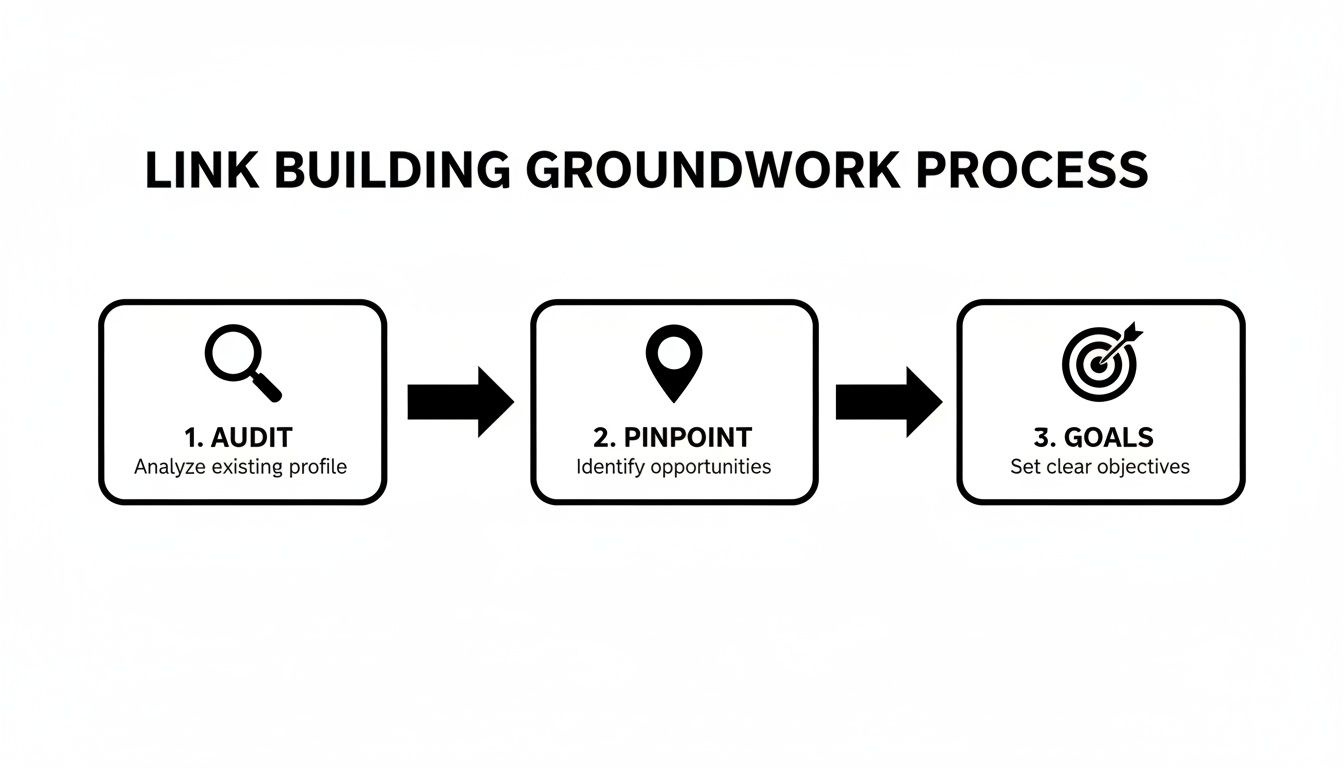
Before you send a single outreach email, you have to get your own house in order. Jumping into link building without a plan is like trying to build a restaurant without blueprints—it’s messy, inefficient, and pretty much guaranteed to fail. A generic strategy just won't work in the hyper-competitive restaurant equipment space. This first phase is all about auditing what you have, figuring out where you want to go, and setting the rules for how you'll get there.
It boils down to three key things: a deep-dive backlink audit, pinpointing your most valuable pages, and setting clear, measurable goals.
Start with a Comprehensive Backlink Audit
Every effective link-building campaign starts with a hard look at your current backlink profile. You need to know who's linking to you right now, the quality of those links, and whether any of them are actually dragging you down. It’s a critical first step that keeps you from building on a shaky foundation.
Grab a tool like Ahrefs or Semrush and export a complete list of your backlinks. From there, your job is to sort them into a few buckets:
- High-Quality Links: These are the keepers. They come from relevant, authoritative sites like industry publications, your suppliers' websites, or respected food blogs. You'll want to nurture these relationships.
- Low-Quality or Spammy Links: Links from irrelevant websites, low-authority directories, or private blog networks (PBNs) can actively hurt your rankings. A single link from a top-tier food service publication is worth more than a hundred of these.
- Toxic Links: In some cases, you might find links that were clearly built to manipulate search rankings. These need to be identified and disavowed using Google Search Console.
A clean backlink profile is non-negotiable. Getting rid of harmful links isn't just housekeeping; it's about signaling to Google that you're focused on quality and earning your authority the right way.
This audit gives you a clear baseline. It shows you which pages are already natural link magnets and can even uncover "easy wins," like finding unlinked mentions of your brand that you can ask to have linked.
Pinpoint Your Most Valuable Pages
Here's a rookie mistake I see all the time: pointing every single link at the homepage. Not all pages are created equal, and your goal should be to build authority for the pages that actually drive your business and help your customers. These are your "linkable assets."
Focus your energy on pages that offer real value and have commercial intent. For a restaurant equipment supplier, these are often pages like:
- High-Margin Product Category Pages: Think "Commercial Convection Ovens" or "Walk-In Coolers."
- In-Depth Buyer's Guides: Content like a guide on "How to Choose the Right Commercial Ice Machine" is incredibly valuable.
- Technical Spec Sheets & Installation Guides: These practical resources are gold mines for attracting links from contractors, technicians, and facility managers.
When you identify these key pages early on, you ensure that every link you earn is working to push your most important commercial keywords higher in the search results. This is how link building stops being a vanity metric and becomes a true revenue driver.
How to Find and Qualify High-Value Link Prospects
Once you’ve mapped out which pages need the most help, it's time to build a targeted list of websites to get links from. In the restaurant equipment world, relevance is everything. A single link from a local culinary school's resource page will do more for you than a dozen links from generic business blogs.
This is where you need to think beyond just swiping your competitors' backlinks. Sure, that's a decent starting point, but the real wins come from uncovering unique opportunities that everyone else has missed. You're hunting for websites that your ideal customers—the restaurant owners, kitchen managers, and chefs—already visit and trust.
Your prospecting list should be diverse. Don't put all your eggs in one basket. Instead, think creatively and broaden your search to include these high-potential categories:
- Industry and Trade Publications: Think of the online homes for magazines like Foodservice Equipment & Supplies or Restaurant Business Magazine.
- Restaurant and Hospitality Associations: This includes big national players like the National Restaurant Association and, just as importantly, regional and state-level chapters.
- Culinary Schools and Training Programs: These places often maintain resource pages for their students and alumni, which are goldmines for relevant links.
- Food Safety and Health Department Sites: Government and private organizations focused on kitchen regulations are seen as highly authoritative by Google.
- Complementary B2B Service Providers: Look for businesses that serve the same audience but aren't competitors. Think POS system providers, commercial cleaning services, or restaurant consultants.
Uncovering Prospects with Smart Searches
So, where do you actually find these sites? The easiest place to start is with advanced search operators right in Google. These are simple commands that help you slice through the noise and find exactly what you’re looking for.
Let's say you've created a fantastic buyer's guide for commercial ovens. You could run searches like:
"restaurant resources" + inurl:links"culinary schools" + "helpful resources"intitle:"food service blog" + "guest post"
This method uncovers pages that are already linking out to helpful content, making them much warmer targets for your outreach. It's way more effective than just Googling "food blogs" and hoping for the best.
Another trick I rely on is a smart competitor analysis. Using a tool like Ahrefs, you can pull a list of every site linking to your competitors' key pages. But don't just copy their list—analyze it. Look for patterns in the types of sites they get links from, then go find similar sites they might have missed.
Vetting Prospects for True SEO Value
Building a huge list of prospects is easy. Building a good list is hard work. You need to vet every single site to make sure you're not wasting your time. A pretty website means nothing if the link from it has no SEO value.
A classic rookie mistake is chasing high Domain Authority (DA) or Domain Rating (DR) scores above all else. These metrics are a decent starting point, but they don't tell the whole story. A site with a DR of 30 that’s hyper-relevant to commercial kitchens is infinitely more valuable than a generic news site with a DR of 70.
I highly recommend creating a simple spreadsheet to track your prospects and score them against a few core criteria. This keeps the process organized and stops you from chasing shiny objects.
Your Prospect Vetting Checklist:
- Topical Relevance: Is the website actually about the food service, restaurant, or hospitality industry? For a link to pass real value, it has to make sense in context.
- Domain Authority/Rating: Use this as a quick gut check of a site's overall strength. Aim for sites with a DR/DA of 30 or higher as a general rule, but don’t automatically dismiss a super-relevant site if it’s a little lower.
- Organic Traffic: Does the site get real visitors from Google? Use an SEO tool to check. A site with steady organic traffic is a healthy site that Google trusts. A site with zero organic traffic is a major red flag.
- Link Profile Health: Take a quick peek at who links to them. Does it look natural, or is it a mess of spammy, low-quality links? You don't want your site associated with a bad neighborhood.
By running every prospect through this quick four-point check, you'll filter out the junk and build a clean, powerful list. This means every email you send has the best possible chance of landing a link that actually moves the needle.
Creating Content That Actually Earns Links
The best links aren't the ones you have to beg for; they’re the ones you earn. That’s the real secret to a link building strategy that actually works for the long haul. Instead of just sending out cold emails asking for a link, your goal should be to create content so genuinely useful that other websites want to reference it.
We need to move past generic blog posts and start creating what I call "linkable assets." These are high-value resources that solve real-world problems for kitchen managers, chefs, and restaurant owners. When you create the go-to guide for a common challenge, you're not just a supplier anymore—you're an authority. That’s when the magic happens.
Go Deep with High-Utility Buyer's Guides
Your product knowledge is your superpower. Use it. A detailed, no-fluff buyer's guide for a complicated piece of equipment is one of the most effective linkable assets you can possibly create. This isn't a sales page; it's a genuine decision-making tool for someone about to make a huge investment.
Think about a chef trying to choose between different commercial combi ovens. A guide titled "The Ultimate Combi Oven Buyer's Guide for Professional Kitchens" that walks them through the decision process is link-building gold.
You'd want to cover things like:
- The Tech Explained: Break down the real-world differences between boiler and boilerless models, without the jargon.
- Sizing & Capacity: Give them practical formulas to figure out what size oven they need based on their menu and how many seats they have.
- Installation Realities: What are the actual electrical, plumbing, and ventilation requirements? Be honest about the headaches.
- Calculating the ROI: Help them build a business case to understand the long-term value and cost savings.
Content like this is a magnet for links from food bloggers, restaurant consultants, and even culinary school websites. Why? Because you're making their audience smarter and their jobs easier.
Create "Cheat Sheets" with Comparisons and Manuals
Another winning play is the detailed comparison sheet. Let's be honest, nobody wants to open ten different browser tabs to compare the specs of commercial mixers. Do the heavy lifting for them. Put together a clean, easy-to-scan table comparing the top models side-by-side.
Here's a sobering fact: an overwhelming 94% of all online content gets zero backlinks. To be in the top 6%, your content can't just be good—it has to be exceptionally helpful. It needs to be a tool that saves people time and effort.
Don't overlook troubleshooting manuals and installation guides, either. These are search-engine magnets. The moment a kitchen manager frantically Googles a common error code for their ice machine, your step-by-step guide can save their day. That's how you build trust and earn natural links from trade forums and contractor sites.
Turn Customer Wins into Compelling Case Studies
Your happiest customers are sitting on a goldmine of link-worthy content. A great case study isn't just a glorified testimonial; it’s a story about solving a painful problem. This is the kind of story that industry publications actually want to share with their readers.
A killer case study for a restaurant equipment supplier might look something like this:
- The Problem: A popular local bistro was getting crushed by an inefficient dishwashing setup. We're talking high labor costs and painfully slow table turnover during the dinner rush.
- The Fix: We'll detail how we analyzed their workflow and recommended a specific high-temp conveyor dishwasher that fit their space and volume.
- The Rollout: A quick look at the installation process and how we trained their staff to use the new machine effectively.
- The Results: This is where the magic is. Use real numbers. "They cut labor costs by 15% in the first three months" or "Table turnover during peak hours jumped by 20%."
This data-driven storytelling is precisely what industry journalists and bloggers are looking for. You're handing them a finished story with tangible results. To see more ways to turn your expertise into assets, check out our guide on content marketing examples for restaurant suppliers.
And don't forget video. Video walkthroughs, installation demos, or customer testimonials can be incredibly powerful. Brushing up on some basic YouTube SEO tips will help those videos get found, shared, and referenced, adding yet another layer to your link-earning strategy. When you focus on truly serving the industry with your content, building links stops being a chore and starts becoming a natural result of your expertise.
Mastering Outreach That Builds Real Partnerships

Alright, you've created a solid library of link-worthy content. Now comes the part where most campaigns completely drop the ball: outreach. This isn’t about blasting out generic, spammy requests that everyone instinctively deletes. Effective outreach is about starting conversations and building real relationships.
The goal isn't just a one-and-done link. It's to position your company as a genuine expert in the food service industry. When you do that, a single request can blossom into a long-term partnership that brings in more links, co-marketing opportunities, and even customer referrals down the line. It's a mindset shift from being transactional to relational.
Crafting Outreach That Actually Gets Read
Personalization is everything. Nobody wants an email that was obviously sent to a hundred other websites. Your message needs to show you’ve actually taken a minute to look at their site and understand what their audience cares about.
A great outreach email doesn't have to be long or complicated. It just needs to be specific and offer something of real value.
Here’s a real-world scenario:
- Your Asset: An in-depth data study on the rising popularity of ventless kitchen equipment in urban restaurants.
- Your Prospect: A journalist who covers restaurant industry trends.
- The Angle: "Hi [Journalist Name], I saw your recent article on compact kitchen design and thought you'd find our new data interesting. We analyzed installation data and found a 45% increase in ventless fryer sales in major cities over the past year. Happy to share the full report if it’s helpful for a future story."
See how that works? It’s not a demand for a link. It's a helpful tip from one industry pro to another, which makes a positive response far more likely.
To help you strategize, let's break down a few different approaches you can take. Each one works best with a different type of prospect and requires a unique angle to be successful.
Effective Outreach Approaches for Restaurant Suppliers
| Outreach Strategy | Target Prospect | Key Angle | Potential Outcome |
|---|---|---|---|
| Data-Driven PR | Industry Journalists, Bloggers | Offer exclusive data or newsworthy insights from your research. | High-authority links from trusted publications. |
| Supplier Partnership | Manufacturers (e.g., Hobart, Vulcan) | Request to be added to their "Authorized Dealer" or "Where to Buy" page. | A highly relevant, authoritative backlink. |
| Local Collaboration | Nearby Restaurants, Food Trucks | Offer a case study or feature them on your blog/social media. | A local backlink and strengthened community ties. |
| Broken Link Building | Industry Blogs, Resource Pages | Find a broken link on their site and suggest your relevant content as a replacement. | A quick, easy link win that provides value. |
Tailoring your message to the specific person and situation is what separates a successful campaign from one that feels like spam. Always think about what's in it for them first.
The Underrated Power of Supplier Partnerships
One of the most potent—and frequently ignored—tactics is simply collaborating with the equipment manufacturers you already work with. These brands have a direct interest in seeing you succeed. Many have "Where to Buy" or "Authorized Dealer" pages on their websites, which are absolute goldmines for high-authority, super-relevant backlinks.
Reaching out to your manufacturer reps should be a core part of your link building strategy. A link from a major brand like Hobart or Vulcan is a massive vote of confidence in the eyes of Google and your customers.
Just ask your contacts if they have a dealer locator or partner resource page. Make sure your business is listed correctly with a link pointing back to your site. This is often one of the quickest and most impactful links you can get. To build on this, exploring formal collaboration opportunities can open doors to even more valuable backlinks and co-marketing efforts.
Using Digital PR for High-Tier Links
Digital PR is all about getting your company’s expertise featured in industry publications. This goes way beyond simple link requests. It involves sharing your unique data, insights, and stories with journalists and bloggers who are hungry for good content.
In fact, a recent survey of over 500 SEO experts found that 66.6% prioritize finding unique backlink opportunities instead of just copying what competitors are doing. Digital PR was their top tactic at 48.6%, proving that sharing compelling stories is a far more effective strategy than old-school guest posting. You can dig into more of these link building trends and statistics to see how the landscape is shifting.
While guest blogging can still be useful, the data is clear: earning media mentions through PR lands more authoritative links. If you want to explore this more, our guide on guest blogging for backlinks offers tips specifically for the food service industry.
This is where all those linkable assets you created come into play. Pitching your buyer's guides, case studies, or original data to relevant publications positions you as a thought leader. You’re not just asking for a link; you're providing them with great material their readers will actually care about. It’s a true win-win that builds a sustainable, authoritative backlink profile.
Powering Up Your Local SEO with Citations and Partnerships
If you have a physical showroom or a set service area, you can't ignore local SEO. While getting a link from a big national publication feels great, the links that really move the needle for your Google Maps and local search rankings are often built right in your own community.
These are the signals that help a local chef find you when they're desperately searching for "commercial refrigeration near me." This is where local citations and strategic partnerships become your secret weapons. They firmly plant your business in a specific geographic area, telling search engines exactly who you are, where you are, and who you serve.
Building a Foundation with Local Citations
Let's start with the basics. A local citation is simply any online mention of your business's name, address, and phone number (NAP). You'll find them on directories like Yelp, Yellow Pages, and even industry-specific sites like the Foodservice Equipment Distributors Association (FEDA).
The trick to making citations effective? Absolute consistency.
Even a tiny difference—like using "St." on one directory and "Street" on another—can create confusion for search engines and water down your local authority. Your first move should always be to run an audit of your existing citations to find and fix every single inconsistency.
Once you’ve tidied up what’s already out there, it's time to build more. A great place to start is by following our detailed guide to build local citations for your business. This methodical process makes sure you get listed correctly on the platforms that matter most, creating a clean, consistent digital footprint that Google trusts.
Beyond Directories: Leveraging Local Partnerships
Citations are the bedrock, but you achieve true local dominance by building real-world relationships that turn into high-quality local backlinks. These links carry far more weight than a simple directory listing because they signal genuine community authority and involvement.
The most effective local SEO goes beyond just data consistency. It involves embedding your business into the local fabric through partnerships, sponsorships, and community engagement. This is how you build a moat around your local search rankings that competitors can't easily cross.
Think about the ecosystem your customers live in. Where do they go? Who do they listen to? The answers to these questions are a goldmine of link opportunities.
- Sponsor a Regional Food Festival: Getting your logo and a link on the event's official website is a fantastic local signal.
- Join a Local Restaurant Association: You could offer an exclusive discount to members in exchange for a spot on their partners page.
- Co-host a Workshop: Team up with a local health inspector or food safety consultant to run a seminar on kitchen safety. The mentions and links you'll get from their site and local event calendars are SEO gold.
- Connect with Culinary Schools: Offer to supply some equipment for a student competition or give a guest lecture from one of your experts.
These aren't just link-building tactics; they build real brand recognition and goodwill in your community. Each local partnership strengthens your online profile, making your business the clear and obvious choice for customers right around the corner.
How to Measure and Scale Your Link Building Efforts
So, you’ve put in the work. You’ve built some great links. Now what?
A link building strategy is only as good as the results it produces. Launching a campaign without tracking its impact is like running a busy kitchen without checking your food costs—you're working hard, but you have no idea if you're actually making money. This is where we move past vanity metrics and focus on what truly matters to your bottom line.
Forget obsessing over the raw number of backlinks. While it's a factor, it doesn’t tell the whole story. The real proof is in the tangible business results that a well-executed strategy delivers. We need to zero in on the key performance indicators (KPIs) that show your efforts are driving real, measurable growth.
Tracking the KPIs That Actually Matter
To prove the return on your investment, you have to connect your link building activities to concrete business outcomes. The whole point is to see that earned authority turning into more traffic and potential sales. It's no coincidence that the top-ranking results on Google have, on average, 3.8 times more links—that visibility is earned.
Here are the core metrics you should be watching like a hawk:
- Keyword Ranking Improvements: Are your key money pages (like "Commercial Convection Ovens") actually climbing the search results? Use a rank tracking tool to monitor this weekly. You want to see steady, upward movement.
- Organic Traffic Growth: This is a big one. Jump into Google Analytics and look at the organic traffic going specifically to the pages you’re building links to. Is it increasing month-over-month? This is direct proof that your higher rankings are attracting more potential customers.
- Referral Traffic: Don’t sleep on this metric. It shows how much traffic is coming directly from the sites linking to you. This tells you which partnerships are sending engaged, relevant visitors your way.
- Domain Authority (DA) or Domain Rating (DR): While these are third-party metrics and not a direct Google ranking factor, tracking the steady increase of your site’s score is a good gut check on your profile's overall health and strength.
Your two most important tools for this are Google Search Console and Google Analytics. Search Console shows you the keywords driving impressions and clicks, while Analytics reveals how that traffic behaves once it hits your site. They work together to paint the full picture.
By focusing on these numbers, you can build a clear report that shows stakeholders exactly how link building is helping the business. You can confidently say, "Our link building for the combi oven guide moved it from page three to page one, which drove a 40% increase in organic traffic to that page." That’s a story people understand.
Scaling Your Link Acquisition Sustainably
Once you’ve got a process that works and the results are rolling in, the next challenge is to scale up without letting quality slip. Scaling doesn't just mean sending more outreach emails; it means systematizing your successful tactics to create a consistent, predictable engine for acquiring links.
The key is to move from one-off campaigns to an ongoing, programmatic approach. That requires structure.
Build a Content Calendar for Linkable Assets
You can't scale link building if you're constantly scrambling for something new to promote. A dedicated content calendar for linkable assets is non-negotiable.
- Quarterly "Big Rock" Content: Plan one major, cornerstone asset each quarter. Think of a deep data study on restaurant industry trends or the ultimate buyer's guide for a new commercial kitchen.
- Monthly Supporting Content: Each month, create smaller but still valuable pieces like detailed product comparisons, "how-to" installation guides, or compelling customer case studies.
This disciplined approach ensures you always have something fresh and valuable for outreach, keeping your campaigns from getting stale.
Systematize Your Outreach and Follow-Up
It’s time to turn your successful outreach into a repeatable process—a well-oiled machine. Create a central database for prospects, track every touchpoint, and use refined templates that still allow for deep personalization.
Here’s a simple workflow you can adopt:
- Prospecting: Dedicate a set number of hours each week to finding and vetting new link targets. Consistency is key.
- Initial Outreach: Use your proven, personalized templates to make the first contact.
- Follow-Up Sequence: Have a polite, non-pushy two-step follow-up plan for those who don't reply. Sometimes people just get busy.
- Relationship Nurturing: Once you've successfully built a link, don't just forget about them. Add them to a separate list for future collaborations and partnership opportunities.
By systematizing your process, you transform link acquisition from a series of disjointed tasks into a sustainable growth channel. This is what separates the businesses that get a few lucky links from those that build lasting authority in the food service industry.
Ready to build a link building strategy that drives real, measurable growth for your business? At Restaurant Equipment SEO, we specialize in creating and executing SEO campaigns tailored for the food service industry. Schedule your free consultation today!