
Your Guide to SEO Keyword Ranking Reports
An SEO keyword ranking report is your go-to document for tracking where your website shows up on search engine results pages (SERPs) for the keywords that matter most. Think of it less like a report card and more like a live scoreboard for your online visibility. It’s the single best way to know what’s actually working in your SEO strategy and, just as importantly, what isn't.
What Is a Keyword Ranking Report
Picture your restaurant equipment business as a brick-and-mortar store in a sprawling city. A keyword ranking report is your GPS. It doesn't just show your store's location; it tells you how many people are walking past your window when they're looking for something specific, like "commercial convection ovens" or "stainless steel work tables." It turns all those abstract marketing efforts into real, measurable results.
This isn't a one-time snapshot, either. It’s a dynamic, ongoing picture of how your product pages and blog posts are performing for the search terms your customers are typing into Google every single day. By keeping a close eye on it, you can see which pieces of equipment are catching fire online and which ones are lost on page five, needing a serious boost.
A Diagnostic and Strategic Tool
A solid keyword ranking report wears many hats, making it the bedrock of a smart digital strategy. It’s not about stroking your ego with high rankings; it’s about gathering actionable intelligence.
- As a Diagnostic Tool: It’s your early warning system. If a crucial keyword like "ice machine for sale" suddenly tumbles from position 3 to 12, the report flags the issue long before you see a painful dip in your organic traffic and sales.
- As a Progress Tracker: It gives you tangible proof that your SEO work is paying off. Seeing a keyword climb from position 20 to the top 5 over a few months is clear evidence that your strategies are hitting the mark.
- As a Strategic Guide: It helps you see around corners. If you notice that keywords related to "eco-friendly refrigeration" are consistently on the rise, that’s a strong signal of a market trend. This insight can guide you to create more content and even adjust your inventory around that theme.
A great report does more than just present data; it tells a story. It highlights your wins, flags threats from competitors, and uncovers new opportunities for growth, turning a spreadsheet of numbers into a clear plan of action.
This table breaks down the core pieces of information you'll find in almost any keyword ranking report.
Core Components of a Keyword Ranking Report
| Component | What It Tells You |
|---|---|
| Keyword | The specific search term you are tracking. |
| Current Rank | Your website's current position on the SERP for that keyword. |
| Previous Rank | Your ranking during the last reporting period (e.g., last week or month). |
| Change | The difference between your current and previous rank (e.g., +3, -5). |
| Search Volume | An estimate of how many times the keyword is searched per month. |
| Ranking URL | The specific page on your site that is ranking for the keyword. |
Understanding these components is the first step. They are the building blocks that help you see the bigger picture of your SEO performance.
Ultimately, this report is what connects your day-to-day SEO tasks to real business goals. The whole process—creating, analyzing, and acting on this data—is foundational. To see how this piece fits into the larger puzzle, you can learn more about what is an SEO report in our detailed guide. Getting this foundational knowledge down is key before we jump into the specific metrics and templates that make these reports so powerful.
Decoding the Metrics That Actually Matter
A good SEO keyword ranking report is so much more than a dry list of numbers and positions. It’s a story. Think of it like a chef tasting a sauce; they don’t just say "it's good." They identify the salt, the acid, the fat, the heat—all the individual components that create the final flavor. We need to do the same with our report, breaking it down into its core metrics to understand the full picture of our SEO efforts.
These data points are what turn a static list into a living dashboard, showing you exactly where you stand and, more importantly, where you're headed. Each metric is a different lens to view your progress, helping you make smarter, more confident decisions for your restaurant equipment business.
This is why an SEO report really serves three critical functions: it helps diagnose problems, track your progress over time, and guide your future strategy.
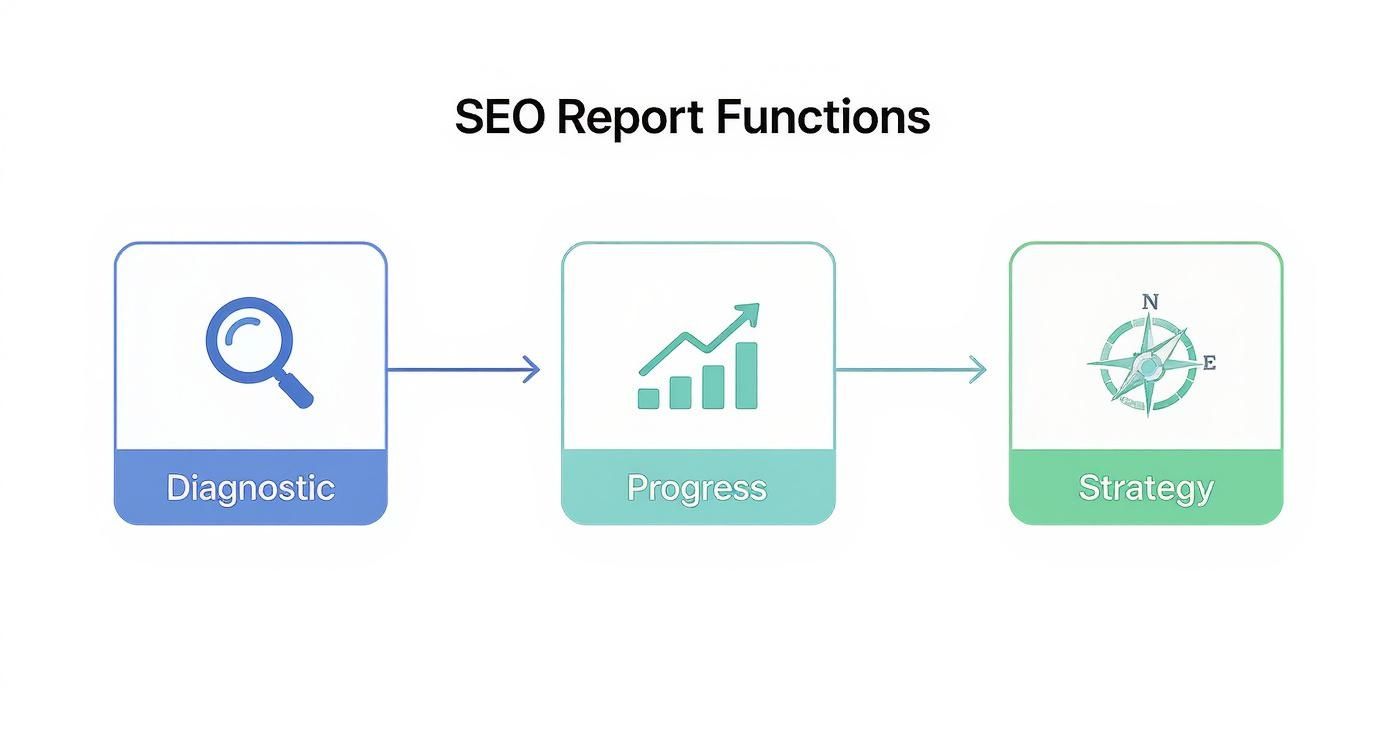
As you can see, a report isn't just a look in the rearview mirror. It's the map that informs every move you make next.
Current Rank and Rank Change
Let's start with the basics. The two most fundamental metrics you'll look at are Current Rank and Rank Change. Current Rank is your real-time position on the search engine results page (SERP). Simple enough. Are you on that all-important first page, or are you lost somewhere on page three?
But Rank Change is where the real story unfolds. It adds the crucial element of momentum. It tells you if you're moving up, sliding down, or just treading water. Seeing a keyword like "commercial deep fryer" jump from position 8 to 4 is a clear win. On the flip side, watching it slip from 4 to 7 is an early warning that something needs your attention—and fast.
These two metrics work in tandem to give you a snapshot of today and a glimpse of tomorrow. A high rank is great, but a consistently improving rank is what proves your strategy is actually working.
Search Volume and Opportunity Size
Here’s a hard truth: not all keywords are created equal. Search Volume is the metric that tells you just how big the prize is. It’s the estimated number of times people are searching for a specific term each month.
Imagine you're tracking two keywords for your business:
- "commercial ice machine parts Chicago" might get 50 searches a month.
- "commercial ice machine" could get 5,000 searches a month.
Nailing the #1 spot for the first term is a nice, targeted win. But climbing into the top 5 for the second one? That’s a game-changer for your business. Search volume helps you prioritize, ensuring you're spending your time and budget chasing keywords that deliver the biggest potential return. You want to win the battles that actually matter.
SERP Features and Digital Real Estate
Google's search results page isn't just a list of ten blue links anymore. It's a dynamic, visual space filled with SERP Features—things like featured snippets at the very top, image carousels, local map packs, and "People Also Ask" boxes. Your SEO report absolutely must track whether you're capturing any of this valuable digital real estate.
Owning one of these features can give you a massive visibility boost and siphon off clicks, even if you aren't in the traditional #1 organic spot. For a restaurant equipment seller, showing up in the Local Pack for "restaurant supply near me" could easily be more valuable than a standard #1 ranking for a less specific term.
These features are massive opportunities to leapfrog the competition. Tracking them in your SEO keyword ranking report is non-negotiable if you want the complete performance picture.
Using Historical Data to Predict SEO Trends
Think of a single SEO keyword ranking report as a snapshot. It’s a great picture, telling you exactly where you stand at one specific moment. But when you string those reports together over time, you get something much more powerful: a time-lapse video. This video tells the whole story of your SEO journey—where you've been, how you got here, and, most importantly, where you're likely going next.
Looking beyond a single point in time is what turns your report from a simple check-up into a strategic game plan. By tracking performance over weeks and months, you can watch the narrative unfold. Is "commercial pizza oven" a steady climber? Has it hit a frustrating plateau? Or is it slowly slipping, signaling it's time for a content refresh?
This historical context is everything. It helps you set realistic goals, forecast what’s coming down the pike with more confidence, and show stakeholders that the investment in SEO is paying off with clear, measurable progress.

Identifying Crucial Ranking Patterns
Once you start analyzing your ranking data over time, patterns will begin to jump out at you. These trends are the clues that lead to smarter SEO decisions, telling you which of your efforts are actually working and which need a rethink.
-
Steady Climbers: These are your success stories. Maybe "stainless steel prep table" has crept up a spot or two every month for the past quarter. That’s a clear sign your current strategy for that page is working, and it’s time to double down.
-
Sudden Spikes or Drops: Did a keyword suddenly rocket to page one or vanish into thin air? This usually points to a specific event. A big jump could be from a new backlink or a technical SEO fix. A drop might be the fallout from a Google algorithm update or a competitor launching an aggressive campaign.
-
Plateaued Keywords: These are the keywords that climbed to a decent spot—say, position 7—and then just got stuck. This is a classic sign that you've hit a wall with your current tactics. It's time to try something new, like building more internal links to the page or giving the content a significant update.
Calculating Ranking Velocity
One of the most useful metrics you can pull from historical data is ranking velocity. In simple terms, it’s just the speed at which a keyword's rank is changing. It's the difference between a keyword that's slowly inching its way up the page and one that's blasting off like a rocket.
Calculating ranking velocity is all about prioritization. A keyword with high positive velocity is a golden opportunity—it has momentum, and a little extra push could get it into those coveted top-three spots. On the flip side, a keyword with negative velocity is a flashing red light that needs your immediate attention.
This long-term view also gives you invaluable context on how long success can actually take. For example, historical data often shows that competitive, high-volume keywords might take four to six months (or even longer) just to crack the first page. In contrast, you might see a niche, long-tail keyword jump from position 50 to the top 10 in just a few weeks. Digging into the timeline for SEO forecasting can help set realistic expectations with your team and leadership.
Setting Benchmarks and Forecasting Future Growth
Without historical data, every new report is an island. You have no benchmark to measure against. Is ranking at position 5 for "restaurant range" this month good news or bad? You can't possibly know unless you see where you were three or six months ago.
Consistent historical reporting lets you establish a clear baseline. From there, you can start setting smart, data-driven goals. If you know a group of keywords has been improving at an average rate of three positions per month, you can confidently forecast where they might be next quarter. This makes your entire strategy more predictable and helps you communicate the value of your work with concrete, forward-looking projections.
Gaining an Edge with Competitor Analysis
Your SEO performance doesn't happen in a vacuum. Think of it like being a star player on a basketball team—your personal stats are great, but they don't mean much if you don't know the final score or how the other team is playing. In the same way, your SEO keyword ranking report becomes a real game-changer when you start looking at what your competitors are doing. It stops being just a report card and turns into an offensive playbook for winning the market.
Sure, tracking your own progress is vital. But the real magic happens when you track how your top competitors are performing for the exact same valuable keywords. This is where you find the answers to the questions that actually move the needle.
Are they creeping up on your most profitable terms, like "commercial refrigerator financing"? Did one of them just steal a featured snippet for "walk-in cooler installation" that should have been yours? This context is everything.

Uncovering Competitor Strategies
When you layer competitor ranking data over your own, you can start to reverse-engineer what’s working for them and where they're dropping the ball. You shift from just reacting to your own ranking drops to proactively spotting threats and opportunities before they become major issues.
It's like having a scout who watches your rival's every practice. This kind of side-by-side analysis helps you see patterns you'd otherwise completely miss.
-
Find Their "Money" Keywords: Pinpoint the high-volume, high-intent keywords where your competitors consistently own the top three spots. These are almost certainly driving their best traffic and should be prime targets for your own content and link-building campaigns.
-
Spot Glaring Content Gaps: See which keywords they rank for that you aren't even targeting. If a major competitor is pulling in traffic for "energy-efficient commercial ovens" and you don't have a single blog post on it, you've just found a huge content gap—and a potential new revenue stream.
-
Benchmark Your Progress: Is your SEO work moving the needle faster or slower than the competition? Comparing your ranking trajectory against theirs gives you a realistic benchmark and helps you set better goals.
A competitor analysis within your report isn't just about envy or imitation. It’s about intelligence gathering. It’s about understanding the battlefield so you can choose where and when to attack for maximum impact.
This level of insight helps you build a much more resilient and effective SEO plan. If you want to go deeper, check out our guide on https://restaurantequipmentseo.com/blogs/restaurant-equipment-seo-blog/how-to-do-seo-competitor-analysis, written specifically for this industry.
Key Competitor Metrics to Track
When you fold competitor tracking into your SEO keyword ranking report, you need to focus on a few key metrics. The goal is to find actionable insights, not drown in a sea of data.
-
Share of Voice (SOV): This is a great big-picture metric. It estimates your overall visibility across your tracked keywords compared to everyone else. If your SOV is climbing, it means you're capturing more of the available traffic and attention in your niche.
-
Ranking Overlap: This shows you how many of your target keywords your competitors are also ranking for. High overlap means you're in a direct, head-to-head fight. Low overlap might mean you've found an underserved corner of the market you can dominate.
-
New Top-Ranking Pages: Keep an eye on which of your competitors' pages have recently broken into the top 10 or 20 search results. This is a huge clue that they've either published hot new content or updated an old page that Google now loves. It gives you a perfect chance to analyze what they did and launch a counter-attack.
To get a serious leg up, consider looking into AI-powered competitor analysis tools that can dig deeper into their strategies. By consistently watching these metrics, your report transforms from a backward-looking document into a forward-looking tool for grabbing more market share.
Turning Ranking Data into Actionable Strategy
A keyword report overflowing with data is interesting, but insight without action is just trivia. This is where the magic happens—where we bridge the gap between looking at the numbers and actually doing something that moves the needle. A report’s real value is unlocked only when you use its findings to create specific, high-impact SEO tasks that help your bottom line.
Think of your report like a diagnostic scan from a car mechanic. The mechanic doesn't just hand you a list of error codes and walk away; they tell you exactly what’s wrong and what needs to be fixed. Your report shows you the patterns, and your job is to turn those patterns into a clear, prioritized action plan.
Every number in that report tells a story and hints at what to do next. A keyword slipping from a comfortable position #4 to a shaky #8 isn’t just a data point—it's a flashing red light. It’s signaling an urgent need for a content refresh or maybe a quick internal linking audit. This is how you turn a passive report into a dynamic playbook for growth.
From Observation to Action
The key to making your report truly useful is to build a simple system connecting what you see to what you do. Instead of getting bogged down in the data, you can sort your findings into a few common scenarios, each with its own set of go-to responses. This framework ensures you never look at a report and wonder, "Okay... so what now?"
- Minor Ranking Slips: A keyword drops 2-4 spots but hangs on to the first page. This happens all the time and usually just needs a quick fix.
- Major Ranking Drops: A high-value keyword falls off page one completely. This is an "all hands on deck" situation that calls for a deeper dive.
- Stuck Keywords: Those important terms that just seem to be stuck on page two or three, never quite breaking through. These are prime opportunities waiting for a strategic push.
- New Opportunities: Your report uncovers keywords you’re ranking for on page two or three that you weren’t even trying for. These are the low-hanging fruit, ripe for the picking.
By sorting your findings like this, you can prioritize your efforts based on what’s going to give you the biggest bang for your buck. Every insight immediately fuels an activity that drives real traffic and revenue for your restaurant equipment business.
Your goal is to build a repeatable process. When you see a specific pattern in your report—like a page-two plateau—you should immediately know the top three actions to take. This transforms reporting from a passive review into an active strategic session.
Because search results are always in flux from algorithm updates and changing user behavior, historical data is non-negotiable for figuring out if your SEO is actually working. Watching your rankings over time reveals what really matters. For instance, while rankings can bounce around daily, it's the sustained improvements over several weeks or months that reliably lead to more organic traffic and sales. You can discover more insights on the best SEO tools for keyword reports on lowfruits.io to see how different platforms help you track this crucial data.
Building Your Action Playbook
Let's get practical and turn these ideas into a concrete plan. Think of the table below as a cheat sheet for translating what you see in your SEO keyword ranking report into specific, actionable tasks. You can use this as a starting point to build out your own internal playbook.
Interpreting Data and Taking Action
Here’s a practical guide for translating common report findings into concrete SEO tasks.
| Observation | Potential Cause | Recommended Action |
|---|---|---|
| "Commercial Mixer" dropped from #4 to #9. | Content is getting stale; a competitor just published a more comprehensive guide. | Content Refresh: Update statistics, add a new section on modern features, and embed a product demo video to make it more engaging. |
| "Ice Machine Parts" is stuck at #14. | The page has weak internal link support and lacks topical authority. | Internal Linking & Backlinks: Add links from relevant blog posts to this page. Then, launch a targeted outreach campaign to get links from industry sites. |
| A competitor just took the featured snippet for "Restaurant Vent Hoods". | Your content doesn't provide a concise, direct answer to the user's core question. | On-Page Optimization: Add a clear, "What is..." heading with a simple paragraph-long definition right at the top. Format the key benefits in a bulleted list. |
| New keyword "Eco-Friendly Refrigeration" appeared at #18. | You mentioned this term in a blog post, but it's not a primary target. | Create Dedicated Content: This is an emerging search trend. Develop a new pillar page or an in-depth article specifically targeting this keyword to capture that interest. |
By consistently applying a framework like this, you ensure that no insight from your report ever goes to waste. Every fluctuation, every plateau, and every new discovery becomes a catalyst for a strategic action designed to strengthen your online presence and grow your business.
Choosing the Right Rank Tracking Tools
The quality of your seo keyword ranking report is only as good as the tools you use to build it. It’s like a professional kitchen—even the best chef will struggle to create a masterpiece with dull knives and a faulty oven. Picking the right software is ground zero for gathering accurate, actionable data for your restaurant equipment business.
The market for these tools can feel pretty crowded, but they generally fall into a few distinct categories. Knowing the difference between them will help you find the perfect fit for your specific needs, your budget, and how deep you really need to go with your data.
Your choice here will define your workflow and the kind of insights you can actually get from your reports.
Finding the Right Fit for Your Business
You don’t always need the biggest, most expensive tool suite. The real goal is to match the tool's horsepower to your own strategic ambitions.
-
Free Starting Points (Google Search Console): If you're just starting out or working with a lean budget, Google Search Console is non-negotiable. It gives you real data, straight from Google, on your average positions and the exact search terms bringing people to your site. It won't give you daily updates or the deep competitive intel that paid tools do, but it's an indispensable source of truth.
-
All-in-One SEO Platforms (Semrush, Ahrefs): Think of these as the Swiss Army knives of the SEO world. Platforms like Semrush and Ahrefs offer powerful rank tracking alongside a full arsenal of tools for keyword research, competitor analysis, and technical site audits. They’re a fantastic investment for businesses ready to get serious about a fully integrated SEO strategy.
-
Specialized Rank Trackers (AccuRanker, Nightwatch): These tools do one thing, and they do it incredibly well: track keyword rankings with speed and precision. Tools like AccuRanker or Nightwatch often provide more frequent updates and highly detailed data on SERP features. This makes them a great pick for agencies or any business that needs hyper-accurate, almost real-time position monitoring.
The best tool isn't the one with the most bells and whistles. It's the one that gives you the data you actually need in a way that makes sense for you and your team. Focus on accuracy, historical data, and clear reporting over a long list of features you'll probably never touch.
Selecting the right software is a foundational step. To get a better handle on the nuts and bolts, check out our detailed guide on how to track keyword rankings effectively.
Ultimately, your decision will boil down to a few key factors: your budget, how many keywords you need to watch, and whether you require deep insights into what your competitors are doing. To make a smart choice, it's also worth researching the best ChatGPT rank tracker tools to see where the market is heading. By weighing your options carefully, you can pick a tool that doesn’t just spit out reports but becomes a true engine for your growth.
Got Questions? We've Got Answers.
Even with a solid plan, you're bound to have questions once you start digging into your SEO keyword ranking reports. It's all part of the process. Let's walk through some of the most common ones we hear from restaurant equipment sellers.
How Often Should I Check My Keyword Rankings?
This is a classic question. For most businesses, checking your rankings weekly hits the sweet spot. It's frequent enough to catch any serious issues or sudden opportunities before they snowball, but not so often that you’re stressing over tiny, meaningless daily jumps.
Save the monthly reports for those bigger, higher-level strategy sessions with your team or management. They’re perfect for spotting broader trends and showing the real, long-term impact of your work.
Why Are My Rankings Bouncing Around So Much?
First off, take a deep breath. A bit of ranking volatility is completely normal in the world of SEO. Google is always tweaking its algorithm, your competitors are constantly trying to outdo you, and even what customers are searching for can change overnight. A small dip of one or two spots is usually just noise.
What you do need to watch for is a sustained downward slide or a sudden, stomach-churning drop of 10+ positions. That’s your signal to pop the hood and investigate. It could be anything from a technical glitch on your site to a major Google algorithm update shaking things up.
My #1 Keyword Dropped! What Do I Do?
Okay, step one: don't panic. The worst thing you can do is make a knee-jerk reaction. Instead, put on your detective hat and start by analyzing the search results page (SERP) itself. What's different? Did a new competitor suddenly leapfrog you? Has Google added a new feature like a "People Also Ask" box or a video panel that's pushing organic results down?
Your best move is always a strategic one. Look closely at the pages that are now outranking you. Is their content more thorough? Do they have stronger backlinks? Is their page simply a better, more direct answer to what the searcher is looking for? Figure out where they have the edge, and that's where you'll focus your energy.
Ready to stop guessing and start growing? Restaurant Equipment SEO offers specialized SEO services—from creating expert content to building authoritative links—all designed to get your business in front of the right customers. Learn how we can improve your search engine rankings today.