
Strategic Link Building for Restaurant Equipment Suppliers
Think of strategic link building as the digital version of earning a five-star review from a world-renowned food critic. It’s the deliberate art of getting high-quality ‘digital endorsements’—or backlinks—from other respected and relevant websites. This isn't about collecting as many links as possible; it’s a focused strategy that tells search engines your site is a legitimate authority in your field.
What Is Strategic Link Building Anyway?
Let's stick with the restaurant analogy. You wouldn't build your reputation by papering the town with cheap flyers. You'd build it by getting a glowing feature in a top culinary magazine or a rave review from a trusted food blogger. Strategic link building works the exact same way for your website. It’s all about earning those powerful endorsements that signal credibility and expertise to search engines like Google.

This is a world away from the old-school, spammy tactics of the past. There was a time when SEO meant scooping up as many links as you could, from anywhere you could get them. That often meant buying junk links from completely unrelated sites—a practice that Google now actively punishes.
Quality Defeats Quantity
Today, the game has changed completely. The real goal is to get backlinks that have genuine authority and are directly relevant to what you do. For a restaurant equipment supplier, that means hunting for links that solidify your standing as an industry expert.
Let's compare two scenarios:
- A Low-Quality Link: You get a backlink from a random blog about dog walking. This link adds zero value and just confuses search engines.
- A High-Quality Link: You earn a link from a major trade publication like Foodservice Equipment Reports or a well-known chef's blog. Now that is a powerful vote of confidence from a source that matters.
A single, high-quality link from an industry authority is worth far more than hundreds of random, irrelevant ones. It sends a crystal-clear signal to Google: "Hey, the experts in the food service world trust this company."
Strategic link building isn't just an SEO task; it's a reputation-building exercise. Each quality backlink is a testament to your authority, directly influencing how search engines—and potential customers—perceive your brand.
The Foundation of Trust and Traffic
At the end of the day, this careful, methodical process of earning authoritative backlinks is about more than just climbing the search rankings. It’s about building a rock-solid foundation of trust that pulls in qualified, organic traffic for years to come.
When Google sees that other credible players in the restaurant industry are pointing to your site, it gains the confidence to show your product pages to chefs and managers searching for commercial kitchen equipment. This translates directly into more visibility, more qualified leads, and ultimately, more sales. For any serious restaurant equipment supplier, it's an investment you can't afford to skip.
Why Backlinks Are the Secret Sauce of SEO
Think of backlinks as the digital equivalent of a powerful word-of-mouth recommendation. Imagine you’ve just opened a new restaurant. If respected chefs, influential food bloggers, and local publications start talking about you, customers will flock to your door. They trust the recommendation. Backlinks work the exact same way for search engines.
When a reputable website links to your page for a commercial convection oven, it's doing more than just sending you a visitor. It’s casting a "vote of confidence" that tells Google you're a legitimate, trustworthy source for that piece of equipment. Time and again, a solid backlink profile is what separates the sites on page one from everyone else.
The Problem with "Publish and Pray"
Too many businesses fall into the trap of thinking great content is enough. They publish a fantastic blog post or a detailed product guide and just hope people find it. But hope isn't a strategy. The internet is overflowing with content, and most of it never gets seen.
This is where a dedicated, strategic link building plan changes the game entirely.
The data here is eye-opening. Ever since Google first launched, links have been a core part of how it ranks websites. Yet, the internet makes it incredibly hard to earn them passively. Research shows that around 94% of all pages online have zero external links. Even more telling, only 2.2% of content ever gets a single backlink from another website. The message is clear: if you aren't actively building links, you’re essentially invisible. You can dig deeper into these numbers in this definitive guide to link building.
Turning a Common Weakness Into Your Strength
This is where the real opportunity is hiding. Because so few businesses are any good at building links, the ones who actually put in the effort can leapfrog the competition. This is especially true in the food service equipment space, where many suppliers are still stuck in the old world of print catalogs and trade shows, leaving their digital potential completely untapped.
A focused link-building strategy can deliver serious results for a restaurant equipment supplier:
- Jump Up in Search Rankings: Quality links from trade publications, dealer associations, and even food blogs can push your key product pages from the depths of page two right into the top spots on page one.
- Generate More Qualified Leads: This boost in visibility isn't just for show. It can lead to a 3–10x increase in organic traffic and quote requests over a 6–12 month period.
- Build Real Authority: A strong backlink profile signals to both Google and your potential customers that you are a serious player in the industry, making them far more likely to buy from you.
In a crowded market, strategic link building isn't just an SEO task; it's a direct investment in your brand's reputation and your future sales. It turns your website from a simple online catalog into a go-to industry resource.
Ultimately, while your competitors are waiting for the phone to ring, a proactive link-building plan lets you build the kind of digital authority that dominates search results and keeps a steady stream of buyers coming your way.
Your Framework for High-Impact Link Building
Great link building isn’t about getting lucky; it’s about having a smart playbook. The real goal is to create what we call "linkable assets"—resources so genuinely useful that others in the food service world want to share and reference them. For a restaurant equipment supplier, this means going way beyond product pages to build real authority.
This framework breaks down five powerful tactics designed specifically for your niche. Each one is geared toward earning high-quality backlinks that tell search engines you’re a trusted expert, which in turn brings more qualified buyers straight to your website.
Supplier Partnerships as Link Magnets
You’re likely sitting on a goldmine of backlink opportunities: your existing business relationships. Think about every manufacturer whose equipment you carry. Most of them have a "Where to Buy" or "Authorized Dealers" section on their website, and getting your business listed is often just a quick email away.
These links are pure gold. They come from highly relevant, authoritative domains, sending a direct signal to Google that a major brand trusts you. It’s a powerful endorsement that immediately boosts your own site's credibility.
Securing Placements in Trade Publications
Imagine getting your company a nod in a top industry magazine. A link from a respected publication like Restaurant Business or a popular food service blog is one of the strongest digital endorsements you can get. This isn't about buying an ad; it's about adding real value to their audience.
Here's how you can make it happen:
- Offer expert commentary on industry news, like new health regulations or trends in kitchen efficiency.
- Write a guest article sharing your expertise, maybe a guide on choosing energy-efficient commercial freezers.
- Share a case study showing how your equipment and expertise helped a local restaurant knock it out of the park.
Dominating Local Search with Citations
If you serve a specific geographic area, local citations are absolutely essential. These are simply mentions of your business's name, address, and phone number (NAP) on local directories—think Yelp, Yellow Pages, and industry-specific listing sites.
Keeping your NAP info consistent across these platforms helps Google understand your geographic relevance, making you the obvious choice for searches like "restaurant equipment near me." While not every citation includes a clickable link, they are a critical piece of any local SEO puzzle.
Creating High-Value Content Assets
This is where you step up and create something so helpful that people can’t help but link to it. Stop just selling products and start solving your customers' biggest headaches.
Consider building assets like these:
- An Equipment Compliance Guide: A detailed checklist breaking down NSF and UL standards for commercial kitchens.
- A Cost-of-Ownership Calculator: An interactive tool to help restaurant owners accurately budget for new equipment.
- An In-Depth Equipment Comparison: A data-driven showdown between two competing convection ovens, complete with performance specs and real-world feedback.
This kind of problem-solving content is the engine for a successful link building campaign. In fact, building out these assets is one of the most effective content marketing best practices because it gives other websites a genuine reason to link back to you.
Key Takeaway: The strongest link profiles are diverse. When you combine high-authority editorial links with a solid foundation of local citations, you send a clear and trustworthy signal to search engines.
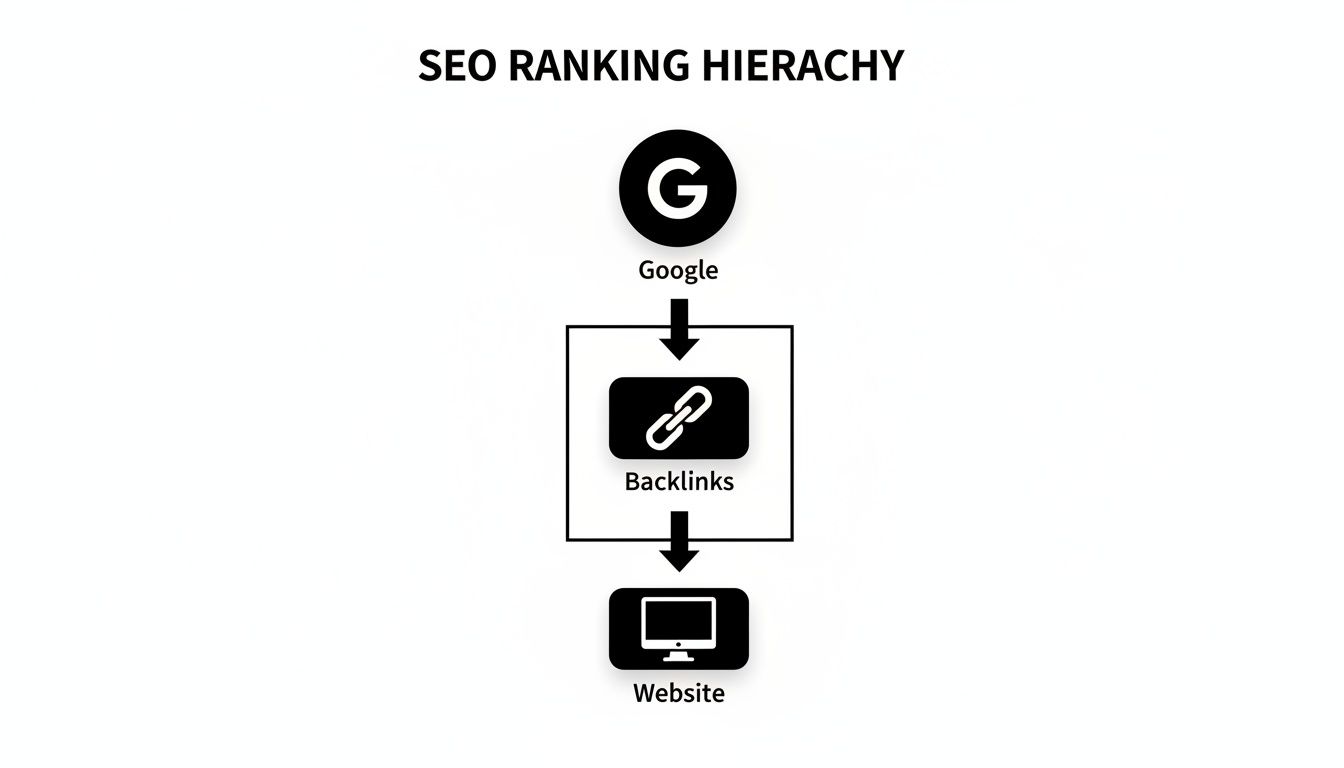
The diagram below illustrates this core concept: Google sees quality backlinks as votes of confidence that help determine where you rank.
The data backs this up, too. Studies show that long-form, in-depth articles generate 77.2% more links than shorter pieces. And posts that answer "what" or "why" questions attract about 25% more backlinks than simple "how-to" guides. A guide on “What Health Inspectors Look for in Commercial Kitchen Equipment,” for instance, is far more link-worthy than a basic product description.
To help you decide where to start, the table below compares these tactics.
Comparing Link Building Tactics for Equipment Suppliers
This table gives a quick overview of the strategies we've discussed, their primary targets, potential impact, and the effort required for a supplier in the food service industry.
| Tactic | Primary Target | Potential Impact | Effort Level |
|---|---|---|---|
| Supplier Partnerships | Manufacturer "Where to Buy" pages | High | Low |
| Trade Publications | Industry blogs, magazines, news sites | Very High | High |
| Local Citations | Business directories, review sites | Medium | Low-Medium |
| Content Assets | Industry peers, bloggers, journalists | Very High | High |
Each tactic plays a unique role, but they all work together to build a powerful and resilient online presence.
For a deeper look at how to organize these efforts into a cohesive strategy, check out our guide on building effective link building programs specifically for the food service industry.
How to Craft Outreach Emails That Actually Get Opened
Look, you can create the most brilliant piece of content or come up with an incredible guest post idea, but if your outreach email never gets opened, it’s all for nothing. All that hard work just evaporates. Strategic link building lives and dies by its outreach, and frankly, this is where most campaigns completely fall apart.
The secret? Stop thinking like a marketer and start acting like a person. You're not trying to blast out a thousand generic messages. The real goal is to start a genuine conversation with another human being. That means doing a little homework, personalizing your message, and making it crystal clear how you can help their audience.
The Anatomy of a Winning Outreach Email
Every outreach email that actually gets a positive reply shares the same DNA. It’s built to respect the recipient’s time and makes it dead simple for them to say "yes."
Think of it like this. Every email you send needs these four things:
- A Compelling Subject Line: This is your entire first impression. "Guest Post Pitch" is boring and gets deleted. Try something that sparks a little curiosity, like "Idea for your restaurant management blog" or "A resource your readers might find useful."
- A Personalized Opening: This is your chance to prove you're not a robot. Mention a recent article they published, a comment they made on social media, or something you genuinely admire about their work. This one small step will immediately separate you from 90% of the spam cluttering their inbox.
- A Clear Value Proposition: Get straight to it. What’s in it for them? Whether you're offering fantastic, free content for their blog or a helpful resource that makes one of their existing articles even better, spell out the benefit.
- A Simple, Low-Friction Call-to-Action (CTA): Never, ever ask for a link in your first email. That’s like asking someone to marry you on the first date. Instead, end with a simple, easy-to-answer question, like "Would you be open to hearing the idea?" or "Is this something that might interest your audience?"
The art of strategic link building heavily relies on effective outreach. Master this crucial skill by learning how to write cold emails that get replies, fostering new connections for backlinks.
Template 1: Guest Post Pitch
Guest posting is a classic for a reason—it lets you get in front of a new audience and earn a fantastic backlink in the process. When you pitch, your entire focus should be on providing a topic that feels like it was made specifically for their readers. For a much deeper look at this tactic, check out our guide on guest posting outreach.
Subject: Idea for [Blog Name] - Commercial Kitchen Efficiency
Hi [Name],
I'm a huge fan of your work on [Blog Name]—your recent article on restaurant inventory management was incredibly insightful.
I'm an expert in commercial kitchen operations at [Your Company] and noticed you haven't covered the latest trends in energy-efficient kitchen equipment. I'd love to write a guest post for your audience on "3 Ways Upgrading Your Fryer Can Cut Utility Bills by 20%."
Would you be open to seeing a brief outline?
Best,
[Your Name]
Template 2: Content Asset Promotion
This approach is perfect when you’ve already created a valuable "linkable asset," like a detailed guide, an original case study, or a useful checklist. Your job is to find articles online where your resource would be a perfect, natural fit.
Subject: A Resource for Your Health Code Guide
Hi [Name],
I was just reading your excellent article, "Navigating Local Health Inspections," and found it extremely helpful. I'll definitely be sharing it with my network.
In our work with restaurant owners, we found many struggled to keep track of equipment compliance. So, we created a detailed "Health Code Compliance Checklist" that covers everything from refrigeration temps to proper sanitation protocols.
It might be a great addition to your article. You can check it out here: [Link to Your Asset]
Either way, keep up the fantastic work!
Cheers,
[Your Name]
See the pattern? Both templates are short, personal, and laser-focused on providing value, not just asking for a favor. That simple change in mindset is what separates a link building campaign that gets results from one that just gets ignored.
7. Measuring Your Success and Avoiding Common Pitfalls
Launching a link building campaign without a way to measure it is like running a kitchen service without checking if the orders are correct. You’re busy, things are happening, but you have no real idea if you’re actually making customers happy or just making a mess. To see a real return on your efforts, you need to track the right numbers and know which mistakes to sidestep.
Success isn't just about counting how many new links you get. It’s about seeing how those links actually help your business grow. Think of it this way: you don't just want positive reviews for your equipment; you want to see those reviews translate directly into more quote requests and sales.
Key Performance Indicators That Matter
To get a clear picture of your campaign's health, you only need to focus on a handful of core metrics. These KPIs tell the full story, from your website's growing authority in the foodservice industry to an actual increase in qualified leads.
Here’s what you should be watching:
- Domain Authority (DA) or Domain Rating (DR): These are industry-standard scores from tools like Moz and Ahrefs that estimate your website's overall strength on a 1-100 scale. A rising score is a great sign that your backlink profile is getting stronger and more authoritative.
- Referral Traffic: Pop open your Google Analytics, and you’ll find this gem. It shows you exactly how many people are landing on your site by clicking a link from another website. A steady climb here means your new backlinks are doing their job and sending real, interested people your way.
- Keyword Rankings: Are your product pages for "commercial ice machines" or "walk-in coolers" finally climbing up from page two? Tracking your most important keywords is the most direct way to see if your links are boosting your visibility for the exact terms that drive sales.
For a deeper dive, our guide on how to measure SEO performance breaks down all the metrics that matter for equipment suppliers.
Now, let's talk about tracking those KPIs. Below is a simple table outlining the most important metrics, what they actually measure, and why they are critical for your business.
Key Performance Indicators for Link Building
A breakdown of essential metrics to track the success and impact of your strategic link building campaigns.
| Metric | What It Measures | Why It Matters for Suppliers |
|---|---|---|
| Domain Authority/Rating | Your website's overall SEO strength and authority, scored from 1-100. | A higher score means Google trusts your site more, making it easier to rank for competitive product keywords. |
| Organic Traffic Growth | The increase in visitors finding your site through unpaid search results. | This is the ultimate goal—more potential customers finding you when they search for equipment. |
| Referral Traffic | The number of visitors who click a link from another website to get to yours. | Shows that your links aren't just for SEO; they're actively sending engaged traffic from relevant industry sites. |
| Keyword Ranking Improvements | How your target keywords (e.g., "commercial convection oven") are moving up in Google's search results. | Direct proof that your link building is improving visibility for the terms that lead to sales. |
| Number of New Referring Domains | The count of unique websites linking to your site for the first time. | A diverse backlink profile from many different relevant sites is a strong signal of trust to Google. |
| Lead/Conversion Rate from Referral Traffic | The percentage of referral visitors who fill out a contact form, request a quote, or make a purchase. | This connects your SEO efforts directly to your bottom line, proving the ROI of your campaign. |
Keeping an eye on these metrics will give you a clear, data-backed view of how your link building is performing. You'll know what's working, what's not, and where to double down.
Critical Mistakes to Avoid at All Costs
Knowing what not to do is just as important as knowing what to do. The wrong moves can do more than waste your time and money; they can actively damage your website's reputation with Google. This can lead to ranking penalties that are incredibly difficult and expensive to fix.
A single bad link can undermine the value of ten good ones. Protecting your website's integrity is just as crucial as building its authority. Avoid shortcuts and focus on sustainable, ethical practices that build long-term trust with search engines.
Here are the most common pitfalls I see suppliers fall into:
- Acquiring Spammy Links: Whatever you do, never buy links from shady "link farms" or private blog networks (PBNs). These are garbage websites built for the sole purpose of selling links. Google is smarter than you think and is exceptionally good at sniffing these out and penalizing the sites they link to. A link from a low-quality, irrelevant site is a massive red flag.
- Over-Optimizing Anchor Text: Anchor text is simply the clickable text in a link. If every single backlink pointing to your "commercial refrigerators" page uses that exact phrase, it screams "manipulation" to search engines. A natural backlink profile has a healthy mix of anchor text—your brand name, generic phrases like "learn more here," and different variations of your keywords.
- Ignoring Link Relevance: Getting a backlink from a super-popular blog about pet grooming does absolutely nothing for your restaurant equipment business. The link must come from a source that is topically relevant to the foodservice world to carry any real weight. Relevance is king.
By tracking the right KPIs and diligently steering clear of these common mistakes, you'll ensure your strategic link building efforts lead to sustainable, long-term growth. It's this balanced approach that protects your website while building the authority you need to dominate the search results for years to come.
Putting It All Together: A Supplier Success Story
Theory is great, but let's be honest—seeing how this stuff works in the real world is what makes it click. Let's walk through the story of "Culinary Commercial," a fictional restaurant equipment supplier. They had a fantastic product line, but they were buried on the third page of Google, totally invisible to the chefs and restaurant owners who needed them.
Their website looked decent, but it had zero authority. Without quality backlinks, search engines just didn't see them as a trustworthy source for competitive terms like "commercial combi oven." Their online growth had completely flatlined. They knew they needed a real plan, and fast.
The Strategy: A Linkable Asset and Smart Outreach
Instead of just begging for links from anyone and everyone, Culinary Commercial got smart with a two-pronged strategic link building campaign. First, they put themselves in their customers' shoes and identified a massive headache: navigating the maze of health and safety regulations. That lightbulb moment led to their first linkable asset—a definitive "Health Code Compliance Checklist for Commercial Kitchens."
This wasn't just some fluffy blog post. It was a downloadable, genuinely helpful guide that solved a pressing problem. That made it a resource other industry websites would actually want to share. With this powerful tool in their back pocket, their outreach suddenly had a purpose.
They zeroed in on two key areas:
- Culinary Blogs: They found the blogs that chefs and restaurant managers actually read. They offered to write guest articles on topics like "5 Common Health Code Violations and How to Avoid Them," which gave them a natural reason to link back to their new checklist.
- Local Food Service Publications: They reached out to regional industry news sites and framed their guide as a free, valuable tool for local restaurant owners, which helped them land some powerful editorial links.
The Six-Month Transformation
The results weren't just good; they were game-changing. By creating something genuinely useful and being thoughtful about who they contacted, they started building real trust with both their audience and the search engines.
By shifting from a sales-only mindset to one of providing genuine value, Culinary Commercial transformed its website from a digital catalog into an authoritative industry resource. This fundamental change was the engine behind their SEO success.
After six months, the impact was undeniable and easy to measure.
Tangible Results:
- Domain Rating (DR) Growth: Their DR, a core metric for backlink strength from tools like Ahrefs, shot up from a weak 12 to a respectable 28.
- Keyword Ranking Improvement: For their main target keyword, "commercial combi oven," they jumped from the bottom of page three right into the top 5 results.
- Measurable Business Impact: Best of all, they saw a 40% increase in qualified quote requests that came directly from their organic search traffic.
This story proves that strategic link building isn't about smoke and mirrors. It's about understanding your customers, creating real value, and building authentic relationships. For Culinary Commercial, that simple approach turned their website from a forgotten liability into their most powerful tool for generating leads.
A Few Common Questions We Hear About Link Building
Even with the best game plan, some questions always pop up when we're talking about link building. Let’s tackle some of the most common ones we get from restaurant equipment suppliers to clear up any lingering confusion.
How Many Backlinks Do I Actually Need?
This is the million-dollar question, isn't it? The truth is, there’s no magic number. Think of it this way: quality will always beat quantity. One solid link from a respected trade publication like Foodservice Equipment & Supplies is worth more than 100 links from random, unrelated blogs.
Instead of chasing a specific number, focus on consistency. Aim to earn a handful of high-quality, relevant links every month. The goal is to build a backlink profile that looks natural over time, signaling to Google that your site is a consistently valuable resource in the industry.
How Long Does This Actually Take to Work?
Look, strategic link building is a marathon, not a sprint. It's a long-term investment in your brand's authority. While you might see a little bump in a few weeks, you should expect to see significant, needle-moving results in about three to six months. It simply takes time for search engines to crawl the web, find your new links, weigh their value, and then adjust your rankings.
Patience is the name of the game here. A steady, consistent effort over several months is what builds sustainable ranking power, drives more organic traffic, and ultimately brings in qualified leads.
Think of it like aging a fine wine or a good cut of charcuterie. You can't rush it. Trying to speed things up with spammy, low-quality tactics will only sour the final product and could land you in hot water with Google.
What's the Real Difference Between "White Hat" and "Black Hat" SEO?
Understanding this distinction is absolutely critical. Getting it wrong can tank your website's reputation and undo years of hard work. The two approaches are complete opposites.
-
White Hat Link Building: This is the ethical, by-the-book approach we've covered in this guide. It’s all about earning your links by being genuinely valuable. This means creating fantastic content, building real relationships, and being a helpful part of the foodservice community—things like guest posting for industry blogs, creating helpful buyer's guides, or getting featured by your manufacturing partners.
-
Black Hat Link Building: This is the shady side of SEO. It involves using manipulative tricks that violate search engine guidelines to try and cheat the system. We're talking about buying links from spammy "link farms," using automated software to create thousands of junk links, or hiding links where users can't see them. These tactics might give you a short-lived boost, but Google is incredibly smart. When they catch you—and they will—your rankings will disappear overnight.
Stick to white hat methods. It’s how you build a rock-solid online presence that drives real growth and won't get wiped out by the next Google algorithm update.
Ready to build a backlink profile that brings in serious business? At Restaurant Equipment SEO, we live and breathe this stuff. We build and run link building campaigns specifically for the foodservice industry. Find out how our targeted SEO services can boost your authority and connect you with more buyers.