
Tier Link Building A Modern SEO Strategy Guide
Let's get straight to it. Tiered link building is an advanced SEO strategy where you build backlinks to your backlinks, creating a powerful funnel of authority that points directly to your main website. It's not some outdated trick; when done right, it builds a strong, natural-looking link profile that protects your site from risk.
Why Tiered Backlinks Are Worth Your Time
In the cutthroat online market for restaurant equipment, you need every edge you can get. Just building a few links to your commercial oven or refrigeration pages often isn't enough to climb the rankings, especially when you're up against industry giants. This is where a more strategic approach pays off.
Think of it like this: a regular backlink is a single recommendation. A tiered link structure is like that initial recommendation getting a whole bunch of its own positive reviews. Suddenly, the original endorsement looks far more credible and carries a lot more weight in Google's algorithm. It's how you build a link profile that's not just powerful, but also defensible.
Direct vs. Tiered Linking: What’s the Difference?
To see why this tactic is so effective, you need to understand its place in the bigger picture of mastering organic search engine optimisation. The main difference between direct and tiered link building comes down to two things: how you channel link authority and how you manage risk.
With a standard direct linking approach, every single backlink you build points straight to your main website—your "money site." It’s simpler, sure, but it also leaves your most valuable online asset completely exposed. If you accidentally get a few spammy or low-quality links, they could drag your site down.
A tiered strategy, on the other hand, creates a smart buffer.
The biggest win with a tiered approach is risk mitigation. You're building most of your links to your Tier 1 assets, not your main site. This insulates your key product and category pages from any potentially harmful backlinks. If a sketchy link pops up on a lower tier, you can just cut off the Tier 1 link it points to, and your primary domain is safe.
Here's a quick comparison to make the differences crystal clear.
Tiered vs. Direct Link Building At a Glance
The table below breaks down the fundamental differences in structure, benefits, and potential risks when comparing a tiered campaign to a more traditional, direct-to-site approach.
| Attribute | Direct Link Building | Tier Link Building |
|---|---|---|
| Link Target | All links point directly to your main website. | Only high-quality Tier 1 links point to your site. Tier 2 and 3 links point to the tiers above them. |
| Risk Exposure | High. Any low-quality link directly impacts your site's authority and can lead to penalties. | Low. Lower-quality links are aimed at buffer pages (Tier 1), shielding your main site from direct harm. |
| Authority Flow | Direct, but each link's power stands alone. | Amplified. Link equity is concentrated and passed up through the tiers, making Tier 1 links more powerful. |
| Resource Cost | Generally lower, as it requires managing fewer link layers and less content. | Higher, as it demands more content creation and careful management across multiple tiers. |
Ultimately, choosing between these two depends on your goals and resources. A direct approach is faster and cheaper, but a tiered strategy offers more power and long-term protection, making it a better fit for competitive niches like ours.
How to Structure Your Tiered Linking Campaign
Think of building a tiered link campaign like an architect designs a building. You need a solid blueprint before you start laying bricks. Without a clear plan, you end up with a shaky structure that could collapse—or worse, get flagged by search engines.
The entire point is to create a logical flow of authority. You'll funnel power from a broad base of links up through a select few high-quality links, which then point to your site. This is a deliberate, strategic process, not just random link building.
Defining Your Tiers
For a business like a restaurant equipment supplier, the classic two-tier pyramid is almost always the best way to go. It strikes the perfect balance between power and manageability without getting too complicated.
-
Tier 1 (Your Foundation): These are the high-quality backlinks pointing directly at your most important pages—your "money site." This could be your product page for commercial refrigerators or your guide to choosing the right convection oven. These links need to be your primary support columns: strong, relevant, and authoritative. A perfect example is a well-researched guest post on a top food service industry blog or a link from a respected culinary publication.
-
Tier 2 (The Support Beams): These links point only to your Tier 1 pages, never directly to your website. Their sole job is to prop up your foundation. Tier 2 links can come from a much wider range of sources. Think relevant forum discussions about setting up a new kitchen, comments on smaller chef blogs, or solid business directory listings.
This structure creates a crucial buffer. By building a larger volume of easier-to-get Tier 2 links, you boost the authority of your premium Tier 1 links without ever exposing your main domain to potential risk from lower-quality sources.
The diagram below shows exactly how this works. You can see the link equity flowing from the wider Tier 2 base, strengthening Tier 1, and ultimately benefiting your main site.
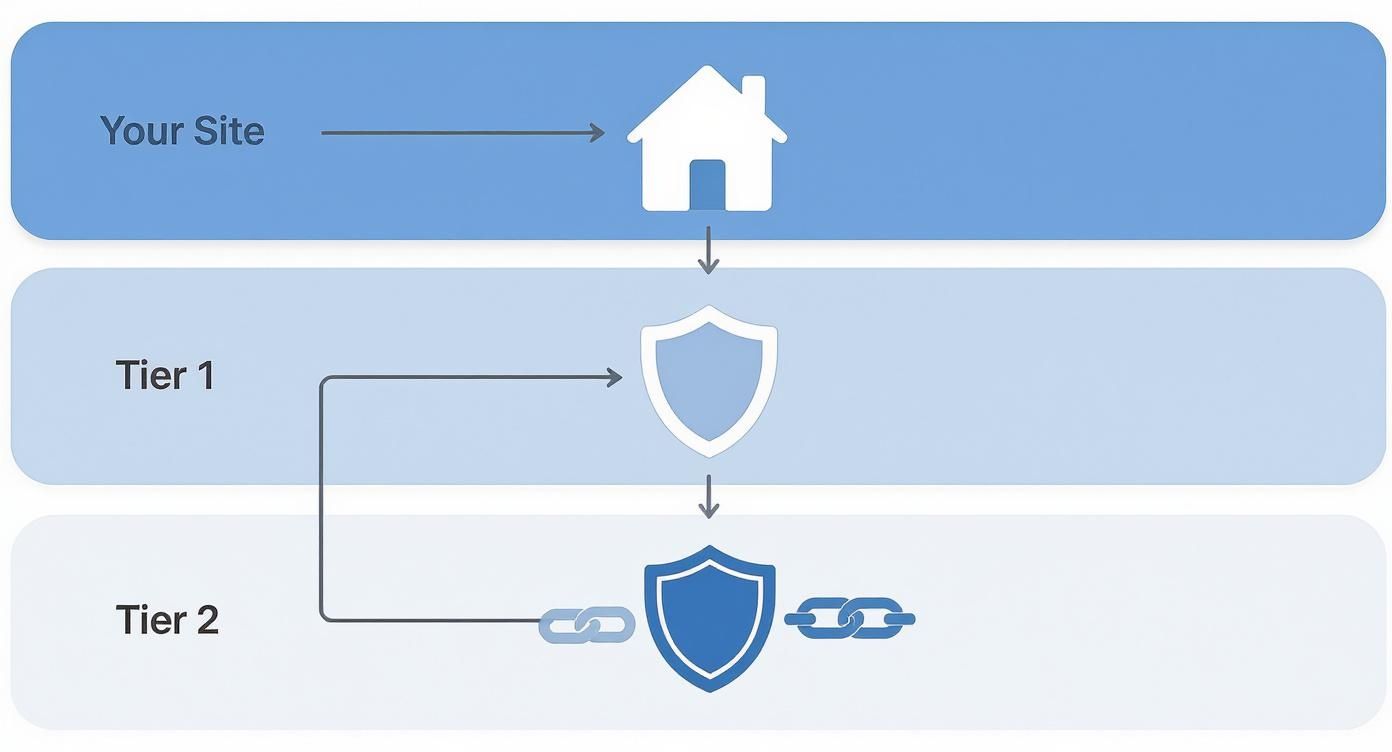
This model makes it clear how each layer supports the one above it, creating a fortified structure that insulates your most valuable online asset.
Setting Quality Standards for Each Tier
One of the biggest mistakes I see people make is applying the same quality standards to every link in the pyramid. It's a waste of time and money.
The core principle is simple: the closer a link is to your money site, the higher its quality must be. You can be much more flexible with links on the outer layers of your structure.
This is what makes the strategy scalable and cost-effective. Here’s a practical breakdown of what that looks like for a restaurant equipment supplier.
Tier 1 Link Quality Checklist
- Source Authority: The site should have a strong Domain Rating (DR) or Domain Authority (DA). Aim for DR 40+.
- Niche Relevance: The linking site has to be directly related to the food service, hospitality, or commercial kitchen industry. No exceptions.
- Content Quality: Your link must sit within well-written, original content that actually helps the reader.
- Organic Traffic: The site should have a history of real, steady organic traffic. This shows it's a legitimate, trusted resource.
Tier 2 Link Quality Checklist
- Source Authority: These can come from sites with lower authority metrics, typically in the DR 10-40 range.
- Topical Relevance: The connection can be broader here. A link from a general small business forum in a thread about kitchen startups is perfectly fine for Tier 2.
- Link Type: You have more options. Forum signatures, user profiles, and well-moderated blog comments all work.
- Indexation: The number one rule for a Tier 2 link is that the page it's on must be indexed by Google. If it isn't, it’s useless.
By setting these tiered standards, you can build a powerful network much more efficiently. You'll focus your budget and heavy-duty outreach on landing a few premium Tier 1 links. Then, you can use more scalable tactics to build a larger volume of Tier 2 links to power them up.
A good ratio to shoot for is building 20-30 supporting Tier 2 links for every one Tier 1 guest post you secure. This creates a powerful and natural-looking link pyramid.
Developing Your Content and Anchor Text Plan
Once your structure is mapped out, it's time to get into the nitty-gritty. A tiered link-building campaign lives or dies by two things: the quality of the content you create and the precision of your anchor text strategy. This is where you shift from being an architect to an artist, carefully blending genuinely helpful content with a technical approach that looks completely natural to search engines.
If you don't have a thoughtful plan here, you risk building a link profile that's either a waste of time or, even worse, looks spammy. The whole point is to make every single link—from a high-authority guest post down to a simple forum comment—work together to strengthen your site's SEO.

Crafting Content for Each Tier
Think of your content in layers, because that's exactly what it is. What works for Tier 1 will be overkill for Tier 2. Your Tier 1 content has to be exceptional—it's the direct bridge to your money site. Tier 2, on the other hand, is all about providing relevance and context, so it doesn't need nearly as much polish.
Tier 1 Content: Your Pillar Assets
This is your A-game material. For a restaurant equipment supplier, a Tier 1 link will almost always come from a well-placed guest post. That article needs to deliver real value and absolutely earn its spot on an authoritative industry blog.
- Solve a Real Problem: Don't just write to write. Create content that tackles a specific headache for restaurant owners or chefs. A guide on "Choosing Energy-Efficient Commercial Ovens to Lower Utility Costs" is infinitely more useful than a generic sales pitch.
- Go Deep with Data: Include original data, insights from industry pros, or a comprehensive checklist. This turns your content into a genuine resource that people will want to reference and link to on their own.
- Write Like a Pro: The article must be well-researched, grammatically flawless, and easy to read. It's representing your brand on someone else's high-quality site, so it needs to look the part.
Tier 2 Content: The Supporting Cast
The only job of Tier 2 content is to make your Tier 1 content look more important. This means it can be much simpler and published across a wider range of platforms. The magic word here is contextual relevance.
- Smart Forum Replies: Find a discussion on a chef forum about kitchen ventilation. A helpful, non-spammy reply that links to your Tier 1 guest post, "The Ultimate Guide to Commercial Hood Systems," is a perfect Tier 2 link.
- Relevant Blog Comments: See a smaller food service blog writing about kitchen design? Drop a comment that adds to the conversation and naturally links to your Tier 1 article.
- Web 2.0 Properties: You can use platforms like Medium or Blogger to publish short, on-topic articles that point back to your main Tier 1 guest post.
The secret to good Tier 2 content is making it feel authentic. It should never seem forced. The link should feel like a natural next step for anyone interested in the topic, offering more depth to the original conversation.
Mastering Your Anchor Text Strategy
This is it. Your anchor text strategy is arguably the most critical part of keeping your tiered link building safe and effective. It's also where most people mess up, creating an over-optimized profile that screams "penalty me!" to Google.
The trick is diversification and strategic placement. Think of it this way: the anchor text pointing to your money site needs to be squeaky clean, while the anchors pointing to your Tier 1 assets can be much more keyword-focused.
Tier 1 to Money Site: Play It Safe
These are the anchors within your high-quality guest posts that link directly to your product or category pages. The goal is to look completely natural. Your anchor text distribution for these precious links should be heavily skewed toward branded and generic terms.
A safe ratio to shoot for looks something like this:
- Branded Anchors (50%): "Your Company Name," or "YourCompany.com"
- Naked URLs (20%): "https://yourcompany.com/commercial-ovens"
- Generic Anchors (20%): "click here," "read more," "this guide"
- Partial Match/Long-Tail Anchors (5%): "commercial convection oven reviews"
- Exact Match Anchors (5% or less): "commercial ovens"
Notice how the money keyword, "commercial ovens," is used very sparingly. Overdoing exact match anchors is the fastest way to get yourself into trouble. It's also crucial to understand the different types of links you get; for a deeper look, our guide on do-follow backlinks breaks down how they pass authority.
Tier 2 to Tier 1: Be More Aggressive
Here's where you get to have a little more fun. Since these links point to your buffer page (the guest post) and not your actual website, you can be much more aggressive with your keywords. This is how you pass targeted relevance up the chain without putting your main site at risk. To come up with a diverse set of these anchors, you'll need to master some long-tail keyword research strategies.
A healthy anchor text profile for your Tier 2 links might look like this:
- Exact Match Anchors (50%): "commercial kitchen ventilation guide"
- Partial Match Anchors (30%): "guide to commercial hoods"
- Generic/Branded (20%): "this article," "read the post on [Guest Post Site Name]"
This aggressive keyword use at Tier 2 powers up your Tier 1 page for those specific search terms. That targeted authority then flows through the much safer, branded anchor text on to your money site. You get the best of both worlds: serious ranking power and a natural, penalty-proof link profile.
Executing and Measuring Your Campaign Safely
Having a killer strategy on paper is one thing, but bringing it to life without getting penalized is a whole different ball game. Successful tiered link building is all about precision and, most importantly, patience. This isn't a race. The goal is to build a backlink profile that looks completely natural over time, leaving no obvious footprints for Google to sniff out.
Let's get one thing straight: you won't see results overnight. It takes time for that link equity to bubble up through the tiers and make a real impact on your money site. We're talking weeks, sometimes even months, before you see the needle move. This is a long-game strategy, built for sustainable growth, not quick wins.

Building a Defensible Link Structure
The number one rule to keep your campaign safe is to avoid creating obvious, easy-to-spot patterns. One of the biggest red flags is having all your Tier 2 links come from the same kind of source. For instance, if all your supporting links are from a bunch of Web 2.0 blogs hosted on the same IP block, you might as well send a postcard to Google announcing your scheme.
Real safety lies in diversification.
- Vary Your Hosting: If you’re using a PBN or other web properties for Tier 2, make sure they live on different hosting providers with unique IP addresses. No excuses.
- Mix Your Link Types: Your Tier 2 shouldn't be a monolith. It needs to be a healthy mix of contextual links, relevant blog comments, forum posts, and even directory listings. A profile with just one type of link just screams "manufactured."
- Pace Yourself: Build links gradually. A sudden blast of 50 new links in a single day, followed by weeks of radio silence, is a massive red flag. Slow and steady always wins this race.
This careful approach is non-negotiable, especially since tiered link building is more common than you might think. A study from Editorial.link revealed that 91.9% of SEO pros believe their competitors are actively buying backlinks. The competition is fierce, and everyone's looking for an edge. By building a natural-looking structure, you ensure your efforts pay off without backfiring.
Key Performance Indicators to Track
You can't improve what you don't measure. Tracking the right KPIs is the only way to know if your campaign is actually working and justify the time and money you're pouring into it. We need to forget about vanity metrics and focus on the data that matters.
Your measurement plan has to cover every level of your link pyramid, from the Tier 2 links all the way to your bottom line.
The most effective measurement plan connects the dots between your Tier 2 efforts and your primary goal: rankings for your money site. If you can’t draw that line, you’re just building links in the dark.
Here are the essential KPIs you absolutely must monitor:
-
Tier 2 Indexation Rate: This is the ground floor. If Google isn't indexing your Tier 2 links, they pass zero value. They're worthless. Use a tool to periodically check if these pages are in the index. You should be aiming for an indexation rate of at least 70%.
-
Tier 1 Authority Growth: Keep an eye on the authority metrics of your Tier 1 pages (your guest posts and resource pages). You want to see an increase in scores like Ahrefs' URL Rating (UR) or Moz's Page Authority (PA). This is hard evidence that your Tier 2 links are doing their job and passing equity.
-
Referral Traffic: While it's not the main goal, check your analytics. Are your Tier 1 assets actually sending any referral traffic to your site? If they are, it’s a great sign that you’ve created genuinely useful content that real people are finding and clicking on.
-
Keyword Ranking Improvements: This is the endgame. You need to be tracking the search engine rankings for the target keywords on your money pages. The pages supported by your Tier 1 links should be climbing the SERPs. This is the clearest indicator of ROI. To get a better handle on how your profile influences this, see our guide on how to check backlinks on Google.
By consistently watching these four areas, you create a feedback loop. You’ll know which Tier 2 sources are giving you the most bang for your buck, which Tier 1 assets are most effective, and how it all translates into tangible ranking boosts for your restaurant equipment business. This data-driven approach turns what can feel like a gamble into a calculated and incredibly powerful SEO strategy.
Powerful Alternatives to Tiered Link Building
While a well-executed tiered link building campaign has its place, let’s be honest—it’s not the only game in town. The sheer complexity and resource drain aren't always a good fit, especially for a busy restaurant equipment supplier.
Sometimes, a more direct and creative approach can deliver even better results without all the multi-layered headaches. Exploring these alternatives helps you pick the right play based on your goals, budget, and how much risk you're comfortable with. For many in our industry, focusing on strategies that generate high-quality, direct links is a much more sustainable path to long-term SEO success.
Earn Your Links with Digital PR
Digital PR is one of my favorite ways to land top-tier backlinks from sources you couldn't otherwise touch. Instead of building links, you earn them by creating something genuinely newsworthy that journalists and industry publications actually want to write about.
For a restaurant equipment supplier, this could be a data-driven report on a hot-button topic. Think about the rise of ghost kitchens or the real-world financial impact of switching to energy-efficient appliances.
Imagine you put together a report called "The 2024 Restaurant Profitability Index," full of original survey data and expert insights. You could pitch that story to major food industry trade publications. A single mention in a respected outlet like Foodservice Equipment & Supplies not only sends you qualified traffic but also gives you an incredibly authoritative backlink.
This approach flips the script. You focus all your energy on landing a handful of premium, natural links instead of managing an intricate pyramid.
Become the Go-To Industry Resource
Another fantastic strategy is to create the absolute best resource on a specific topic. This is the classic "build it and they will come" approach, but with a critical catch: it only works if what you build is truly the most comprehensive guide out there.
Your content needs to be so valuable that other bloggers, editors, and industry experts feel like they have to link to it.
Consider creating pillar content like:
- The Definitive Guide to Commercial Kitchen Ventilation: A true deep dive covering everything from local codes and hood types to maintenance schedules.
- A Complete Checklist for Opening a New Restaurant: An interactive guide that new restaurateurs will bookmark and share with their partners.
- An In-Depth Comparison of Commercial Convection vs. Combi Ovens: A detailed analysis with performance data, cost breakdowns, and real testimonials from chefs.
These aren't just blog posts; they're foundational assets. They demand a serious upfront investment, but the payoff can be huge. A single epic resource can attract dozens of high-quality backlinks on its own as it becomes the trusted reference in your niche.
The goal here is simple: create content so valuable it becomes a linkable asset. When you're the source of truth on a subject, links just naturally follow, building your site's authority without the manual grind of a tiered campaign.
Build Your Network Through Collaborations and Partnerships
Don't underestimate the power of relationships. Collaborating with non-competing businesses, industry influencers, or even culinary schools can unlock incredible link-building opportunities that also build your brand's reputation.
This is where strategic guest posting shines. By contributing genuinely helpful articles to other reputable sites, you can secure powerful backlinks. To really dig into this tactic, check out our in-depth guide to SEO guest posts and how to use them to elevate your authority.
Think about co-hosting a webinar with a popular food cost consultant or partnering with a well-known chef to create a video series on kitchen efficiency. These projects generate buzz, create amazing content, and produce natural linking opportunities from your partners' websites and social channels. Every collaboration strengthens both your network and your backlink profile. It's a powerful cycle that builds lasting authority.
Got Questions About Tiered Links? Let's Clear Things Up.
Diving into a strategy like tiered link building always stirs up a few questions. It's a more complex approach than just standard link building, so it's smart to get a handle on the details before you start. Let's tackle some of the most common things people ask.
Is This a Black Hat Strategy?
This is the big one, and the honest answer is: it depends entirely on how you do it.
Tiered link building has a reputation for living in that "gray hat" SEO space. If you're using automated software to blast out thousands of junk links to your Tier 2 and Tier 3 properties, then yes, you're firmly in black hat territory. That's a surefire way to get penalized.
But that's not what we're talking about here. When your approach is manual and strategic—say, building a handful of solid Tier 2 links from relevant Web 2.0s or well-placed forum comments to boost a high-quality guest post—you're simply amplifying your best assets. It's all about quality over quantity.
How Many Tier 2 Links Do I Need for Each Tier 1?
There's no single magic number, but from my experience, a good range to aim for is 10 to 30 Tier 2 links for every one Tier 1 link you're trying to boost.
Why that many? Well, just building two or three isn't going to move the needle much. On the flip side, hammering a single guest post with hundreds of spammy links is a huge, unnatural red flag for Google. The 10-30 range seems to be the sweet spot—enough to make a real impact without looking suspicious.
How Long Does This Actually Take to Work?
This is not a get-ranked-quick scheme. You have to be patient. With a direct link pointing to your site, you might see a little bump in a few weeks. Tiered linking is a different beast.
The "link juice" has to flow from your Tier 2 links, power up your Tier 1 asset, and then pass that amplified value over to your main website. It's a multi-step process.
Plan on waiting at least 2-3 months before you really see a noticeable shift in your rankings for your target keywords. Think of it as a long-term investment in your site's authority.
Can I Get My Site Penalized Doing This?
Absolutely, if you get sloppy. The risk of a penalty is the whole reason this strategy is built in layers—to protect your main site.
The biggest mistakes I see people make are:
- Firing up automated tools that create a massive, spammy footprint.
- Getting lazy with anchor text and using the same exact phrase over and over.
- Building links way too fast, creating an unnatural velocity that Google spots from a mile away.
The beauty of the tiered structure is that it acts as a buffer. Your riskier, lower-quality links never point directly at your money site. If Google devalues a batch of your Tier 2 links, the only thing that takes a hit is your Tier 1 property, not your business's website.
At Restaurant Equipment SEO, we've perfected the art of building powerful, safe link structures that get results specifically for the food service industry.
Ready to see how a professional link building strategy can push you up the rankings? Contact us today to get started.