
Mastering Web Content Creation for Restaurant Equipment Sellers
When we talk about web content creation, we're not just talking about filling up your website with blog posts and product descriptions. For restaurant equipment sellers, it's about building a library of strategic assets. These are the very tools that will pull in qualified buyers, earn their trust, and ultimately, drive sales.
Building Your Content Foundation for Equipment Sales

Before you write a single word, you need a solid game plan. Jumping into content creation without a strategy is like trying to build a commercial kitchen without a blueprint—it’s a recipe for chaos and rarely ends well. The goal here is to move past random blogging and develop a deliberate approach that actually fuels your business goals.
A strong foundation ensures every piece of content, whether it’s a deep-dive on commercial ovens or a comparison of walk-in coolers, serves a specific purpose. We're not just chasing traffic; we're attracting the right traffic.
And this isn't just a hunch. The global content marketing industry has absolutely exploded, skyrocketing from $36.8 billion in 2018 to a projected $600 billion by 2024. This massive growth proves that businesses are all-in on using content to connect with customers, and it's a trend you can't afford to miss.
Define Your Ideal Customers with Buyer Personas
Let's be real: you don't sell to a generic "restaurant owner." You sell to very different people with unique problems, budgets, and ambitions. That's why effective web content creation always starts with understanding exactly who these people are through detailed buyer personas.
Go beyond the basic demographics. A good persona should feel like a real person with specific goals, pain points, and daily frustrations. For instance:
- "Startup Sofia," the Independent Pizzeria Owner: She's extremely budget-conscious and overwhelmed by all the choices out there. She’s looking for durable, multi-functional equipment to maximize her tiny kitchen. Her biggest fear? Making a costly purchasing mistake she can't recover from.
- "Operations Owen," the Multi-Location Catering Manager: His world revolves around efficiency, reliability, and easy maintenance across multiple sites. He needs equipment that can handle punishingly high volume and demands to see clear ROI calculations to justify the expense.
Once you have these profiles, your content strategy writes itself. Sofia needs a blog post on "Best All-in-One Pizza Ovens for Small Kitchens," while Owen is searching for "Calculating the ROI of a High-Capacity Combi Oven."
Key Takeaway: Deeply understanding your audience is the single most important step. When you know their problems intimately, you can create content that provides genuine solutions and builds immediate trust.
Audit Your Existing Content for Gaps and Opportunities
Before you start churning out new material, take stock of what you've already got. A content audit is simply a systematic review of your current website content to see what’s working, what isn’t, and where you can improve.
Your audit should answer a few critical questions:
- What's actually working? Pinpoint your top-performing pages for traffic, engagement, and leads. What topics or formats are clearly resonating?
- What's dead weight? Find the pages that get little to no traffic or have terrible bounce rates. Can they be updated and salvaged, or should they be consolidated or even deleted?
- Where are the obvious gaps? Now, compare your existing content library against your buyer personas' needs. Are you missing crucial information that "Startup Sofia" or "Operations Owen" would be searching for?
This process is fantastic for finding low-hanging fruit and strategic gaps. Maybe you have tons of great content on refrigeration but absolutely nothing on commercial ventilation. Boom—that's a clear opportunity for a whole new topic cluster. A good audit ensures your efforts are focused where they'll have the most impact. If you want to go deeper, check out our guide on how to build an SEO content strategy.
Uncovering Keywords and Topics Your Customers Search For
 Now that you have a solid picture of your ideal customer, it’s time to get inside their head and figure out what they’re actually typing into Google. This isn't about guesswork; it's about smart keyword research. This is the engine that drives any good web content creation plan.
Too many sellers get hung up on broad, hyper-competitive terms like "commercial freezer." Sure, it's relevant, but it's a beast to rank for and usually just attracts window shoppers. The real magic happens with long-tail keywords—those longer, more specific phrases that tell you exactly what a buyer needs.
Think about it. A search for "commercial freezer" is vague. But a search for "best undercounter freezer for a small cafe"? That tells you everything. You know their business type, their space constraints, and that they're deep into the buying cycle. That's the level of insight you're aiming for.
Decoding Customer Search Intent
Knowing why someone is searching is just as critical as knowing what they're searching for. This is called search intent, and it’s the key to creating content that actually helps people and leads to sales.
Every search query falls into a handful of categories, and each one demands a different kind of content.
Mapping Content Types to Buyer Intent
This table breaks down how to align your content with what your customer is trying to do at each stage.
| Search Intent | Customer Question Example | Best Content Type | Keyword Example |
|---|---|---|---|
| Informational | "How do I clean my deep fryer correctly?" | How-To Guide or Blog Post | "how to clean a commercial deep fryer" |
| Commercial | "Which brand is better, Avantco or True?" | Comparison Guide or Review | "Avantco vs True Refrigeration review" |
| Transactional | "Where can I get a good deal on this oven?" | Optimized Product Page | "buy Blodgett convection oven online" |
| Navigational | "Where is the login for my account?" | About or Contact Page | "websitename login" |
Matching your content to these intents means you're there with the right answer at the right time, guiding them from their first question to the final purchase. If you want to really dig into this, we've got a comprehensive guide on how to build a keyword list that generates real traffic.
Structuring Content with the Topic Cluster Model
Once you have your keywords, you need a smart way to organize them into a content plan. The topic cluster model is a powerful SEO strategy that builds your authority and boosts your rankings. It's all about creating a central "pillar" page for a broad topic and surrounding it with "cluster" articles that cover specific subtopics in more detail.
Think of it like this: your pillar page is a massive, in-depth guide called "The Ultimate Guide to Commercial Kitchen Ventilation." It covers the subject from A to Z, touching on everything from hood types to fire suppression.
Key Insight: The topic cluster model is more than just good organization. It’s a way to signal deep expertise to Google. When you build this interconnected web of content, you're showing search engines you're the go-to resource, which they reward with better rankings.
From that central pillar page, you'll link out to more focused cluster posts that target those valuable long-tail keywords we talked about.
Pillar Page: "The Ultimate Guide to Commercial Kitchen Ventilation"
Supporting Cluster Articles:
- "How to Choose the Right Type 1 Hood for Your Restaurant"
- "Understanding Commercial Kitchen Makeup Air Requirements"
- "A Step-by-Step Guide to Cleaning Your Kitchen Exhaust System"
- "Comparing the Top 5 Commercial Ventilation Brands"
Each cluster post links back to the pillar page. This creates a strong internal linking structure that tells Google your pillar page is the definitive authority on ventilation. This helps the pillar page rank for that big, competitive term, while the cluster articles pull in highly targeted traffic for their specific long-tail keywords. It's a win-win.
Creating High-Impact Content That Resonates
Okay, you've got a solid strategy and a killer list of keywords. Now for the fun part: actually creating the content. This is where you roll up your sleeves and turn all that research and industry knowledge into genuinely helpful resources for busy restaurant professionals.
The goal isn't just to churn out blog posts. It’s to become the go-to answer for their most pressing questions, the resource they bookmark and share. For anyone selling restaurant equipment, this means going way beyond generic product descriptions and proving you understand the real-world challenges of running a commercial kitchen.
Focus on High-Value Content Formats
Let's be honest, not all content types are created equal. Some are just far more effective at guiding a potential buyer from "I have a problem" to "This is the exact piece of equipment I need." Instead of throwing spaghetti at the wall, focus your energy on these three proven frameworks.
-
In-Depth Buying Guides: These are the bedrock of a great content plan. Think big. A comprehensive guide like "The Ultimate Guide to Commercial Ice Machines" instantly positions you as the expert. You need to cover everything a buyer is wondering about—types of ice, capacity calculations, energy efficiency, water filters, and maintenance schedules—all in one place.
-
Direct Product Comparisons: Your customers are always weighing their options. An honest, head-to-head comparison like "Vitamix vs. Blendtec for High-Volume Smoothie Shops" is pure gold. This type of article intercepts buyers who are very close to pulling the trigger. The key is to be objective. Lay out the pros and cons, and clearly explain which machine is the better fit for specific scenarios (e.g., a quiet café vs. a bustling juice bar).
-
Actionable How-To Articles: Practical, step-by-step content builds an incredible amount of trust. An article on "A Practical Guide to Maintaining Your Walk-In Cooler" solves a real, and often expensive, pain point. This simple act transforms you from just another seller into a helpful partner, which builds loyalty long before they ever need to buy new equipment.
These formats work so well because they perfectly match the kinds of questions restaurant owners and kitchen managers are typing into Google. You’re giving them exactly what they need, right when they need it.
Weave in Your Expertise, Authority, and Trust
In an industry where a single purchase can cost thousands, trust is non-negotiable. Your content needs to scream expertise, authority, and trustworthiness (what Google calls E-A-T). This isn't about using fancy jargon; it's about proving you know your stuff inside and out.
Showing real expertise means going beyond the spec sheet. Anyone can list features. You need to explain the why. For instance, in a guide about convection ovens, don't just mention it has a two-speed fan. Explain that this feature is an absolute game-changer for a bakery that needs to produce delicate macarons without cracking them. That’s an insight born from experience.
My Two Cents: Some of the most persuasive content I've ever seen comes from real customer stories. Forget marketing copy for a minute. Write a quick case study about the local pizzeria that doubled its nightly output after upgrading to a specific deck oven you sell. That kind of real-world proof is more powerful than anything else you could write.
Here are a few practical ways to inject that E-A-T into every piece you create:
- Feature Industry Pros: Get a quote from a seasoned chef or a health inspector. Their third-party validation is incredibly powerful.
- Showcase Customer Wins: Write up detailed case studies. How did your equipment solve a specific, nagging problem for a client?
- Use Your Own Data: If you have internal data on equipment failure rates or common repair costs, share it. Unique insights make you an indispensable authority.
This approach gives a potential customer the confidence they need to make a big-ticket purchase. It shows you’re a partner who is genuinely invested in their success.
Don't Forget Visuals
The restaurant world is a visual, hands-on place. Your content needs to reflect that. While text is critical for getting found on Google, visuals often get the point across much faster and more effectively. In fact, research shows that viewers retain 95% of a message from a video compared to just 10% from text.
Please, step away from the generic stock photos. Invest a little time and effort into creating visuals that actually help your audience.
- Equipment Demo Videos: Show your products in action. A simple two-minute video showing how easy it is to clean a commercial fryer is more compelling than a thousand words ever could be.
- Helpful Infographics: Break down a complex topic, like "Designing an Efficient Commercial Kitchen Layout," into a simple, shareable graphic. These are magnets for links and social media shares.
- High-Quality Photos: Use your own photos of the equipment, preferably in a real kitchen. Get close-ups of the details that matter—the control panel, the welding, the interior construction.
Visuals do more than just break up long walls of text. They make your articles more engaging and easier for busy professionals to scan. More importantly, they provide the tangible proof a buyer needs to feel comfortable and confident in their decision. When you combine sharp writing with compelling visuals, you create an unbeatable resource.
Building an Efficient Content Workflow with AI
A sustainable content strategy really comes down to one thing: efficiency. If you want to consistently publish high-impact guides and comparisons, you need a smart process. This is where artificial intelligence can be a real game-changer, but only if you use it the right way.
The goal isn't to replace your team's expertise—it's to amplify it. Think of AI as an assistant, not the author. For a specialized B2B market like restaurant equipment, it can be a lifesaver for getting past writer's block or structuring a first draft. But it completely lacks the real-world, hands-on experience that builds trust with your audience. Your human touch is what makes the content valuable.
AI in content creation is already the norm. In 2024, a staggering 83.2% of content marketers reported using AI, which is a huge leap from 64.7% in 2023. This is especially true in e-commerce, where 47% of sellers are already using AI for product writing.
Designing Your AI-Assisted Editorial Workflow
A solid workflow gives you clear steps and makes it obvious who is accountable for what, ensuring a piece of content moves from a simple idea to a published asset without getting stuck. When you define roles, you eliminate bottlenecks and can keep a consistent publishing schedule. The real magic happens when you blend AI's speed with your team's deep industry knowledge.
Here’s a practical workflow you can adapt for your own team:
- Strategic Brief (Human-Led): This is where it all starts. Your marketing lead or content strategist maps out the core of the article. That means defining the target keyword, the specific buyer persona you're talking to, their main pain points, and a list of specific equipment or features to cover.
- AI-Powered Outline: Once the brief is ready, use an AI tool to generate a detailed outline. This step is a huge time-saver. It quickly organizes the structure and suggests logical headings and subheadings, making sure you cover the topic from all angles.
- Expert Drafting (Human + AI): Now, hand it over to your subject matter expert. This could be a seasoned sales associate or a service technician. They use the outline to draft the content, leaning on AI to flesh out basic sections but weaving in their own unique insights, real-world stories, and specific examples that AI could never come up with.
- Rigorous Fact-Checking (Human-Only): This step is non-negotiable. A dedicated editor must review the draft for technical accuracy, brand voice, and clarity. They're the gatekeeper, ensuring every claim is correct and that the content genuinely helps the reader.
- SEO & Final Polish: The last pass involves checking all the on-page SEO elements—meta descriptions, internal links, image alt text. The goal is to make sure the polished, human-verified content is perfectly optimized for both search engines and your audience.
Following a process like this ensures your content remains authentic and authoritative. If you're looking to scale this even further, there are specialized approaches for creating https://restaurantequipmentseo.com/pages/ai-generated-restaurant-equipment-articles the right way.
Visualizing Your High-Impact Content Process
To make this even clearer, here’s a simple visual of how these high-impact content types fit together.
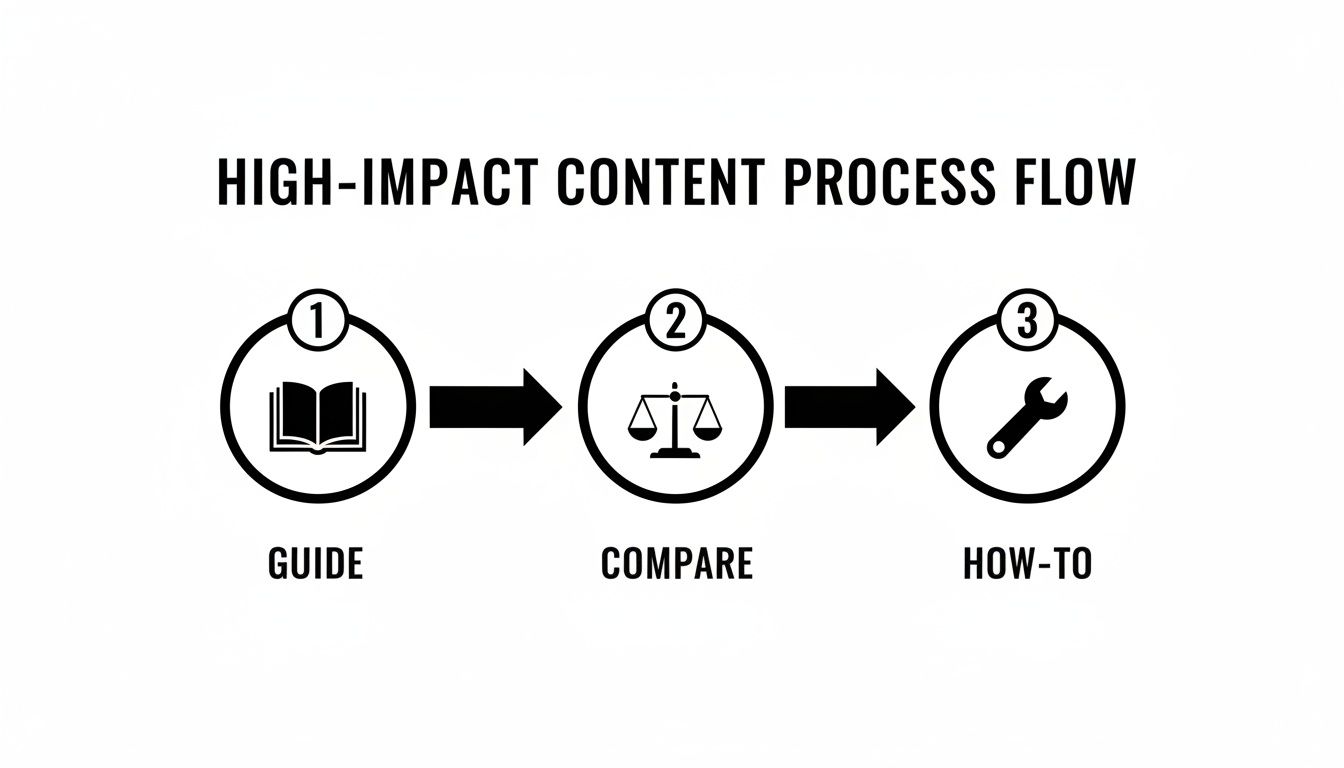
This workflow zeroes in on the core formats that build authority and drive sales in our industry. By focusing your energy on creating comprehensive guides, detailed comparisons, and practical how-to articles, you’re effectively covering every stage of your customer's journey.
Key Takeaway: AI is a powerful accelerator, but human expertise is your real competitive advantage. A structured workflow lets you produce more content without watering down the expert insights that make your brand the one customers trust.
By integrating AI thoughtfully, you can build a content engine that runs smoothly, allowing you to scale your efforts without sacrificing the quality your audience expects. To take it a step further, you can even explore new formats by leveraging script to video AI content creation.
Getting Your Content in Front of the Right People

Let's be honest. You could write the world's most detailed guide on commercial convection ovens, but if no one sees it, it’s a waste of time. Publishing is only half the battle. Now comes the work of getting it into the hands of your audience through smart optimization and targeted promotion.
This is where you build a distribution engine that ensures every article pulls its weight. The goal is simple: when a stressed-out kitchen manager is searching for answers late at night, your content is what they find.
Perfecting Your On-Page SEO Checklist
Before any article goes live, it needs a final SEO pass. This isn't just about feeding the Google algorithm; it's about making your content clearer and more accessible for actual human beings. Think of it as your pre-flight check to give every piece the best possible chance of ranking.
Your checklist should be quick, repeatable, and focused on what truly moves the needle. For every single article, run through these fundamentals:
- SEO-Friendly Title: Is your main keyword near the beginning? Does the title hook the reader while still being a clear description of what's inside?
- Compelling Meta Description: This is your 155-character ad on Google. It needs to include your keyword and give someone a compelling reason to click your link over the others.
- Proper Header Tags: Keep it clean. One H1 for the main title, H2s for major sections, and H3s for sub-points. This hierarchy creates a logical roadmap for both readers and search engines.
- Descriptive Image Alt Text: Every image needs alt text. It’s crucial for accessibility and tells search engines what the image is about. Instead of "oven," write something like, "chef inspecting a walk-in cooler condenser coil."
- Smart Internal Linking: Connect the dots for your visitors. Link to at least two or three other relevant pages on your site, whether it's a product page for that ice machine you just mentioned or another blog post on kitchen efficiency.
This whole process should take 15 minutes or less per article, but the cumulative effect on your organic traffic over time is massive.
Key Insight: On-page SEO isn't a one-and-done task. It's about building a consistent habit of excellence. Small, repeated optimizations across dozens of articles compound over time to create a powerful ranking advantage.
Driving Traffic with Multi-Channel Promotion
Once your content is live and optimized, it's time to get it out there. Waiting for Google to find you is a slow, painful game. A proactive promotion strategy is how you jumpstart the process and build brand recognition where your customers are already spending their time.
The key is to find the specific channels where restaurant owners, chefs, and facility managers are looking for information. Spraying and praying your links across the internet is just noise. Targeted sharing, on the other hand, starts a conversation.
A Promotion Strategy for the Food Service Industry
Not all promotion tactics are created equal, especially in a B2B space like this. Forget trying to go viral on TikTok; focus on the platforms where real professional conversations are happening.
Targeted LinkedIn Engagement:
- Join Industry Groups: Become a helpful member of groups like "Restaurant & Hospitality Network" or "Foodservice Equipment & Supplies Professionals."
- Share Actionable Insights: Never just drop a link and run. Pull out a key tip from your article and ask a question to get people talking. For example: "Our new guide covers preventative maintenance for ice machines. What’s the one trick that has saved you the most on repair calls?"
Value-Driven Email Newsletters:
- Go Beyond the Sale: Your newsletter should be more than a list of special offers. Make your latest how-to guide the star of the show. You’ll position yourself as a go-to resource, not just a vendor.
- Segment Your List: Don't send an article about bakery equipment to your pizzeria clients. Segment your list and send people content that's actually relevant to their operation.
Industry Collaborations:
- Partner with Publications: Get in touch with food service trade publications or even popular chef blogs. Offer to write a guest post or team up on a guide that helps both of your audiences.
By zeroing in on these channels, you aren't just hoping for traffic—you're strategically placing your expertise directly in front of potential buyers. And to really squeeze every drop of value out of your work, solid content repurposing strategies can be a game-changer, turning one article into a dozen different assets.
Got Questions? We've Got Answers
Jumping into a full-scale content strategy can feel like staring at a blank menu. You know what you want to achieve, but figuring out the first few steps is tough, especially in a niche industry like ours. It's easy to get sidetracked by the details.
Let's cut through the noise and tackle the big questions we hear all the time from sellers. Getting these sorted out will help you move forward and focus on what really matters: creating content that actually sells equipment.
How Often Should We Be Publishing New Stuff?
This is the big one, and the answer isn't what most people expect. Consistency will always beat frequency.
For most equipment dealers, a great (and ambitious) goal is to publish one solid, in-depth article every week. But let's be realistic. If you're a smaller operation, one or two really comprehensive posts a month is a fantastic start.
It's far better to publish one killer 2,000-word buying guide that solves a real problem than it is to churn out four flimsy, 500-word blog posts that don't help anyone. The goal is to become a genuinely useful resource for your customers, and that means sticking to a schedule you can actually manage long-term.
What Kind of Content Actually Works Best?
There's no magic bullet here. The best strategy is a mix of different content types that meet buyers at different stages of their journey. Your web content creation plan should be diverse.
These are the formats that consistently deliver for restaurant equipment sellers:
- In-Depth Buying Guides: These are your money-makers. They catch buyers who are actively comparing models and are close to pulling the trigger. Think "The Ultimate Guide to Choosing a Commercial Convection Oven."
- Direct Product Comparisons: Articles that go head-to-head, like a "Blodgett vs. Vulcan" comparison, are perfect for customers who have their options narrowed down and just need that final nudge.
- How-To and Maintenance Guides: This type of content attracts people with an immediate problem, like "How to Clean a Deep Fryer." It instantly positions you as the expert they can trust.
Don't sleep on video. A simple walkthrough showing how to uncrate and set up a new ice machine or a quick tutorial on daily maintenance can be incredibly powerful. It shows the equipment in a real-world context, answering questions that pictures and text just can't.
A well-rounded plan uses all of these to build authority and trust, making sure you have something valuable for everyone, from the person just starting their research to the chef ready to buy today.
How Long Before We See Any SEO Results?
I'll be straight with you: SEO is a long game. While you might see a small trickle of traffic within a few weeks, you're typically looking at 6 to 12 months before you see significant, business-moving results from your content. This is a marathon, not a sprint.
A few things will affect that timeline:
- Your website's current authority. Is it a brand-new site or one that's been around for a while?
- How tough the competition is for the keywords you're after.
- The quality of your content. Is it truly the best answer on the internet for that topic?
Think of the content you publish today as a long-term investment. Every great guide you create is an asset that will keep bringing in qualified traffic and leads for years to come. Just stay consistent, focus on quality, and watch the results compound over time.
At Restaurant Equipment SEO, we turn these principles into a growth engine for dealers just like you. Our strategies are built from the ground up to attract qualified buyers and make you the definitive authority in the food service space.
Ready to see what a dedicated content and SEO plan can do for your bottom line? Learn more about our approach at https://restaurantequipmentseo.com.