
What Is Reciprocal Link Building and Does It Still Work for SEO
At its core, a reciprocal link is a simple "you scratch my back, I'll scratch yours" agreement between two websites. It’s a two-way street: Site A links out to Site B, and in return, Site B links right back to Site A. This mutual exchange, often called a link exchange, is one of the oldest tactics in the book for sharing traffic and, hopefully, boosting SEO authority.
What Are Reciprocal Links in SEO
Think of it this way. Imagine two local businesses that complement each other but don't directly compete. One sells high-end commercial ovens, while the other specializes in custom walk-in freezers. To better serve their customers, the oven supplier puts up a flyer recommending the freezer expert. The freezer expert does the same for the oven shop. That's a reciprocal link in the real world, and it works the same way online.
This strategy goes way back to the early days of the internet, when search engines were a lot less sophisticated. Back then, the number of links pointing to your site was a huge ranking signal. A quick "I'll link to you if you link to me" deal was a straightforward and effective way to beef up your backlink profile.
Why Context Matters Today
But things have changed. A lot. Today, Google's algorithms are incredibly advanced and prioritize the quality and relevance of links far more than the raw number. They've gotten exceptionally good at spotting patterns that look like someone is trying to game the system. A website with tons of unnatural reciprocal links can get flagged for participating in a "link scheme," which can lead to some serious penalties in search rankings.
That doesn't mean all reciprocal links are toxic, though. When they happen organically between two relevant, authoritative sites, they can still be a good thing. For instance, a link between a popular food blogger and a restaurant equipment supplier makes perfect sense—it provides genuine value to the audience.
It all boils down to intent. Is the link there to genuinely help the reader, or is it just a transparent attempt to manipulate search rankings? Google can almost always tell the difference.
A fascinating study by Ahrefs revealed that 73.6% of domains with high authority have reciprocal links. This shows that linking back to sites that link to you is a natural, common occurrence on the web. The deal-breaker isn't the link itself, but the context and relevance behind it.
For a quick overview, here's a breakdown of the key points.
Reciprocal Linking at a Glance
| Aspect | Description |
|---|---|
| Definition | A mutual agreement where two websites link to each other. |
| Historical Use | An early SEO tactic focused on building a high quantity of backlinks. |
| Modern View | Viewed with caution by search engines; can be penalized if done excessively or unnaturally. |
| Key Factor | The relevance and context of the link are more important than the reciprocity. |
| Best Practice | Link to partners, suppliers, and other relevant sites where it provides real value to users. |
Ultimately, a reciprocal link is only as good as the reason it exists. If it's a logical connection that helps your audience, you're likely in the clear. If it’s part of a forced, large-scale scheme, you're playing with fire.
The Rise and Fall of a Classic SEO Tactic
Back in the early days of the internet, SEO was a much simpler game. Think of search engines as new librarians trying to figure out which books were most popular. Their primary method? Counting how many other books referenced them. These references, or backlinks, were "votes," and the more votes a website had, the more important it seemed. This created the perfect environment for reciprocal linking to become a go-to strategy.
A quick "I'll link to you if you link to me" email was all it took. Website owners would trade links with anyone and everyone, sometimes racking up hundreds of them to shoot up the search rankings. For a while, this numbers game worked like a charm. It was all about quantity, not quality—a mindset that pretty much defined early link building.
The Turning Point for Link Exchanges
Of course, this "Wild West" of SEO couldn't last forever. Search algorithms started getting a lot smarter, learning to understand the context and actual intent behind a link. The widespread use of reciprocal linking as a shortcut to the top of the search results didn't go unnoticed. Eventually, the search engine quality teams caught on.
Google's Webmaster Guidelines (now called Spam Policies for Web Search) began to specifically call out "excessive 'link to me and I'll link to you' exchanges" as a form of link spam. This was a massive shift. You can dig deeper into how these policies changed and what constitutes a spammy link exchange on rhinorank.io.
Suddenly, websites that had built their authority on a foundation of low-quality, irrelevant link swaps saw their rankings tank. What was once a golden ticket to page one became a serious risk. Search engines weren't just counting votes anymore; they were now checking the voter's credentials.
The core issue was never that two sites simply linked to each other. The problem was the manipulative intent—the large-scale, low-relevance exchanges designed for one reason only: to game the system.
A New Focus on Quality and Relevance
This crackdown didn't spell the end of reciprocal linking, but it certainly forced it to grow up. The death of these old-school tactics ushered in a new era where quality, relevance, and natural intent became the name of the game. Now, a reciprocal link between, say, a commercial kitchen designer and a restaurant equipment supplier makes perfect sense because it genuinely helps their shared audience.
Today, a single, high-quality reciprocal link from an authoritative, relevant website is worth infinitely more than a hundred random links from junk domains. The practice evolved from a simple quid pro quo to a strategic partnership. The goal is no longer to fool an algorithm but to provide real value to a real person, which is how it should have been all along.
Understanding the Risks and Rewards

A reciprocal link is a double-edged sword. Get it right, and a link from a relevant, high-authority website can give you a real boost. But get it wrong, and a poorly planned exchange can torpedo your SEO efforts, setting you back months. It’s not the link itself that’s the problem; it’s the intent and quality behind it.
Think of it like a business referral. A shout-out from a respected industry peer can send a flood of perfect customers your way. On the flip side, an endorsement from a shady operator can tarnish your reputation. Reciprocal links are the digital equivalent—who you associate with online matters. A lot.
The Potential Rewards of a Smart Exchange
When you do it the right way, a reciprocal link is so much more than just a backlink. The real value comes from building relevant partnerships that create a win-win for everyone.
- Boosted Referral Traffic: A link from a relevant site puts your brand directly in front of an audience that's already interested in what you offer. These aren't just random clicks; they're highly qualified visitors ready to engage.
- Strengthened Topical Authority: When you and a partner in your industry link to each other, you're both sending a powerful signal to Google. It says, "Hey, we're both experts on this topic."
- Enhanced Credibility: Associating your brand with other respected names in the field builds trust. It’s a digital vote of confidence that both human visitors and search engines pick up on.
Imagine a commercial oven seller and a ventilation hood installer linking to each other. That exchange is genuinely helpful for a restaurant owner planning a kitchen. This is exactly the kind of natural, value-driven partnership that modern SEO is all about.
The Significant Risks of a Poor Strategy
The danger zone with reciprocal linking is when your focus shifts from helping the user to just trying to manipulate rankings. Search engines are smarter than ever and have gotten incredibly good at sniffing out—and punishing—these schemes.
The critical factor determining whether reciprocal links help or hurt SEO is intention. Natural reciprocal links between sites with genuinely related content are considered harmless and potentially beneficial, while artificial exchanges designed primarily for ranking manipulation are flagged as black hat SEO practices. Discover more insights about safe linking strategies on bluehost.com.
Getting caught up in low-quality link schemes can lead to some serious headaches.
- Google Penalties: If Google catches you engaging in excessive or unnatural link exchanges, they can hit you with a manual penalty. Your rankings can disappear overnight.
- Eroded Domain Authority: Linking out to spammy or low-quality sites is like moving into a "bad neighborhood" online. Your own site's authority can be damaged just by association.
- Manipulative Backlink Profile: A backlink profile packed with reciprocal links looks completely unnatural. It screams to search engines that you're trying to game the system instead of earning links on merit.
A Modern Playbook for Safe Reciprocal Linking
In today's SEO world, you have to be smart about reciprocal links, not just aggressive. The real goal isn't just to snag a backlink. It's about building a genuine, two-way partnership that actually helps both of your audiences. Forget the old spray-and-pray outreach tactics; the modern approach is all about quality over quantity.
Think of it like forming a strategic business alliance. You wouldn't just partner with any company off the street, right? You’d do your homework, make sure your values line up, and craft an agreement where everyone wins. That’s the exact mindset you need to bring to link building. It's the only way to do it safely and effectively.
Step 1: Find Partners That Actually Make Sense
Everything hinges on finding the right partner. The sweet spot is a website that’s relevant to your world but isn’t a direct competitor. If you sell restaurant equipment, you could team up with a popular food blogger, a commercial kitchen designer, or even a restaurant marketing agency.
You’re looking for sites that have real authority and credibility. A great partner will have:
- Relevant Content: They’re already publishing top-notch articles, guides, or resources that your own customers would find useful.
- An Engaged Audience: You can see signs of life—comments, social shares, and real discussion happening around their content. This proves they have an actual following.
- A Clean Backlink Profile: A quick check shows their own links come from other respectable sites, not a bunch of spammy directories.
Don't skip this vetting process. It’s non-negotiable. Partnering with a low-quality site can backfire and hurt your SEO, so invest the time to research your potential allies.
Step 2: Write Outreach Emails That Don’t Get Deleted
Once you’ve got a shortlist, it's time to reach out. Your first email needs to be about partnership, not just a cold, one-sided request for a link. Ditch the generic templates that scream "I want something from you." Personalize your message and lead with the mutual value you can create together.
A solid outreach email should do three things:
- Show you've paid attention: Reference a specific article or resource on their site that you genuinely liked. It shows you're not just a bot.
- Explain what’s in it for them: Clearly spell out how a partnership could benefit their audience. For instance, "Your guide on commercial kitchen layouts would be an amazing resource for our readers. On that note, I think our detailed oven maintenance checklist could be a great fit for your audience, too."
- Suggest a collaboration: Propose a natural way to work together. Maybe you can reference their content in an upcoming blog post and ask if they have a piece that would be a good fit for one of yours.
This approach flips the script. It’s no longer a transactional "link for a link" deal; it’s the start of a real collaboration, which is way more likely to get a positive response.
Step 3: Place Links Naturally and Keep an Eye on Them
If they’re on board, the final piece is the execution. The link has to feel completely natural and editorially justified. Don't just cram a link into a five-year-old article where it doesn't belong. Place it in a relevant, high-quality piece of content where it genuinely adds value for the reader. The anchor text should also be descriptive and natural—not stuffed with exact-match keywords.
Once the links are live, you're not done. Use your analytics tools to see how much referral traffic is coming from your partner's site. Are these visitors sticking around and engaging with your content? This data tells you the real-world value of the exchange. For a more detailed breakdown, our guide on strategic SEO link exchanges covers more advanced ways to track performance.
By focusing on relevance, mutual value, and natural placement, you transform a potentially risky tactic into a sustainable strategy for building authority and driving qualified traffic.
How To Vet Partners and Avoid Red Flags
Picking the right partner for a link exchange is the most critical part of the entire process. Think of it like co-signing a loan—their online reputation instantly becomes connected to yours. A great partnership can lift your authority and send fantastic traffic your way, but a bad one can absolutely sink your website's credibility. The secret is to be incredibly selective and know exactly what you're looking for.
Vetting a potential partner is more than just a quick glance at their homepage. You need to do some real detective work to see if they're a legitimate, authoritative voice in our industry. Before you even think about swapping links, it's a good idea to get comfortable with analyzing your own backlink profile first, and then applying that same lens to others. This guide on how to find links to your website is a perfect starting point.
What to Look For: Signs of a High-Quality Partner
A high-value partner is a business that adds genuine credibility to your site. They’re the ones publishing original, useful content that shows they actually know what they’re talking about and keeps their audience coming back for more. Their website looks professional, runs smoothly, and has a clean backlink profile of its own.
A great way to get a feel for a site's link health is to learn how to check backlinks on Google and then use those same techniques on any site you're considering.
This flowchart maps out what a safe link exchange process should look like, from finding a partner to placing the link.
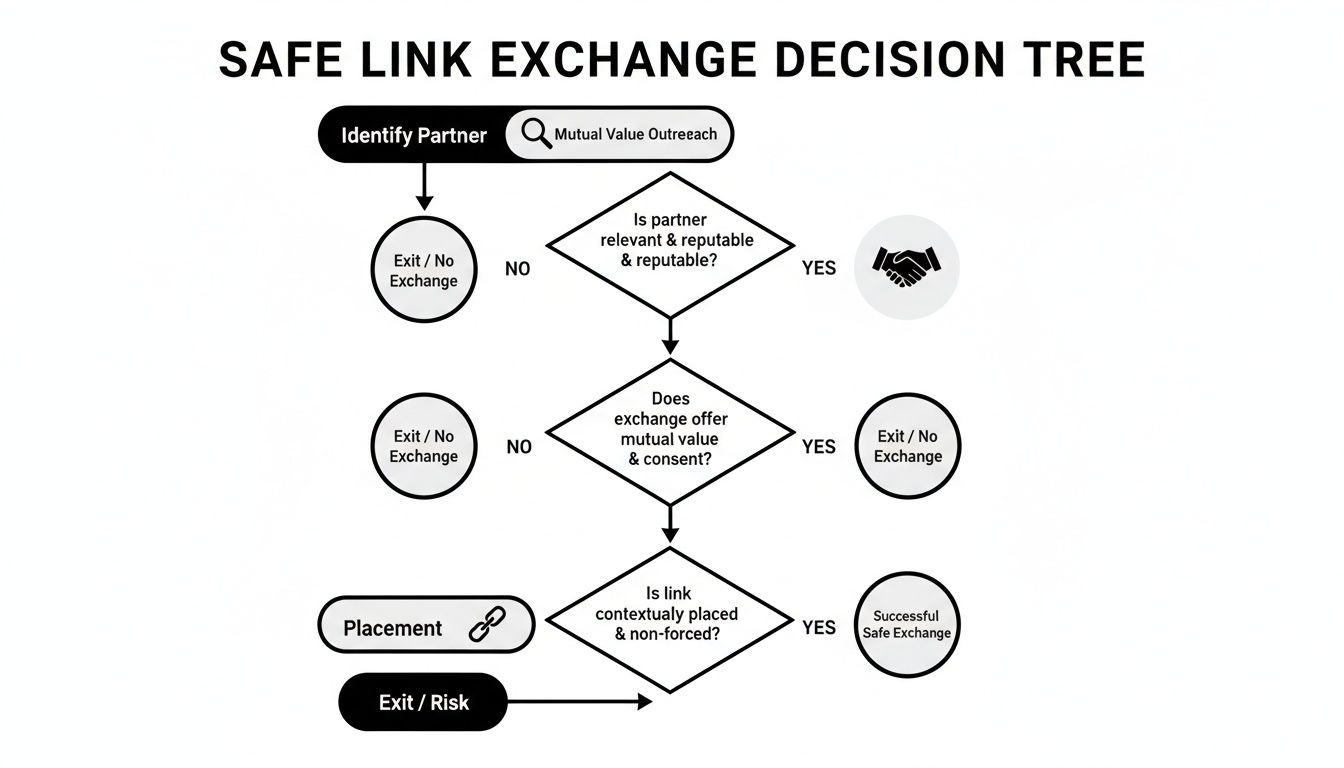
As you can see, every step is built around mutual value and making sure the link feels natural. Those are the two pillars of a partnership that actually works.
What to Avoid: The Big Red Flags
On the flip side, a low-quality partner is usually pretty easy to spot once you know the warning signs. These are the sites that exist for the sole purpose of trying to game the system and offer zero real value to actual human readers. Linking to them isn't just a waste of time—it can actively damage your SEO.
To help you tell the good from the bad, I've put together a quick comparison table. Think of this as your cheat sheet for vetting potential partners.
High-Value Partner vs. Low-Value Partner
| Characteristic | High-Value Partner (Safe) | Low-Value Partner (Risky) |
|---|---|---|
| Content Quality | Publishes original, insightful articles and guides. | Features thin, generic, or poorly written content. |
| Relevance | Directly serves the restaurant, culinary, or hospitality industry. | Covers dozens of unrelated topics with no clear focus. |
| Website Design | Clean, professional, and easy to navigate. | Looks outdated, cluttered, or full of ads. |
| Outbound Links | Links out thoughtfully to relevant, authoritative sources. | Is covered in links pointing to low-quality, irrelevant sites. |
| Spam Score | Has a low spam score in SEO analysis tools. | Registers a high spam score, indicating a toxic profile. |
Ultimately, your gut is a pretty good guide. If a website feels spammy or "off," it probably is. Trust that instinct and move on to find a partner that reflects the quality and integrity of your own brand.
When you're digging in, keep an eye out for these specific red flags:
- Thin or Poor-Quality Content: Are their blog posts super short, full of fluff, and riddled with typos? That's a bad sign.
- Irrelevant Niche: If a website selling pet supplies wants to swap links, there's no logical connection to your restaurant equipment business. Steer clear.
- High Spam Score: Tools like Moz or Ahrefs can show you a site's "spam score." A high number is a serious warning to stay away.
- Too Many Outbound Links: If you see a page that links out to 50 different, unrelated websites, you're looking at a "link farm." Run.
Remember, the goal is to build relationships with sites that are just as committed to quality as you are. Anything less is a risk not worth taking.
Smarter Link Building Alternatives
Look, while a well-placed reciprocal link isn't the end of the world, making it the cornerstone of your SEO strategy is asking for trouble. To build real, lasting authority in the restaurant equipment space, you need to think bigger. The goal isn't to just trade favors; it's to become such a go-to resource that people want to link to you.
The most effective way to do this is by creating what we call link-worthy assets. These are pieces of content so genuinely helpful, insightful, or unique that other websites will link to them without you even having to ask. It's about earning links on merit, not begging for them.
Focus on Earning Links Naturally
Instead of pouring all your time into outreach emails begging for link swaps, shift that energy into building things that naturally attract links. This isn't just a safer approach; it's how you build a rock-solid backlink profile and establish your brand as a true industry leader. For a more comprehensive look at this, our full guide on how to build links covers a much wider range of tactics.
So, what does a link-worthy asset actually look like? Here are a few tried-and-true examples:
- Original Research and Data: Be the source of truth. Run a survey on emerging restaurant trends or analyze your own sales data to reveal what equipment is flying off the shelves. When you publish unique data, you become the primary source that journalists and bloggers have to cite.
- Ultimate Guides: Go deep. Create the single most detailed, comprehensive guide on a topic like "Commercial Kitchen Ventilation" or "Choosing the Right Walk-In Cooler." When your guide is the best resource on the internet for that topic, it naturally becomes the go-to reference.
- Free Tools or Calculators: Give something away that provides real value. A "Restaurant Startup Cost Calculator" or an "ROI Calculator for a New Combi Oven" can become an evergreen source of high-quality backlinks for years.
Shifting your focus from acquiring links to earning them is a fundamental change in mindset. When you create truly valuable content, you're not just building links—you're building a brand that search engines and customers trust.
Forget chasing risky reciprocal links. A much more sustainable game plan involves creating these kinds of exceptional resources and then using proven content distribution strategies to get them in front of the right people. This is how you build an authoritative backlink profile that can withstand any Google algorithm update and stand the test of time.
Got Questions? Let's Talk Reciprocal Links
When you start digging into reciprocal links, a lot of the same questions tend to pop up. Let's clear the air and tackle some of the most common ones so you can move forward with confidence.
So, How Many Reciprocal Links Are Actually Too Many?
This is the million-dollar question, but honestly, there's no magic number. It all comes down to context and intent.
Having a few reciprocal links with genuine partners—think a local restaurant you supply, or a food blogger you collaborated with—is completely normal. It’s expected, even. The problem starts when you go from zero to a hundred overnight, or when a huge chunk of your backlink profile is just tit-for-tat exchanges.
The real red flag isn't the number itself, but the pattern.
Think of it like this: if your site naturally earns about 10 new backlinks a month, and then suddenly you have 100 new reciprocal links in a week, that’s going to look suspicious. It screams "link scheme." Forget about hitting a quota and focus on making each link count.
Can Just One Bad Reciprocal Link Get Me Penalized?
It's highly unlikely that a single bad link will trigger a full-blown manual penalty from Google. But that doesn't mean it's harmless.
Think of it as guilt by association. If you link out to a spammy, low-quality site, it reflects poorly on you. It can chip away at your site's authority and credibility. While one link might not sink the ship, it's part of a larger picture that search engines are constantly evaluating.
Should I Slap a "Nofollow" Tag on These Links?
It depends on the "why" behind the link. If there's any money, sponsorship, or free product involved in the exchange, then yes, you absolutely should use a rel="nofollow" or rel="sponsored" tag. That's a direct instruction from Google to signal that the link is commercial, not an editorial vote of confidence.
But if the link is part of a natural, value-driven partnership where you're genuinely recommending each other, a standard (dofollow) link is perfectly fine. The key is that the partnership has to be real.
Ready to build a backlink profile that search engines love, without walking on eggshells? At Restaurant Equipment SEO, we build powerful, safe link-building campaigns specifically for the food service industry. See how we help our clients earn the kind of links that drive real, sustainable growth at RestaurantEquipmentSEO.com.