
Competitive SEO Research Your Guide to Outranking Industry Rivals
Competitive SEO research is all about systematically dissecting your competitors' search engine strategies to figure out what’s working for them, where they’re falling short, and how you can leapfrog them in the search results. For a restaurant equipment supplier, this means getting under the hood to find the exact keywords your rivals are using to attract chefs, restaurant owners, and food service managers.
It’s about understanding their content playbook and reverse-engineering their backlink profile to build a smarter, more effective strategy of your own.
Why Competitive SEO Research Is Your Secret Weapon
In the hyper-competitive market for food service equipment, just having a website is table stakes. Your ideal customers—from the local coffee shop owner to the procurement manager for a major hotel chain—are online right now, searching for everything from 'commercial convection ovens' to 'industrial kitchen ventilation systems'.
The real question is: are they finding you, or are your competitors getting all the attention?

Think of effective competitive SEO research not as a one-time task, but as an ongoing intelligence operation. It’s what turns your website from a static digital brochure into a powerful, lead-generating machine. This isn't about guessing games or just copying what the top-ranked site is doing. It’s a methodical process that gives you a data-backed roadmap to proactively capture market share instead of just reacting to what everyone else is doing.
From Data to Dominance
When you ground your strategy in solid research, the results speak for themselves. We saw this firsthand with a restaurant equipment supplier who committed to this approach. By diving deep into their rivals' strategies, they uncovered a goldmine of high-value, industry-specific keywords they were completely missing.
The outcome? Over just 11 months, their organic traffic exploded by 390%. This wasn't just any traffic; it was highly qualified buyers ready to make a purchase, which had a massive impact on their bottom line.
To get the most out of this process, it helps to follow a structured competitive analysis framework. This keeps your efforts organized and ensures you’re turning raw data into moves you can actually make.
Core Components of Competitive SEO Research
A truly thorough analysis goes way beyond a simple keyword list. You need to investigate every angle of a competitor's online presence. Think of it like a head chef meticulously inspecting a rival's five-star kitchen—you're checking out their ingredients (content), their cooking techniques (on-page SEO), and their public reputation (backlinks).
The goal of competitive SEO research is not just to see what your competitors are doing, but to understand why it's working and find opportunities to do it better. It's about turning their success into your blueprint for growth.
To give you a clearer picture, here’s a breakdown of what a comprehensive investigation involves.
| Component | What to Look For | Why It Matters |
|---|---|---|
| Keyword Analysis | High-volume & long-tail keywords, branded vs. non-branded terms, question-based queries. | These are the exact terms your audience uses. Winning them means capturing ready-to-buy traffic. |
| Content Audit | Blog post topics, resource guides, product descriptions, video content, and content formats. | Uncovers what topics resonate with your audience and reveals content gaps you can fill. |
| Backlink Profile | Linking domains, industry publications, guest post opportunities, anchor text used. | Backlinks are a huge ranking factor. Analyzing them shows you how to build your site's authority. |
| Technical SEO Health | Site speed, mobile-friendliness, site architecture, structured data (schema). | A technically sound site provides a better user experience and is easier for Google to crawl and rank. |
By methodically digging into each of these areas, you can identify your competitors' weaknesses, replicate their winning tactics, and start turning more online searches into real, sustainable revenue for your business.
Figuring Out Who You're Really Competing With Online
First things first: before you can even think about outranking someone, you need to know who you’re actually up against. It's a common mistake to assume your real-world business rivals are your main SEO competitors. They often aren't.
The local supplier you compete with for contracts might have a terrible website, while some niche industry blog or a massive national distributor is gobbling up all the valuable search traffic.
Your true competitors are simply the websites that show up when your ideal customers search on Google. For a restaurant equipment supplier, that means figuring out who owns the results for "commercial refrigerators," "restaurant bar stools," or "high-capacity ice machines."
Define Your Battleground
The starting point for any good competitive SEO research is setting a few clear goals. Without a target, you're just wandering. What does a "win" actually look like for your business?
Maybe you want to:
- Go after high-intent keywords: This means getting on page one for searches like "buy commercial deep fryer online" where the searcher is ready to pull out their credit card.
- Dominate a whole category: You could aim to be the go-to authority for everything related to 'commercial kitchen ventilation,' from product pages to how-to guides.
- Own local search: If you serve a specific city or region, your main goal might be to dominate the Google Local Pack for searches like "restaurant equipment near me."
Nailing down these objectives from the start gives your research a clear purpose. It's the lens you'll use to look at every competitor and every bit of data you collect.
Unmasking Your Digital Rivals
With your goals in hand, it's time to see who's already winning where you want to be. You probably have a few big names in mind, but the real magic happens when you let the search results tell you the full story.
Pop open an incognito browser window (this keeps your search history from skewing the results) and start searching for your most important keywords. Take a close look at the top 5-10 domains that appear for each one. You'll likely see a mix of direct competitors, huge e-commerce players, and even content-heavy sites. These are your true SEO competitors.
Your SEO competitors aren't just the companies you recognize. They are any domain that occupies the digital real estate you want to claim. This could be a manufacturer, a review site, or an industry publication.
To get this done efficiently, using some of the best free competitor analysis tools is a game-changer. These tools can automate the grunt work of finding who ranks for what, saving you a ton of time and giving you a much clearer picture of the landscape.
Prioritizing the Competition
Once you have a list of domains, you need to sort them out. Not every competitor is worth the same amount of your attention. I like to group them into tiers.
- Primary Competitors: These are the businesses that look just like yours. They sell similar products to the same people and are actively fighting you for the same keywords.
- Secondary Competitors: These sites are also ranking for your keywords, but they aren't direct business rivals. Think of a national big-box store or a specialized e-commerce site that sells more than just restaurant gear.
- Tertiary Competitors: This group is usually made up of blogs, news outlets, and industry publications. They aren't selling anything, but they're ranking for informational keywords and catching your audience early in their research process.
This tiered system helps you focus your most intense analysis on the competitors who matter most—the ones who pose the biggest threat and offer the best lessons.
If you're ready to get into the software that makes this all possible, check out our guide on the best tools for competitor analysis tailored for our industry.
Finding Gold with Keyword and Content Gap Analysis
Think of your competitors' websites as a treasure map. They've already spent the time and money figuring out what search terms attract qualified buyers. Keyword and content gap analysis is how you read that map. It’s the fastest way to find proven topics that will bring new customers to your site.
Essentially, you’re systematically identifying what’s already working for them so you can build something even better and claim a piece of that traffic for yourself.

This process reveals two critical types of opportunities. A keyword gap is when your competitors rank for valuable search terms that your site doesn't. A content gap is broader, highlighting entire topics, formats, or customer questions they’re addressing that you've completely overlooked.
Imagine a top rival gets thousands of visits a month from a detailed guide on "how to maintain commercial ice machines," while all you have is a basic product listing. That's a massive gap you can exploit by creating a more helpful, in-depth resource.
Uncovering Lucrative Keyword Gaps
First things first, you’ll need a solid SEO tool. Fire up Semrush or Ahrefs and find their "Keyword Gap" or "Content Gap" feature. This is built specifically for this kind of reconnaissance.
You just plug in your domain and two or three of your top competitors. The tool will spit out a massive list of keywords they rank for that you don't.
But the raw data is just the starting line. The real magic happens when you start filtering that list to find the actual gold.
You'll want to prioritize keywords based on a few key factors:
- High Search Volume: These are terms people are actually searching for every month.
- High Buyer Intent: Look for phrases that scream "I'm ready to buy," like "commercial combi oven for sale" or "best restaurant POS system."
- Low Keyword Difficulty: This score estimates how hard it will be to rank on page one. Lower scores often represent the quickest wins.
The goal isn't just to find any keywords your competitors rank for. You need to pinpoint the ones that drive qualified traffic and have a clear path to revenue. Focus on terms that align directly with the products and services you actually sell.
Identifying Untapped Content Topics
Beyond just the keywords, you need to look at the bigger picture of your competitors' content strategy. This means moving beyond the data tables and doing some manual investigation. Go browse their blogs, resource centers, and even their YouTube channels.
As you poke around, ask yourself a few key questions:
- What formats are they using? Are they leaning into video tutorials, downloadable checklists, detailed case studies, or brand-vs-brand comparison guides?
- Which topics get the most engagement? Look for articles with lots of comments or social media shares. Your SEO tool can also show you which of their pages attract the most backlinks.
- What customer problems are they solving? Are they answering common questions about equipment financing, installation, or how to navigate health code regulations?
You might discover a competitor has built an entire content hub around "sustainable kitchen practices." This tells you that the topic resonates with modern restaurant owners—an angle you can adopt and improve upon.
Of course, before you build out this content, you need a solid keyword foundation. If you're starting from scratch, our guide explains in detail how to build a keyword list specifically for the food service industry.
This analysis gives you the raw material for a powerful, data-backed content calendar. When you systematically fill these keyword and content gaps, you stop guessing what your audience wants. You start creating resources that directly answer their questions, solve their problems, and guide them toward a purchase—all based on your competitors' proven success.
Dominating Local Search with Competitive Audits
For a restaurant equipment supplier, the real battle isn’t fought on a national stage—it’s won block by block. A chef opening a new spot in Chicago isn't going to buy their walk-in freezer from a supplier in Miami. They’re searching for a local partner, which makes mastering local SEO the most important play in your book.
This is where your competitive audit becomes a blueprint for winning the neighborhood.
And this isn't a small detail. Local search intent is on fire. In fact, data from Q1 2024 shows local searches shot up by an astonishing 654% year-over-year. For a business like yours, that means you're in a dogfight for a spot in Google's Local Pack, where the top three businesses snatch up 64% of all clicks. It's worth diving into these local search trends to see just how big the opportunity is.

Auditing Google Business Profiles
Your first stop is always the Google Business Profile (GBP). Think of it as your digital storefront. Sizing up your competitors' profiles is the fastest way to understand their strategy and, more importantly, find where they're dropping the ball.
Start with the basics: their name, address, and phone number (NAP). Is it consistent everywhere you look online? Once you've checked that, it's time to go deeper.
- Categories: Have they picked the right primary and secondary categories? A competitor who just lists "Appliance Store" is completely missing the boat compared to one who specifies "Commercial Refrigeration Supplier."
- Services and Products: Look at what they've listed. Are they detailing high-value services like "commercial kitchen design" or "equipment installation"? Have they actually taken the time to add products with good photos, like "undercounter ice machines"? Empty sections are missed opportunities.
- Photos and Videos: What kind of visuals are they using? Real photos of their showroom, recent installations, or their team build way more trust than generic stock images. Quality and authenticity matter here.
Analyzing Reviews and Responses
Reviews are pure gold for local SEO. Pay close attention to how your top rivals handle their online reputation. Are they on top of responding to both good and bad reviews? A business that ignores unhappy customers or just pastes in a generic reply is telling the world they don't really care.
A competitor's review section is a direct line into their customer service quality. A pattern of unanswered complaints about delivery times or equipment failures is an opportunity you can highlight in your own marketing.
This gives you a clear roadmap for providing a better experience. If a rival is slow to respond, you can make it a point for your brand to offer prompt, personal replies.
Evaluating Local Citations and Directories
Your local footprint extends far beyond Google. It's built on citations—mentions of your business's NAP information on other websites. These pop up in industry-specific directories, like Foodservice Equipment Reports, and on broader platforms like Yelp.
To get a leg up, you need to find out where your competitors are listed. More importantly, you need to check for consistency. An old address or a disconnected phone number listed on a directory confuses search engines and can tank a business's local rankings.
To help with your audit, I've put together a simple checklist to run through when comparing your local SEO efforts against a key competitor.
Local SEO Competitive Audit Checklist
| Local SEO Factor | Your Business Status | Competitor Status | Action Items |
|---|---|---|---|
| GBP Primary Category | e.g., Restaurant Supply Store | e.g., Commercial Kitchen Supplier | Test if a more specific category improves rankings. |
| GBP Secondary Categories | e.g., 2 of 10 used | e.g., 8 of 10 used | Fill out all relevant secondary categories. |
| Review Response Rate | e.g., Approx. 75% | e.g., Approx. 50% | Create a process to respond to 100% of new reviews within 24 hours. |
| Citation Consistency | e.g., 90% consistent | e.g., 70% consistent (old address found) | Run a citation cleanup campaign to fix all NAP inconsistencies. |
| Industry Directory Listings | e.g., Listed in 3 major directories | e.g., Listed in 5 major directories | Identify the 2 directories they are in that we are not and get listed. |
This checklist isn't just an exercise; it's a direct path to actionable wins. By systematically finding these gaps and weaknesses in your competitors' local game, you can optimize your own presence and become the obvious choice for businesses in your service area.
Looking Under the Hood: Backlinks and Technical SEO
Alright, let's get into the nitty-gritty. Beyond the keywords and content you see on the surface, a competitor's real search engine authority comes from two places: their backlink profile and their website's technical health.
Think of backlinks as a vote of confidence from other respected sites in our industry. Technical SEO, on the other hand, is like the plumbing and foundation of their digital storefront. If either is shaky, it creates an opportunity. Nailing both is often what separates the companies on page one from everyone else.
By digging into a competitor's backlinks, you're essentially getting a ready-made roadmap for your own link-building efforts. You can see exactly which culinary blogs, trade publications, and industry associations already trust them. At the same time, a quick technical check-up can show you where their site is slow, broken, or confusing for users—giving you a clear shot to do it better.
What Their Backlink Profile Really Tells You
It’s not just about who has the most links. That’s an old-school metric that doesn't mean much anymore. The real gold is in the quality and relevance of those links. A single, well-placed link from a major publication like Food & Wine or a top industry association can be worth more than a hundred generic directory listings.
Fire up a tool like Ahrefs or Semrush and pull the backlink data for your top three or four competitors. Don't get overwhelmed by the sheer volume of data. Instead, start looking for patterns.
- Industry Publications: Are they getting quoted in well-known food service magazines or featured on equipment review sites?
- Local Press: Have they been mentioned by local business journals for a new warehouse opening or a community event?
- Food Blogs: Are influential chefs or food bloggers linking to their guides on how to choose the right commercial convection oven?
- Manufacturer & Partner Sites: Do they have solid relationships with the brands they sell, leading to links back from those manufacturer websites?
This process reveals where your potential customers are hanging out online and which sites carry weight in the restaurant equipment world. For a deeper dive, our guide on building a powerful backlinks SEO strategy walks through this in more detail.
Pro Tip: Don't just look at who is linking to your competitors—figure out why. Are they linking to an original data study, an incredibly detailed how-to guide, or an interview with an expert? The "why" is your clue to what kind of content actually earns high-authority links in our space.
Running a Quick Technical Health Check
You don't need to be a web developer to spot technical issues that are holding a competitor back. A few simple checks can reveal some major weaknesses. The goal here is to find problems that create a bad experience for their visitors, because what frustrates users also frustrates Google.
A slow, clunky website is a huge liability. We've all seen the data—even a one-second delay in page load time can slash conversions by 7%. When you're selling high-ticket items like commercial walk-in coolers, that's a staggering amount of lost revenue.
Use Google's free PageSpeed Insights tool to test a few of your competitor's key pages—their homepage, a major category page, and a couple of their best-selling product pages. If you see poor scores, especially on the mobile test, you've found a massive opportunity. A faster site is a better site, plain and simple.
Beyond speed, keep an eye out for these common technical tripwires:
- Mobile-Friendliness: Seriously, just pull up their site on your phone. Can you actually use it? Are the buttons big enough to tap? With over 60% of searches happening on mobile, a site that isn't mobile-friendly is practically invisible to a huge chunk of the market.
- Site Structure: Does the navigation make sense? Can you find what you’re looking for in just a couple of clicks? A tangled site structure with confusing URLs makes it hard for both people and search engine crawlers to figure out what’s going on.
- Broken Links: Use a free online broken link checker to scan their site. A site littered with broken links (404 errors) just looks neglected and creates dead ends for visitors, which is a terrible user experience.
By spotting these technical fumbles on your competitors' sites, you get a clear checklist of what not to do. Avoiding these mistakes on your own website doesn't just help your SEO; it builds a more trustworthy and professional platform for your customers.
From Research Insights to a Winning SEO Strategy
All that research you've done? It's gold. But right now, it's just a pile of data. The real magic happens when you turn those insights into a clear, prioritized roadmap that will guide your marketing for months to come. This is the moment you move from analysis to action.
Your job is to bring everything together—the keyword gaps, the content audit, the local citation review, and the technical deep-dive. By consolidating it all, you get a bird's-eye view of the competitive landscape, making it obvious where your biggest opportunities and most urgent fixes are hiding.
Prioritizing Your Action Items
Let's be realistic: you can't do everything at once. The key is to prioritize your to-do list based on a simple matrix: potential impact versus the effort required. This framework is crucial for focusing on what will actually move the needle.
I like to break tasks down into four distinct buckets:
- Quick Wins (Low Effort, High Impact): Jump on these immediately. A perfect example? You found a high-intent, low-difficulty keyword during your gap analysis. Go optimize an existing product page for it right now.
- Major Projects (High Effort, High Impact): These are the game-changers that deliver massive returns but require serious resources. Think about creating a definitive, 10,000-word guide on "commercial kitchen planning" to fill a glaring content gap you discovered.
- Fill-In Tasks (Low Effort, Low Impact): These are the smaller jobs to chip away at when you have spare moments. Things like updating a few stale meta descriptions or fixing a handful of broken internal links fit perfectly here.
- Reconsider (High Effort, Low Impact): Be honest with yourself and avoid these. Trying to outrank a national distributor for a hyper-competitive, broad term like "kitchen supplies" is almost certainly a waste of time and money.
The essence of a smart strategy isn't just knowing what to do, but in what order to do it. Nailing the quick wins first builds momentum and shows immediate value, which buys you the time and confidence to tackle those larger projects.
This process ensures your analysis of off-page authority (backlinks), on-page content, and user experience (technical SEO) all work together to build a complete picture.
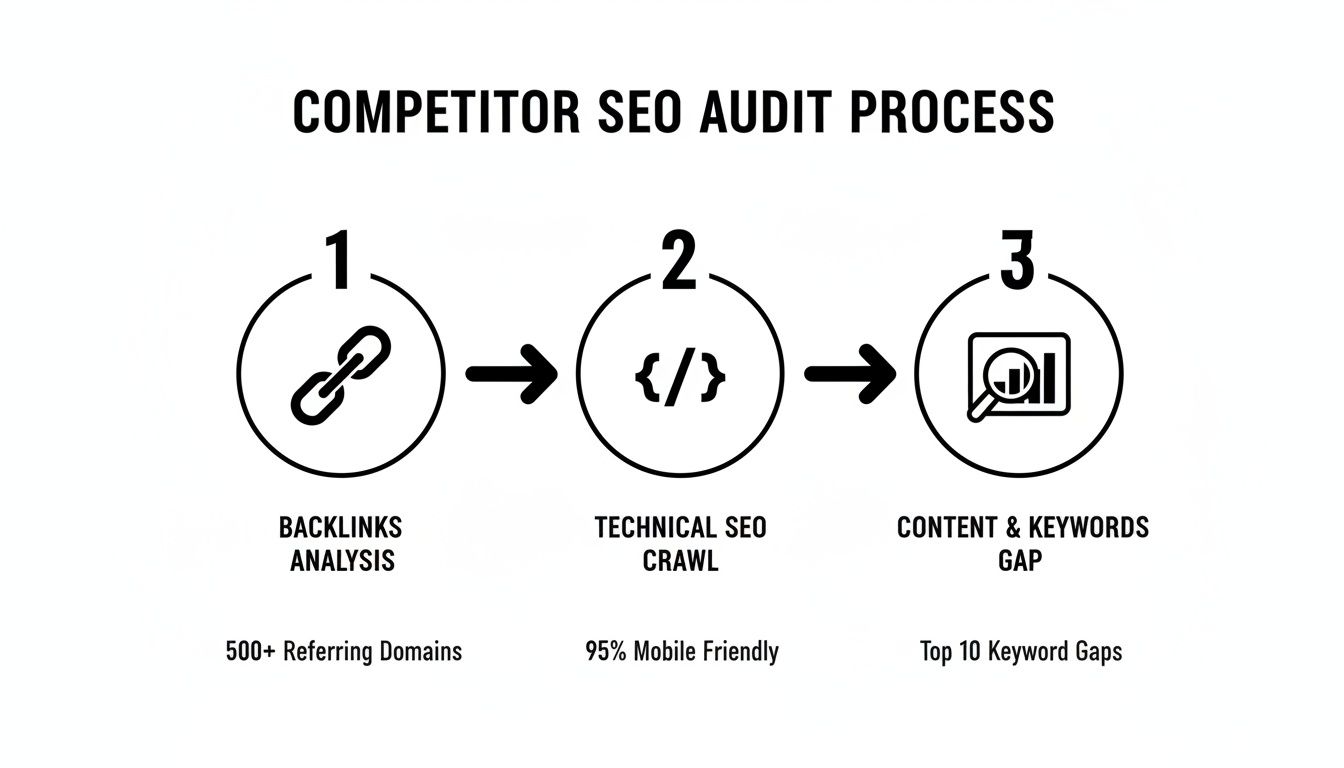
As you can see, these elements aren't isolated. They flow into one another, helping you connect the dots and set strategic priorities based on a holistic understanding of your competitors' strengths and weaknesses.
Fueling Your Content and Outreach
Your research should now become the engine for your content creation and link-building. That keyword and content gap analysis you did? It’s not just data—it’s your new editorial calendar, packed with proven topics your customers are actively searching for.
Your backlink analysis is equally valuable. It hands you a curated list of high-authority websites, like industry trade publications and popular food blogs, to target for your own outreach. You already know they link to your competitors, which means your pitch is already warm.
AI is making this whole process faster and more effective. With competition getting tougher, 51% of restaurant operators are now using AI for their marketing. For a supplier, this means you can use AI-powered tools from platforms like Ahrefs or Semrush to analyze a competitor’s entire content and backlink profile in minutes, instantly spotting opportunities.
Maybe you'll discover a growing trend around "sustainable kitchen equipment" that your rivals are ignoring. You can explore the 2025 restaurant industry outlook to get a better handle on these shifts. By transforming raw data into a prioritized action plan, you build a sustainable engine for growth that will help you start dominating the search results.
Frequently Asked Questions
When it comes to digging into competitive SEO, I hear a lot of the same questions from restaurant equipment suppliers. It's a complex process, so let's clear up some of the most common sticking points so you can get started with confidence.
How Often Should I Be Doing This Research?
Think of competitive research as an ongoing intelligence mission, not a one-time task you check off a list.
A full, deep-dive analysis is something you should tackle annually or just before a big project like a website overhaul or a major marketing push. That deep dive sets your strategic baseline.
But things move fast online. That's why I always recommend doing quarterly check-ins on your main rivals. These reviews are your chance to spot new players entering the market, catch significant ranking changes, and see what kind of content is starting to get traction before everyone else jumps on it.
Here's a pro-tip: Get into the habit of taking a quick look at the new content and backlinks your top three competitors have published each month. This keeps you agile and ensures you’re never caught completely by surprise.
What Are the Best Free Tools for Competitive Analysis?
While the big paid platforms like Semrush or Ahrefs are fantastic, you absolutely don't need to break the bank to get started. You can uncover a ton of valuable intel with some excellent free tools.
- Google Search (in Incognito Mode): This is always your first stop. Using an incognito window strips away your personal search history, showing you the raw, unbiased results that a new customer would actually see.
- Google Keyword Planner: It's built for Google Ads, but it's still a goldmine for brainstorming new keyword ideas and getting a rough idea of search demand.
- Ubersuggest: Neil Patel's tool gives you a handful of free searches every day. That's often more than enough to peek at a competitor's best-performing pages, top keywords, and recent backlinks without spending a dime.
These three alone can give you a surprisingly solid foundation for your analysis.
Should I Bother Analyzing a Competitor Who Ranks Badly?
Absolutely, but your goal is different. You should always spend most of your time on the competitors who are eating your lunch—the ones outranking you for the keywords you want to own. They're doing something right, and you need to figure out what.
However, there's a lot to be learned from a direct business competitor with a terrible online presence. Looking at their site can be a masterclass in what not to do.
You might find they have major technical flaws, like painfully slow page load times or a confusing site structure you can learn to avoid. On the flip side, you might also discover that while their SEO is a mess, their email marketing is fantastic or they have a killer social media presence. There's always something to learn, even from their mistakes.
At Restaurant Equipment SEO, we turn all this complex research into a clear, actionable game plan that drives real growth. From building powerful backlinks to managing local citations, our services are built from the ground up for food service suppliers. Let us help you dominate the search results.