
A Modern Guide to Using Forums for Backlinks
Let’s be honest, the phrase “forum backlinks” can still make some SEOs cringe. For years, it was synonymous with spammy, low-effort tactics that did more harm than good. But things have changed. A lot.
What was once a high-volume, low-quality game has evolved into a sophisticated way to build real authority and drive highly targeted traffic. For restaurant equipment suppliers, this is a huge opportunity. It’s no longer about how many links you can get, but about earning a single, powerful link in the right conversation.
How Forums for Backlinks Evolved in Modern SEO

The entire playbook for forum link building has been rewritten. The old method of using automated bots to drop links everywhere is dead and buried. Today, success is all about authenticity, expertise, and adding real value.
Think about it: your ideal customers—the chefs, restaurant owners, and kitchen managers—are online right now, asking questions and looking for solutions. The goal isn't to interrupt their conversation with a link; it's to become a trusted voice within it.
The Penguin Update and Its Aftermath
So, what changed? Google did. Back in the early 2010s, forums were a free-for-all. But in 2012, the Penguin update came along and completely upended manipulative link schemes. Forum spam was hit especially hard.
Google's algorithms got much smarter, learning to spot and penalize the flood of automated, irrelevant posts. This forced a massive cleanup, filtering out all the noise. What was left is a powerful strategy for businesses willing to put in the work and engage genuinely.
From Spam Tactic to Authority Signal
Today, search engines look at a forum link through a completely different lens. They’re much better at understanding context. If you, a commercial kitchen supplier, drop a helpful link in a detailed discussion about the best type of ventilation hoods, Google sees that as a relevant, useful resource—not spam.
The modern approach isn’t about tricking algorithms; it’s about genuinely helping people. When you provide a thoughtful answer and link to a resource that supports it, you're building trust with both users and search engines.
This approach delivers far more than just a backlink. You also get:
- High-Quality Referral Traffic: You’re sending people who are actively looking for your products straight to your site.
- Serious Brand Authority: You establish your company as a go-to expert in the food service industry.
- Valuable Trust Signals: Consistent, helpful engagement in niche communities shows Google you’re a legitimate and respected player.
This is a world away from outdated, risky tactics like reciprocal link building schemes, which search engines are quick to penalize. It's about earning your place in the conversation, not forcing your way in.
Finding And Qualifying Niche Food Service Forums
To make forum link building work, you first have to find where your people are. A generic business forum isn't going to help you connect with a head chef desperate for a new combi oven. You've got to dig deeper and find the specific online hangouts for food service pros.
The hunt starts with smart, targeted searching. Forget just Googling "food service forums." You need to think like your actual customer and use search terms that cut through the noise.
Unearthing Relevant Communities
The trick is to combine industry keywords with search operators that specifically look for community-style websites. This lets you skip past all the sales pages and land right in the middle of real conversations.
Here are a few search strings I use all the time:
"commercial kitchen" inurl:forum"restaurant equipment" + "community"site:reddit.com "bakery equipment""chef talk" + "forum"
These aren’t just random phrases; they're specific commands. The inurl:forum operator, for example, tells Google to only show you results where the word "forum" is literally in the website's address. It's a quick way to filter everything else out. For a more automated approach, checking out the best forum search engine tools can also speed up the discovery process significantly.
Vetting Forums For Quality And Activity
Finding a forum is just the first step. Next, you have to make sure it's worth your time. There's no point in posting in a digital ghost town or a community overrun with spam. You're looking for an active, well-managed space where genuine conversations are happening.
Your goal is to find a community that will actually value your expertise, not just a place to drop links. A healthy forum has clear signs of life: recent posts, members who actually talk to each other, and moderators who keep the junk out.
Before you even think about creating an account, do a quick health check. Look for these signals:
- Recent Activity: Are the newest posts from today, this week, or three years ago? A forum with daily or at least weekly posts is a good sign.
- User Engagement: Click into a few threads. Are people getting answers to their questions? Are there real back-and-forth discussions? High engagement means your contributions will actually be seen.
- Moderation: Is the forum littered with spammy posts and irrelevant links? That's a huge red flag that the moderators are asleep at the wheel.
- Link Policies: Find the community rules. Many forums have strict policies about links, especially for new members. Knowing the rules upfront will keep you from getting banned on your first day.
This vetting process is a critical part of a solid link building strategy for restaurant equipment suppliers. A link from a respected, niche community can send you highly qualified traffic and build your brand's authority, even if the link itself is "nofollow."
To make this even easier, use this quick checklist to size up any potential forum.
Forum Vetting Checklist
Use this table as a quick reference to decide if a forum is worth your effort. It helps you systematically evaluate a community's potential before you dive in.
| Metric | What to Look For | Red Flag |
|---|---|---|
| Activity Level | Posts from the last 24-48 hours; multiple active threads. | Last post was weeks or months ago. |
| Engagement | Threads have multiple replies; users interact with each other. | Most threads have 0 or 1 reply. |
| Moderation Quality | No obvious spam, ads, or irrelevant content on the first page. | Threads are full of spammy links. |
| Link Rules | Clear guidelines on linking; signature links allowed after X posts. | All external links are strictly forbidden. |
| Topic Relevance | Discussions are focused on your niche (e.g., specific equipment). | Topics are too broad or off-topic. |
A quick run-through of this checklist can save you hours of wasted effort on communities that won't provide any real value.
Think about it this way: the game is changing. By 2026, forums are expected to excel at driving brand mentions more than just raw links, turning them into powerful trust signals for search engines. Semrush data shows that Reddit alone gets over 2 billion organic visits every month, making it a behemoth you can't ignore. Unlike paying for guest posts, genuine participation in a forum is a high-reward approach for anyone willing to provide real value.
How to Become a Trusted Voice and Earn Your Links
Once you've pinpointed a few promising communities, the real work begins. Let's be clear: dropping a lazy "check out my site" comment is the fastest way to get your account banned and your brand blacklisted. The entire strategy here pivots from getting links to earning them. You have to become an indispensable member of the community.
Your first move is setting up a credible profile. Use a real name or a sensible username, upload a professional-looking avatar, and take a few minutes to fill out the bio. This isn't just about appearances; it’s about signaling to moderators and members that you're a real person, not a spam bot waiting to pounce.
This whole process really breaks down into three phases: find the right forums, assess their quality, and then—most importantly—genuinely engage with people.
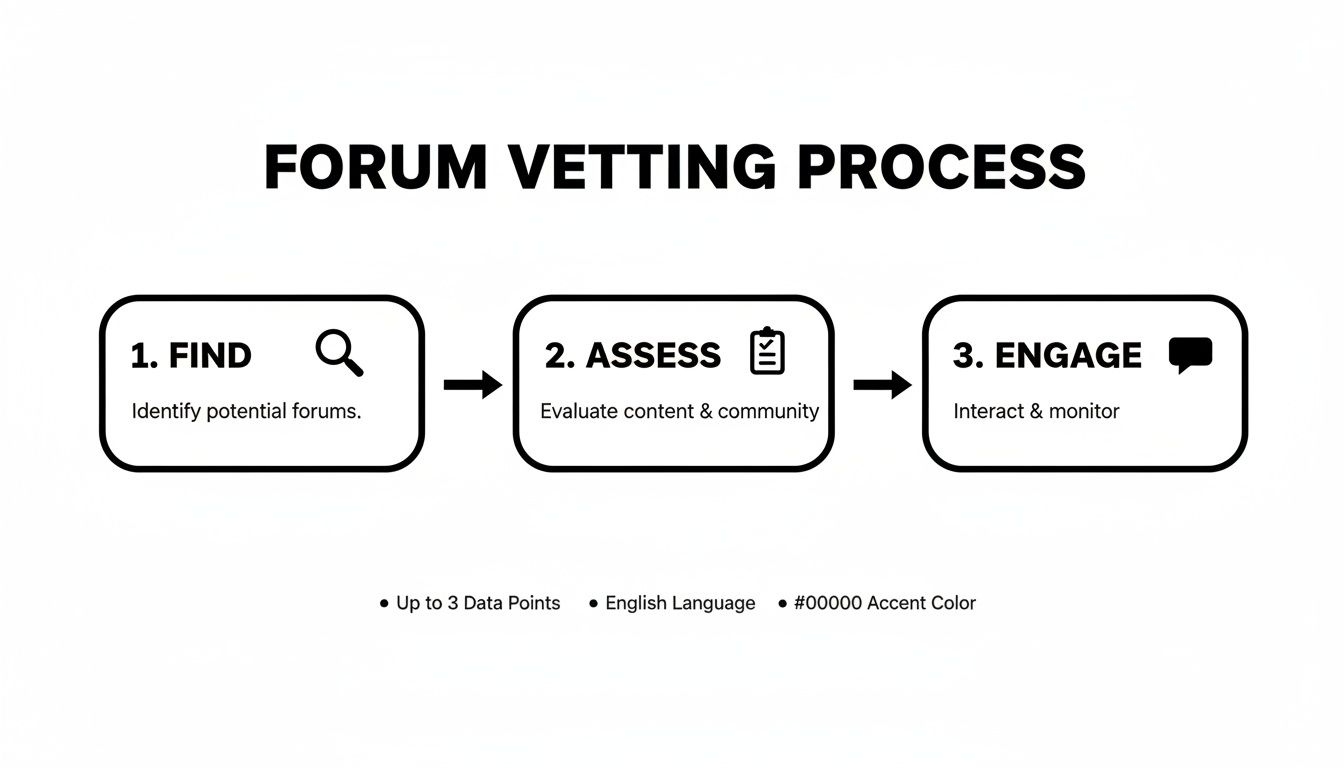
As you can see, engagement is the final and most crucial step. It’s where you build trust, create value, and eventually, earn the right to share a link.
First, Listen and Learn the Local Culture
Before you even think about posting, just lurk for a while. Read the top posts. Get a feel for the tone. Figure out who the "power users" are—the members everyone respects and listens to.
Every forum has its own unwritten rules, inside jokes, and specific etiquette. Getting this right is non-negotiable if you want to be accepted.
A forum is like a dinner party. You wouldn't walk into a stranger's house and immediately start shouting about your business. You listen, you contribute to existing conversations, and you earn your right to speak.
Pay attention to what kind of content gets upvoted or receives positive replies. Is it long-form, technical advice? Or is it quick, helpful tips and tricks? This intel gives you the blueprint for your own successful contributions.
Find Problems You Can Genuinely Solve
Your goal is to become the go-to expert for restaurant equipment in that community. That means you need to actively hunt for problems you can solve. Set up alerts or just scan for keywords like "convection oven," "walk-in freezer," or "commercial mixer."
When you find a relevant question, don't just drop a one-sentence answer. Go deep. Give them a framework for finding their own solution.
For instance, if a new bakery owner asks, "What's the best convection oven for a high-volume bakery?" you can provide a detailed breakdown:
- Explain the different types of convection ovens, like countertop vs. full-size floor models, and the pros and cons of each for their specific need.
- Discuss key features they should be looking for, such as steam injection or programmable controls, and why those matter for a bakery.
- Share a mini-case study (anonymized, of course) about how a similar business saved on energy costs or improved product consistency by choosing a specific model.
This simple shift in approach turns you from a salesperson into a trusted advisor. It's a value-first mindset that's central to effective https://restaurantequipmentseo.com/blogs/restaurant-equipment-seo-blog/branding-and-content-marketing.
Master the Art of Contribution
Becoming a truly trusted voice requires more than just answering a few questions here and there. To really understand the nuances and avoid common mistakes, it's worth exploring strategies for genuine engagement on forums like Reddit, a platform where communities fiercely police self-promotion.
Now, it’s true that the golden age of forum link building peaked before 2012. But their role has simply evolved. Today, links from engaged, niche communities are incredibly valuable. While Google may not weigh them as heavily as other links among its 200+ factors (thanks to years of spam), their ability to drive real, relevant traffic is undeniable. Just look at a platform like Reddit, which pulls in over 2 billion visits a month.
When you consistently provide in-depth, helpful content, you build a stellar reputation. So, when you eventually share a link to one of your blog posts or guides, it won’t be seen as spam. It’ll be viewed as a natural, helpful extension of the value you've already been providing all along.
Placing Your Backlink Without Raising Red Flags
You've spent weeks, maybe even months, building up your reputation and providing solid advice. Now comes the moment of truth: placing your first link. This is precisely where most people mess it up, torpedoing all their hard work with a single post that screams "spam."
The trick is to make your link feel like a natural, helpful extension of the conversation, not the entire reason you're there.
Your link should be an essential resource that adds real depth to your answer. For instance, if someone is asking a detailed question about the energy efficiency of commercial ice machines, linking to your comprehensive guide on that exact topic is a genuinely helpful move. But linking directly to a product page? That’s a classic sales pitch and a surefire way to get your post deleted by a moderator.
Always remember your primary goal: help the person who asked the question. Everything else is secondary.
Choosing The Right Anchor Text
The words you use to create the link—the anchor text—are a massive signal to both people and search engines. Nailing this is critical. Whatever you do, avoid stuffing your anchor text with exact-match keywords. It’s a huge red flag.
Think about it from a user's perspective. A restaurant owner asking about fryers doesn't want to see a link that says "best commercial deep fryer for sale." It’s clunky, unnatural, and just feels like an obvious SEO play.
Instead, go for a much more organic approach. Here are a few styles that work well and keep you under the radar:
- Branded: "We actually covered this in a guide on the [Your Brand Name] blog."
- Naked URL: "You can see a full breakdown of the specs here: https://yoursite.com/fryer-guide"
- Generic: "We wrote a post that explains more about this."
- Natural Phrase: "...a lot of it comes down to the unit's recovery time, which is something we explained in our guide."
These options look far less manipulative. They’re less likely to trigger a moderator's spam filter while still passing on valuable contextual relevance to Google.
Understanding Nofollow And UGC Links
Don't be surprised to find that most modern forums automatically add rel="nofollow" or rel="ugc" (user-generated content) tags to any links posted by members. A few years back, the SEO community would have written these links off as worthless. That thinking is seriously outdated.
Since 2019, Google has treated these attributes as "hints" rather than rigid rules.
This means a well-placed nofollow link in a highly relevant, active discussion can absolutely pass along SEO value. Even more importantly, it drives real, targeted referral traffic from people who are already deep in the consideration phase and actively looking for solutions you provide.
Don’t dismiss a forum just because its links are nofollow. A link that sends a ready-to-buy customer to your site is always valuable, regardless of its SEO attributes.
This mindset is crucial for a successful strategy using forums for backlinks. Recent surveys show that nearly 79% of SEO experts believe nofollow links still have an impact on rankings, and over 80% agree that building a natural-looking link profile is their top priority. You can discover more insights about the future of link building at Adsy.
Pace Yourself And Stay Relevant
Finally, a couple of golden rules to live by. First, don't rush to drop links. If your account is only a week old and you’ve already linked out five times, you’re going to look like a spammer. A good rule of thumb is to aim for a ratio of roughly one link for every 10-15 genuinely helpful, non-linking posts.
Second, context is everything. Your link to a commercial refrigeration guide is perfect in a thread about walk-in cooler maintenance. It's completely out of place and jarring in a discussion about digital menu boards. Stay in your lane, and your contributions—and your links—will be a welcome part of the community.
Measuring the Real Impact of Your Forum Efforts
Getting your backlink placed is a great feeling, but that’s just the starting line. How can you be sure all that time spent engaging in communities is actually moving the needle for your business? The real proof isn't just a list of new links.
What truly matters are tangible results: more referral traffic, better keyword rankings, and a stronger brand presence. You need a straightforward way to track these metrics to make sure your forum strategy is actually paying off.
Tracking Performance Beyond the Link Itself
Google Analytics is your best friend here. I recommend setting up a custom segment to isolate traffic coming specifically from the forums where you’re active. Check in on this data weekly. Are people actually clicking through?
Even more importantly, what do they do when they get to your site? A high bounce rate could be a red flag, signaling that the page you linked to isn't what they expected. On the other hand, if visitors from a particular forum stick around and browse multiple pages, you’ve struck gold. That’s a clear sign you’ve found a highly engaged, relevant audience.
Beyond direct traffic, keep a close eye on a couple of other key metrics:
-
Keyword Rankings: Are the pages you’re linking to starting to climb in the search results? Use a tool like Ahrefs or Semrush to track the rankings for the specific keywords tied to those pages.
-
Brand Mentions: Sometimes the biggest win isn't a link at all. Set up alerts with a tool like Google Alerts or Mention to see when your brand name gets dropped in conversations. These unlinked mentions are fantastic for building authority.
Remember, the goal of using forums for backlinks isn't just about link juice. It's about driving high-intent traffic and establishing your brand as a trusted authority in the food service industry.
Mitigating Risks and Protecting Your SEO
Forum link building is powerful, but it's not a "set it and forget it" tactic. Communities change. A forum that’s thriving today could decline or get overrun by spammers a year from now, and you don’t want your site associated with that.
That’s why you absolutely have to monitor your backlink profile.
Periodically use your SEO tool of choice to review the domains linking to you. If you spot a forum that’s gone downhill and is now filled with spam, it could slowly start to chip away at your site's authority.
In rare cases, you might need to use Google's Disavow Tool. But let me be clear: this should always be a last resort. Disavowing a link is a serious step, and if you get it wrong, you can do more harm than good. Only go down this road if you see a clear, toxic pattern from a specific source and have solid proof it's hurting your rankings.
Ultimately, staying proactive with your monitoring is the best defense. It allows you to spot potential trouble long before it becomes a real problem.
Answering Your Top Questions About Forum Link Building
Even with a solid game plan, you probably have a few questions rolling around in your head. That's normal. Getting into forum marketing isn't an exact science, and the small details are what make or break your efforts. Let's clear up some of the most common sticking points for suppliers like you.
A huge one is about nofollow and ugc links. The old-school SEO wisdom was that these links were worthless. That's just not true anymore. Today, search engines treat these tags more like strong suggestions. A link from a super relevant, high-traffic discussion—even if it's nofollow—signals authority and can drive real, paying customers to your site. Honestly, that targeted referral traffic is often worth more than a "dofollow" link from some random website.
So, Are Forum Links Actually Safe?
Absolutely, as long as you earn them. The danger isn't in the forum itself; it's in the approach. Dropping links without context is spam, plain and simple. Moderators will catch it, algorithms will flag it, and it'll do more harm than good.
But if you’re genuinely contributing to a conversation and your link provides a real resource, it’s not just safe—it’s a smart move. Think of yourself as a trusted advisor, not a link-builder. If you’re in a thread about the "best commercial fryers for high-volume kitchens," sharing your expertise and linking to a helpful guide on your site is a natural fit.
This is critical because a staggering 94% of online content gets zero backlinks. You have to stand out by being genuinely helpful. You can discover more insights about the power of forum backlinks at Jeenaa Infotech.
Okay, How Often Can I Drop a Link?
This is the million-dollar question, and where most people trip up. There's no set schedule, but a good rule to live by is to focus on giving way more than you take. As a baseline, try to make 10 to 15 valuable, link-free posts for every one time you share a link.
Your goal is to be seen as a consistent contributor first and a brand representative second. If your post history is 90% helpful advice and 10% well-placed resources, you’ll build a fantastic reputation.
Patience is the name of the game here. Build up your reputation as a helpful member of the community. When you eventually do post a link, people will trust it because they trust you. If you rush it, you risk getting banned and losing all that effort. Think of it as a marathon, not a sprint.