
Learn how to do search engine optimization yourself for restaurant equipment pro
Doing your own SEO really comes down to three things: picking the right keywords, tuning up your web pages, and owning your local search results. For a restaurant equipment business, this approach gets you in front of serious buyers without blowing your budget. You’re building a solid online presence, one practical step at a time.
Building Your Foundation for DIY SEO Success
You don't need a marketing degree to get started with search engine optimization. If you're selling restaurant equipment or food service supplies, it's all about translating what you already know into a language that search engines can understand and reward. The whole point is to connect with the chefs, restaurant owners, and purchasing managers who are right now looking for the exact products you carry.
Forget about chasing complex algorithms. This is about building a foundation that consistently brings in customers who are ready to buy. Your first move is to grasp a few key concepts and get your hands on some powerful, free tools that will act as your control panel.
Starting with the Right Mindset
The biggest mistake I see business owners make is treating SEO like some mysterious, one-and-done project. It’s not. Think of it more like building your shop’s reputation online, piece by piece. Every product page you sharpen and every helpful article you publish tells Google that you're a legitimate expert in the commercial kitchen world.
Your goal is simple: when a local restaurant manager searches for "commercial six-burner gas range" or "NSF certified prep table," your website should be one of the first things they see. You get there with consistent, focused effort, not by trying to game the system.
Your Essential DIY SEO Toolkit (Free Tools)
Before you start changing page titles or writing blog posts, you need the right tools to see what’s actually happening. These free platforms give you the data you need to make smart decisions instead of just guessing. They're non-negotiable for any serious DIY SEO effort.
| Tool Name | Primary Function | Why It's Essential for Your Business |
|---|---|---|
| Google Search Console | Reports on your site's search traffic and performance. | This is your direct line to Google. It shows you which keywords people use to find you and alerts you to technical issues. |
| Google Business Profile | Manages your online presence across Google, including Search and Maps. | Absolutely critical for local customers. This is what puts you on the map—literally—and is your most powerful local marketing tool. |
| Google Analytics | Tracks and reports website traffic and user behavior. | This tells you what visitors do once they land on your site: which pages they visit, how long they stay, and where they came from. |
| Ahrefs Webmaster Tools | Audits your website, shows backlinks, and provides keyword data. | Offers a free way to check your site for over 100 common technical SEO problems and see who is linking to you. |
Setting these up correctly is the first real step toward taking control of your online visibility. Once they're running, you can get a clear picture of where you stand today. Our guide on how to perform a website audit is a great place to start that initial checkup.
If you want to brush up on the fundamentals before you get your hands dirty, this guide on SEO basics for small business does a fantastic job of breaking things down.
Finding the Keywords Your Customers Actually Use

Look, effective SEO all boils down to one thing: speaking your customer's language. If you're tackling this yourself, your first real job is to get inside the heads of your buyers and figure out the exact phrases they’re punching into Google. This isn't about guessing; it's about listening.
For a restaurant equipment supplier, that means you have to think like a chef, a GM, or a small café owner. They’re not just searching for "oven." They’re on the hunt for a "commercial convection oven double stack" or a "20 quart planetary mixer."
These super-specific, multi-word phrases are what we call long-tail keywords. Honestly, they're the bedrock of any solid DIY SEO strategy. Why? Because they signal serious intent to buy. Someone searching for "refrigerator" is probably just browsing. But a search for a "True T-49 two-door reach-in refrigerator"? That person knows exactly what they want and is likely ready to pull the trigger.
Decoding What Your Customer Really Wants
Before you even think about opening a keyword tool, you need to understand the why behind a search. This is called search intent, and in your business, it usually falls into a few key buckets. Getting this right is critical.
- Informational Intent: Your potential customer is looking for answers. Think "how to clean stainless steel prep table" or "what size grease trap do I need."
- Commercial Intent: They're in research mode, comparing options before making a decision. You'll see searches like "best commercial ice machines" or "Hoshizaki vs Manitowoc ice maker."
- Transactional Intent: This is it—they’re ready to buy. These are your money-makers, like "buy Blodgett convection oven" or "walk-in cooler for sale near me."
A great website has content that serves all three. Your blog posts are perfect for grabbing those informational searches, while your product and category pages are built to capture and convert the transactional ones.
Your goal here is to map your keywords to the customer's journey. You're not just a seller; you're the expert resource they turn to at every step, from troubleshooting a problem to making a five-figure purchase.
Kicking Off Your Keyword List
Let's get practical. Start with what you already know: your products and your customers. Grab a notepad or fire up a spreadsheet and just start brainstorming. Don't filter yourself yet.
Think about things like:
- Broad Categories: Commercial ranges, convection ovens, reach-in refrigerators, ice machines.
- Product-Specific Features: Gas vs. electric, stainless steel grade, NSF certified, ENERGY STAR rated.
- Brand Names: Vulcan, True, Hobart, Blodgett, Hoshizaki.
- Customer Problems: "Leaking walk-in cooler," "fryer temperature problems," "commercial dishwasher not draining."
This raw list is your starting point. From here, you can use free resources like Google's own search results—just type in a phrase and see what comes up in the "People also ask" box. For a more detailed walkthrough, check out our guide on how to build a keyword list for your business.
Focusing on these niche, industry-specific terms works. One agency, for example, saw a 390% surge in organic traffic over 11 months simply by building content around trends like ghost kitchens, which demand very specific, compact equipment. You can read more about how industry shifts impact SEO over at Nation's Restaurant News. This proves that zeroing in on what your customers are actually dealing with gets results. That’s your playbook.
Winning the Local Search Game in Your City
Let's get one thing straight: for a restaurant equipment supplier, your local market is everything. Chefs, new restaurant owners, and catering managers aren't looking for suppliers halfway across the country—they need a partner right down the street, especially when a walk-in freezer dies on a Friday night. This is where getting your hands dirty with some basic SEO pays off immediately.
Your goal is simple: become the undeniable go-to supplier in your city. When a local chef frantically searches "commercial refrigerator repair near me" or "restaurant supply open now," you need to be the first name they see. This isn't about some complex global strategy; it's about owning your backyard.
Your Most Powerful Local Marketing Tool
Your Google Business Profile (GBP) is, without a doubt, the single most important tool you have for local SEO. It's that free listing that pops up in Google Maps and the coveted "Local Pack" at the top of the search results. If you're ignoring it, you're essentially hiding your storefront from customers who are actively trying to hand you their money.
Think of your GBP as a dynamic, digital storefront, not just a static directory listing. It's your first impression. A fully optimized profile drives phone calls, website clicks, and, most importantly, foot traffic right through your showroom doors.
A well-managed Google Business Profile does more than just list your hours. It builds trust and provides immediate answers, turning a quick search into a valuable customer relationship before they even visit your website.
So, where do you start? Focus on getting these core pieces right:
- Business Description: You get 750 characters, so make them count. Ditch "We sell restaurant equipment" and try something with more personality and detail: "Your trusted partner for new and used restaurant equipment in [Your City], specializing in commercial kitchen design, installation, and 24/7 emergency repairs."
- Primary Category: This is a big one. Choose "Restaurant Supply Store." It's the clearest signal you can send Google about who you are.
- Secondary Categories: Don't stop at one. Add other relevant categories to cast a wider net. Think "Commercial Refrigeration Supplier," "Kitchen Supply Store," and even "Appliance Repair Service" if you offer it.
Building Trust with NAP Consistency
One of the oldest and still most crucial parts of local SEO is NAP consistency. It's simple: your Name, Address, and Phone number need to be identical everywhere your business is listed online.
Little inconsistencies—like using "St." on one directory and "Street" on another, or having "LLC" in one place but not another—create confusion for search engines. This confusion can seriously hurt your local rankings. Take some time to audit your listings on major players like Yelp, Yellow Pages, and any industry-specific sites. Make sure your NAP is a perfect match across the board.
This simple housekeeping task builds a powerful web of trust signals, reinforcing to Google that you are a legitimate, established local business.
The Power of Photos and Customer Reviews
People buy with their eyes, especially when it comes to big-ticket equipment. Your GBP is the perfect place to show off your operation. Get some high-quality photos up there:
- Your clean, well-lit showroom
- Specific equipment like ranges, mixers, and walk-in coolers
- Your team helping customers (with their permission, of course!)
- Your delivery trucks proudly displaying your logo
These images offer visual proof of your business's scale and professionalism.
Just as important are your customer reviews. Positive reviews are a massive ranking factor. You have to be proactive here—don't just wait for them to roll in. A simple follow-up email after a big sale, with a direct link to your GBP review page, can work wonders. And always, always respond to every single review, good or bad. It shows you're engaged and that you actually care about what your customers think.
Engaging the Local Culinary Community
Finally, start using GBP Posts. Think of them as free mini-billboards right on your Google listing. Announce the arrival of a new line of convection ovens, offer a weekend discount on smallwares, or share a quick tip about commercial ice machine maintenance. It keeps your profile fresh and gives potential customers a reason to check you out.
Getting your local SEO right is your golden ticket to appearing in the Google Local Pack, where 64% of clicks go to the top 3 results. That isn't just a number; it's foot traffic waiting to happen. In Q1 2024, local searches skyrocketed 654% year-over-year, and in the food service world where 93% of patrons check things out online before committing, that intent is golden. To see more on these trends, you can find a breakdown in these local SEO statistics. By mastering these local strategies, you ensure that when someone in your city needs what you sell, your business is the one they find.
Getting Your Website Pages Ready to Convert

Alright, you’ve done the legwork on keywords and started building your local presence. Now it's time to focus on your own turf: your website. Getting traffic is one thing, but your product and category pages need to seal the deal. They have to convince both Google and your potential customers that you're the right choice. This is all about smart on-page SEO.
Think of it like merchandising a physical showroom. You wouldn't just dump equipment on the floor. You’d create clear pathways, use descriptive signs, and put your best-sellers front and center. Your website needs that same level of care.
Crafting Titles and Descriptions That Earn the Click
Your title tag and meta description are the first things anyone sees in the search results. They function as your digital storefront window, and their entire purpose is to get someone to click your link over the competition's. A lazy title like "Product Page" is a completely wasted opportunity.
You have to be specific and compelling. Start with your primary keyword, try to keep the title under 60 characters, and make it crystal clear what the page is about.
The meta description isn't a direct ranking factor, but it's your 155-character sales pitch. Use those 155 characters to highlight a key benefit, like "Free Shipping" or "Energy Star Certified." It’s your chance to answer the searcher's unspoken question: "Why should I click this one?"
Using Headings to Structure Your Content
Once a potential buyer lands on your page, you’ve got seconds to convince them to stick around. A clear, scannable structure is your best friend here. Headings (H1, H2, H3) act as signposts, breaking up the text and letting people find what they need, fast.
Every page needs one—and only one—H1 tag. This is your main headline. It must include your primary keyword and define the page's content.
- H1 Tag: Your top-level headline. Something like: "True T-49G-HC-LD Glass Door Refrigerator."
- H2 Tags: Use these for major sections. Think "Key Features," "Product Specifications," or "Warranty & Service."
- H3 Tags: These are perfect for breaking down those H2 sections even further, like listing individual specs under "Product Specifications."
This hierarchy doesn't just help your human readers; it gives search engines a clean outline of your page's content, which helps them understand and rank it properly.
To put this into practice, here’s a quick checklist showing how to apply these elements to a typical product page.
On-Page SEO Checklist for a Product Page
| On-Page Element | Unoptimized Example | Optimized Example |
|---|---|---|
| Title Tag | Product Details | True T-49G-HC-LD Refrigerator |
| Meta Description | View more information about this product. | Shop the True T-49G-HC-LD Glass Door Refrigerator. Energy efficient with LED lighting. Free shipping on all commercial refrigeration units. |
| H1 Tag | True Refrigerator | True T-49G-HC-LD 54" Glass Door Reach-In Refrigerator |
| Image Alt Text | image.jpg | True T-49G-HC-LD glass door refrigerator in a commercial kitchen |
| Internal Link | Click here for more. | Need help? Check out our guide on choosing the right commercial refrigerator. |
As you can see, the optimized examples are specific, keyword-rich, and far more helpful to both search engines and users.
Weaving Keywords into Your Copy Naturally
With a solid structure in place, it’s time to work your keywords into the page copy. The absolute golden rule here is to sound like a human. Don't just cram "commercial 6-burner gas range" into every other sentence—that’s a one-way ticket to sounding like a robot.
Instead, focus on writing genuinely helpful product descriptions that answer real customer questions. Mention your main keyword in the H1, a few subheadings, and naturally within the first 100 words. From there, use related terms and variations (e.g., "6-burner commercial stove," "restaurant gas range") to show Google you’re an authority on the topic.
The Hidden Power of Internal Linking
Internal links are just links that point from one page on your site to another. Simple, right? But they are incredibly powerful. They help search engines find all the pages on your site, they pass authority between pages to boost your site’s overall strength, and, most importantly, they guide your visitors to other helpful content.
For instance, on a product page for a commercial deep fryer, you could link to a blog post you wrote titled, "A Guide to Choosing the Right Commercial Fryer Oil." This is a perfect way to keep people on your site longer while positioning your brand as a true expert.
Don't Forget to Optimize Your Images
Your product images are a huge asset, but search engines can't "see" them. You have to provide context using alt text—a short, descriptive phrase that explains what's in the image.
An unhelpful alt text is just "refrigerator." A great one is "True T-49G-HC-LD glass door refrigerator with interior LED lighting." Not only does this help you rank in image searches, but it's also crucial for making your site accessible to users who rely on screen readers.
Building Authority with Content and Link Building
If you're serious about DIY SEO, you need to think less like a salesperson and more like a trusted advisor. Search engines, especially Google, are all about rewarding authority. You build that authority in two key ways: creating genuinely helpful content and getting other websites to vouch for you with links.
This one-two punch of great content and quality links tells Google you're a legitimate expert in the restaurant equipment world. Get it right, and you’ll start attracting customers who are actively searching for solutions, establishing your brand as the place to go for real answers, not just products.
Creating Content That Serves Your Customers
Your customers are asking questions that go way beyond product specs. They're trying to figure out maintenance schedules, choose between two similar-looking models, or understand confusing health code regulations. Answering these questions with high-quality content is the most organic way to pull in qualified traffic.
Just think about the phone calls and emails you get every day. What are the common headaches and pain points you hear about? Every single one of those questions is a golden opportunity for a blog post or a guide that can show up in search results and bring people to your site.
The best content strategy isn’t about pumping out generic articles. It’s about taking the expertise you already have, documenting it, and sharing it with the people who need it. You're not just selling equipment; you're building an invaluable library for the entire food service community.
Here are a few practical content ideas you could probably write in your sleep:
- Buying Guides: "How to Choose the Right Commercial Dishwasher for a Small Cafe"
- Checklists: "Your Essential Commercial Fryer Maintenance Checklist"
- Comparison Articles: "Convection Ovens vs. Combi Ovens: What’s the Difference?"
- How-To Articles: "A Step-by-Step Guide to Calibrating Your Commercial Oven"
Each of these topics hits a specific customer need, positioning you as an expert long before they're even thinking about adding something to a cart.
Starting Your Link Building Journey
So, what is link building? It’s simply the process of getting other reputable websites to link to your site. Think of each of these links, called backlinks, as a professional referral or a vote of confidence.
When a respected industry blog or a local food writer links to one of your guides, they’re essentially telling search engines, "Hey, this site knows what it's talking about."
I know link building can sound intimidating, but you don't need to be an SEO guru to get started. The name of the game is quality over quantity. A single link from a relevant, high-authority site is worth more than a hundred links from random, spammy directories.
Here are a few beginner-friendly ways to earn your first links:
- Industry Directories: Get listed in well-known food service and equipment supplier directories.
- Local Partnerships: Team up with local food bloggers or restaurant consultants. You could offer an expert quote for an article they’re writing in exchange for a link. It's a classic win-win.
- Supplier Relationships: This one is huge. Ask the manufacturers you work with if they have a "Where to Buy" or "Authorized Dealers" page on their site. A link from a major brand like Vulcan or Hobart is a massive trust signal for Google.
Building backlinks is a slow burn, not an overnight fix. It takes time and consistent effort, but it's absolutely essential for building your site's credibility. For a more detailed look at this, you can learn more about how to build domain authority for your website, which is the core metric that reflects all this hard-earned trust.
Your 90 Day DIY SEO Action Plan
All the SEO theory in the world doesn't mean much without a plan. The key to doing this yourself is breaking it down into small, manageable chunks so you can build momentum without getting buried.
This 90-day roadmap does exactly that. We'll start with the foundational work, then build up with content and on-page tweaks, and finally, amplify your reach through local signals and basic link building. It's a structured approach that delivers real progress.
Month 1: Laying the Foundation
The first 30 days are all about getting your technical house in order and mapping out the competitive terrain. Don't skip these steps. Everything you do later will build directly on the work you put in now.
-
Weeks 1-2: Get your core tools set up. This means installing Google Analytics and connecting your site to Google Search Console. Just as important, claim and completely fill out your Google Business Profile. I’m talking every single field: accurate name, address, phone (NAP), a compelling business description, and plenty of high-quality photos of your products and showroom.
-
Weeks 3-4: It's time for keyword research. Your goal here is to come up with two lists. First, your top 20 "money" keywords—the terms people use when they're ready to buy (like "commercial convection oven for sale"). Second, 20 informational keywords that answer questions (like "how to clean stainless steel prep table").
Month 2: On-Page Optimization and Content Creation
With your keywords in hand, you can start putting them to work on your website. This is where you shift from just being a product catalog to becoming a genuinely helpful resource for your customers.
The whole point of Month 2 is to turn your site into a magnet for your ideal customers. Every page you optimize and every article you write becomes another digital doorway for them to walk through.
For a great set of guidelines, check out this ultimate 10-point small business SEO checklist to keep you on track.
-
Weeks 5-6: Time to optimize your most important pages. Pick your top 5 product or category pages and give them a tune-up. That means rewriting the title tags, meta descriptions, and H1 headings to include your target keywords naturally. While you’re there, make sure every product image has descriptive alt text.
-
Weeks 7-8: Let's write. Grab one of your informational keywords and create your first piece of truly helpful content. A blog post like a "Commercial Fryer Maintenance Checklist" is a perfect example of something that helps your audience and signals your expertise to Google.
Month 3: Boosting Local SEO and Building Links
You've got a solid foundation and some great on-page work done. Now it's time to send signals to Google that you're a legitimate, authoritative local business. This month is all about building trust and credibility.
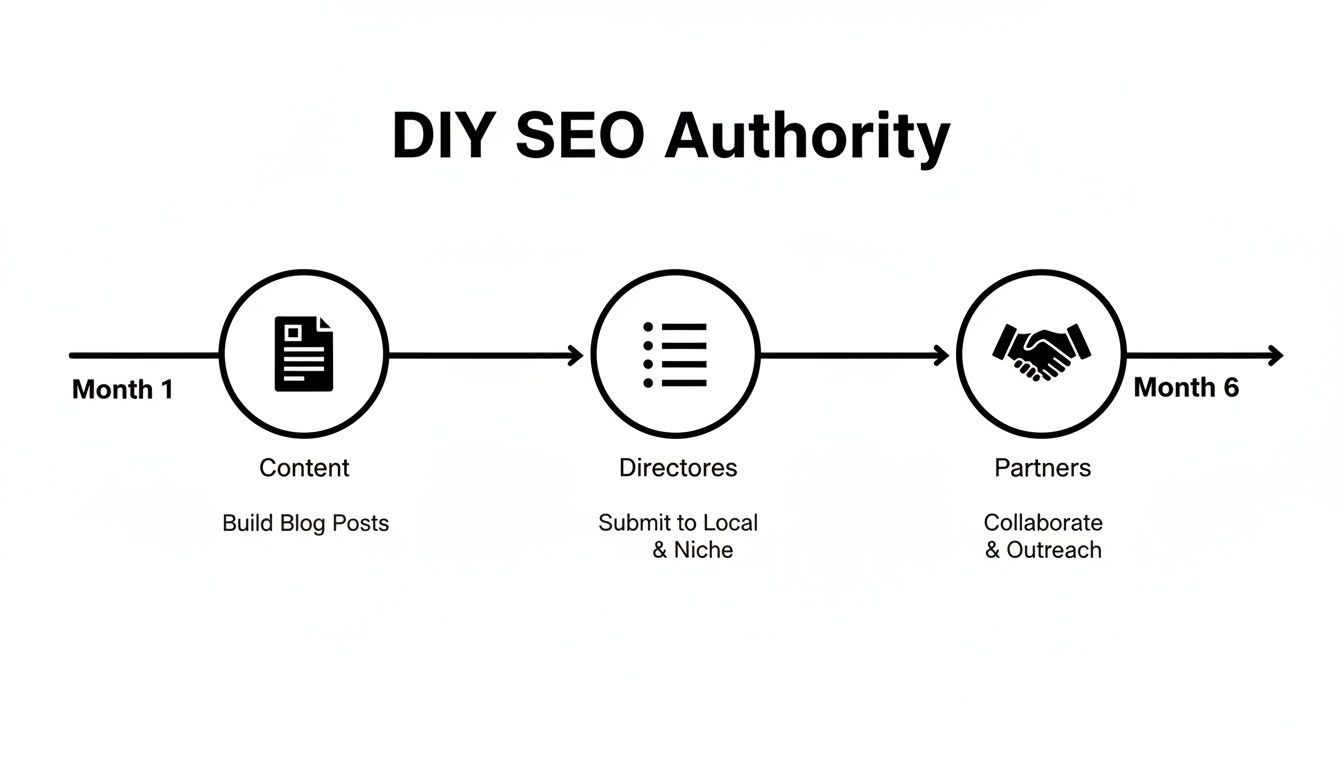
As you can see, consistently creating helpful content naturally leads to opportunities for directory features and partnerships, which are key to building authority over time.
-
Weeks 9-10: Let’s focus on local citations. This means getting your business listed in key food-service and restaurant industry directories. The golden rule here is to ensure your NAP is 100% consistent across every single listing. This is also the perfect time to start asking your happy customers for reviews.
-
Weeks 11-12: Now for some simple outreach. Identify one of your key suppliers and ask if they can add you to their "where to buy" or "dealers" page on their website. Next, find a local food blogger and offer them an expert quote for an article they're working on. These are your first baby steps into link building.
A Few Common Questions About DIY SEO
Diving into SEO for the first time can feel a bit like stepping into a busy kitchen during the dinner rush—there's a lot going on. You've got the main strategies down, but questions are bound to come up. This is where we tackle some of the most common ones I hear from restaurant equipment suppliers who are just getting started.
Think of this as your quick reference guide. It's here to give you straightforward answers so you can stay focused and confident that you're heading in the right direction.
How Long Does This Actually Take to Work?
This is the big one, isn't it? The honest-to-goodness answer is, it's a slow burn. SEO is a long-term play, not a quick win. You'll likely spot some positive movement for things like your business name or very specific product model numbers within 4 to 8 weeks. That's usually how long it takes for Google to notice and process your first round of changes.
But for the really competitive stuff, like "commercial refrigerator" or "restaurant oven," you're looking at a 3 to 6 month timeline of consistent work before you see a real jump in the rankings. The key here is patience.
I always tell my clients that SEO is like building muscle at the gym, not flipping a light switch. The initial effort builds the foundation. It's the consistent work over months that builds the strength to climb the rankings and hold your spot.
Do I Really Need to Shell Out for Expensive Tools?
Not at all, especially when you're just starting out. While the big-name paid tools are powerful, you can get an incredible amount of work done with a completely free toolkit.
- Google Search Console: This is non-negotiable. It's your direct line to Google, showing you how your site is performing and flagging any technical problems.
- Google Business Profile: Your most important tool for winning local customers.
- Google Analytics: Shows you who is visiting your site and what they do when they get there.
- Free Versions of Pro Tools: Platforms like Ahrefs or Semrush have free tiers that give you more than enough keyword data and site audit features to get started.
You can build a seriously effective SEO strategy with these resources without spending a dime.
If I Only Have Time for One Thing, What Should It Be?
Easy. Your Google Business Profile (GBP). For any local or regional supplier, your GBP is your single most powerful SEO asset. It's your digital storefront, your billboard, and your business card all rolled into one.
Get that profile dialed in—I'm talking accurate hours and contact info, tons of high-quality photos of your showroom and products, and a steady stream of new customer reviews. This is what drives phone calls and gets people walking through your door.
Consider this: 46% of all Google searches are from people looking for local information. If you can dominate the local map results by mastering your GBP, you’ll see a return on your time faster than with any other tactic. It's the absolute bedrock of a good local SEO plan.
Ready to stop guessing and start ranking? Restaurant Equipment SEO provides the specialized strategies and services your business needs to dominate the search results. Visit us at https://restaurantequipmentseo.com to see how we can drive qualified traffic to your site.