
Mastering Long Tailed Keywords for Restaurant Equipment Sales
Trying to rank for a super-broad term like "commercial ovens" is like shouting into a hurricane. You're just another voice lost in the noise.
A much smarter play is to focus on long-tail keywords. These are the longer, more specific search phrases that connect you directly with customers who know exactly what they're looking for and are often ready to buy.
Moving Beyond the Crowded Marketplace
Let's get real for a second. You're up against industry giants with marketing budgets that could probably buy a small island. Throwing money at general, high-traffic keywords is a fast track to frustration and a slow path to sales.
It's time for a different approach. The secret weapon isn't a bigger budget—it's a sharper strategy.
This guide is about a fundamental shift in how you think about SEO. Forget battling it out for those high-volume, low-conversion keywords. It’s time to start attracting highly motivated buyers who are already halfway to the checkout.
The core idea is simple: Stop competing for everyone and start connecting with the right one. By targeting long-tail keywords, you transform your website from a general catalog into a specialized solution provider.
The Power of Specificity
Think about the mindset behind two different Google searches:
- Search 1: "commercial refrigerator"
- Search 2: "three-door stainless steel reach-in refrigerator for a small bakery"
The first person is just kicking tires. They could be a culinary student doing research or a restaurant owner in the very early stages of planning.
But that second searcher? They have a problem they need to solve now. They know the size, the material, and the application. They aren't just browsing; they're hunting for a supplier. When your website is optimized for these detailed queries, you're not just getting more traffic—you're getting traffic that actually converts. This is a crucial first step in finding low-competitive keywords that drive real business results.
A More Efficient Path to Growth
Here’s the best part: this strategy doesn’t require a Fortune 500 budget. It just requires you to get inside your customer's head and anticipate their needs.
Throughout this guide, we'll walk through actionable steps to discover, prioritize, and use long-tail keywords all over your site. You'll learn how to create content that answers very specific questions and optimize product pages that turn searchers into customers. You'll be attracting people who are looking for exactly what you sell.
What Exactly Are Long-Tailed Keywords?
Think of a search query as a conversation with a potential customer. A one-word search like "fryer" is just someone shouting a topic into the void. It’s broad, vague, and tells you almost nothing about what they really want.
Now, long-tailed keywords are where the real conversation begins. These are longer, more specific search phrases—usually three or more words—that reveal a customer's true intentions. Someone isn't just looking for any fryer; they're looking for a "high efficiency 50 lb gas deep fryer with filtration." That’s not a casual browser. That’s a restaurant owner with a problem to solve, and they're close to making a purchase.
By focusing on these detailed phrases, you stop casting a wide, ineffective net and start speaking directly to the people who are ready to buy what you sell.
Capturing High-Intent Buyers
The magic of long-tailed keywords is their ability to connect you with customers who are already deep into the buying process. A search for "commercial kitchen equipment" is a window shopper. A search for "undercounter glass door back bar cooler" is someone who has measured the space under their bar and needs a solution now. That’s purchase intent in its purest form.
While any single long-tailed keyword gets less traffic than a big, generic term, their combined power is staggering. It’s a classic case of quality over quantity.
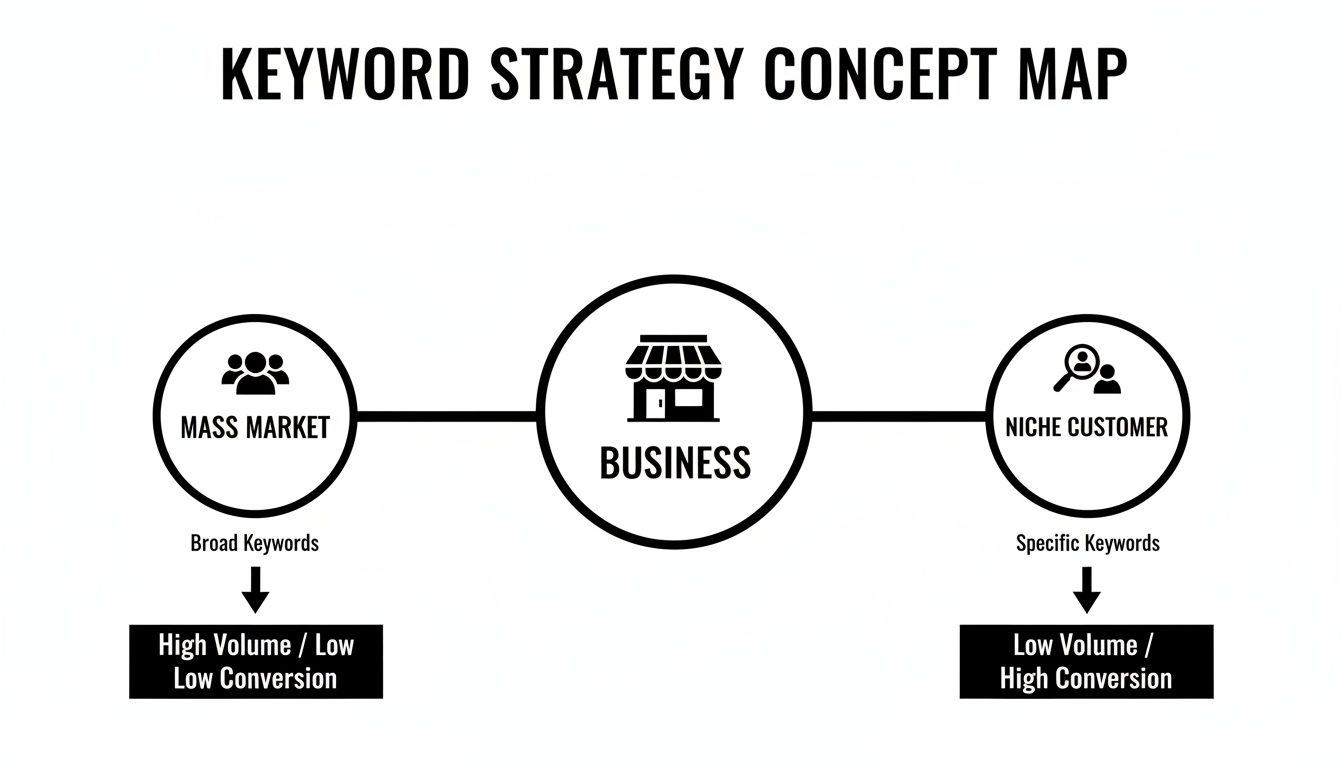
This shift in focus is the core of a smart SEO strategy. You’re no longer just trying to get clicks; you’re trying to get the right clicks.
You’re essentially trading a massive, uninterested audience for a smaller, highly motivated one. This move is what supercharges your conversion rates, because you’re offering the perfect solution to a very specific problem.
Make no mistake, long-tailed keywords are the workhorse of modern SEO. They account for around 70% of all search traffic. With 34.71% of Google searches containing four or more words, it’s clear that people are getting more and more descriptive. This strategy is essential everywhere online, not just on your website. For instance, to see how it works in a competitive marketplace, you can learn how to Master Long Tail Keywords Amazon and apply the same principles.
Head Terms vs. Long-Tailed Keywords: A Comparison
To really drive this point home, let's look at a side-by-side comparison. It illustrates just how different these two approaches are in practice for a restaurant equipment seller.
| Attribute | Head Term (e.g., 'Commercial Fryer') | Long-Tailed Keyword (e.g., 'high efficiency 50 lb gas deep fryer with filtration') |
|---|---|---|
| Search Volume | Very High | Very Low |
| Competition | Extremely High (big-box retailers, major brands) | Low to Medium (niche competitors) |
| Search Intent | Informational, Broad (researching options) | Transactional, Specific (ready to buy) |
| Conversion Rate | Low (typically 1-2%) | High (often 10% or more) |
| Cost-Per-Click (PPC) | High | Low |
| Content Focus | Broad category pages, general guides | Detailed product pages, specific blog posts, FAQs |
As you can see, the head term might look attractive because of the high search volume, but the long-tailed keyword is where the real business happens. It delivers qualified buyers who are much more likely to convert, making it a far more efficient and profitable strategy.
How to Find Your Most Profitable Keywords
Finding the long-tail keywords that actually move the needle isn't about some secret algorithm. It starts with the most powerful tool you already have: your own brain and deep industry expertise. Before you even open a keyword tool, put yourself in your customer’s shoes. What specific problems are keeping them up at night?
Think about it. A cafe owner isn't just typing “commercial ice machine” into Google. They’re thinking, "What's the best quiet undercounter ice maker for my coffee shop?" A hotel bar manager is trying to solve a different problem, maybe searching for a "high-capacity modular ice machine head for a hotel."
Your hands-on knowledge of customer pain points, niche equipment applications, and brand reputations is your single greatest advantage. Start by just brainstorming these real-world scenarios.
Uncover Keywords with Free Google Tools
Once you have a handful of core ideas, it’s time to let Google do some of the heavy lifting for you. Google's own search features are fantastic for expanding your list because they show you what real people are looking for right now.
Start by typing a broad term like "commercial convection oven" into the Google search bar. Pay attention to the Autocomplete suggestions that pop up. These are popular, longer phrases people are actually using, like "commercial convection oven for baking bread" or "single deck gas convection oven."
Next, scroll down the search results page and look for the "People Also Ask" (PAA) box. This thing is a goldmine for question-based keywords that are perfect for blog posts or FAQ sections. You’ll find gems like:
- How do you clean a commercial convection oven?
- What is the difference between a convection oven and a combi oven?
- Can you bake cakes in a commercial convection oven?
Every one of these questions is a cry for help from a potential buyer. Answering them builds trust and authority. This kind of content strategy is a core part of effective ecommerce SEO best practices that helps you connect with customers before they even think about buying.
Use SEO Platforms for Deeper Insights
Free tools are great for getting started, but dedicated SEO platforms like Ahrefs or Semrush bring the data you need to make smarter decisions. These tools let you see how hard it might be to rank for a keyword, estimate how many people are searching for it, and spy on what's working for your competitors.
While getting exact traffic numbers is notoriously tricky, our guide on how to determine search volume for keywords can give you some much-needed context.
Pro Tip: Look for a "Questions" report in your SEO tool of choice. In Ahrefs, for example, you can plug in a seed keyword and this report will instantly spit out dozens of question-based queries. It’s a content-planning cheat code.
These platforms are also killer for competitive analysis. Just pop in a competitor's domain, and you can see the exact long-tail terms they’re ranking for. This quickly reveals gaps in your own strategy and highlights the product categories or customer problems that are already proven winners in the market.
By blending your own industry knowledge with Google's free insights and the hard data from SEO platforms, you'll build a powerful, repeatable process. You'll stop guessing what your customers want and start using real data to find those profitable, high-intent long-tailed keywords that lead straight to a sale.
Putting Your Keywords to Work Across Your Website

Finding a solid list of long-tail keywords is a great first step, but that's all it is—a first step. A keyword list is just a blueprint. Now it's time to start building.
Those valuable phrases won't do you any good sitting in a spreadsheet. They need to be woven thoughtfully into your website. The trick is to match the specificity of the keyword with the purpose of the page. This isn't about just stuffing words in; it’s about creating a clear path for customers, answering their exact needs, and leading them right to a sale.
Optimizing Your Product Pages
Let's start where the money is made: your product pages. These are your final sales pitch, and they are the perfect home for your most specific, granular long-tail keywords. Think of these as your "buyer-ready" pages, catching customers at the very bottom of the funnel who know exactly what they want.
Put yourself in their shoes. A busy restaurant owner who has done their homework isn't just googling "commercial range." They're searching for a "36-inch 6-burner commercial gas range with convection oven." That ultra-specific phrase, right down to the features and model numbers, is your golden ticket.
Here’s exactly where to put those high-intent keywords:
- Product Title (H1): The main heading of your page should be the full, descriptive keyword. No need to be clever, just be clear.
- Product Descriptions: Weave in natural-sounding variations like "heavy-duty six-burner stove" and call out the specific features they searched for.
- Image Alt Text: Describe what's in the picture using your keyword. For example: "Front view of the [Brand Name] 36-inch 6-burner gas range."
- Technical Specifications: Make sure every feature mentioned in their search query is clearly listed in the specs.
When you optimize this way, you're creating a direct connection with a buyer who has already made their decision and is just looking for the right supplier.
Building Authority with Category Pages
Category pages play a different role. They're for the customer who knows what they need but is still weighing their options. This is where your slightly broader, but still targeted, long-tail keywords come into play.
Someone might be searching for "energy-efficient commercial ice machines" or "compact countertop convection ovens for cafes." These phrases signal clear intent but show the customer is in a comparison phase. Use these terms as the H1 title and in the introductory paragraph of your category pages to capture this crucial mid-funnel traffic.
By aligning the keyword intent with the page type—ultra-specific for products, broader for categories—you create a logical and effective user journey that guides customers from consideration to purchase.
Creating High-Value Blog Content
Your blog is your chance to become a trusted expert, not just a seller. This is the perfect place to put all those question-based long-tail keywords you found.
Every question like "how to clean a commercial deep fryer" or "what size walk-in cooler do I need" is a blog post waiting to happen. These are real problems your customers face. By answering them, you build trust and attract potential buyers long before they're ready to pull out their credit card.
Start creating content that genuinely helps people:
- How-To Guides: "A Step-by-Step Guide to Winterizing Your Outdoor Patio Heaters."
- Comparison Posts: "Combi Oven vs. Convection Oven: Which is Right for Your Kitchen?"
- Best-Of Lists: "The 5 Best Undercounter Dishwashers for a Busy Bar."
This kind of content marketing transforms your site from a simple catalog into an indispensable resource, keeping your brand top-of-mind when it's finally time to buy.
Winning with Local and Voice Search Queries
Search is changing fast, and it's happening right in your backyard. The two biggest shifts—local and voice search—are where your biggest opportunities are, and long-tail keywords are the key to unlocking them.
This is especially true if your business serves a specific city or region. Adding a simple location to a search query completely changes the game. Think about it: someone searching for “commercial kitchen repair” is just browsing. But someone searching for “commercial kitchen repair service in Dallas”? That person has a problem right now and needs a local solution.
Capitalizing on Local Search Intent
Local long-tail keywords are your secret weapon for getting in front of nearby customers who are ready to make a move. These aren't just faceless web traffic; they're potential partners looking for a local expert they can rely on.
Here’s what that looks like in the real world:
- "Used restaurant equipment near Chicago"
- "Walk-in cooler installation in the Phoenix area"
- "Emergency commercial oven repair in Brooklyn"
Sprinkling these kinds of phrases throughout your website—on service pages, in your blog, and especially in your Google Business Profile—is how you show up on Google Maps and in those "near me" searches that drive real foot traffic and phone calls.
Answering the Questions of Voice Search
It's not just about where people are searching; it's also about how. Thanks to Siri, Alexa, and Google Assistant, we're all getting used to asking our devices questions instead of typing in robotic keywords. People talk like people, not like search engines.
This is where a smart long-tail strategy really pays off. Instead of just targeting a term like "commercial dishwasher," you need to be the one answering the questions people are actually asking, like, "What's the best commercial dishwasher for a busy restaurant?" For a deeper dive, check out our guide on how to optimize for voice search.
Search engines are already adapting to this conversational shift. According to recent SEO statistics from incremys.com, Google's AI Overview feature now pulls from long-tail queries in 46% of its results. Even more telling, 57.9% of those are direct, question-based searches.
When you create content that answers things like, “what size commercial refrigerator do I need for a pizza restaurant,” you’re perfectly positioned to capture not just standard organic traffic, but those highly visible AI-powered answers, too.
When you build your content around real questions, you stop optimizing just for algorithms and start optimizing for actual human beings. That’s how you build trust and become the obvious answer to the exact problems your customers are trying to solve.
Measuring What Matters for Your Business
It's easy to get obsessed with rankings, but a successful long-tail keyword strategy isn't about hitting #1 for a single, broad term. It’s measured in things that actually grow your business, like quote requests and new sales.
Think about it this way: would you rather have one top ranking that brings in a lot of window shoppers, or hundreds of specific searches that drive qualified, ready-to-buy customers to your site every single day? The focus has to shift from vanity metrics to actions that generate revenue.
The secret is tracking conversions. By setting up goals in a tool like Google Analytics, you can see which of your long-tail pages are pulling their weight and which ones need more work. This lets you connect your SEO efforts directly to your bottom line.
Key Metrics to Track
Instead of fixating on individual keyword positions, look at the big picture—the cumulative impact of all your niche content. Your goal is a steady, upward trend in leads coming from all those specific, high-intent pages you’ve built.
Here’s what you should actually be monitoring:
- Quote Requests: How many people fill out a quote form after landing on a page for something like a "walk-in freezer for a small bakery"?
- Phone Calls: Use call-tracking software to attribute inbound sales calls to the exact pages that sparked them.
- Contact Form Submissions: Are your blog posts about "how to choose a commercial convection oven" generating real inquiries?
- Downloads: If you offer spec sheets or buyer's guides, track how many potential customers are downloading them.
The real magic happens when you can draw a straight line from a specific, long-tail search query to a completed sale. That’s when SEO stops being an expense and starts becoming a profit center.
You can use Google Search Console to see the exact long tailed keywords driving clicks to your most valuable pages. When you see terms like "high-capacity ice machine for a busy hotel" leading to a quote request, you know you’ve cracked the code. That’s not just traffic; that's real, tangible sales growth.
Frequently Asked Questions
Still have a few questions about putting a long-tail keyword strategy to work? Let's clear up some of the most common ones we hear from sellers just like you.
How Many Long-Tail Keywords Should I Target on a Single Page?
It’s best to focus on one primary long-tail keyword that nails the main topic of your page. Think of this as your bullseye. Then, you can support it with three to five closely related keyword variations sprinkled naturally throughout the content.
For instance, if your product page is for a "36-inch 6-burner commercial gas range," that's your primary target. You'd then want to weave in secondary phrases like "heavy-duty six-burner stove" and "commercial range with standard oven" in the product description, specs, or features. This helps you catch all the different ways a real person might search for that exact item.
Do Long-Tail Keywords Still Work if My Business Is Brand New?
They don’t just work—they’re one of the smartest moves a new business can make. Let's be real: trying to rank for a massive term like "commercial dishwasher" when you're the new kid on the block is an uphill battle against established giants.
But the game changes completely when you get specific. A new website has a much better shot at ranking for something like "undercounter high-temp dishwasher for bars." Why? Because the competition is a fraction of what it is for the broader term. This is how you gain that crucial first bit of traction and start building a name for yourself in a specific niche.
Targeting long-tail keywords lets a new business sidestep the industry giants and win smaller, more strategic battles that lead to early sales and growth.
Should I Create a New Blog Post for Every Single Keyword?
Definitely not. That’s a recipe for burnout and creates a lot of thin, repetitive content that Google doesn't like. The better approach is to group a cluster of closely related long-tail keywords into a single, powerhouse piece of content.
The key is to look at the searcher's intent. Questions like "how to clean a commercial deep fryer," "best way to maintain a deep fryer," and "deep fryer cleaning safety tips" all point to one need. You can answer all of them—and then some—in one definitive guide to deep fryer maintenance.
At Restaurant Equipment SEO, we specialize in building these kinds of targeted strategies that connect you with high-intent buyers. Learn how we can help you grow your business at https://restaurantequipmentseo.com.