
Finding Low Competitive Keywords for Restaurant Equipment
Low-competition keywords are the search terms your competitors are ignoring.Think of them as the side streets that lead directly to ready-to-buy customers, letting you completely sidestep the digital traffic jam everyone else is stuck in.
Your Hidden Advantage in a Crowded Market
Let's say your ideal customer needs a very specific piece of equipment. While your biggest rivals are burning cash to rank for a generic term like "commercial refrigerator," you can build a direct path to your website for the customers who are much further along in their buying journey. That's the power of targeting low-competition keywords.
These aren't just obscure phrases. They're highly specific, laser-focused queries that scream "I'm ready to buy!" Instead of just getting clicks, you attract customers who know exactly what they're looking for. The result? Higher conversion rates and a much better return on your marketing dollars.
Shifting Focus from Volume to Intent
The whole idea is to stop chasing high search volume and start focusing on high buyer intent. It's like fishing: you could cast a giant net into the open ocean and hope for the best, or you could use the right bait in a small cove where you know the exact fish you want are biting. The second approach is always more efficient.
This strategy helps you:
- Attract Qualified Leads: You're getting in front of people who've done their homework and are close to making a decision.
- Reduce Marketing Waste: Every bit of effort is aimed at keywords that actually lead to sales, not just empty traffic stats.
- Build Authority Faster: It's much quicker to rank for these niche terms, which builds your site's credibility and helps you rank for bigger keywords down the road.
The global restaurant equipment market is on a massive growth trajectory, projected to hit USD 206.07 billion by 2035. With thousands of suppliers all fighting for attention, this growth presents a huge opportunity for businesses smart enough to capture niche search traffic.
The biggest mistake we see is companies chasing the highest search volume. Real SEO success comes from finding and owning the keyword categories your competition has completely overlooked. That's where the motivated buyers are hiding.
This guide will give you the complete roadmap to find and use these powerful keywords. By mastering the fundamentals of SEO competition research, you can carve out your own profitable corner of the food service industry and turn those overlooked searches into your best source of customers.
Understanding What Your Customers Really Want
Chasing low-competition keywords isn't about settling for less traffic. It's about attracting the right traffic. Think about it this way: you could have a hundred people wander through your showroom just browsing, or you could have one customer walk in with a specific model number written on a piece of paper, ready to buy. The keywords people type into Google reveal that exact same level of intent.
Every search query tells a story about where a customer is on their path to purchase. Your job is to listen to that story and provide the perfect answer right when they need it. When you understand the specific language your customers use, you can meet them at the precise moment they're ready to make a decision.
Decoding the Three Types of Search Intent
Not all searches are created equal. A potential customer who needs a new convection oven will start with a pretty general search. But as they get deeper into their research, their queries become much more specific, signaling they're getting serious about buying.
We can break these searches down into three main buckets:
-
Informational Intent: These are the "what is" or "how to" questions. A search like "what is a convection oven" shows someone is at the very beginning of their journey. They're just gathering information, not ready to buy.
-
Commercial Intent: At this stage, the searcher is actively comparing their options. A query like "best convection oven for a small bakery" tells you they know what they need and are now weighing different brands and models. They're trying to figure out the best choice.
-
Transactional Intent: This is the finish line. When someone searches for "buy Blodgett MARK V-100 online," they're basically holding their credit card. They've made their decision and are looking for a place to complete the purchase.
High-intent, transactional keywords are the name of the game. These are the searches that drive sales, not just clicks. And you'll find that low-competition keywords almost always carry this powerful, high-intent signal.
The Power of Speaking Your Customer's Language
The real secret to finding these golden-nugget keywords is to get inside your customer's head. What specific problems are they trying to solve? What jargon, model numbers, or technical terms would they use if they were a seasoned pro in the industry? This is where the untapped opportunities are hiding.
For example, a restaurant owner with a cramped kitchen won't just search for "oven." They're much more likely to search for something like "half size electric convection oven". This longer, more descriptive phrase is a classic long-tail keyword. Sure, fewer people search for it, but the ones who do are far more likely to convert because you're offering the exact solution to their specific problem.
To really dig in and hear how customers talk, a tool like the Reddit Threads Finder can be invaluable. It lets you eavesdrop on real conversations where your target audience is asking questions and describing their needs in their own words. Listening to these discussions gives you a direct line to the exact phrases your future customers are using every day.
This whole approach shifts your strategy from guessing what people might be looking for to knowing exactly what they're looking for. Once you learn to recognize these signals, you can focus your energy on the search terms that actually drive revenue and build a straight line from their problem to your product. Now, let's get into how to systematically find these keywords.
Your Blueprint for Finding Untapped Keywords
Finding the right low-competition keywords isn’t about some secret formula; it’s about having a smart, repeatable process. Think of it like a chef developing a new recipe. You start with a core ingredient and layer in complementary flavors until you have a perfectly balanced dish. Your keyword research should be just as methodical.
This blueprint will walk you from a broad idea to a curated list of high-intent, low-difficulty keywords that actually drive sales. It's a workflow you can come back to again and again.
At its core, this process is about understanding where your customer is in their buying journey. Are they just browsing, or are they ready to pull the trigger on a big purchase?
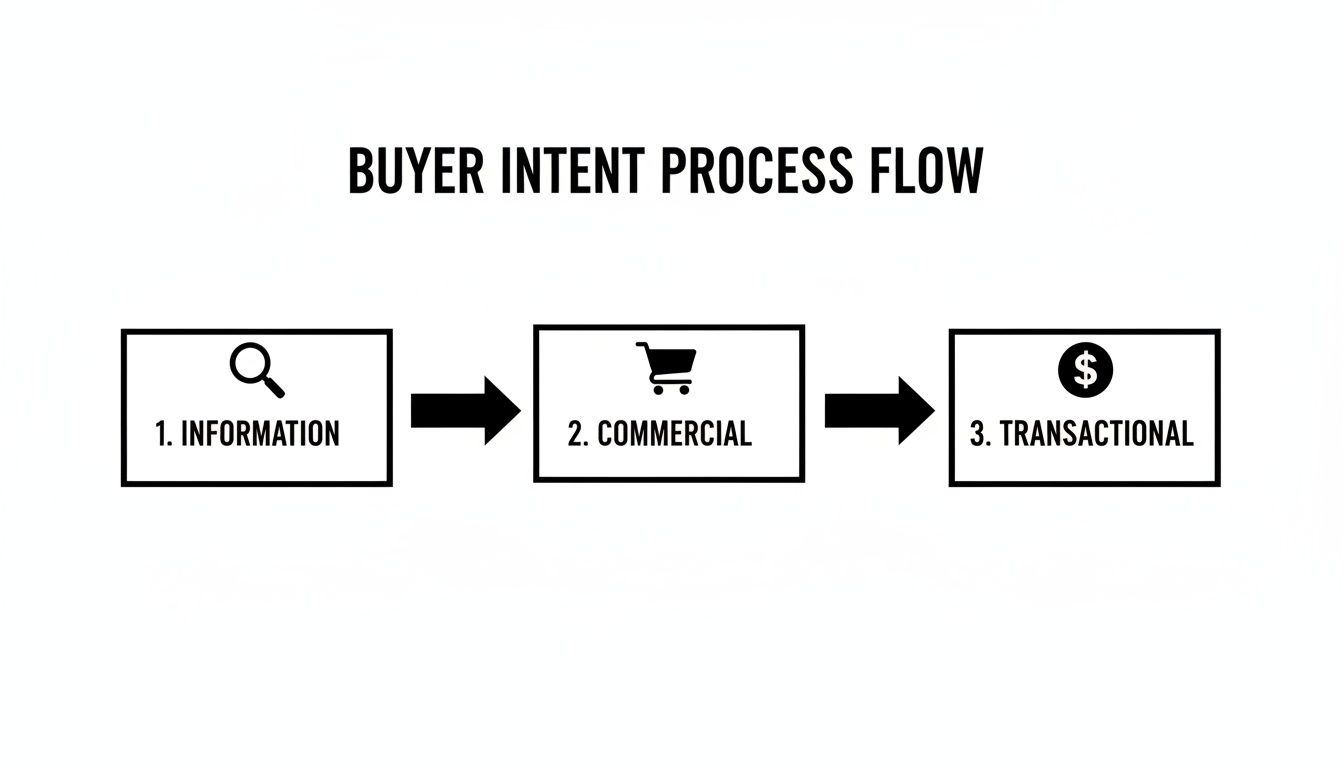
As you can see, buyer intent starts broad and gets more specific. By targeting keywords in those later commercial and transactional stages, you connect with customers who are much, much closer to making a decision.
Step 1: Start with Foundational Seed Keywords
Every great keyword list starts with the basics. We call these seed keywords, and they’re really just the broad, one- or two-word terms for your main products. Don’t overthink it—just jot down the main categories of equipment you sell.
Your initial list might look something like this:
- Commercial ice machine
- Restaurant freezer
- Pizza oven
- Deep fryer
- Convection oven
Sure, these terms themselves are incredibly competitive. But they are the essential starting point—the "core ingredient"—that we’ll use to uncover dozens of more specific, long-tail variations.
Step 2: Expand Your List with Keyword Research Tools
With your seed keywords ready, it's time to find out what real people are actually searching for. This is where keyword research tools are a game-changer. You plug in a simple term like "pizza oven," and they spit back hundreds of related queries.
Free Tools to Get You Started:
- Google Keyword Planner: A solid, no-cost option for getting search volume estimates and new ideas straight from the source.
- Ahrefs Free Keyword Generator: Fantastic for uncovering question-based keywords (“how to clean…”) that are perfect for blog content.
- Google Search Itself: Don’t underestimate Autocomplete and the "People Also Ask" box. Typing your keyword into Google reveals a goldmine of real-time search data.
Paid Tools for Deeper Analysis:
- Ahrefs or Semrush: These are the industry standards for a reason. They provide a crucial metric called Keyword Difficulty (KD). This score, usually from 0-100, estimates how hard it will be to rank on page one for that term. This is your secret weapon for finding low-competition keywords.
For a really deep dive into the whole process, from brainstorming to data analysis, check out this guide on how to conduct keyword research like an expert.
The goal isn't just finding keywords; it's finding keywords you can realistically rank for. Filtering by a low Keyword Difficulty score—typically under 20 for newer or smaller sites—is the most efficient way to separate achievable targets from impossible battles.
Step 3: Manually Analyze the Search Results (The Eye Test)
Data from tools is a great start, but it never tells the whole story. The final, most important step is to manually check out the Search Engine Results Page (SERP) for your most promising keywords. You have to see what you're up against with your own eyes.
Go to Google, type in your keyword, and look for signs of weakness in the current top-ranking pages:
- Forums & Community Sites: Are pages from Reddit or Quora ranking on page one? That’s a massive green light. It means Google can’t find enough high-quality, dedicated content and is resorting to user-generated posts.
- Outdated Content: Do the top articles have old "last updated" dates from years ago? You can easily win by providing fresh, current information.
- Low-Quality Pages: Look for sites with thin content, a terrible user experience, or pages that just don't fully answer the question.
While it’s tempting to chase high-volume keywords, the real opportunity is in the balance between decent search volume and high buyer intent.
High-Volume vs. High-Intent Keyword Examples
The table below shows the stark difference between a broad, competitive keyword and a specific, low-competition one. Notice how the intent becomes much clearer as the phrase gets more specific.
| High-Competition (Broad) | Monthly Searches | Low-Competition (Specific) | Monthly Searches | Likely Intent |
|---|---|---|---|---|
| commercial freezer | 22,000 | best undercounter freezer for a small cafe | 150 | Transactional |
| pizza oven | 65,000 | outdoor commercial pizza oven with stand | 200 | Commercial |
| commercial ice machine | 27,000 | how to clean a scotsman nugget ice machine | 90 | Informational |
| deep fryer | 33,000 | ventless countertop commercial deep fryer | 120 | Commercial |
As you can see, the specific keywords have a fraction of the search volume, but the person searching is much further along in the buying process. That's the customer you want to attract.
By following this blueprint—brainstorming seeds, expanding with tools, filtering by difficulty, and finally, manually checking the search results—you create a reliable workflow for uncovering the low-competition keywords that will become the bedrock of your SEO success.
Finding Keyword Ideas in Your Own Showroom

Theory is great, but let's get practical. The best low-competition keywords aren't buried in some complex software—they're hiding in plain sight. They’re in the questions customers ask you every day, the specific problems they need to solve, and the unique challenges of their kitchens.
Stop thinking of your showroom as just a collection of equipment. Start seeing it as a goldmine of keyword themes. When you organize your research around how real chefs and restaurant owners think, you'll uncover a wealth of search terms that are high-intent and much easier to rank for. These themes go way beyond generic product names and plug you directly into your customer's mindset.
Theme 1: Equipment for Specific Cuisines
A chef opening a new Indian restaurant isn't just googling "commercial oven." That's far too broad. They need gear tailored to their menu, and that specificity is exactly where you can find keywords your bigger competitors are completely ignoring.
- Who's Searching? A passionate chef or an entrepreneur who lives and breathes a particular cuisine. They know the exact tools needed to create authentic dishes and are searching for a supplier who "gets it."
- What They Type: "tandoor oven for Indian restaurant," "commercial tortilla press for Mexican food truck," or "high capacity pasta cooker for Italian bistro."
- How You Can Rank: Write a detailed guide titled something like, "The Essential Kitchen Equipment for an Authentic Indian Restaurant." It's the perfect place to showcase your expertise, feature the right products, and naturally use those super-specific, long-tail keywords.
Theme 2: Used and Refurbished Gear
Not every customer has a budget for brand-new everything. In fact, a huge number of them are actively looking for reliable used or refurbished options to keep startup costs down. These searchers are often highly motivated buyers on the hunt for a great deal from a supplier they can trust.
- Who's Searching? A budget-conscious new business owner, a food truck operator, or an established restaurant needing to replace a single item without a huge capital investment.
- What They Type: "refurbished Hobart mixer for sale," "used Blodgett convection oven near me," or "certified pre-owned commercial ice machine."
- How You Can Rank: Build out a dedicated category page for "Used & Refurbished Equipment." Make sure every listing has detailed descriptions, clear photos, and warranty info to build confidence and capture people ready to buy.
By targeting "used" or "refurbished" keywords, you tap into a segment of the market that prioritizes value over brand-new condition. These customers are often ready to make a purchase decision quickly once they find the right piece at the right price.
Theme 3: Space-Saving Solutions
Urban restaurants, ghost kitchens, and food trucks all fight the same battle: not enough space. This one constraint dictates almost every purchasing decision they make, sending them on a search for compact, multi-functional, or undercounter models. Their practical needs translate directly into powerful, low-competition keywords.
Want to go deeper on these kinds of specific queries? Our guide on long-tail keyword research has more strategies just like this.
- Who's Searching? An operator of a small cafe, bar, or food truck where every single square inch is prime real estate. They need efficient solutions that don't sacrifice performance.
- What They Type: "undercounter glass washer for small bar," "ventless countertop deep fryer," or "slimline commercial reach-in refrigerator."
- How You Can Rank: Write a blog post like, "Maximizing Your Small Kitchen: Top 10 Space-Saving Restaurant Equipment Solutions." An article like this provides genuine help while seamlessly weaving in product recommendations for these niche keywords.
Theme 4: Energy-Efficient Models
With utility costs always on the rise and a growing focus on sustainability, more restaurant owners are looking for energy-efficient equipment. When you see keywords with terms like "Energy Star," "low water usage," or "high efficiency," it's a signal from a buyer who is thinking about the long-term total cost of ownership, not just the sticker price.
- Who's Searching? A forward-thinking owner or manager focused on sustainability and trimming operational expenses. They're often willing to invest more upfront for big savings down the road.
- What They Type: "Energy Star commercial reach-in freezer," "high-efficiency commercial dishwasher," or "low water usage combi oven."
- How You Can Rank: Create comparison articles that do the math for them. A post titled "Energy Star vs. Standard Freezers: A Cost Breakdown" can attract these savvy buyers by showing them a clear return on their investment.
Turning Your Keyword List Into Paying Customers
Finding that perfect list of high-intent, low-competition keywords feels like a major win, but it's really just the beginning. Think of it like a detailed blueprint for a new building. The plans themselves are worthless until you actually start construction. In the same way, your keywords don't bring in a dime until you put them to work.
This is where your research turns into real-world results. You're going to use that keyword list to build two critical assets: valuable content that pulls people in, and perfectly tuned pages that turn visitors into paying customers.
Let's break down exactly how to do both.
Build Authority with Content Creation
A good chunk of your low-competition keywords will be informational. These are all the "how-to," "what-is," and "best-for" questions your potential customers are punching into Google before they’re anywhere near ready to buy. Your job is to answer those questions better than anyone else on the internet.
Doing this is your single best chance to become the go-to expert in your niche. When you create genuinely helpful content, you build trust and naturally guide potential buyers through their decision-making journey, from confused to confident.
Here are a few common ways to put those informational keywords to use:
- Buying Guides: A detailed post for a keyword like "how to choose a commercial griddle" can walk a new restaurant owner through materials, sizes, and power sources. Naturally, you can position your products as the perfect solution.
- FAQ Pages: Got a bunch of related questions like "how often to clean a commercial ice machine"? Group them onto a single, comprehensive resource page that solves common problems for your existing and future customers.
- Comparison Posts: An article targeting "deck oven vs convection oven for artisan bread" helps a baker make a crucial, expensive decision. You're building massive goodwill long before they even think about adding something to a cart.
By answering your audience's questions, you're not just gunning for a quick sale. You are building a relationship and establishing topical authority. This signals to Google that your website is a credible source of information for the entire restaurant equipment industry.
Capture Sales with On-Page and Local SEO
While content builds your audience over time, on-page optimization is what closes the deal right now. This is where you deploy your transactional and local keywords—the phrases that scream "I'm ready to buy!"—directly onto the pages that make you money.
Think about keywords like "commercial pizza oven financing near me" or "buy True T-49 refrigerator online." The person searching these terms isn't just browsing; they have a problem and they're looking for an immediate solution. Your product and category pages must be perfectly aligned with these queries to grab that sale.
Optimizing these pages isn't rocket science. It's about placing your target keyword in a few key spots so both search engines and human users immediately understand what the page is about. This alignment is what gets you ranked and converts local buyers.
Your On-Page Optimization Checklist
Use this simple checklist for every product page, category page, and even your Google Business Profile to make sure you're capturing that high-intent search traffic.
Let’s use the keyword "undercounter glass washer for small bar" as our example.
-
Title Tag: This is your most important on-page signal. It needs to be compelling and include the exact keyword phrase.
-
Example:
Buy the Best Undercounter Glass Washer for Small Bars | YourBrand
-
Example:
-
Meta Description: Think of this as your 155-character sales pitch in the search results. Make it descriptive and tell them what to do next.
-
Example:
Find the perfect undercounter glass washer for your small bar. We offer compact, high-efficiency models with fast shipping. Shop our collection now!
-
Example:
-
H1 Heading: This is the main headline on your page. It should be crystal clear and match what the person searched for.
-
Example:
Undercounter Glass Washers for Small Bars
-
Example:
-
Page Content: Weave your keyword and relevant variations naturally into your product descriptions and introductory text.
- Example: "This compact undercounter glass washer is designed specifically for the tight spaces found in a small bar or cafe..."
By systematically applying this process, you transform your keyword list from a simple spreadsheet into a powerful revenue-generating engine. You start connecting the right customers to the right products at the exact moment they’re ready to buy.
How to Measure Your SEO Success
Creating content around low-competition keywords isn't a one-and-done job. You have to track your progress to make sure your hard work is actually turning into business growth. Measuring your success shows you what’s working, where to double down, and how to justify your investment in SEO.
Think of it like a chef tasting a sauce as it simmers. You don't wait until the dish is served to find out it's bland; you taste and adjust along the way. Your SEO strategy needs that same constant attention to get the results you want. The good news is, you don’t need a bunch of expensive tools to get started.
Key Metrics to Monitor
You can get all the most important data you need from free tools like Google Analytics and Google Search Console. Instead of getting lost in a sea of data, just focus on the handful of metrics that show the direct impact of your new content.
Here are the vital signs of a healthy low-competition keyword strategy:
- Organic Traffic Growth: Are the new pages you built actually bringing people to your site from Google? You should be looking for a steady, upward trend in traffic to those specific URLs.
- Keyword Rankings: Jump into Google Search Console and see if you’re starting to show up for your target keywords. It's an incredible feeling to watch a term climb from page ten to page one over a few months.
- Click-Through Rate (CTR): This number tells you what percentage of people who see your page in the search results actually click on it. If your CTR is going up, it means your page titles and descriptions are hitting the mark.
Success with low-competition keywords creates a powerful snowball effect. Each new ranking you achieve builds your website's overall authority, making it progressively easier to rank for more competitive terms in the future.
From Traffic to Tangible Results
Look, traffic and rankings are great, but they don't pay the bills. The real goal is to connect your SEO efforts to actual business outcomes. This means tracking conversions—the specific actions a visitor takes that tell you they're a hot lead.
For a deeper dive into this topic, you can learn more about how to measure SEO performance in our detailed guide.
Make sure you're tracking these bottom-line actions:
- Quote Requests: Someone fills out a form asking for pricing on a commercial ice machine or a walk-in cooler.
- Phone Calls: A prospect clicks the phone number on your site to talk to a sales rep.
- Email Sign-ups: A potential customer joins your newsletter to get deals and industry updates.
By focusing on these less-obvious keywords, you create a sustainable cycle of growth. You attract highly qualified traffic, turn that traffic into real leads, and build the authority needed to go after the bigger, more competitive terms later. This approach turns your initial research and content work into a lasting competitive advantage.
Answering Your Top Questions
Let's tackle some of the most common questions we hear from restaurant equipment suppliers about using these low-competition keywords. Getting these answers straight can make all the difference as you get started.
How Long Does This Actually Take?
Everyone wants to know when they'll see the payoff, and that's fair. While it’s never an exact science, targeting low-competition keywords gets you results much faster than chasing the big, flashy terms.
You can often see your content start to gain traction—and even hit the first page—within 2 to 4 months. The key isn't a single magic article; it's consistency. Each piece of content you create builds on the last, creating a powerful snowball effect that boosts your site's authority over time.
So, I Should Just Ignore the Big Keywords?
Absolutely not. It's all about playing the short game and the long game at the same time. Think of it as a balanced portfolio.
Your main focus, especially at first, should be on winning those achievable, low-competition keywords. They bring in qualified traffic and build momentum. Once you have that foundation, you can start creating comprehensive, pillar-style content aimed at those high-volume head terms.
Think of low-competition keywords as your stepping stones. They build the authority and trust you need with search engines to eventually compete for the most valuable, high-traffic terms in the industry.
How Does This Strategy Fit with Local SEO?
This approach is a local business's best friend. It’s tailor-made for attracting customers in your specific service area. The method is straightforward: simply pair your target equipment keywords with local modifiers.
For example, instead of just "used commercial convection oven," you'd go for something like "used commercial convection oven for sale in Denver." This laser-focused targeting cuts right through the national competition and puts you directly in front of local buyers ready to make a deal.
At Restaurant Equipment SEO, we specialize in turning these overlooked search terms into your most valuable source of leads. Discover how our targeted strategies can build a direct path from local searchers to your showroom. Visit our website to learn more.