
SEO Competition Research for Restaurant Equipment Suppliers
SEO competition research is simply the practice of figuring out what your rivals are doing online, so you can do it better. It's not about stealing their playbook; it’s about analyzing their game film to create a smarter, more effective strategy for your own business.
Why Competitor Insights Are Your Most Valuable Asset

In the crowded online market for restaurant equipment, just having a website is table stakes. To actually grow, you have to treat SEO competition research as a core business intelligence activity, not just another marketing task on a checklist. This is the mindset shift that separates the real players from everyone else.
Think about it: your competitors are already spending a ton of time and money discovering what resonates with your shared audience. By analyzing their digital footprint, you get a shortcut. You can see exactly what high-intent buyers—like executive chefs, restaurant owners, and procurement managers—are typing into Google. This lets you move from guessing what customers want to knowing what they need.
Uncovering the Blueprint to Success
A deep dive into a competitor's strategy reveals far more than a simple list of keywords. You're essentially uncovering a blueprint that shows you:
- Their most profitable product lines: Are they getting the most organic traffic for commercial ovens or refrigeration units?
- The content that actually converts: Are they using detailed buyer's guides, product comparison videos, or ROI calculators to turn browsers into buyers?
- Their authority-building strategy: Where are their best backlinks coming from? Food service blogs, industry magazines, or supplier directories?
- Untapped market opportunities: What valuable topics or product niches are they completely ignoring, leaving the door wide open for you?
This isn't just snooping. It’s methodical intelligence gathering. The insights you find become the bedrock of a marketing plan built to systematically capture more market share. To really get into the weeds on this, exploring various SEO competitive intelligence tactics is a great next step.
The goal here is to change your perspective from "SEO is this huge, confusing thing" to "I can use these specific insights to win." By understanding what’s working for others, you can fine-tune your approach, sidestep costly mistakes, and put your budget where it will actually make a difference.
The Stakes of Digital Visibility
The numbers don't lie. In the restaurant equipment space, organic search drives nearly 47% of all website traffic, making it the most critical channel for finding new customers.
Even more telling, the top result on Google gets about 27.6% of all clicks—that's a click-through rate of nearly 40%. That rate gets cut by more than half for the site in the second position. The value of earning that top spot for your most important commercial keywords is massive.
How to Identify Your True Online Competitors
In the restaurant equipment business, your biggest local rival—the one whose truck you see on the road every day—might be a complete ghost online. On the flip side, a website you've never even heard of could be quietly stealing most of your potential customers right from Google's search results.
The first, and most critical, step in any real SEO competition research is to toss your offline assumptions out the window. You need to identify who you're really up against on Google.
Your digital competitors fall into three distinct buckets. Getting this right from the start is crucial because it completely changes your strategy. You just don't fight a content blog the same way you fight a direct eCommerce seller.
The Three Tiers of Online Rivals
Think of your competitive landscape less like a flat playing field and more like a multi-layered arena. Each tier demands a different game plan.
- Direct Competitors: These are the obvious ones. They're selling the same commercial refrigeration units, combi ovens, and stainless steel tables to the exact same audience you are. Think of giants like WebstaurantStore or a strong regional supplier with a killer online presence.
- Indirect Competitors: These businesses solve the same core problem but with a different angle or product. This could be used equipment marketplaces, local repair services, or even auction sites that pop up for keywords like "buy used commercial mixer."
- Content Competitors: These aren't even sellers. They're industry publications, food blogs, or chef forums (like Foodservice Equipment & Supplies magazine) that create killer guides and reviews. They compete for valuable "how-to" and "best of" keywords, grabbing your audience's attention way before they're ready to buy.
You have to analyze all three types. Ignoring content competitors is a massive, rookie mistake. They own the top of the sales funnel and influence your customers' research long before anyone adds a product to a cart.
Pinpointing Your Competitors with Precision
So, how do you actually find these players?
Start simple. Fire up an incognito window in your browser and run a few Google searches for your main product categories. Look up terms like "commercial ice machine" or "restaurant range for sale" and just see who consistently shows up on page one.
For a more data-driven approach, SEO tools are your best friend. Platforms like Ahrefs and Semrush have fantastic 'Competing Domains' or 'Organic Competitors' reports. Just plug in your own website's domain, and the tool will spit out a list of sites that rank for a similar batch of keywords. For a full rundown of your options, check out our guide on the best tools for competitor analysis.
Here’s a quick look at what the 'Competing Domains' report in Ahrefs gives you. It clearly shows how many keywords you share with another site.
This isn't just guesswork; the data immediately points you to your most significant organic threats based on pure keyword overlap. Now you have a clear, data-backed starting list.
What you're left with isn't just a random jumble of URLs. It’s a segmented, prioritized roster of your true online competition. Now you know exactly whose playbook you need to deconstruct to start winning more market share.
Finding Profitable Keyword and Content Gaps

Alright, this is where the detective work really pays off. We're moving beyond just knowing who our competitors are and starting to dig into their playbook to find opportunities they've missed. The entire point here is to uncover the exact keyword and content holes in their strategy that we can fill to drive qualified buyers straight to our site.
Your best tool for this job is a keyword gap analysis. Using a platform like Semrush or Ahrefs, you'll pit your website's keyword profile against your top two or three competitors. The software then spits out a goldmine of information: all the valuable keywords they rank for that you currently don't.
But don't just grab every keyword you see. We’re hunting for the phrases that signal a customer is getting ready to open their wallet.
Zeroing In on Money Keywords
Broad terms like "commercial oven" have their place, but the real wins are in the specific, long-tail searches. These are the queries people use when they've done their initial research and are narrowing down their options.
You're looking for keywords that have modifiers tied to purchasing, cost, or specific needs. These are what I call "money keywords."
- Transactional Intent: "buy Hoshizaki ice machine" or "commercial combi oven financing"
- Comparison Intent: "True vs Turbo Air refrigerator" or "best commercial deep fryer 2024"
- Solution-Oriented Intent: "energy-efficient walk-in cooler" or "compact commercial dishwasher for small cafe"
Discovering these gaps is like finding a restaurant owner's shopping list. You’re seeing the precise language they use right before making a major equipment purchase.
Analyzing Content Beyond Keywords
A spreadsheet full of keywords is just data. The real strategic insight comes from looking at the content that’s actually ranking for those terms. This is a crucial step in SEO competition research that, frankly, most suppliers skip.
Get out of the spreadsheet and actually visit the top-ranking pages. Start asking the right questions.
What kind of content is Google rewarding for this search? Is it a super-detailed product page? A long-form buyer's guide? A video review? The format itself is a massive clue about what your audience actually wants to see.
For instance, if the top three results for "how to clean a commercial grease trap" are all video tutorials, writing a 2,000-word blog post is probably the wrong move. Your competitors have already done the testing for you, showing what format works best for both Google and the user.
Uncovering Overlooked Content Opportunities
Now for the exciting part: finding the topics your competitors have totally ignored. This is your chance to build real authority and pull in customers that no one else is talking to.
Let's say you specialize in eco-friendly kitchen equipment. You run your analysis and realize none of your main competitors have a truly comprehensive guide on "choosing energy-efficient commercial refrigeration." Sure, they have product pages, but no one has created the definitive resource that helps a buyer understand ROI, utility rebates, and long-term savings.
That's a huge content gap. By creating the ultimate guide on this topic, you achieve three things at once:
- You attract high-quality leads who are already thinking about a specific equipment need.
- You establish yourself as the expert on a specialized, high-value topic.
- You naturally rank for dozens of related long-tail keywords.
The stakes here are high. Organic channels drive an incredible 44.6% of revenue in related B2B sectors, and with Google's algorithm considering over 200 factors, great content is your ticket to the top. As you can see from these detailed SEO statistics on SERanking.com, long-form content consistently earns more traffic and links, making these in-depth guides a powerful part of your strategy.
Prioritizing Your Content Attack Plan
After this deep dive, you’ll be sitting on a long list of potential keyword and content ideas. You can't do it all at once, so you need a simple way to decide what to tackle first for the biggest impact.
This is where a simple prioritization matrix comes in handy. It helps turn a subjective list into an objective, actionable roadmap.
Keyword Opportunity Prioritization Matrix
This simple framework helps you evaluate each keyword or content idea against key business metrics. By assigning scores, you can quickly identify the low-hanging fruit and the high-impact projects that will move the needle fastest.
| Keyword/Content Idea | Business Relevance (High/Med/Low) | Monthly Search Volume | Keyword Difficulty (KD) | Priority Score |
|---|---|---|---|---|
| commercial combi oven financing | High | 150 | 18 | 9/10 |
| Choosing Energy-Efficient Refrigeration | High | 90 | 12 | 9/10 |
| True vs Turbo Air refrigerator | Medium | 300 | 25 | 7/10 |
| best commercial ice machines | Medium | 1,200 | 45 | 5/10 |
Scoring each opportunity based on relevance, traffic potential, and ranking difficulty gives you a clear plan of attack. Start with the ideas that have high priority scores. This focused approach ensures your time and resources are spent creating content that directly helps your bottom line, closing the gap between you and the competition one strategic move at a time.
Picking Apart Their Backlinks and Technical SEO
Even the best content on earth will fall flat if it isn't backed by authority or is stuck on a clunky, slow website. Now we move beyond just keywords and get into the nitty-gritty of what really props up a strong search presence: their backlink profile and technical site health.
Think of digging into a competitor's backlinks as mapping out their network. You’re seeing exactly who in the industry trusts them enough to send their own audience their way. This isn't just about SEO metrics; it's pure market intelligence.
The real goal here is to figure out their link-building strategy. Are they consistently getting featured in big-name trade magazines? Or are they sponsoring local food festivals to get links from community event pages? Every single link tells you a story about where they're putting their marketing dollars and effort.
Finding the Links That Actually Matter
First things first: don't get spooked by the sheer number of backlinks a competitor has. The vast majority are usually low-quality, automated junk that Google barely even registers. Your job is to sift through the noise and find the gold.
Using a tool like Ahrefs or Semrush, you can sort their backlink profile by "Domain Rating" (DR) or "Authority Score" (AS). This is the fast track to seeing the most powerful links right at the top.
From there, start looking for patterns. Zero in on sources you could realistically get a link from, too.
- Trade Publications: Links from industry staples like FSR Magazine or Restaurant Business Online are incredibly valuable. See if your competitors are writing guest articles or getting quoted in industry roundups.
- Chef & Culinary Blogs: A lot of high-traffic food blogs review or feature new kitchen equipment. Find out which ones are linking to your rivals.
- Supplier & Partner Lists: This is often low-hanging fruit. Many manufacturers and industry associations keep directories of their certified dealers. If you fit the bill, getting listed is usually straightforward.
- Event Sponsorships: Look for links from local food and wine fests, trade shows, or charity cook-offs they've sponsored.
Knowing how to properly size up these links is a crucial skill. For a more detailed process, check out our guide on how to check backlinks on Google. By grouping these links, you’re not just making a list to copy—you're reverse-engineering a proven outreach strategy.
Your goal isn't a list of 100 domains to spam with emails. It's the insight that your top competitor is successfully guest posting on three major chef forums, which reveals a content strategy you can adopt and make even better.
Running a Quick and Dirty Technical Audit
A technically sound website gives users a better experience, and Google rewards that. While a full-blown technical audit is a massive project, a "lean" version focused on your competitors can uncover huge opportunities. We're looking for things that directly impact a customer's journey and, by extension, search rankings.
The single most important check? Site speed. Nothing kills a sale faster than a product page that takes forever to load. Google's PageSpeed Insights is the perfect tool for this—just plug in a competitor's URL, especially for a key product or category page.
The tool spits out a clear performance score and, more importantly, tells you why it's slow. If you see that their pages are sluggish because of things like render-blocking resources, you’ve just found a major competitive advantage. A faster site is a better site.
Beyond pure speed, your lean audit should poke around a few other key areas:
- Mobile Experience: This is simple. Just pull up their site on your phone. Is it easy to get around? Are product photos clear and zoomable? Can you actually read the spec sheets without pinching and scrolling all over the place? A bad mobile site is a huge vulnerability.
-
Site Structure & Navigation: How do they organize everything? Does it make sense to get from "Commercial Ovens" to "Convection Ovens" and then to a specific model? A clean URL structure (like
/ovens/convection/brand-model) is a great sign for both users and search engines. - Structured Data (Schema): Use Google's Rich Results Test to see if they're using schema markup on their product pages. This is special code that helps Google understand details like price, stock status, and review ratings, which can earn them those eye-catching, enhanced listings in search results.
This focused technical check-up gives you a concrete to-do list. By finding and fixing these same issues on your own site—or simply doing them better where your competitors fall short—you create a superior online experience that both customers and Google will notice.
Zooming In: Auditing Local Search and Product Pages
Sure, ranking for broad terms is great, but in the restaurant equipment world, the real money is made in two places: local search results and the product page itself. This is where a chef, manager, or owner makes their final call. A truly effective competitive analysis has to get granular and dissect these high-stakes conversion points.
Winning the local game almost always starts with a rock-solid Google Business Profile (GBP). For many local buyers, this is the very first time they'll interact with your brand. You need to start by putting your top local competitors' profiles under the microscope.
Don't just give it a quick scan. Methodically pull apart their entire approach. Is their profile 100% complete? I mean every single field—services, accurate hours, a detailed business description, the works. This foundational stuff is surprisingly easy to get wrong, and you can cross-reference your efforts with our complete local SEO checklist for restaurant suppliers to make sure you're ahead of the curve.
How Are They Managing Their Local Reputation?
Beyond just filling out the profile, look closely at how they interact with customers. A well-tended GBP is a living, breathing part of their marketing, not just a static business listing.
Keep an eye out for these tell-tale signs of a smart local strategy:
- Review Flow and Feeling: Are new reviews coming in consistently? More importantly, what’s the general sentiment? Are customers dropping hints about specific products or standout service?
- Response Game: Do they reply to reviews, especially the negative ones? A competitor who takes the time to thoughtfully address a bad experience is actively building trust and showing they care.
- Google Posts in Action: Are they using Google Posts to show off new equipment, run promotions, or share company news? It’s a powerful feature that so many businesses ignore, and it keeps their profile looking fresh.
- Q&A Engagement: Is the Questions & Answers section full of helpful, company-provided answers, or is it a ghost town? Smart competitors seed this area with common questions to head off customer friction before it starts.
This kind of analysis gives you a crystal-clear picture of how seriously they take their local presence. Every unanswered question or ignored review is a weakness you can turn into your strength.
Deconstructing Their Best-Selling Product Pages
Now, let's pivot to their top-performing product pages. Think of these pages as their star digital salespeople. Analyzing them shows you exactly what they believe convinces a visitor to become a customer. You have to look past the price and the hero image and see the entire experience from the perspective of a busy procurement manager.
Start with their product descriptions. Are they just lazily copying and pasting the generic text from the manufacturer? Or have they written unique, benefit-focused copy that speaks directly to the headaches of running a commercial kitchen? Look for details that matter, like cleanability, energy efficiency, and how the unit improves workflow.
A great product page doesn't just list features; it answers the unasked questions a chef would have. It preemptively addresses concerns about installation, maintenance, and long-term durability.
This is also where we see the real-world impact of SEO data. In a niche like restaurant supplies, where 72% of local searches are heavily influenced by photo-rich listings, your content has to be on point. Since Google handles over 90% of all search traffic, your product pages need to be practically perfect to grab a top spot and its average 39.8% click-through rate. You can dig into more data on how these factors impact lead generation by exploring these comprehensive SEO statistics on seoprofy.com.
Use your competitive analysis to build a checklist for creating superior product pages of your own:
- Visuals: Are they using high-res, multi-angle photos? Better yet, do they have videos showing the equipment in action or a quick demo of a key feature?
- Tech Specs: How easy is it to find and download spec sheets, CAD files, installation guides, and warranty info? Hiding these documents behind clunky navigation is a major turn-off.
- Schema Markup: Use Google's Rich Results Test tool to see if they're using product schema. This is the code that helps Google show rich snippets like price, availability, and review stars right in the search results, making their listing way more enticing to click.
- Calls-to-Action (CTAs): Is the "Add to Cart" or "Request a Quote" button impossible to miss? Are they offering financing options or a live chat button right there on the page?
By auditing these two critical areas—local presence and product pages—you're essentially creating a precise blueprint for success. You’ll know exactly where to strengthen your local game and how to build product pages that don't just rank, but actually sell.
Turning Your Research Into an Action Plan
All the data in the world won't do you any good if it just collects dust in a spreadsheet. This is where the rubber meets the road. The final, and arguably most important, part of any seo competition research is transforming those insights into a real, actionable plan. It’s how you connect the dots between your keyword gap analysis, backlink audit, and technical review to build a roadmap that actually gets results.
The trick is not to get overwhelmed. You can't, and shouldn't, try to fix everything at once. The goal is to distill everything you've learned into smaller, more manageable projects with crystal-clear objectives.
Creating a Prioritized Roadmap
First things first, start grouping your findings into logical themes. You'll quickly see that your long list of "to-dos" naturally falls into a few key buckets. This simple step keeps you from bouncing between random tasks and helps focus your energy where it matters most.
Your themed buckets will probably look something like this:
- New Content Plays: This is your list of new blog posts, buyer's guides, and resource articles you uncovered during the keyword gap analysis.
- On-Page & Product Page Tune-Ups: Think of tasks like rewriting stale product descriptions, beefing up internal linking, or adding product schema.
- Technical SEO Housekeeping: This is where you'll tackle issues like slow page speed, mobile usability problems, or crawl errors.
- Local SEO Boosts: Everything related to optimizing your Google Business Profile and building out local citations goes here.
- Authority & Backlink Building: This covers targeted outreach to industry publications and getting listed in relevant supplier directories.
Once you categorize your tasks, the big opportunities often jump right out. If you realize 80% of your high-priority items are about "On-Page & Product Page Tune-Ups," you know exactly where to point your team for the next three months.
The audit process isn't just about keywords and backlinks, though. It's about understanding the complete customer journey, from local discovery to the final click on a product page.
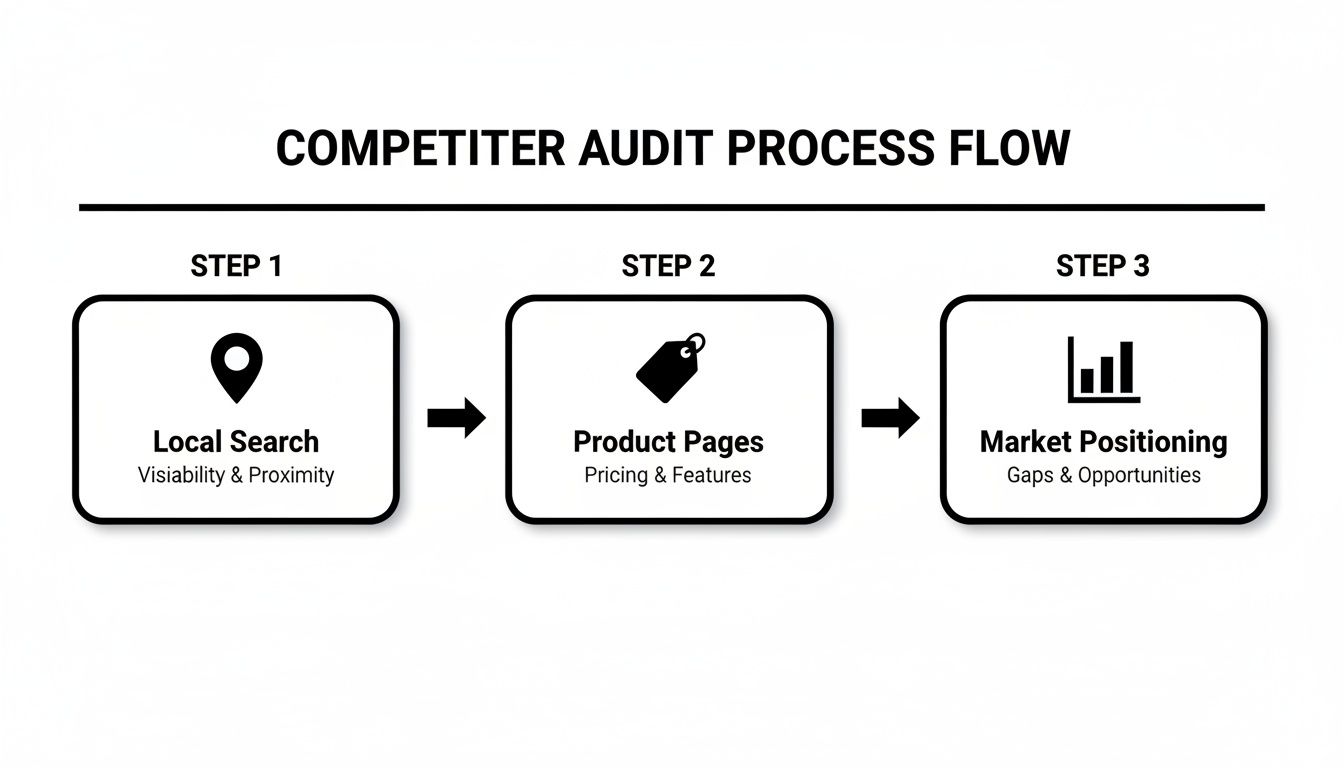
This flow highlights two critical areas your plan needs to cover: how customers find you in their local area and how well your product pages convert them once they arrive.
Setting Realistic Goals and Next Steps
With your tasks neatly organized, it’s time to get specific. Vague goals like "increase traffic" are pretty much useless. You need tangible targets that are tied directly to your research.
Here’s what some strong, actionable goals might look like:
- Content Goal: "Publish three new, in-depth buyer's guides targeting our top-priority keyword gaps within the next 90 days."
- Product Page Goal: "Optimize our five top-selling product pages by rewriting descriptions, adding videos, and implementing review schema by the end of this month."
- Local SEO Goal: "Secure 10 new, high-quality local citations and respond to all new Google reviews within 24 hours for the next quarter."
Once you have these clear goals, assign an owner to each task and give them a firm deadline. This is what turns a research document into a living strategy. If you need help executing the plan, bringing in professional search engine optimization services can ensure your findings are implemented correctly.
Finally, set up a simple way to track your progress—even a Google Sheet will do. Monitoring your efforts keeps everyone accountable and, more importantly, helps you prove the ROI of all this hard work.
Got Questions? We've Got Answers
Diving into SEO competition research can feel a bit overwhelming, especially in a niche industry like ours. It's totally normal to have questions pop up along the way. Let's tackle some of the most common ones I hear from folks in the foodservice supply space.
How Often Should I Do Competitor Research?
In a market that moves as fast as foodservice, I recommend a full-blown competitive analysis at least twice a year. Think of this as your deep dive—a chance to see who's making big moves, spot major strategy changes, and recalibrate your own game plan.
But you can't just set it and forget it. On a monthly basis, you should be keeping a close eye on your top rivals' keyword rankings and any new content they're publishing. This keeps you agile and ready to respond if they launch a big content push or a new link-building campaign. A great shortcut is to set up automated alerts in your SEO tool of choice; it saves you from doing manual checks all the time.
Here's how I look at it: the bi-annual research is the complete annual physical. The monthly check-ins are for tracking vital signs. You need both to stay healthy and catch any issues before they become real problems.
What Are the Best Free Tools for Starting Out?
You don't need a huge budget to get started. While the paid tools definitely give you more firepower, there are some fantastic free options that can give you a solid baseline before you decide to invest.
-
Google Search: Seriously, don't underestimate it. Using search operators like
site:competitor.comorinurl:blogis a quick and dirty way to get a feel for a competitor's site structure and content strategy. - Google Keyword Planner: If you have a Google Ads account, you can plug in a competitor's URL and get a surprisingly good list of keyword ideas to start with.
- Ubersuggest: Neil Patel's tool has a free version that gives you a limited but very real snapshot of a competitor's top pages and keywords. It's more than enough to get the ball rolling.
These will give you a solid foundation and help you understand what you're up against without spending a dime.
My Biggest Competitor Is a Huge National Chain. Can I Still Compete?
Yes, 100%. But you have to be smart about it. You're not going to win by playing their game. Forget trying to outspend them on massive, broad keywords. That's a losing battle.
Your advantage is in precision and focus. Go after the long-tail, niche keywords they completely overlook. Think "commercial kitchen outfitter for small cafes" or "bakery convection oven repair service." You should also aim to absolutely dominate your local search results. This is a huge weak spot for the big national players who often lack a genuine local connection.
Your superpower is specialization. Create incredibly detailed, expert-level content that solves the very specific problems of your local customers. That's a level of nuance and personalization the big box chains just can't replicate.
Ready to turn this competitive intelligence into a real-world advantage? At Restaurant Equipment SEO, we build targeted strategies—from link building to content creation—that are crafted specifically for the foodservice industry. Find out how our focused approach can bring more qualified buyers to your website at https://restaurantequipmentseo.com.