
What Are Searchable Keywords a Guide for Foodservice SEO
So, what exactly are searchable keywords? Think of them as the bridge connecting a potential customer's problem—say, a broken commercial oven—to your business's solution. They are the exact words and phrases people type into Google when they need something you sell.
In essence, it's the language of your customer.
Your Digital Welcome Mat
Picture your restaurant supply business as a physical storefront. Your searchable keywords are the big, bright signs out front that tell everyone passing by exactly what you offer. Without those signs, your digital shop is practically invisible. Potential buyers will scroll right past, never knowing you have the perfect commercial refrigerator or the high-capacity ice machine they’re desperate to find.
These terms aren't just random words; they're a direct line into your customers' minds, revealing their needs, questions, and immediate goals. When you learn to speak their language, you can make sure your website shows up at the precise moment they're ready to buy.
Why Keywords Are the Key to Your Business
Getting a handle on these search phrases is the first, most critical step to getting found online. It’s how you open the door to a steady flow of high-intent customers—the people actively looking for the equipment you provide.
This entire process is a fundamental piece of a much larger strategy. To really grasp their importance, it helps to understand the basics of What Is Search Engine Optimization (SEO).
In the fiercely competitive foodservice equipment market, getting this right can be the difference between thriving and being invisible. For example, a simple term like ‘commercial coffee machine’ is typed into search engines an estimated 18,500 times every month around the world. That one phrase represents a huge pool of cafes, restaurants, and offices that need reliable brewing equipment to keep their businesses running.
When you align your website content with powerful terms like these, you start to see real results:
- You Attract the Right People: You stop wasting time on casual browsers and start connecting with users who have a genuine, immediate need for your products.
- You Build Trust and Authority: By providing answers and solutions that match their searches, you position yourself as a go-to expert in the field.
- You Drive More Sales: More visibility directly translates into more leads and, ultimately, more sales opportunities.
Searchable Keywords at a Glance
Not all keywords are created equal. Some cast a wide net, while others target very specific buyers. Here’s a quick look at how different types of keywords attract different volumes of potential customers in the foodservice industry.
| Keyword Example | Typical Monthly Searches | Who Is Searching |
|---|---|---|
| kitchen equipment | 60,500 | General browsers, students, new business owners in early research stages. |
| commercial refrigerator | 27,100 | Restaurant managers, chefs, and supply purchasers looking for specific equipment. |
| True T-49-HC refrigerator | 1,300 | Buyers who know the exact brand and model they want and are close to purchasing. |
As you can see, the more specific the keyword, the lower the search volume—but the higher the purchase intent. A smart strategy uses a mix of all three to capture customers at every stage of their journey.
Translating Searches into Customer Intent
Think about this for a second. A chef typing ‘commercial refrigerator reviews’ into Google is in a totally different headspace than one searching for ‘buy 2-door reach-in refrigerator now’. One is doing their homework, the other has their credit card out.
That fundamental difference is what we call search intent—it’s the "why" behind what someone types into that little white box.
Getting a handle on search intent is like reading your customer's mind. It lets you meet them exactly where they are, with the exact information they need, right when they need it. When you match your content to their intent, you’re not just selling; you’re helping. And that builds the trust that turns a curious browser into a loyal customer.
The Three Core Types of Search Intent
In the foodservice world, every customer goes on a journey. We can break that journey down into three main stages, each with its own kind of search intent. Nailing these is the secret to a content strategy that actually works.
-
Informational Intent: Your customer has a problem or a question. They're looking for answers, not a sales pitch. They’re in pure research mode.
- Example Search: "how to clean a commercial deep fryer"
- Example Search: "what size ice machine do I need"
- Example Search: "walk-in cooler vs reach-in refrigerator"
-
Commercial Intent: Okay, now they’ve moved past the basic questions. They're sizing up specific products, comparing brands, and figuring out the best solution for their kitchen.
- Example Search: "Hobart mixer reviews"
- Example Search: "best commercial convection ovens 2024"
- Example Search: "True T-49 vs Beverage-Air KR49"
-
Transactional Intent: This is it—the moment of truth. They’ve made their decision and they are ready to buy. These are your money-making, "buy now" keywords.
- Example Search: "2 door reach-in freezer for sale"
- Example Search: "commercial dishwasher financing"
- Example Search: "restaurant equipment supply near me"
When you align your keywords with these three types of intent, you build a complete path for your customer on your website. You become the go-to resource while they're researching and the obvious choice when they're ready to pull the trigger.
Why Intent Matters More Than Keywords Alone
Here’s a classic mistake: focusing on a keyword but ignoring the person behind it. A restaurant owner searching for "commercial oven" could be looking for anything—repair guides, brand new models, used equipment, you name it. If you don't know what their goal is, you're just guessing.
But when you target a super-specific, intent-driven phrase like "commercial oven repair Houston," you know exactly what that person needs. They need a local tech, and they probably need one fast.
That kind of precision turns a random searcher into a hot lead. By creating content that speaks directly to each type of intent, you make sure your business shows up and provides real value at every single stage. This isn't just about climbing the Google rankings; it's about building relationships that last.
Understanding Different Types of Keywords
Not all keywords are created equal. Think of your keyword strategy like a restaurant menu—some items are broad categories, while others are highly specific orders for customers who know exactly what they want. Nailing the difference is how you attract the right audience at precisely the right time.
You have your big, broad terms, often called head terms. These are the "Entrees" or "Beverages" on your menu. They're usually just one or two words, like "commercial ovens." While these keywords see a ton of search traffic, the competition is brutal, and it's tough to know what the searcher really wants. A person typing "kitchen equipment" could be a culinary student doing research, not a chef ready to make a purchase.
From Broad Strokes to Finer Details
As we get more specific, we move into what are known as body keywords. These are typically two- or three-word phrases that start to narrow things down, like "convection oven" or "undercounter ice machine." The search volume is lower than for head terms, but the intent behind the search is much clearer. These folks have moved past casual browsing and are actively looking into specific types of equipment.
Finally, we land on the real money-makers: long-tail keywords. These are longer, super-specific phrases, usually four or more words. Think of this as a customer's custom order: "energy-efficient undercounter ice machine for small cafe."
This diagram perfectly illustrates how searcher intent sharpens as queries get more specific, shifting from general fact-finding to a clear desire to buy.
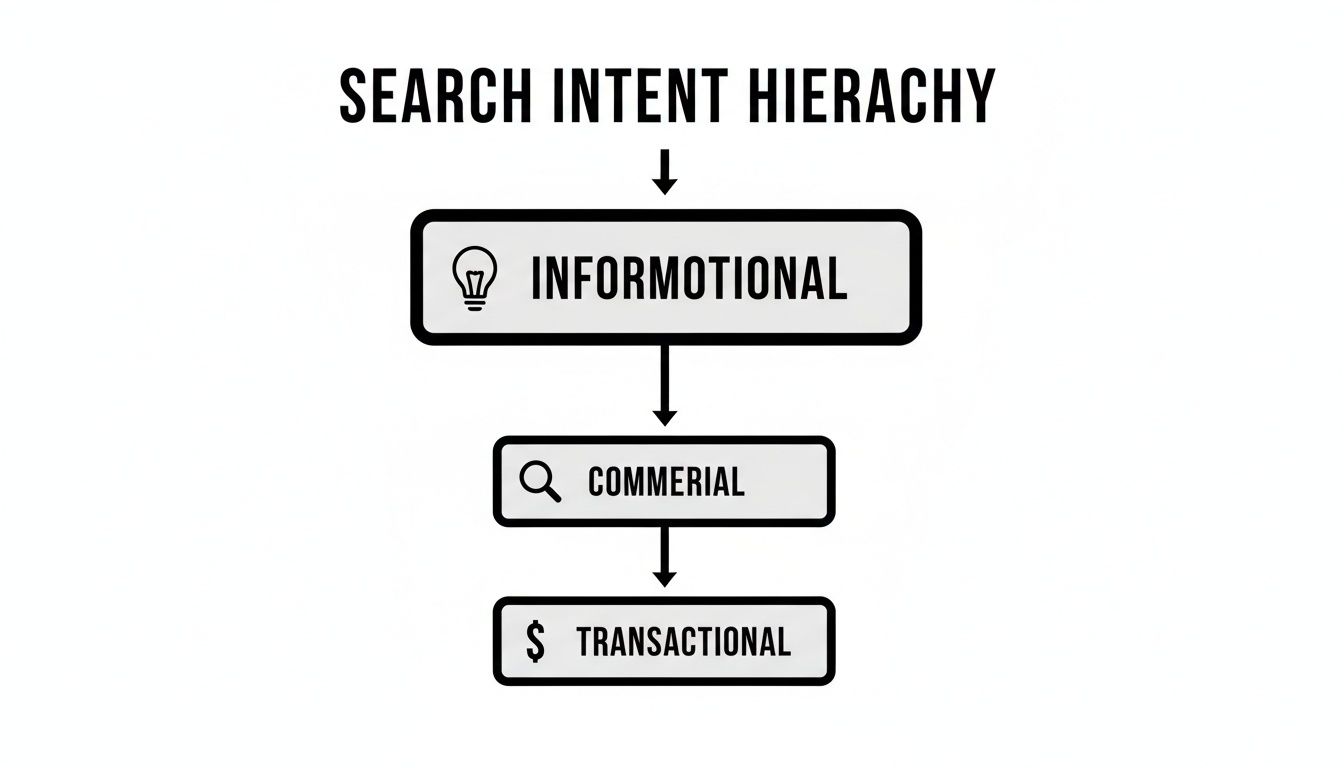
As you can see, broad informational searches are at the top of the funnel, but the highly focused transactional searches at the bottom are where a user signals they're ready to pull out their credit card.
Why Long-Tail Keywords Are Your Secret Weapon
Long-tail keywords might have low search volumes on their own, but together, they make up the vast majority of all Google searches. Even better, they convert at a much higher rate. Why? Because someone searching for a specific model or feature is already deep into the buying process. To really get this right, you need to understand the difference between long-tail and short-tail keywords.
When a customer uses a long-tail keyword, they’ve already done their homework. They know their problem, they've looked at solutions, and now they're zeroing in on the exact product that meets their needs. Getting in front of them at this stage is like meeting a buyer at the finish line.
If you want to dig deeper into finding these powerful phrases, our guide on long-tail keyword research has you covered.
Don't forget about local keywords, either. For any business with a physical storefront or service area, terms like "commercial oven repair Houston" are pure gold. These searches are loaded with local and transactional intent, connecting you directly with nearby customers who need help now. By simply adding a city or neighborhood, you slice through the global competition and target the people right in your own backyard.
How to Find Keywords That Actually Drive Sales
Finding the right keywords isn't about pulling ideas out of thin air. It’s a strategic hunt, and the best place to start is with what you already know inside and out: your products and your customers.
Put yourself in the shoes of a new restaurant owner. What would they type into Google? Your first list will probably include broad terms like "commercial refrigerators," "convection ovens," or "ice makers." These are your "seed" keywords—the simple starting points for a much deeper dive.
Once you have this foundational list, it's time to bring in the heavy hitters: SEO tools.
Using SEO Tools to Uncover Hidden Gems
This is where your brainstormed list gets supercharged. Platforms like Ahrefs and Semrush are essential for turning your gut feelings into a data-backed strategy. They show you what real people are searching for, how often they're looking for it, and how tough it'll be to show up on the first page.
You can plug in a seed keyword like "commercial kitchen equipment" and get back hundreds of related phrases, specific questions, and long-tail variations that your customers are using every single day.
Just look at this screenshot from Ahrefs' Keywords Explorer. One simple search opens up a treasure trove of data, including how many people are searching (Search Volume) and how competitive the term is (Keyword Difficulty).
This data is crucial. It helps you zero in on keywords that hit the sweet spot—high enough search volume to matter, but not so competitive that you have no chance of ranking.
Ethically Spy on Your Competitors
Want a shortcut to finding keywords that work? Look at what your competitors are already ranking for. This isn't about stealing their strategy; it's about smart reconnaissance to find gaps and opportunities they've overlooked.
SEO tools let you plug in any competitor’s website and see the exact keywords that are sending them the most customers. Look for terms where their content is weak or outdated. Find valuable long-tail keywords they aren't even targeting. This is how you can leapfrog them.
This process helps you build a master list of terms that are not only relevant but also offer a clear path to winning. For a complete walkthrough, check out our guide on how to build a keyword list that gets real results.
Building a keyword list is like creating a map. Each term is a potential route to a new customer, and your goal is to map out the clearest and most profitable paths directly to your digital storefront.
Choosing the right tool can feel overwhelming, so here’s a quick breakdown of the most popular options to help you decide.
Choosing Your Keyword Research Tool
| Tool | Best For | Key Feature | Price Point |
|---|---|---|---|
| Ahrefs | Competitive Analysis | Its "Content Gap" tool shows keywords competitors rank for that you don't. | Premium |
| Semrush | All-in-One SEO | A comprehensive suite covering everything from keywords to site audits. | Premium |
| Moz Pro | User-Friendly Interface | Great for beginners with intuitive tools and strong educational resources. | Mid-Range |
| Ubersuggest | Budget-Conscious Teams | Offers a generous free tier and affordable paid plans with solid data. | Freemium |
Ultimately, the best tool is the one that fits your budget and gives you the insights you need to make smarter decisions. Any of these will give you a massive advantage over simply guessing what your customers are looking for.
And make no mistake, people are looking. The keyword "restaurant supplies" alone gets a staggering 90,500 monthly searches. That's a huge audience, from brand-new restaurateurs to established chains. Add in "commercial kitchen equipment" at 9,900 searches a month, and you start to see just how big the opportunity is. This data proves that targeting the right keywords connects you with a massive, active audience ready to buy.
Putting Your Keywords to Work for Maximum SEO Impact

Having a solid keyword list is a great start, but it’s just a list. The real magic happens when you put those words to work. Think of your keywords as ingredients and your website as the recipe; you have to mix them in just right to create something that both search engines and your customers will love.
The trick is to weave your searchable keywords into the fabric of your website so it feels completely natural. You want to place them where they make sense to a human reader first and a search engine second. When you strike this balance, you're sending clear signals to Google about what your content is about without sounding like a robot.
Where to Place Keywords on Your Website
Some spots on your website carry more weight with search engines than others. By placing your primary and secondary keywords in these high-impact areas, you give yourself a much better shot at ranking for the searches that matter.
Here are the most critical on-page SEO elements to nail down:
- Title Tags: This is the main, clickable headline that shows up in Google’s search results. Putting your most important keyword here—like "Commercial Convection Ovens for Sale"—is one of the strongest signals you can send.
- Meta Descriptions: That little snippet of text under the title tag? That's the meta description. It doesn't directly influence rankings, but a well-written one that includes your keyword will entice people to click.
- Headings (H1, H2, H3): Your H1 is the main title on the page itself. Your primary keyword absolutely needs to be here. Then, use related keywords and long-tail variations in your subheadings (H2s and H3s) to build context and structure.
- Body Content: Sprinkle your primary keyword and its variations throughout your page copy, making sure to include it somewhere in the first 100 words. The key is to keep it natural—never force it.
- Image Alt Text: This text describes your images for search engines and visually impaired users. For a product photo, it’s a perfect spot for a specific keyword, like "Manitowoc UY-0140A Undercounter Ice Machine."
Think of on-page SEO as setting up your digital storefront. The title tag is the big sign over the door, headings are the aisle markers, and the body content is the detailed product information on the shelves. Each element helps guide both customers and search engines exactly where they need to go.
Creating Content That Ranks and Converts
Beyond just placing keywords, let them inspire the actual content you create. This is your chance to answer your customers' questions, solve their problems, and build a reputation as a trusted authority. Your keyword research should guide two crucial types of content.
First, you need to optimize your product and category pages. Don't settle for generic, manufacturer-provided descriptions. Write compelling copy that uses the keywords your customers are searching for. For a category page on "Commercial Dishwashers," you can naturally include terms like "undercounter dishwashers," "high-temp sanitizing," and "restaurant-grade glasswasher."
Second, build a genuinely helpful blog. That keyword list you made is a goldmine for blog post ideas. A search query like "how to choose the right commercial dishwasher" is a clear signal that people need help. Write a detailed guide answering that exact question, and you'll naturally incorporate valuable long-tail keywords. This strategy attracts customers early in their research and points them toward your product pages when they’re finally ready to pull the trigger.
Winning the Local Market with Targeted Keywords
While having a national presence is great, let's be honest: the lifeblood of most restaurant equipment suppliers is local. Chefs, new restaurant owners, and kitchen managers in your city aren't just searching for "commercial refrigerators"—they're searching for "commercial refrigerators in Miami." This is where local SEO stops being a buzzword and starts being your most powerful sales tool.
Winning the local search game is all about showing up the moment a nearby customer needs you. The goal is to become the undeniable go-to provider in your area, grabbing the attention of high-intent buyers who are ready to pull out their credit cards.
Your Local SEO Foundation
The absolute cornerstone of any local strategy is your Google Business Profile (GBP). This free listing is often the very first interaction a local customer has with your business. If it isn't fully optimized with your location, hours, and service details, you're leaving money on the table. It's non-negotiable.
Here’s a look at the main dashboard where you can manage your local online presence.
Think of this as your command center for telling Google who you are, what you sell, and where you're located. Getting this right directly impacts how you show up in local search results and on Google Maps.
Beyond your GBP, you need to weave your geographic relevance into the fabric of your website. A killer strategy is creating dedicated landing pages for each major service area—think 'Tampa Restaurant Equipment Supply' or 'Orlando Commercial Oven Repair.' These pages scream to Google that you are a specialized authority in that specific location.
Local SEO isn't just about being on the map; it's about owning the map. When a local chef searches for equipment, your business should be the first and most trusted result they see.
Finally, you need to build up local citations. These are simply mentions of your business name, address, and phone number (NAP) on other local websites and online directories. Each one acts like a vote of confidence, signaling to search engines that you're a legitimate, active part of the local business community.
If you want to go deeper on this, check out our complete guide on performing local keyword research. By mastering these elements, you can start to really dominate local search and connect directly with the customers in your own backyard.
Your Keyword Questions, Answered
Let's wrap up by tackling a couple of common questions that always come up when restaurant equipment suppliers start digging into keywords. These quick answers should help solidify the concepts we've covered.
How Often Should I Refresh My Keyword List?
Think of your keyword strategy like your inventory—it needs regular check-ins. Keyword trends shift just like customer tastes and industry innovations. A good rule of thumb is to give your core keyword strategy a solid review at least twice a year.
That said, plan for a deeper, more comprehensive audit once a year. This is your chance to spot new opportunities, prune keywords that have lost their punch, and make sure your website's language still matches how your customers are searching right now.
Does Voice Search Mean I Need a Whole New Keyword Strategy?
Not a whole new one, but definitely an adjusted one. Voice search is all about conversation. People don't talk to their smart speakers in choppy phrases; they ask full questions.
This is where long-tail keywords really shine. Your focus should shift to more natural, question-based phrases.
- Instead of targeting "commercial oven cost," you should also target "what is the price of a commercial convection oven?"
- Instead of "ice machine repair," think more like "where can I find someone to fix my ice machine near me?"
Embracing these conversational queries is how you show up when someone asks Alexa or Google Assistant for help.
Ready to stop guessing and start ranking? Restaurant Equipment SEO provides specialized strategies to get your business in front of the chefs and restaurateurs actively searching for your products. Discover how our targeted SEO services can drive qualified traffic and grow your sales at https://restaurantequipmentseo.com.