
Finding Keywords With Low Competition for Restaurant Equipment SEO
Tired of trying to outrank the industry giants for generic terms like "commercial refrigerators"? It’s an uphill battle. A much smarter approach for restaurant equipment suppliers is to focus on keywords with low competition. This is all about working smarter, not harder, to attract customers who are much closer to making a purchase.
Why Niche Keywords Are Your Secret Weapon
If you've ever tried to rank for a massive term like "commercial ovens," you know it feels like shouting into the wind. You're up against huge national distributors and manufacturers with bottomless marketing budgets. It’s an expensive, slow, and frankly, discouraging fight.
This is where shifting your strategy to niche keywords can completely change the game for your business.
Instead of fighting over broad, top-of-the-funnel terms, you start targeting highly specific, long-tail phrases. These are the queries real customers are typing in when they're deep in the research phase and ready to buy. Think about the intent behind a search for "commercial ovens" versus "ventless high-speed ovens for cafes." The first person is just browsing; the second has a specific problem they need to solve right now.
Tapping into High-Intent Buyers
By going after these less-contested terms, you connect directly with prospects who have already done their homework. They know exactly what they need and are actively looking for the right supplier. This dramatically shortens your sales cycle and boosts the quality of your leads.
Let's look at the bigger picture. The US restaurant equipment wholesaling market is a $40.3 billion industry with over 3,111 businesses all competing for attention. It's a crowded field. But even within this space, there are golden opportunities. You can find low-competition phrases like 'ventless hoods for cloud kitchens' that still get solid monthly search volume but have difficulty scores that are actually within reach for a smaller business.
High Competition vs Low Competition Keyword Scenarios
To really drive this point home, let's compare two realistic scenarios. This table breaks down the strategic difference between targeting a broad, highly competitive term and a specific, low-competition one.
| Metric | High Competition Example ('Commercial Ovens') | Low Competition Example ('Ventless High-Speed Ovens') |
|---|---|---|
| Search Volume | Very High (50,000+ monthly) | Moderate (1,000-5,000 monthly) |
| Keyword Difficulty | Extremely High (KD 70+) | Low & Attainable (KD < 20) |
| Searcher Intent | Informational, Broad Browsing | Commercial, Problem-Solving |
| Typical Competitors | National Chains, Manufacturers | Niche Suppliers, Specialized Blogs |
| Conversion Potential | Very Low | Very High |
| Time to Rank | 12+ Months (if ever) | 3-6 Months |
The numbers don't lie. While that massive search volume for a generic term might look tempting, the path to actual profit is much clearer and faster when you focus on the low-competition keyword. It’s one thing to understand the theory, but it’s another to put it into practice. A great next step is to learn exactly how to find niche keywords for your own business.
The goal isn't to get the most traffic; it's to get the right traffic. Targeting keywords with low competition shifts your SEO from a costly war of attrition into a precise and profitable strategy for capturing high-intent customers.
Building Your Low-Competition Keyword Arsenal
Alright, let's get our hands dirty. Enough with the high-level theory—this is where we roll up our sleeves and start building a killer list of keywords that can actually get you traffic. The secret to finding these low-competition gems isn't some complex SEO trick; it's about tapping into what you already know about the problems your customers face every single day.
Your own experience in the food service industry is your biggest advantage. Start with your core product categories—refrigeration, cooking equipment, food prep stations—and then dig a little deeper. What are the specific, nagging problems that certain features solve? Think about the real-world chaos of a commercial kitchen.
This is all about gathering your initial "seed keywords." These aren't the final phrases you'll target, but they're the starting point for everything that follows.
Brainstorming Your Seed Keywords
First things first, let’s get all your core business terms down on paper (or a spreadsheet). Don't censor yourself or overthink it. Just list everything that comes to mind.
A solid brainstorming list usually includes:
- Product Categories: "Combi ovens," "undercounter freezers," "ice machines," "blast chillers."
- Customer Problems: "Small kitchen space," "energy efficiency," "food safety compliance," "labor shortages."
- Unique Features: "Ventless technology," "programmable controls," "HFC phase-down compliance," "self-cleaning cycles."
These seeds are the raw material we'll plug into SEO tools to uncover a goldmine of long-tail variations. You’re hunting for the exact language your customers use when they're in a bind and need a solution.
I’ve found that the best low-competition keywords live at the intersection of a product and a specific customer pain point. A chef isn’t just Googling ‘oven.’ They’re searching for a ‘high-speed oven that fits a small cafe counter.’ That’s where you win.
Once you have a healthy list of these foundational ideas, you're ready to use some tools to find the precise phrases people are actually searching for. This is how we move from broad concepts to highly specific, actionable keywords.
The flowchart below visualizes this entire strategy—shifting from the high-stakes battle for broad terms to a smarter focus on niche opportunities that actually drive profit.
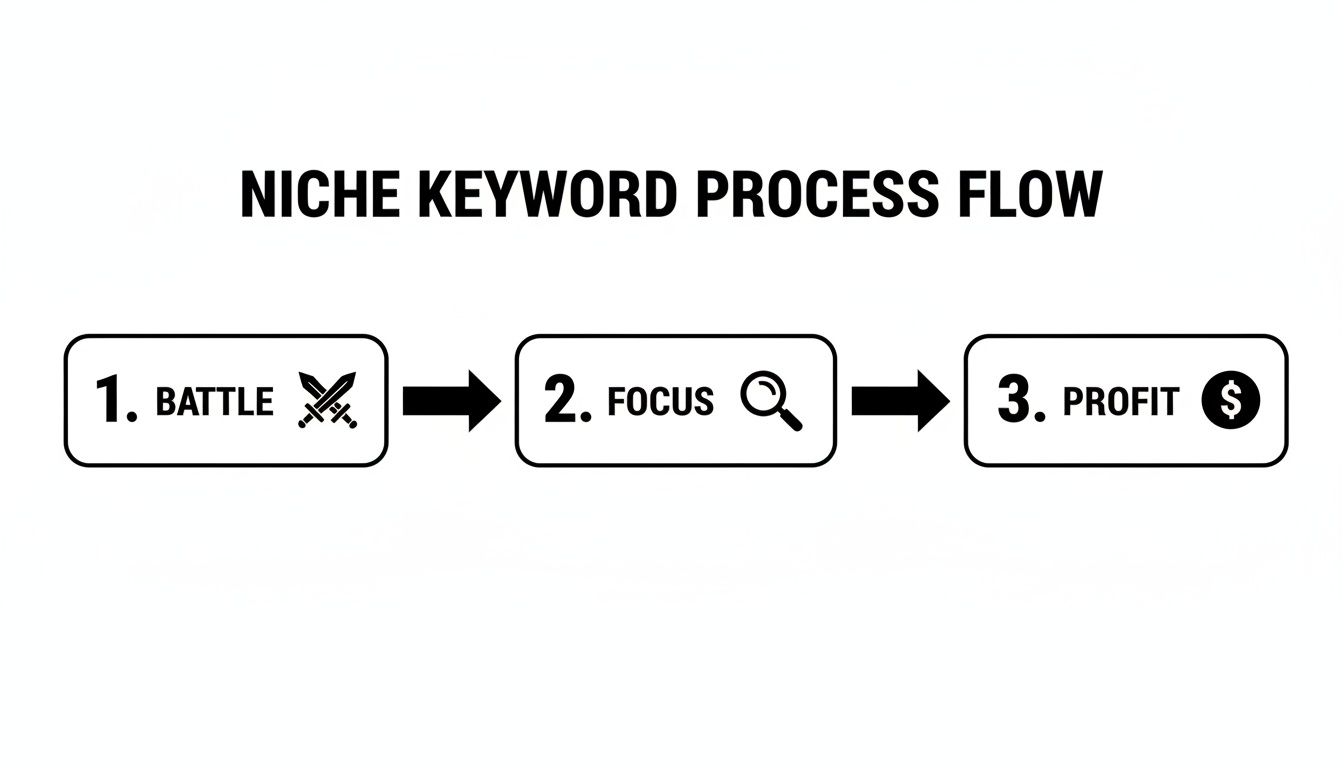
This process is about moving away from the crowded, high-competition keywords and zoning in on the focused, profitable phrases that bring in genuinely qualified leads.
Expanding Your List with Keyword Tools
With your seed keywords in hand, it's time to multiply them. This is where tools like Google Keyword Planner, AnswerThePublic, or the Ahrefs Keyword Explorer become indispensable. Their job is to show you what people are really typing into that search bar.
As you dive in, keep an eye out for two particularly valuable types of keywords:
- Question-Based Queries: These almost always start with "how," "what," or "why." For instance, your seed term "combi oven" could easily unearth valuable phrases like "how to clean a combi oven" or "what are the benefits of a combi oven." These are pure gold for blog posts and guides.
- Comparison Terms: Customers who are close to making a purchase love to compare their options. A search for "convection vs combi oven for bakeries" signals serious buying intent and is often far less competitive than going after "combi oven" by itself.
For example, just plugging "commercial ice machine" into a tool can instantly reveal a whole universe of related opportunities you might never have thought of. The tool will spit back dozens of related terms, common questions, and other suggestions, giving you a much richer list to work with.
The key here is to use the filters. Set the keyword difficulty (KD) or competition score to "low" or "easy" right from the start. This immediately weeds out the hyper-competitive head terms and lets you focus only on the phrases where you have a fighting chance to rank.
Building this list is the absolute foundation of your content strategy. If you're ready to go even deeper, our guide on long-tail keyword research for restaurant equipment breaks down more advanced techniques. The end goal is to create a robust, organized list that you can confidently validate and map to specific pages on your website.
Validating Keywords That Actually Drive Sales
So you've got a big spreadsheet packed with keyword ideas. That's a solid starting point, but it's really just raw material. The real work starts now: sifting through that list to find the actual opportunities and tossing out the digital dead ends.
This is the validation phase. It’s where we get critical and figure out which terms are going to bring in qualified buyers, not just random traffic. You need a simple, repeatable process for this, otherwise, you're just throwing your marketing budget at the wall and hoping something sticks. Our goal is to whittle this down to a lean, mean list of keywords we know we can rank for and that will attract the right customers.
Decoding the Core SEO Metrics
When you plug your list into a tool like Ahrefs or Semrush, you're hit with a wall of numbers. For our purposes, the only two that really matter at this stage are Keyword Difficulty (KD) and Search Volume. But in a niche B2B industry like ours, these metrics can be incredibly misleading if you take them at face value.
A huge search volume isn't always a good thing. Take a term like 'commercial refrigerators'—it might get 50,000+ searches a month, which looks fantastic on paper. But the competition is brutal, dominated by giants. On the flip side, a keyword with a monthly search volume of just 70 might seem worthless. But what if those 70 people are all kitchen managers ready to drop $10,000 on a new setup? Suddenly, it's one of the most valuable keywords on your list.
If you want to go deeper on this, we have a whole guide on how to determine search volume for keywords in this specific niche.
A low-volume, high-intent keyword is always more valuable than a high-volume, low-intent one. Don't get distracted by big numbers; focus on the quality and specificity of the search query.
The same logic applies to Keyword Difficulty. In the restaurant equipment space, I've found that a KD score under 30 is generally the green light. It tells you that the top-ranking pages don't have an insane number of backlinks, which gives you a realistic shot at breaking into the top ten with great content and smart promotion.
The Three-Point Validation Framework
To keep this process organized, I run every single keyword through a simple three-question filter. If a keyword can't pass all three, I ditch it and move on.
- Is the Intent Commercial? You need to get inside the searcher's head. Are they just kicking tires, or are they ready to pull out a credit card? Understanding search intent in SEO is everything. Look for modifiers like "buy," "for sale," "pricing," or specific model numbers—these are flashing neon signs of a buyer.
- Is the Difficulty Beatable? Is that KD score realistically under 30? Go beyond the number and actually look at the search results. Who's ranking? Are they direct competitors with massive authority, or is it a mix of forums and outdated blog posts? Seeing a few weak results on page one is a great sign that you can create something better and climb the rankings.
- Is the Traffic Worth the Effort? Let's be practical. Creating a detailed product guide or a helpful blog post takes time and resources. You have to weigh the potential return against that investment. Does the combination of search volume and the average value of the equipment make it worthwhile?
A Real-World Validation Example
Let's walk through a real example. Imagine you've identified the keyword 'NFPA 96 compliant hoods'.
- Intent: The word "compliant" is a massive giveaway. This person isn't just browsing; they have a specific, urgent regulatory need. This points directly to a serious, problem-aware buyer. Pass.
- Difficulty: A quick check in an SEO tool shows a KD score of 18. I glance at the SERPs and see a mix of manufacturers and a few supplier blogs. No single, unbeatable authority owns this term. Pass.
- Value: The search volume is only about 150 a month. But a compliant hood system is a $5,000 to $20,000 sale. If you capture just one or two of those sales per year from this single piece of content, the ROI is huge. Pass.
This keyword is a clear winner. It's the perfect example of a low-competition term that can become a cornerstone of your SEO strategy. While long-tail keywords are said to drive 70% of all search traffic, very few businesses in our industry actively chase them. With the food service equipment market projected to hit $66.2 billion by 2033, ignoring these validated, high-intent terms is leaving serious money on the table.
Mapping Keywords to High-Value Content
So, you've done the hard work and validated your keywords. You're now sitting on a goldmine of potential traffic. But a list of keywords is just that—a list. It doesn’t do anything on its own. The next move is where strategy really kicks in: keyword mapping.
This is the process of assigning each of those hard-won keywords to a specific page on your website. Think of it as creating a blueprint for your content. It turns your SEO research into an actual, actionable plan.
This isn’t just a housekeeping task; it's a critical strategic step. Without a clear map, you’ll inevitably end up with pages competing against each other for the same terms—a classic case of keyword cannibalization. Or worse, you’ll target a great keyword with the wrong type of page, completely whiffing on what the searcher actually wants.
The goal is simple: create a one-to-one relationship. One primary keyword (and its close buddies) gets one dedicated page.

Aligning Keyword Intent with Content Type
The absolute most important part of keyword mapping is matching the user’s intent to the right kind of content. In the world of restaurant equipment, search intent usually falls into one of two main buckets: transactional or informational. Nailing this is non-negotiable.
Just ask yourself one question: is the searcher trying to learn something or buy something? Their search query gives you all the clues you need.
-
Transactional Keywords: These scream "I'm ready to buy!" You'll see words like "buy," "for sale," "pricing," or even specific model numbers. The query 'buy countertop electric griddle' is a perfect example. Someone searching this wants to see products and an "add to cart" button, not a history lesson.
-
Informational Keywords: These queries are all about research and learning. They often start with phrases like "what is," "how to," or "benefits of." A search for 'what is a blast chiller' tells you the person is in the educational phase, not pulling out their credit card.
Mapping these is pretty straightforward. Transactional keywords belong on your product pages or category pages. Informational keywords are the lifeblood of your blog posts, buying guides, and resource articles.
Building the Right Page for the Right Keyword
Once a keyword has a home on your map, you know exactly what kind of page to build or optimize.
For your transactional terms, this means beefing up your product and category pages. We're talking high-quality photos from every angle, detailed spec sheets, crystal-clear pricing, and compelling descriptions that naturally include your target keywords.
For informational keywords, your mission is different. You need to create the single best, most helpful resource on the internet for that topic. If your target keyword is 'how to clean a commercial deep fryer,' your article should be the definitive guide. Cover the A-to-Z of it—safety precautions, the right supplies, step-by-step instructions, and common mistakes to avoid. The goal is to fully answer their question so they have no reason to hit the back button. That’s how you build real authority and trust.
If you want to double-check your fundamentals, take a look at our guide on how to build a keyword list to make sure your foundation is solid before you start mapping.
A huge mistake I see all the time is trying to shoehorn a transactional keyword onto a blog post. If someone is searching to buy a griddle, don't send them to a 2,000-word article on the history of griddles. Send them to a page where they can buy one. Respecting user intent is more than half the battle.
A Simple Template for Informational Content
To make sure your informational articles really deliver, you can follow a simple but incredibly effective structure. This kind of template ensures you cover all your bases and fully satisfy what the searcher is looking for.
Let's use the keyword 'benefits of a combi oven' as an example.
- H1 Title: What Are the Benefits of a Combi Oven? A Chef's Guide
- Introduction: Start with a strong hook. Touch on a common kitchen pain point (like inconsistent cooking or limited space) and promise to deliver the solution.
- H2: What is a Combi Oven? Give a quick, no-fluff definition for anyone new to the term.
-
H2: Key Benefits of Using a Combi Oven: This is the meat of the article. Break it down with H3s for each benefit.
- H3: Versatility and Space Saving
- H3: Improved Food Quality and Consistency
- H3: Faster Cooking Times
- H3: Energy and Water Efficiency
- H2: Who Should Use a Combi Oven? Talk about the ideal scenarios—high-volume restaurants, catering operations, bakeries, etc.
- Conclusion: Wrap it up with a quick summary of the main advantages and give them a clear next step, like a link to browse your selection of combi ovens.
This structure directly answers the user's question, provides real depth, and logically guides them from curiosity to consideration, positioning you as the expert every step of the way.
Creating and Promoting Content That Ranks

Alright, you've done the hard work of digging up those golden-nugget keywords and mapping them out. Now it's time to bring that research to life. This is where you move from the spreadsheet to the screen, creating content that actually satisfies the person searching and checks all the right boxes for Google.
It's one thing to find a great keyword; it's another thing entirely to build a page that truly deserves to rank for it.
The good news? On-page SEO isn't some mystical secret. It’s really just a logical way of signaling what your content is about to both your readers and the search engines. We’re talking about crafting page titles that grab attention, writing clear meta descriptions that get the click, and using headings to give your content a scannable, logical flow.
But creating the content is only half the battle. In the B2B world of food service, promotion is what separates a blog post that collects digital dust from one that becomes a genuine lead-generation machine.
Mastering On-Page SEO Essentials
Think of on-page SEO as the foundation of your house. Without a solid foundation, everything else you build on top—no matter how brilliant—is going to crumble. Getting these elements right from the start ensures search engines can understand and value what you’ve published.
Here are the core components you absolutely need to nail:
- Page Titles: Your title tag is arguably the most critical on-page factor. It needs to be compelling, include your primary keyword, and stay under 60 characters so it doesn't get awkwardly cut off in the search results. For a post about 'combi oven benefits,' a title like "7 Key Combi Oven Benefits for Commercial Kitchens" is spot on.
- Meta Descriptions: While not a direct ranking factor, your meta description is your one and only ad in the SERPs. It’s your sales pitch! It should summarize why someone should click on your link and include a clear call to action. Keep it under 160 characters and make it impossible to ignore.
- Logical Heading Structure: Use your headings (H1, H2, H3) to create a clean, easy-to-follow hierarchy. Your page title is your one-and-only H1. Major sections get an H2, and any sub-points get an H3. This simple structure doesn't just make your content easier for people to read; it helps search engines quickly grasp its main topics.
Tailored Promotion for the Food Service Industry
Creating fantastic content is the price of admission. Promotion is how you win the game. Just hitting "publish" and hoping for the best is a proven recipe for failure. You have to be proactive and get your content in front of the right eyeballs.
For restaurant equipment suppliers, this means going where your audience already hangs out. Forget about generic social media blasts. Your promotion needs to be targeted and strategic. For instance, imagine sharing an in-depth guide on 'choosing ENERGY STAR certified equipment' with state-level restaurant associations or equipment technician guilds. That’s hitting the bullseye.
Another incredibly powerful tactic is guest posting. Identify influential food service consultants or popular restaurant management blogs and offer to write a custom piece for their audience. Doing this not only builds your credibility but also earns you a high-quality backlink—a massive vote of confidence in Google's eyes.
The goal of promotion isn't just to get clicks. It's to build real authority and earn the kind of industry-specific backlinks that search engines can't ignore. One link from a respected food service publication is worth more than a hundred from irrelevant directories.
Unlocking keywords with low competition is like finding hidden inventory gold. The numbers back this up. As the global restaurant equipment market grows from $4.15 billion in 2025 to $4.47 billion in 2026, SEO data shows that a whopping 80% of traffic comes from these less obvious, long-tail terms. Think about it: a specific keyword like 'smash burger griddles 500F thermostat' might have a monthly search volume of 1,800 with a Keyword Difficulty under 10. Meanwhile, the broad term 'commercial griddles' is stuck at a brutal KD of 65. You can find more insights on these restaurant tech trends that will define 2026.
Building a Simple Yet Effective Outreach Plan
Your outreach strategy doesn't need to be some complex, multi-channel behemoth. You can start with a simple spreadsheet of potential partners.
- Identify Your Targets: List out industry blogs, online trade magazines, restaurant associations, and even complementary equipment manufacturers—anyone who serves your audience but isn't a direct competitor.
- Find the Right Contact: A little digging is all it takes. Look for an editor, content manager, or marketing lead on their website or LinkedIn.
- Craft a Personalized Pitch: Ditch the generic templates. Send a brief, personalized email. Mention a specific article of theirs you enjoyed, then explain exactly why your new content would be a valuable resource for their readers. Offer genuine value, don't just ask for a link.
This methodical approach to creating and promoting your content ensures that all the hard work you put into keyword research actually pays off with tangible results: more traffic, better leads, and a stronger foothold in your market.
Common Questions About Niche Keyword SEO
Once you get the theory down, the real questions start popping up. It's one thing to have a strategy on paper, but it’s another thing entirely to navigate the messy realities of putting it into practice.
Let's clear up some of the most common uncertainties I see from restaurant equipment suppliers when they first start digging for these low-competition keywords. Getting these answers straight will give you the confidence to move from research to real-world results.
How Long Does It Take to Rank for Low Competition Keywords?
This is always the first question, and the only honest answer is: it depends. But the good news is that the timeline is a world away from what you'd face trying to rank for a massive head term. While a term like "commercial kitchen design" could take years (if you’re lucky), you can often see real movement for a niche, low-competition keyword in just 3 to 6 months.
What makes the difference? A few things:
- Your Website's Authority: An established site with a decent backlink profile will naturally see results faster than a brand-new domain.
- Content Quality: If you go all-in and create the definitive, most helpful resource on that topic, Google notices. Fast.
- Promotion Efforts: You can't just publish and pray. How quickly and effectively you get your content in front of the right people through outreach makes a huge difference.
The key is to remember you're playing a different game. You’re not trying to take down an industry giant. You're just trying to become the absolute best answer for a very specific question.
I’ve seen clients hit the first page for a targeted, low-difficulty keyword within 90 days of publishing one high-quality, well-promoted blog post. It's not a myth—it happens when you focus on the right opportunities.
Is a Keyword with Only 50 Monthly Searches Worth Targeting?
Yes, a thousand times yes. This is one of the biggest mental hurdles to clear in B2B SEO. In the B2C world, 50 searches is a rounding error. In the world of high-ticket restaurant equipment, those 50 searches could be worth millions in potential pipeline.
Think about a keyword like "walk-in freezer floor replacement panels." The search volume is tiny. But the person typing that into Google has a very specific, very expensive, and very urgent problem. They aren't just window shopping; they need a solution, and they need it now.
Let's say a single sale for that part is worth $5,000. If your content converts just one of those 50 searchers all year, that single blog post just paid for itself many times over. Never dismiss a keyword based on volume alone. Judge it by the commercial intent behind it and the lifetime value of a single customer. It's about quality, not quantity.
How Often Should I Update My Keyword Research?
Keyword research isn't a "set it and forget it" task you can check off a list. The food service industry is always in motion—new tech, changing regulations, and evolving customer pain points pop up all the time. Your keyword strategy has to keep pace.
As a general rule, plan on doing a major keyword research refresh once or twice a year. This is your chance to spot new trends and get a foothold before they become hyper-competitive.
But beyond that, you should always be listening. Pay attention to the exact words your customers use on sales calls or in support emails. What are their specific challenges? These conversations are an absolute goldmine for keywords with low competition. If you hear three different customers mention "HFC-free refrigerants," that's your signal to start digging into related keywords and build content around that emerging need.
What If My Competitors Start Targeting the Same Keywords?
It'll happen. If you find a profitable little corner of the internet, someone else will eventually notice. Don't panic—this is actually a good sign that your strategy is working. The goal is to use your first-mover advantage to build a defensible position.
Here’s how you stay one step ahead:
- Create Superior Content: Don't just be the first one there; be the best one there. Make your guide the most thorough, helpful, and easy-to-understand resource on the planet for that topic.
- Build Better Backlinks: Double down on earning high-quality, relevant links from respected publications and partners in the food service industry. A strong link profile is like a moat around your rankings that’s incredibly difficult for a competitor to cross.
- Keep Your Content Fresh: Go back and update your post periodically with new info, updated stats, or better product examples. This signals to Google that your content is still the most current and valuable resource.
By establishing yourself as the clear authority on that niche topic from the get-go, you make it significantly harder and more expensive for anyone else to catch up. You're not just ranking; you're owning the conversation.
Ready to stop fighting for scraps and start winning with a smarter SEO strategy? At Restaurant Equipment SEO, we specialize in finding these profitable, low-competition keywords and turning them into real-world traffic and leads for your business. Let's build a content plan that gets you noticed. Explore our SEO services.