
SEO Competitor Analysis for Restaurant Equipment Suppliers
In the high-stakes, crowded world of online restaurant equipment sales, just having a website is like putting up a sign in the middle of the desert. To truly compete—and win—you need a sharp SEO competitor analysis. Think of it as your strategic blueprint for not just showing up, but standing out.
This isn't just about looking over your rival's shoulder; it's a deep dive into their digital playbook to find what works, what doesn't, and where you can outmaneuver them.
Winning the Digital Shelf in the Food Service Industry
Let's be honest: your competitors are aggressively chasing the same chefs, restaurant owners, and procurement managers you are. They are fighting for that prime "digital shelf space" on Google's first page, right where customers are comparing commercial freezers and deciding which convection oven to buy.
This guide cuts through the generic advice and gives you a battle-tested process built specifically for food service suppliers. We're going to turn market intelligence into a real-world growth plan for your business.
It’s Strategic Intelligence, Not Just Spying
A proper SEO competitor analysis isn't about blindly copying what the other guys are doing. It's about gathering strategic intelligence so you can make smarter decisions with your time and budget. When you understand the competitive terrain, you can stop guessing and start focusing on tactics that actually move the needle.
The whole point is to answer the crucial questions that will define your marketing strategy:
- What specific keywords are driving real sales for the top suppliers?
- Where are the industry leaders getting their most authoritative backlinks?
- What kind of content—blog posts, buying guides, spec sheets—is actually connecting with restaurant owners?
- Are there technical SEO tricks that are giving them an unfair advantage?
A thorough SEO competitor analysis isn't just about finding keywords. It's about dissecting what makes giants like WebstaurantStore and KaTom successful and turning their strategies into your own actionable growth plan.
Your Blueprint for Market Leadership
This guide is designed to give you a detailed framework that addresses the unique challenges of the food service equipment industry. You'll learn how to identify your true online rivals—and they might not be who you think they are.
From there, we'll get our hands dirty. We'll uncover the exact keywords driving their most valuable traffic and map out their backlink profiles to find powerful link-building opportunities you can seize for your own brand.
By the end, you'll have more than just data; you'll have a clear, prioritized roadmap of actions you can take to improve your rankings, attract more qualified buyers, and start claiming a bigger piece of the digital shelf. It’s the foundational work that separates the industry leaders from everyone else.
Your SEO Competitor Analysis Toolkit
To do this right, you'll need the right tools for the job. While there are countless options out there, a few stand out as essential for digging into the restaurant equipment niche. Here's a quick look at the toolbox we'll be using.
| Tool Category | Recommended Tools | Primary Use Case for Food Service Suppliers |
|---|---|---|
| All-in-One SEO Platforms | Ahrefs, Semrush, Moz Pro | Uncovering competitor keywords, analyzing backlink profiles, tracking keyword rankings for specific product categories (e.g., "commercial ice machines"). |
| Keyword Research Tools | Ahrefs' Keywords Explorer, Google Keyword Planner | Finding long-tail keywords like "best NSF certified countertop fryer" and identifying question-based queries your customers are asking. |
| Backlink Analysis | Ahrefs' Site Explorer, Majestic | Discovering which industry blogs, trade publications, or chef forums are linking to your competitors. Essential for digital PR and link building. |
| On-Page & Technical SEO | Screaming Frog SEO Spider | Auditing competitor sites for their structure, internal linking, and meta data on thousands of product pages at once. |
| Local SEO & Rank Tracking | BrightLocal, Semrush Position Tracking | Monitoring your visibility in key service areas and seeing how you stack up against local supply houses in "near me" searches. |
These tools provide the raw data you need to make informed decisions. Throughout this guide, we'll show you exactly how to use them to extract actionable insights.
Identifying Your True Digital Competitors
When you're in the restaurant equipment business, it’s easy to think your biggest rival is the supply house down the street. And for local walk-in traffic, maybe they are. But online, the game is completely different.
The competitors stealing your online customers are often entities you've never even considered. The first step in a solid SEO analysis is to figure out who you’re really up against on the search results page. That local showroom you’ve been worrying about might be a ghost on Google, while a massive e-commerce player is quietly eating your lunch.
Look for Keyword Overlap, Not Just Brand Names
The most reliable way to unmask your true SEO rivals is by looking at keyword overlap. This simply means finding the websites that consistently rank for the same search terms you're trying to win.
Specialized tools like Ahrefs or Semrush are perfect for this. They cut through the noise and show you exactly who shows up when a potential customer searches for "walk-in cooler for sale" or "True T-49F review." Your real digital competitor isn't just another business with "restaurant supply" in their name; it's the website dominating the search results for your most profitable keywords.
For a deeper dive into the methodology, this guide on how to do competitor analysis in SEO is a great starting point.
Sort Your Competitors Into Tiers
Once you have a list of websites that share your keywords, you need to organize them. Not all competitors are the same, and understanding the differences is key to building a smart strategy.
You'll generally find they fall into three main buckets:
- Direct Competitors: These are the ones you’d expect. They sell the same equipment to the same people. If you’re a dealer for Vulcan and Blodgett ovens, another online store featuring those same brands is your direct competitor.
- Indirect Competitors: These folks solve the same core problem for your customers, just with a different solution. A company that only sells smallwares might still rank for "restaurant kitchen setup," pulling in potential buyers before they even start thinking about heavy equipment.
- Content Competitors: These aren't trying to sell equipment at all—they're fighting for eyeballs. Think industry blogs, trade publications, or even chef forums that rank for helpful articles like "how to clean a commercial ice machine."
A common mistake is focusing only on direct competitors. When you ignore the indirect and content players, you’re missing huge opportunities to connect with buyers at the top of the funnel, long before they're ready to make a purchase.
Knowing who you’re up against tells you what to do next. Your plan for outranking a content competitor on an informational blog post will look very different from how you’d tackle a direct competitor for a high-value product category page. We go into more detail on this discovery process in our guide on how to find a competitor website. Getting this first step right ensures your entire analysis is focused on the rivals who actually impact your bottom line.
Digging Into Your Competitor’s Keyword and Content Playbook

Keywords are the language of your customers. They’re what a restaurant owner types into Google when they need a solution, want to compare models, or are finally ready to pull the trigger on a big purchase. If you want to show up, you have to know which terms your competitors are targeting and—more importantly—where they’re winning.
This is where a keyword gap analysis becomes your secret weapon. It’s not just about finding keywords you’re missing. It's about getting inside your customer’s head, understanding their intent, and building a content strategy that meets them at every step of their journey.
Running a Keyword Gap Analysis
The simple goal here is to find valuable keywords your competitors rank for that you don’t. Fire up a tool like the Content Gap report in Ahrefs or the Keyword Gap tool in Semrush, pop in your domain, and add two or three of your top digital rivals. What comes out is a goldmine.
For example, you might see a national supplier ranking for "commercial kitchen ventilation requirements," a term that wasn't even on your radar. This isn’t just a keyword; it’s a glaring content opportunity. It points directly to a major headache for restaurant owners—navigating health codes—and you can be the one to solve it with a comprehensive guide.
A keyword gap analysis isn't about finding keywords to stuff onto your pages. It's about uncovering the questions your audience is asking and seeing which of your competitors are doing the best job of answering them.
Sorting Your Findings into Strategic Buckets
Once you have that raw list of keywords, the real work of your seo competitor analysis begins. Don't get distracted by high search volumes alone. The key is to sort these keywords into three distinct buckets to guide what you do next.
-
Transactional "Money" Keywords: These are the bottom-of-the-funnel terms that scream "I'm ready to buy!" They often include phrases like "buy," "for sale," "price," or specific model numbers like "buy Rational iCombi Pro oven." These are your top priority for product and category pages.
-
Informational Keywords: These are the "how-to" and "what-is" queries. Think "how to clean a commercial deep fryer" or "walk-in cooler maintenance checklist." Ranking for these establishes you as the expert and gets your brand in front of potential customers long before they're ready to buy.
-
Branded Keywords: This bucket includes searches for your competitors' names, often with words like "reviews" or "vs." You can't directly target their brand name, but this gives you priceless intelligence on their reputation and what customers are comparing them to.
Categorizing like this brings instant clarity. If your product pages are underperforming, start with the transactional keywords. If you don't have a blog, the informational keywords give you a ready-made content calendar that will build trust and attract new visitors.
Identifying Their Most Valuable Content
Keywords are only half the picture. You also need to pinpoint which specific pages are bringing in the most organic traffic for your competitors. This reveals their home-run content assets. Most SEO tools have a "Top Pages" report that lays this out for you.
Let’s say you’re a regional supplier going up against a behemoth. By digging into their top pages, you might find that a single blog post, "The Ultimate Guide to Choosing a Commercial Ice Machine," is pulling in 15% of their entire organic traffic.
That one piece of information is huge. It tells you:
- There's massive search demand for this topic.
- Their guide is hitting the mark and satisfying what searchers want.
- You now have a clear benchmark for what it takes to win.
Your goal isn't to just copy their guide. It's to one-up them. Could you create something ten times better by adding a video walkthrough? An interactive cost calculator? Or maybe interviews with service technicians? This is how you turn competitor data into content that truly stands out. To get a better sense of how content performance can change, looking at Surfer SEO timeline data can reveal how competitors' rankings fluctuate over time.
A Real-World Example of Finding an Opening
Let’s walk through a quick scenario. A regional supplier analyzes a major national competitor and focuses their keyword gap analysis on informational terms. They discover their rival ranks on page one for dozens of phrases around equipment upkeep, like "commercial refrigerator gasket replacement" and "how to calibrate a commercial oven."
Their own website? It has nothing on these topics. That’s not a weakness; it's a massive, untapped opportunity.
Instead of trying to fight a losing battle for hyper-competitive product terms, they can build an entire resource hub dedicated to equipment maintenance. This smart move accomplishes two things at once. It attracts a super-relevant audience of equipment owners who will need parts or a new unit eventually. It also builds their site's authority on all things equipment, which will help lift their product page rankings over time. They didn’t charge head-on; they found a flank and created their own competitive advantage.
2. Taking Apart Your Competitors' Backlink Profiles
In the world of SEO, backlinks are the ultimate currency of trust. Every link pointing to your site is basically another website vouching for you, telling Google that you’re a credible source. For restaurant equipment suppliers, a strong backlink profile is often the single biggest difference-maker between ranking on page one and getting lost in the noise.
This phase of your competitor analysis is all about playing detective. We're going to reverse-engineer what makes your competitors' link-building tick. The goal isn't to just copy every single link they have—that's a fool's errand. Instead, we want to peel back the curtain on their strategy, pinpoint their most powerful links, and use that intel to build a much stronger, more strategic backlink profile for your own business.
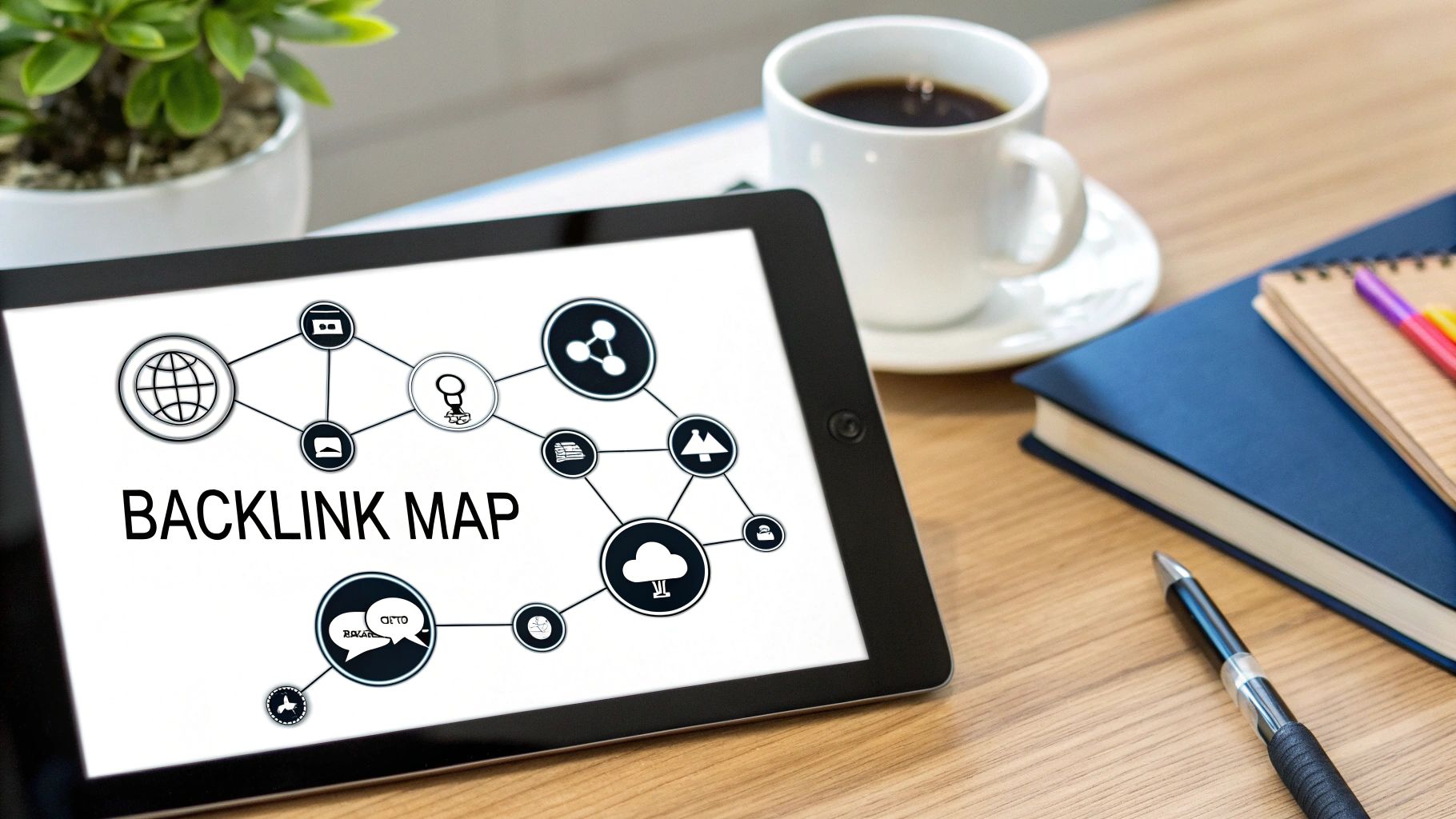
Think of it like this: an SEO tool like Ahrefs or Semrush can map out all the sites linking to your competitors, just like the image above. By digging into this data, you’ll start to see patterns. Maybe they're getting consistent shout-outs from popular food blogs or have built solid relationships with equipment manufacturers who link back to them. That's the gold we're looking for.
Finding Their High-Authority Referring Domains
First things first: who is actually linking to your competitors? You need to know if they're earning links from major industry publications like Foodservice Equipment & Supplies magazine or if they're getting mentioned on influential culinary school websites. Or, maybe their strategy is more grassroots, with links from local business directories and specific equipment manufacturers.
Fire up a tool like Ahrefs' Site Explorer or Semrush's Backlink Analytics, pop in a competitor's domain, and you'll get a firehose of data on all their referring domains.
It's easy to get overwhelmed here, but don't. Your mission is to sift through the noise and find the gems. Filter the list to find domains with high authority scores (often called Domain Rating or Authority Score) that are directly relevant to the food service industry. These are the "power links" that truly move the needle.
A single link from a trusted, relevant industry site is worth a hundred low-quality links from random websites. Always focus your energy on identifying these high-impact opportunities first.
Analyzing Their Anchor Text Strategy
Once you know who is linking to them, the next question is how. Anchor text—the actual clickable words in a link—is a huge clue for Google about what the destination page is about. A healthy, natural-looking anchor text profile is always varied.
When you pull up a competitor's anchor text data, you’ll see a mix of different types. Look for these patterns:
- Branded Anchors: Are lots of links using their company name, like "WebstaurantStore"? This is a great sign of strong brand recognition.
- Keyword-Rich Anchors: Are they snagging links with specific phrases like "commercial refrigeration units"? This directly helps them rank for those valuable terms.
- Generic Anchors: You should also see plenty of "click here" or "learn more" links. It might seem basic, but it’s a normal part of a healthy profile.
- Naked URLs: Links that are just the raw URL (like https://www.competitor.com/ovens) also look natural to Google.
If you spot a competitor who is leaning too heavily on exact-match keyword anchors, that's a potential weakness. It can look spammy to Google, giving you an opening to build a more natural and diverse profile that will stand the test of time. For a deeper dive, check out our guide on what makes a strong backlink profile.
Running a Backlink Gap Analysis
This is where the real magic happens. A backlink gap analysis is a simple but powerful exercise that shows you which websites are linking to multiple competitors, but not to you. This is, hands down, the lowest-hanging fruit in link building. If a site has already shown it's willing to link to two or three of your rivals, they’ve clearly got an interest in our industry.
The process itself is pretty straightforward:
- Find the "Link Intersect" or a similarly named tool in Ahrefs or Semrush.
- Plug in your own domain.
- Add the domains of 2-4 of your main competitors.
- Run the report, and voilà!
You now have a prioritized outreach list of websites that are already linking to your competition. For a restaurant equipment supplier, this report might uncover a ton of opportunities you never knew existed, like niche industry directories, product review blogs, or annual "best of" roundups.
The impact here can be huge. In competitive e-commerce niches, which are a lot like the food service equipment market, it's common for top sites to have hundreds of referring domains. We've seen companies that perform a targeted backlink gap analysis uncover so many overlooked opportunities on supplier blogs and industry sites that they see a 250% increase in high-quality links within just six months. You can explore other SEO benchmarks to see how your efforts stack up.
Remember, this isn't about begging for the exact same link your competitor has. It's about using this intel to get your foot in the door, introduce a receptive audience to your brand and excellent content, and start building your own powerful, unique backlink profile.
Taking a Closer Look at On-Page SEO and User Experience
Getting the right keywords and backlinks is just the entry ticket. The real game is won—or lost—on your website itself. Your competitors’ sites are living, breathing examples of what resonates with restaurant owners and search engines. Digging into their on-page SEO and user experience (UX) will show you the small, crucial details that add up to better rankings and more sales.
This is where we move past simply what they rank for and start dissecting how their site performs. We're looking at how they organize information, how they guide a potential buyer from a blog post to a product page, and how easy they make it to actually buy something.
How They Structure Their Site and Link Internally
Think of a great website like a professionally designed commercial kitchen—everything has its place, and the workflow just makes sense. When you're poking around a competitor's site, pay close attention to their navigation and internal linking.
Are their most important product categories, like "Refrigeration" or "Cooking Equipment," easy to find right from the homepage? Even more telling is how they guide you from a broad category down to a specific subcategory and, finally, to an individual product. A smart internal linking strategy does more than just help users find things; it spreads ranking power across their site and tells Google which pages are the most important.
For instance, you might find a competitor has a blog post on "How to Choose the Right Commercial Oven." If that article strategically links out to their pages for convection ovens, combi ovens, and pizza ovens, that's a brilliant move. They’re connecting genuinely helpful content directly to the products people are there to buy.
A little detail that often gets missed is the use of breadcrumbs. You know, that little navigational path at the top of a page that looks like Home > Cooking Equipment > Ovens. They're gold for both users and SEO, making it crystal clear where you are within the site's hierarchy.
Auditing Their Product and Category Pages
For any restaurant equipment supplier, the real money is made on the product and category pages. This is where your analysis needs to get incredibly detailed. Pull up a competitor’s page for a popular item, like a "Hoshizaki ice machine," and start looking for these things:
- Product Descriptions: Did they just copy and paste the manufacturer's description, or did they write something original and compelling? Good copy answers the questions a chef or manager would have about output, dimensions, and the warranty.
- High-Quality Media: Count the number of high-resolution photos. Do they have spec sheets available for download? The ultimate goal is a product video. The more a customer can see and learn, the more confident they'll be in their purchase.
- Schema Markup: Use a tool like Google's Rich Results Test to check if they're using product schema. This is the behind-the-scenes code that tells Google to show star ratings, pricing, and availability right in the search results, which can be a huge driver for clicks.
This kind of audit gives you a practical checklist for beefing up your own pages. In fact, our own experience with user experience optimization for restaurant equipment websites has shown that even minor tweaks in these areas can result in a serious lift in conversions.
Keeping an Eye on AI and Core Web Vitals
The on-page experience is only getting more important as AI-driven search becomes the norm. A solid on-page strategy is absolutely vital for getting featured in Google's AI Overviews. Current data shows that 52% of the sources cited in these AI answers already rank in the top 10 organic results. You can dig into more stats on how AI is changing the SEO game to see where things are headed. The takeaway is clear: your content has to be technically sound and perfectly answer what people are asking.
Finally, don't ever skip the technical basics. Grab a tool like Google's PageSpeed Insights and run your competitors' key pages through it. How fast do they load, especially on a phone? A snappy, mobile-friendly site is no longer a "nice-to-have." It's a fundamental part of the user experience that Google rewards with higher rankings.
Turning Your Analysis Into an Action Plan
You've done the digging, and now you have a pile of data. But let's be honest—data without action is just trivia. The whole point of this exercise is to turn your findings into a clear, strategic roadmap that tells you exactly what to do next.
This is where you shift from research to execution. You need a plan that will guide your SEO efforts for at least the next quarter, helping you decide what to tackle first for the biggest return. Should you start cranking out blog posts for those new keywords you found, or is your site’s slow loading speed the real emergency?
How to Prioritize Your Next Moves
The best way I’ve found to make sense of it all is by using a simple priority matrix. It helps you organize every potential task by scoring it against two critical factors: its potential impact and the effort required to get it done (think time, budget, and technical help).
For a restaurant equipment supplier, this brings immediate clarity. Here’s how it might shake out:
- High-Impact, Low-Effort: These are your quick wins. Think about optimizing your top product pages for the transactional keywords you just uncovered. Simply adding "for sale" to page titles or beefing up your product descriptions can make a huge difference.
- High-Impact, High-Effort: This is where your big strategic projects live. Maybe you decide to create the definitive "Ultimate Guide to Commercial Kitchen Ventilation" to finally dethrone a competitor's top-ranking article. It’s a major project, but the payoff could be enormous.
- Low-Impact, Low-Effort: These are nice-to-haves. For instance, updating the meta descriptions on old blog posts that don't get much traffic. It's easy, but it won't move the needle much.
- Low-Impact, High-Effort: Avoid these for now. Chasing a backlink from a huge, but completely unrelated, news site is a classic example. It's a resource drain with very little upside for your business.
This simple exercise instantly shows you where to start. Your high-impact, low-effort tasks are where you should focus first to get some momentum going.
Your action plan isn't a one-and-done report; it's a living document. It should spell out your top SEO goals for the next 3-6 months, breaking them down into specific tasks with owners and deadlines. This is how you make sure your research actually leads to growth.
By prioritizing this way, you ensure your competitor analysis becomes the strategic backbone of your marketing. It’s how you’ll systematically climb the rankings, pull in qualified traffic, and ultimately, sell more equipment.
Your SEO Competitor Analysis Questions, Answered
Even after walking through the entire process, I know a few questions are probably still bouncing around in your head. It's completely normal. Here are some of the most common ones we get from food service suppliers just like you.
How Often Should I Run a Full Competitor Analysis?
For a full-blown, deep-dive analysis, plan on doing one once or twice a year. That's enough to spot major strategic shifts.
But don't just set it and forget it. You should be keeping a much closer eye on things more regularly. A quick quarterly check-in on new content that's taking off for them, plus a monthly glance at keyword rankings, is a smart rhythm. It ensures you’re never caught off guard.
Should My Focus Be on National or Local Competitors?
Honestly, this depends entirely on your business model. It's all about where you play.
If your customers are all within a specific city or state, your local rivals are the ones that matter most. But if you're an e-commerce supplier shipping nationwide, you have to benchmark yourself against the big players like WebstaurantStore. For most suppliers, the real answer is a mix of both.
If I Can Only Track One Thing, What’s the Most Important Metric?
There are a lot of valuable metrics, but if I had to pick just one to start with, it would be organic keyword overlap. Hands down.
Why? Because it immediately tells you who you’re really up against in Google search results where your customers are looking. It cuts through the noise of brand recognition and shows you your true digital rivals. Everything else in your analysis builds on this foundation.
The real goal here isn't just to gather a mountain of data. It's about turning that data into a sharp, prioritized action plan that actually gets results.
This is how you bridge the gap between knowing and doing. You take what you've learned and build a clear roadmap.
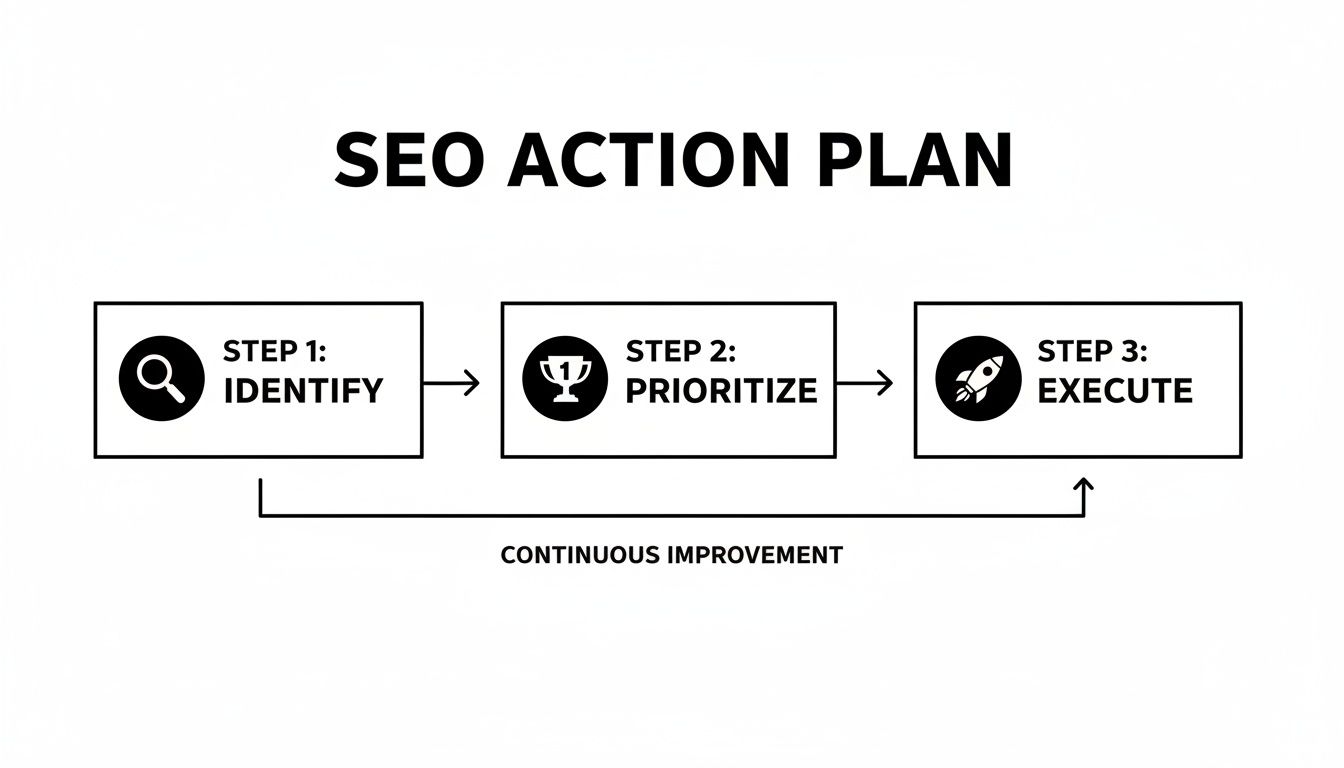
It’s a simple but powerful flow: Identify the low-hanging fruit and strategic gaps, prioritize them based on impact and effort, and then execute with a focused strategy.
At Restaurant Equipment SEO, we live and breathe this stuff. We specialize in turning these kinds of analyses into real-world results for food service suppliers looking to own their space online.
Ready to get started? Let's talk about outranking your competition.